

₹50 lakh is not a small number to hand over to anyone, and if you are looking at Equentis PMS, that is roughly the entry point you are working with.
Equentis Wealth Advisory Services Limited does hold a valid SEBI Portfolio Management Services registration, number INP000008969, and offers two strategies under this PMS structure.
But here is the one detail that changes how you should read everything else on this page, these PMS strategies only launched in early 2025, so there simply isn’t enough live performance history yet to judge them meaningfully.
For a commitment this size, that absence isn’t a footnote, it is the central fact of any honest review right now.
Should You Invest in Equentis PMS Right Now?
The honest answer at this point in time is that there is not enough live data to tell.
The Equentis PMS strategies were launched in early 2025. As of mid-2026, that gives you roughly 12 to 18 months of real-world operation.
In the investment world, 12 to 18 months is not enough to assess whether a strategy works across different market conditions. Markets go through cycles that play out over years.
A strategy that looks good in a bull market may perform very differently when conditions change.
When trying to figure out Is Equentis a good company for your portfolio, looking purely at corporate history isn’t enough.
What Equentis does have is a track record in their IA subscription business going back to 2015. That is a meaningful operating history for the company.
But the IA subscription track record and the PMS performance are separate things.
The strategies, the portfolio construction, and the investment process in a PMS are different from giving subscribers a list of stocks to consider.
So if you are evaluating Equentis PMS, the right question to ask is not whether the company has experience.
It clearly does.
The right question is what evidence exists specifically for these PMS strategies. Right now the honest answer is that the evidence is too limited to be conclusive.
That is not a reason to automatically say no.
It is a reason to ask the right questions, understand exactly what you are agreeing to, and make sure the service contract covers what happens if performance is poor.
How Equentis PMS Works: The Strategy Behind the ₹50L Minimum
Portfolio Management Services under SEBI regulations is a specific type of service where the investment adviser takes your money, invests it in securities on your behalf, and manages the portfolio actively.
This is different from an advisory subscription where you receive recommendations and then decide whether to act on them yourself.
In a PMS arrangement, Equentis makes the investment decisions for you within the strategy parameters you agree to at the start. Your money is held in a separate demat account in your own name but traded by Equentis on your behalf.
The minimum investment mandated by SEBI for any PMS provider is Rs. 50 lakh.
This is not an Equentis-specific threshold. It is a regulatory floor that applies to every SEBI-registered PMS provider in India.
The SEBI registration for Equentis PMS: Equentis holds Portfolio Management Services registration number INP000008969. This is separate from and in addition to their Investment Adviser registration INA000003874.
The PMS registration can be verified on SEBI’s intermediary portal at sebi.gov.in by selecting Portfolio Manager from the category dropdown and entering the registration number.
Inside the 2 Equentis PMS Strategies: What Are You Buying?
Choosing a portfolio manager often comes down to alignment, how well does their investment philosophy match your personal comfort with risk?
With Equentis, your capital is deployed across distinct mandates that approach market opportunities from very different angles.
Before looking at the specific stock selection mechanics, it helps to understand how each strategy navigates market volatility to achieve long-term growth.
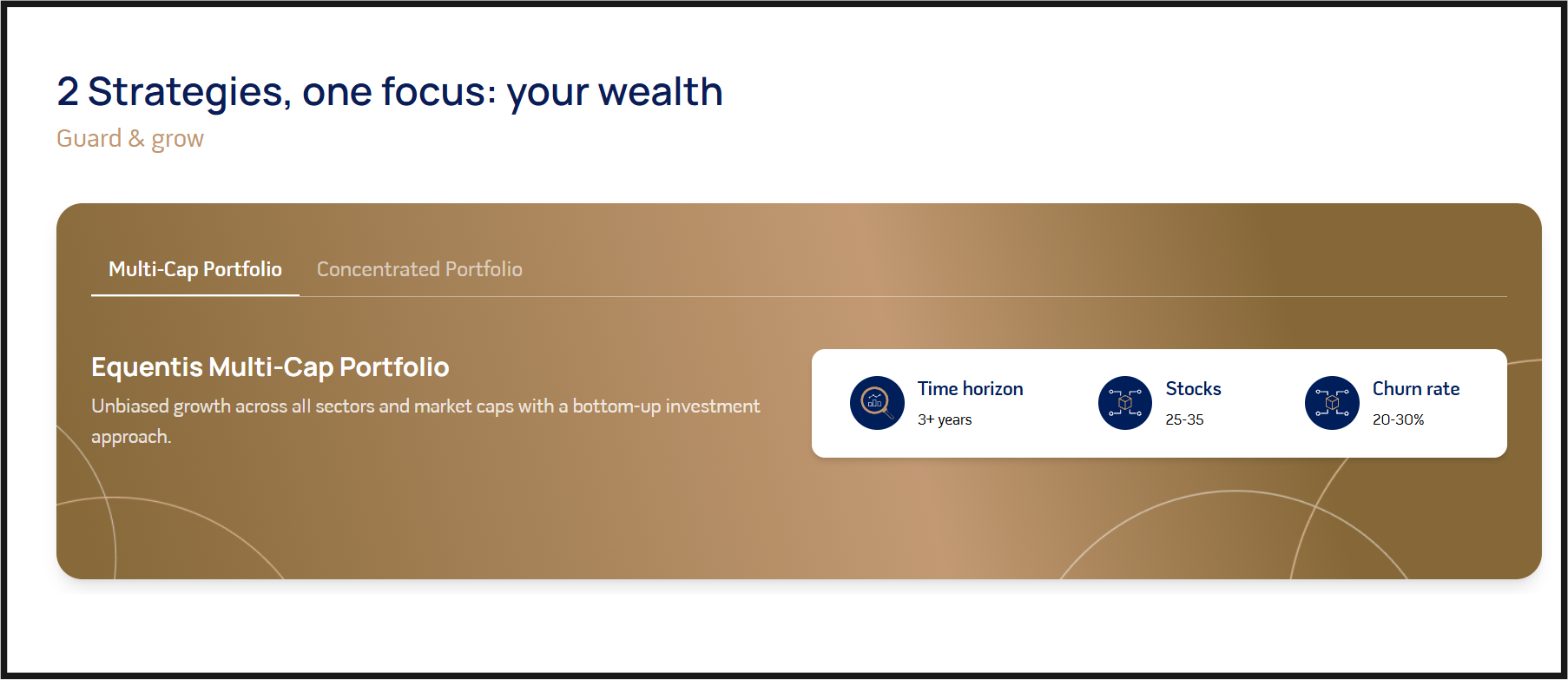
Strategy 1: The Emerging Leaders Strategy
This strategy targets small and mid-cap companies with high growth potential.
The investment thesis is to identify businesses that are in early or mid stages of a growth phase and hold them over a multi-year period as they scale.
The risk profile of this strategy is higher than a large-cap focused approach because small and mid-cap stocks are more volatile and less liquid than large-cap stocks.
Before investing in this strategy, you need to be clear about your own tolerance for short-term volatility.
A portfolio of small and mid-cap stocks can move significantly in either direction over 12 to 24 months even if the long-term thesis is sound.
Strategy 2: The 5 in 5 PMS Strategy
This strategy is the PMS version of Equentis’s best-known retail product, the 5 in 5 wealth creation approach.
The idea is to identify 15 to 20 stocks with the potential to deliver 5x returns over a 5-year period.
The strategy is concentrated by design, meaning it holds fewer stocks than a typical diversified portfolio, with higher conviction in each holding.
A concentrated strategy carries specific risks. If one or two holdings significantly underperform, the impact on the overall portfolio is larger than it would be in a more diversified approach.
This is a reasonable strategy design for a long-term investor who understands and accepts the concentration risk. It requires discussion before committing.
The Biggest Warning Sign: Why the Missing Track Record Matters?
This section is important enough to say twice.
Before committing Rs. 50 lakh or more to any PMS strategy, the standard piece of due diligence is to review audited performance data for the strategy going back at least 3 years.
Three years covers at least one full market cycle, including periods of decline, which is where strategy quality is most clearly revealed.
Equentis PMS does not have three years of live performance data yet. The strategies launched in early 2025.
When you ask Equentis for performance data, you will likely be shown backtested returns.
Backtesting runs a strategy through historical market data to show how it would have performed in the past. Backtested results are useful for understanding how a strategy is designed.
They are not the same as live performance, because backtesting always has the advantage of hindsight and does not fully capture the execution costs, liquidity issues, and behavioural factors that affect real-world investing.
The right thing to ask is specifically: what is the audited live performance of this strategy from the date it was actually launched with real client money?
If the answer is that there is less than 12 months of live data, that is the honest picture.
This does not mean the strategies will not work.
It means you are making a Rs. 50 lakh decision based on a strategy that has not yet had enough time to demonstrate its real-world effectiveness.
What Does SEBI Require Equentis PMS to Disclose to You?
Investing ₹50 lakh is a major financial step, and the regulator wants to ensure you aren’t flying blind.
To protect your interests, SEBI makes it mandatory for every Portfolio Management Service (PMS) to hand over specific legal paperwork before you transfer a single rupee.
Think of these as your safety net, they ensure absolute transparency about where your money is going and how it is being managed.
Here are the three vital requirements you need to check off:
- The Disclosure Document: This is the most critical booklet you will receive.
It acts like an official rulebook, detailing exactly how the investment strategy works, what risks you are taking on, the complete fee structure, and the company’s past performance.
You have a legal right to review this before committing your capital. - The Portfolio Management Agreement: This is the binding legal contract between you and Equentis.
It officially outlines what services they will provide, your rights as a client, how fees will be deducted, and the step-by-step process for resolving any disputes if things go wrong. - Regular Performance Reports: Your job isn’t done once you invest. By law, Equentis must send you regular, transparent updates and portfolio statements.
These documents show you exactly which stocks were bought or sold, the current value of your holdings, and how your wealth is tracking over time.
Important Note: If a provider hesitates to give you the Disclosure Document or the Agreement upfront, or if they fail to send your regular statements later on, these are serious compliance failures.
Knowing how to file a complaint against portfolio managers ensures you can hold the firm accountable through official regulatory channels if these duties are breached.
Equentis PMS Fees
PMS fees are typically structured in one of two ways: a fixed management fee as a percentage of assets under management, or a combination of a fixed fee and a performance-based fee.
Equentis’s specific PMS fee structure should be clearly stated in the Disclosure Document they are required to provide.
Do not invest until you have seen the Disclosure Document and understood the complete fee arrangement including how performance fees are calculated if they apply.
One important point is that PMS fees are in addition to brokerage costs, transaction charges, and taxes on gains.
The total cost of a PMS arrangement is higher than the stated management fee alone.
How PMS Complaints Work Differently From IA Complaints?
If something goes wrong with Equentis PMS, the complaint process works differently from a standard IA subscription complaint.
For PMS, complaints about investment decisions, performance, or disclosure failures go to SEBI under the Portfolio Manager category, not the Investment Adviser category.
The registration number to use is INP000008969, not INA000003874.
SEBI’s Portfolio Manager Regulations give investors specific rights that are different from IA investor rights, including the right to inspect your portfolio records, the right to receive audited accounts, and the right to withdraw funds subject to the terms of the agreement.
Knowing these boundaries ensures you can spot a compliance issue before it impacts your capital.
If you believe your rights have been compromised, you can follow our step-by-step guide on How to file a complaint against Equentis to route your grievance through the correct regulatory channel.
Stuck with an Equentis PMS Issue? We Can Help
Navigating SEBI’s Portfolio Manager Regulations on your own can be overwhelming. Our team can review your case, clarify your legal rights, and help you route your complaint through the exact regulatory channel needed to get results.
Register with us now for a free consultation.
Conclusion
Equentis PMS holds a valid SEBI registration under INP000008969 and offers two strategies: the Emerging Leaders Strategy targeting small and mid-cap growth stocks, and the 5 in 5 PMS Strategy based on the firm’s existing wealth creation approach.
The minimum investment is Rs. 50 lakh.
The central caveat for anyone considering this service right now is that the strategies launched in early 2025 and do not yet have a long-term performance record.
For a Rs. 50 lakh investment decision, the absence of a track record is important to understand clearly before you commit.
Ask for the audited live performance data from the actual strategy launch date. Ask for the Disclosure Document and the Portfolio Management Agreement before signing anything.
Understand the complete fee structure, including all costs beyond the management fee.
Frequently Asked Questions
1. Is Equentis PMS SEBI registered?
Yes. Equentis Wealth Advisory Services Limited holds SEBI Portfolio Management Services registration number INP000008969.
This is separate from and in addition to their Investment Adviser registration INA000003874. Both are active and verifiable on SEBI’s intermediary portal.
2. What is the minimum investment for Equentis PMS?
The minimum investment is Rs. 50 lakh. This is a regulatory floor mandated by SEBI for all Portfolio Management Services providers in India.
It is not an Equentis-specific requirement.
3. What strategies does Equentis PMS offer?
Equentis currently offers two strategies. The Emerging Leaders Strategy targets small and mid-cap high-growth companies.
he 5 in 5 PMS Strategy is the portfolio management version of their existing 5 in 5 wealth creation approach, focusing on 15 to 20 stocks with long-term growth potential.
4. Is there a track record for Equentis PMS?
The Equentis PMS strategies were launched in early 2025. As of mid-2026, there is limited live performance history.
Before investing, ask specifically for audited live performance data from the strategy launch date, not backtested figures.
The absence of a multi-year live track record is the most important caveat for a Rs. 50 lakh investment decision.
5. What documents should Equentis provide before I invest in PMS?
SEBI requires Equentis to provide a Disclosure Document covering the strategy, fees, risks, and terms before you invest. You should also receive the Portfolio Management Agreement before signing.
If these documents are not provided upfront, ask for them directly and do not invest until you have received and reviewed them.
6. How are Equentis PMS complaints different from IA complaints?
PMS complaints are filed under the Portfolio Manager category on SEBI SCORES using registration number INP000008969.
IA subscription complaints use the Investment Adviser category and registration number INA000003874.
Using the wrong category is the most common reason complaints are delayed.
7. Can Equentis PMS guarantee returns?
No. SEBI prohibits any PMS provider from guaranteeing returns just as it prohibits IAs from doing so. All investment returns in a PMS arrangement are subject to market risk.
Any representative who implies guaranteed returns or specific profit targets is making a prohibited statement.





 Add us as a preferred source on Google »

