
Quick Summary
You can file a complaint against a SEBI registered investment adviser (RIA) or research analyst on SCORES, SEBI’s official grievance portal, at scores.sebi.gov.in. The entity gets 21 calendar days to respond, and if that doesn’t resolve things, you can escalate to conciliation and binding arbitration through SEBI’s SMART ODR platform. A valid complaint needs the specific violation documented, not just the losses; guaranteed-return promises, unauthorised trades, and fees above the ₹1,51,000 cap are the strongest grounds.
5300+ Complaints Registered Against
RIA in 2026
The right procedure increases the chance of recovery of losses.
Have You Been Scammed Too?
Get assistance in filing a Complaint Now!
Let’s help you report this!
How to File a Complaint Against a SEBI Registered Investment Advisor(RIA)

If a SEBI registered investment adviser, commonly called an RIA, has promised you guaranteed returns, executed trades without your consent, charged fees above the regulatory cap, or gone silent after taking your money, you have grounds to file a complaint against the investment advisor with SEBI. The first stop is SEBI SCORES (scores.sebi.gov.in), the regulator’s official SEBI investor complaint portal and grievance portal for the securities market. If SCORES doesn’t get you a resolution, you can escalate to conciliation and arbitration through the SMART ODR platform, which is where binding, enforceable orders come from.
This guide walks through all three parts of that process: what actually counts as a valid complaint, exactly how to file and track one on SCORES, and what your options are once you’ve filed, including where expert help genuinely changes the outcome.
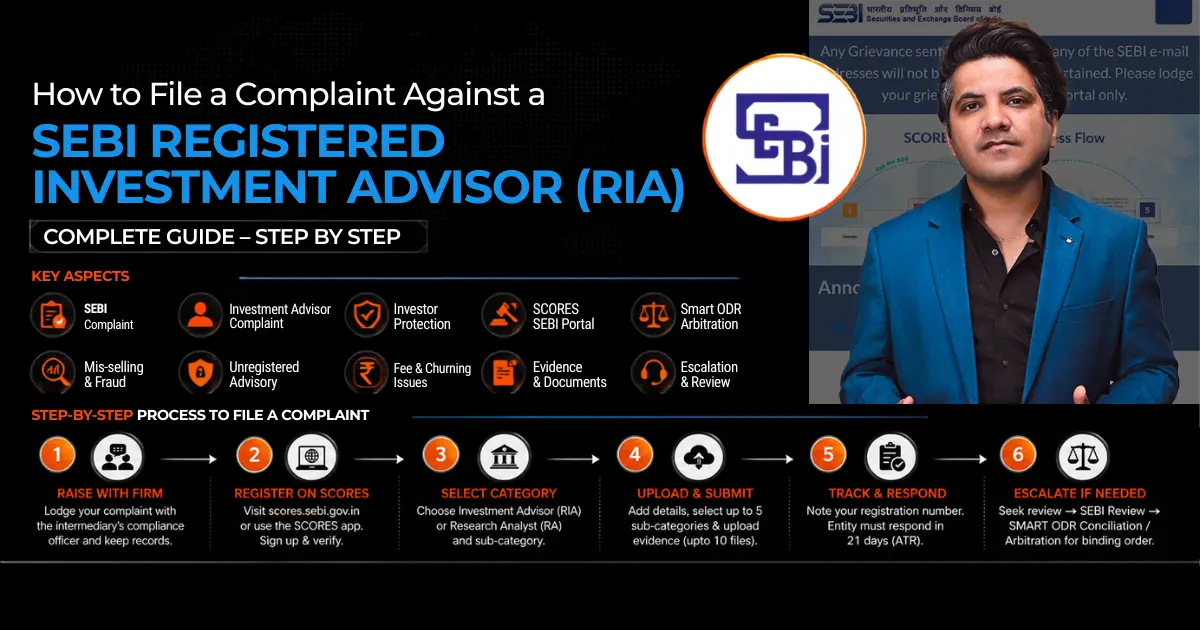
In short: yes, you can complain against any SEBI registered investment adviser (RIA/IA) or research analyst (RA), and a SEBI registered investment advisor complaint follows the same basic path either way. File first with the firm’s compliance officer, then on SCORES if that doesn’t resolve it. The entity gets 21 calendar days to respond. If you’re unhappy with that response, you can request a review, and if that still doesn’t work, you can move to arbitration through smartodr.in for a binding award.
Key facts at a glance
| Question | Answer |
|---|---|
| Where do I file? | The SEBI complaint portal, SCORES: scores.sebi.gov.in, or the SCORES mobile app |
| Cost to file | Free |
| Time limit to file | Within 1 year of the cause of action (SEBI can reject complaints filed later) |
| Entity’s response deadline | 21 calendar days to submit an Action Taken Report (ATR) |
| Documents you can attach | Up to 10 files, 20 MB total, in jpg, jpeg, or pdf |
| Sub-categories you can select | Up to 5 per complaint |
| Escalation route if unresolved | First-level review by the Designated Body, then SEBI review, then SMART ODR conciliation/arbitration |
| Toll-free helpline | 1800 266 7575 or 1800 22 7575, 9 AM to 6 PM, in 8 Indian languages |
| RA/IA annual fee cap | ₹1,51,000 per client family (revised periodically) |
Can I complain against a SEBI registered investment adviser?
Yes. Anyone who has used the paid services of a SEBI registered investment adviser (RIA/IA) or research analyst (RA) and believes they were misled, overcharged, or subjected to unauthorised activity has standing to file a complaint. SCORES exists specifically for this: it is the official channel for complaints “pertaining to securities market against listed companies, SEBI registered intermediaries and Market Infrastructure Institutions.” If you’re wondering how to complain against an investment advisor at all, this is the starting point: confirm the firm is a registered entity, then use the channel SEBI has built for exactly this kind of dispute.
A private subscription agreement or a “no refund” clause you signed does not remove this right. A contract between you and an advisory firm cannot override SEBI’s regulatory framework. If the firm broke SEBI’s rules, you can still complain, regardless of what the fine print says.
There’s one distinction worth getting right before you file: SEBI treats Investment Advisers, commonly called RIAs, and Research Analysts as separate categories of intermediary, each governed by its own regulations. An RA is only allowed to publish research and buy/sell/hold recommendations. An RIA gives personalised advice tied to your specific financial situation and goals. If you’re not sure which one you’re dealing with, search for the firm on SEBI’s website under registered intermediaries; the registration number will show the category.
What counts as misconduct by an investment adviser or research analyst
A handful of specific behaviours come up again and again in complaints against SEBI-registered advisers, and each one has a clear regulatory basis behind it.
| Conduct | Why it’s a violation | What to document |
|---|---|---|
| Guaranteed or assured return promises | SEBI’s IA and RA regulations prohibit any promise of assured, risk-free, or minimum returns, verbal or written | Screenshots of chats, call recordings, marketing material |
| Live execution calls from an RA | Research analysts can publish recommendations; they cannot direct you to buy or sell at a specific moment or manage your account | Chat logs, call recordings showing execution instructions |
| Unauthorised trading | A registered adviser cannot log in and trade on your behalf, even if you shared your credentials | Login/OTP history from your broker, trade confirmations you never authorised |
| Fees above the annual cap | RAs and IAs are capped at ₹1,51,000 per client family per year; this limit is reviewed periodically | Invoices, payment receipts, the fee schedule advertised to you |
| “Pay more to recover your losses” pitches | Recovery-fee pitches after a client has already lost money are a recognised red flag and a prohibited representation | Messages or calls where a higher-fee “recovery service” was pitched |
| Refusing a refund you’re entitled to | If the service wasn’t delivered as promised, or fees were collected outside the cap, a blanket refusal doesn’t hold up in a SCORES or arbitration review | Your original agreement, service description, correspondence requesting a refund |
If your situation matches any row in that table, you have a filing basis. If it doesn’t, and your complaint is really about disappointing investment performance in normal market conditions, SCORES will not treat that as misconduct: SEBI’s own FAQ excludes complaints that are really just “suggestions or seeking guidance” or disputes with no supporting documentation.
When can you complain
SEBI gives complainants one year from the date of the cause of action to lodge a complaint on SCORES. Complaints filed after that window can be rejected.
Working out “the date of the cause of action” is more specific than it sounds. SEBI’s own FAQ uses this example: if a company declares a dividend on 1 January 2024, it has 30 days to pay it. If payment doesn’t happen by 31 January 2024, that’s the date the cause of action arises, and the one-year clock starts there, not on the date of the original dividend declaration. Apply the same logic to an advisory dispute: the clock generally starts from the specific date the advisor failed to act (refused a refund, stopped responding, executed an unauthorised trade), not from when you first signed up.
Practically, this means the earlier you document each specific failure with a date, a screenshot, or a written request, the stronger your filing position later.
How to file a complaint against a SEBI registered investment adviser (RIA): step by step
This is the investment advisor complaint procedure SEBI has built into SCORES, and it works the same way whether you’re filing a SEBI SCORES complaint against an investment advisor or against a research analyst.
1. Raise it with the firm first. Every registered intermediary is required to publish its compliance officer’s contact details. Send your complaint there in writing and keep a copy. This step matters for two reasons: it’s the process SEBI expects, and the firm’s non-response becomes evidence for your SCORES filing.
2. Register on SCORES. Go to scores.sebi.gov.in and sign up. You’ll need your PAN, name, address, email, mobile number, and date of birth: these five KYC details are mandatory, and you can’t lodge a complaint without them. Registration can pull your details automatically from your KYC Registration Agency (KRA) record using PAN and date of birth, or you can fill the form manually if you’d rather not link your KRA data.
3. Select the correct intermediary category. This is the single most common reason valid complaints against advisers get delayed. If your complaint is against a Research Analyst, select “Research Analyst.” If it’s against an Investment Adviser, select “Investment Adviser.” Picking the wrong one routes your complaint to the wrong desk and adds weeks to resolution. You can select up to five relevant sub-categories against the same entity if your complaint covers multiple issues, so there’s no need to leave anything out to fit a single category.
4. Upload your evidence. SCORES accepts jpg, jpeg, and pdf files, up to 10 files and 20 MB combined. Bank statements showing payments, the fee invoice or subscription confirmation, any written or recorded promise of guaranteed returns, and your trading statements showing losses are the documents that carry the most weight. Certain special characters aren’t accepted in text fields for security reasons; the portal tells you which characters (like . , - &) are allowed as you type.
5. Note your registration number and track the complaint. Once submitted, SCORES gives you a tracking number. You’ll get email and SMS updates whenever the entity, the Designated Body, or SEBI takes an action or asks for clarification. You can also check the full action history at any time by logging in and clicking on your registration number.
Documents required to complain against an investment advisor (IA)
| Category | What to gather |
|---|---|
| Identity/KYC | PAN, full name, registered mobile number, email, date of birth, address (mandatory to even register on SCORES) |
| Proof of engagement | Signed service agreement, subscription confirmation, welcome letter from the firm |
| Proof of payment | Fee invoices, payment receipts, bank statement entries showing the transfers |
| Proof of the violation | Screenshots or recordings of guaranteed-return promises, execution instructions, or recovery pitches |
| Proof of loss | Trading statements, contract notes, profit-and-loss statements from your broker |
| Proof you tried to resolve it directly | Your written complaint to the firm’s compliance officer, and their response (or lack of one) |
If any of the mandatory KYC fields are missing, SCORES won’t let you lodge the complaint at all, so it’s worth having all six ready before you start the form rather than midway through.
What happens after you file a complaint on SCORES
Filing is the start of a structured, timed process, not a one-off submission that disappears into a queue. Here’s how it actually moves:
| Stage | Who acts | Timeframe |
|---|---|---|
| Complaint auto-forwarded to the entity | The registered entity (the adviser or analyst) | Immediate |
| Entity submits Action Taken Report (ATR) | The entity | 21 calendar days |
| You review the ATR | You | 15 calendar days to request a review if unsatisfied |
| First-level review | The Designated Body (usually the relevant stock exchange or depository) | 10 calendar days |
| You review the first-level outcome | You | 15 calendar days to request a second review |
| Second-level review | SEBI directly | No fixed statutory deadline stated, but SEBI can seek clarification from the entity or Designated Body |
| Disposal | SEBI, or your own decision to move to ODR | Once satisfactory ATR is received, or you opt for arbitration |
If the investment advisor doesn’t respond within the 21-day window, SEBI’s system doesn’t just leave the complaint pending. It automatically escalates to first-level review by the Designated Body, treating the silence itself as a failure in the SEBI grievance redressal process. The same automatic escalation applies if the Designated Body misses its own 10-day window at first review.
How long a SEBI investment advisor complaint takes depends on how many review rounds you need. A complaint resolved cleanly at the entity’s first ATR can close inside a month. One that goes through both review levels realistically runs eight to ten weeks before you’d consider moving to arbitration. SEBI’s own reported average resolution time across all SCORES complaints has run between roughly 24 and 29 days in recent years, though that average covers straightforward cases as well as contested ones.
Escalating a SEBI complaint beyond SCORES itself is straightforward: request a review after each ATR you’re unhappy with, and the system routes it up automatically. Beyond that internal review process, you have a separate and more powerful escalation path in SEBI’s Online Dispute Resolution (ODR) mechanism, run through the SMART ODR portal (smartodr.in). This is where conciliation and, if that fails, binding arbitration happen. Opting into ODR while a SCORES complaint is still open closes the SCORES complaint automatically and moves the matter to ODR instead.
If you’re not satisfied with the SCORES resolution, you have three paths from here: pursue conciliation and arbitration through SMART ODR, approach a consumer court, or pursue another appropriate civil remedy. SEBI SCORES itself does not adjudicate disputes or award compensation; it facilitates a response from the entity. If you want an enforceable, binding order requiring a specific refund or payment, arbitration is the mechanism that produces that.
One more thing worth knowing before you file: SEBI classifies someone as a “chronic complainant” if they keep re-filing the same complaint without new facts or supporting documents, and can block that person’s SCORES access as a result. It’s a reminder that a well-documented complaint the first time round, with dates, amounts, and evidence attached from the start, moves faster and further than repeated re-filing of a thin one.
Where to complain against an investment advisor: your full set of options
There’s more than one SEBI grievance portal and escalation channel available, depending on where you are in the process:
| Channel | Best for |
|---|---|
| SEBI SCORES (scores.sebi.gov.in) | Your first, mandatory step for any complaint against a registered intermediary |
| SCORES mobile app | Same process as the website, for filing or tracking on the go |
| SMART ODR (smartodr.in) | Conciliation and binding arbitration once SCORES hasn’t resolved things, or you want an enforceable award |
| SEBI toll-free helpline (1800 266 7575 / 1800 22 7575) | Help with lodging a complaint or checking its status, 9 AM–6 PM, in 8 languages |
| Consumer courts or other civil remedies | Available at any point, independent of SCORES or ODR |
Can SEBI help me recover money from an investment advisor?
Indirectly, yes, but it helps to be precise about which part of the process actually gets you money back. SCORES is a facilitation platform. It gets your complaint in front of the entity and holds them to a response deadline, but SEBI’s Dealing Officer does not issue orders directing a firm to pay you a specific amount for a private dispute. Arbitration is the mechanism that does: an arbitrator hears both sides and can issue a binding award directing the firm (or the individual involved) to pay a stated amount, with interest if they don’t pay on time. Every recovery case in the track record section below came from a complaint that was escalated to conciliation and arbitration, not resolved at the SCORES ATR stage alone.
Documents, timeline, and options at a glance
A working reference for filing a complaint against a SEBI registered investment adviser or research analyst on SCORES: what to attach, what happens after you submit it, and where else you can take it.
- Portal
- SEBI SCORES
- Cost to file
- Free
- Filing window
- 1 year
- Entity response
- 21 days
- Attachments
- 10 files / 20 MB
- Fee cap
- ₹1,51,000 / yr
Identity & KYC
- PAN
- Full name & address
- Registered mobile number
- Email ID
- Date of birth
Proof of engagement
- Signed service agreement
- Subscription confirmation
- Welcome letter or onboarding email
Proof of payment
- Fee invoices
- Payment receipts
- Bank statement entries showing transfers
Proof of the violation
- Screenshots of guaranteed-return promises
- Call recordings or chat logs
- Marketing material used to pitch you
Proof of loss
- Trading statements
- Contract notes
- Profit-and-loss statement from your broker
Proof you tried to resolve it directly
- Your written complaint to the compliance officer
- Their response, or record of no response
SCORES accepts jpg, jpeg, or pdf files only — up to 10 files and 20 MB combined per complaint.
days
days
days
days
Common grounds for a complaint
| Conduct | Regulatory basis |
|---|---|
| Guaranteed or assured returns | Prohibited under IA/RA regulations |
| Live execution calls from an RA | Outside an RA’s permitted scope |
| Unauthorised trading | No consent for the specific trade |
| Fees above the annual cap | Exceeds ₹1,51,000 / family limit |
| “Pay more to recover losses” pitch | Recognised prohibited pitch |
| Refusing an entitled refund | Challengeable via SCORES / arbitration |
Where to take it
| Channel | Best for |
|---|---|
| SEBI SCORES | Your first, mandatory step |
| SCORES mobile app | Filing or tracking on the go |
| SMART ODR (smartodr.in) | Conciliation & binding arbitration |
| SEBI helpline | 1800 266 7575 / 1800 22 7575, 9AM–6PM |
| Consumer courts | Independent civil remedy, any time |
Real cases: how this process has actually played out
These are arbitration outcomes Aseem Juneja has represented or assisted investors through, using the SCORES-to-arbitration process described above. Each case links to the underlying award so you can read the tribunal’s reasoning directly.
| Case | Against | Category | Claimed | Recovered | Outcome date | Source |
|---|---|---|---|---|---|---|
| Research analyst profit-sharing/fee violation | Aurostar Investment Advisory Private Limited | Research Analyst | ₹16,20,000 | ₹14,10,000 | January 2024 | Case details |
| Guaranteed-return and excess-fee dispute | Dealwise Pro Research Analyst | Research Analyst | ₹3,32,000 | ₹59,000 | Awarded July 2025 | Arbitral award PDF |
| Unauthorised trading via an Authorised Person | Motilal Oswal Financial Services Ltd. | Trading Member / Authorised Person | ₹28,00,000 | ₹28,00,000 | May 2026 | Arbitral award PDF |
| Unauthorised trading, broker directed to refund | Angel One | Stockbroker | ₹18,00,000 | ₹10,80,000 | May 2026 | Case details |
The Dealwise and Motilal Oswal awards are worth a closer look, because the reasoning behind them is exactly the kind of thing that helps when you’re building your own complaint.
In the Dealwise Pro matter (NSDL-RA-2025-02-729522), the investor, Amit Kumar Manna, had paid ₹84,000 in fees to a SEBI-registered research analyst and lost ₹2,52,000 following recovery-style pitches urging him to keep positions open and add funds. Aseem Juneja appeared as his authorised representative in the arbitration. The tribunal rejected the trading-loss portion of the claim because the investor had placed the trades himself and had prior trading experience, but it did find the analyst’s fee collection irregular against the ₹1,51,000 annual cap and directed a partial refund of ₹59,000. The award is a useful read for anyone building a fee-related complaint: it shows exactly how an arbitrator works through a disputed fee structure line by line.
In the Motilal Oswal matter (NSE-SB-2025-08-812314), the dispute centred on an Authorised Person who had allegedly gained access to the investor’s demat account, altered his registered email, and induced him into a private repayment agreement after losses. The sole arbitrator, Ms. Madhu P. Singh, held that under NSE’s framework a trading member is responsible for the acts of its Authorised Person, and directed payment of the full ₹28,00,000 claim jointly against the respondents. This case is a good illustration of a distinct but related SEBI grievance route: complaints against a broker or its authorised representative go through the same SCORES-to-ODR pipeline as complaints against an adviser or analyst, and the “who is responsible for whom” question the tribunal answers there comes up constantly in complaints involving sub-brokers and franchisees too.
Get Expert Assistance to Lodge Your SEBI Grievance & Recover Losses
Everything above is the process as SEBI has designed it, and you’re free to run through every step of it yourself. Where investors most often lose ground isn’t the portal itself; it’s picking the wrong intermediary category, submitting a complaint without the documentation an arbitrator will actually ask for, or not knowing when a SCORES rejection is the end of the road versus the point to move into arbitration.
This is where getting help filing a SEBI complaint pays off. Aseem Juneja has worked on more than 10,000 cases involving SEBI-registered brokers, research analysts, and investment advisers since moving into full-time investor representation in mid-2024, with over ₹11 crore recovered for investors and more than 300 arbitrations resolved. He spent two years as Vice President at Angel One before this, which is where the read on how these firms handle complaints internally, and where the gaps in that process sit, actually comes from. He holds an MBA from CEIBS, and his YouTube channel on SEBI regulation and market fraud has over 1.2 million subscribers.
If you’d rather have someone experienced handle the filing itself, this is the kind of help filing a complaint against an investment advisor that’s available. It starts with complaint drafting: getting the facts, the regulation each fact violates, and the relief you’re asking for onto one clear document, in the format SCORES and arbitrators actually expect. It includes evidence organisation, sorting payment records, chat and call evidence, and trading statements into the specific documents a reviewer or arbitrator will look for, rather than a folder of everything you have. It includes SCORES filing assistance, making sure the intermediary category, sub-categories, and attachments are right the first time, since a miscategorised complaint is the most common cause of delay. And it includes follow-up and escalation support: responding to clarification requests on time, requesting a review when an ATR falls short, and building the case for arbitration if SCORES doesn’t resolve things.
This kind of investment advisor complaint assistance goes further than what a SEBI complaint consultant who only proofreads your paperwork after the fact can offer. Recovery through arbitration depends on the specific facts and evidence in each case, and no outcome can be promised in advance. What proper drafting and evidence support change is whether your complaint is built the way SEBI’s process and arbitrators expect to see it, which is what the cases above were built on.
Connect with Aseem Juneja if you’d like help evaluating your case and filing your complaint.
Facing RIA Misconduct? How to Lodge a Complaint to SEBI & Resolve Your Grievance Fast
Get assistance to register complaint Against Registered Investment Advisor (RIA)
Frequently Asked Questions
Yes. Any investor who has used a SEBI-registered adviser's or research analyst's paid services can file a complaint on SCORES if that firm has violated SEBI's regulations, regardless of what any private agreement with the firm says.
Raise it with the firm's compliance officer first, then register and file on scores.sebi.gov.in, selecting the correct intermediary category (Research Analyst or Investment Adviser) and attaching your supporting documents.
Document the issue with dates and evidence, complain to the firm's compliance officer first, then file on SEBI SCORES under the correct intermediary category. That sequence is how to complain against an investment advisor while keeping your one-year filing window and your evidence intact.
SEBI SCORES is the official SEBI investor complaint portal and grievance redressal platform. If SCORES doesn't resolve it, SEBI's SMART ODR platform (smartodr.in) handles conciliation and arbitration. The SEBI toll-free helpline (1800 266 7575 / 1800 22 7575) can help with either.
Yes, this is the intended channel. Select "Investment Adviser" as the intermediary category if your complaint is against an IA, or "Research Analyst" if it's against an RA.
Your PAN, name, address, email, mobile number, and date of birth to register, plus supporting evidence such as payment receipts, your service agreement, screenshots of any guaranteed-return promises, and trading statements. You can attach up to 10 files totalling 20 MB.
If the entity misses its 21-day deadline to submit an Action Taken Report, SCORES automatically escalates the complaint to the Designated Body for first-level review, so a non-response doesn't leave your complaint stuck.
It depends on how many review rounds are needed. A straightforward case can close within the initial 21-day ATR window. One that goes through both review levels typically takes several weeks longer before arbitration becomes the next option.
File a complaint on SCORES against the specific registered entity. If the misconduct involves possible fraud beyond a personal grievance, SEBI's separate Market Intelligence portal (miportal.sebi.gov.in) is where broader violations of securities law get reported.
SCORES itself facilitates a response rather than awarding compensation. A binding, enforceable order for a specific payment comes from arbitration under SEBI's ODR framework (smartodr.in), which is the stage that produced every recovery in the case examples above.
Yes. Any promise of guaranteed, assured, or risk-free returns, verbal or written, is a regulatory violation for both Investment Advisers and Research Analysts, and is one of the strongest grounds for a complaint if you have it documented.
Yes, provided you can point to specific misrepresentation, such as inflated profit claims, live execution guidance from an RA who isn't permitted to give it, or advice inconsistent with your stated risk profile.
Yes. If fees were collected above the regulatory cap, or the service wasn't delivered as agreed, a refusal to refund can itself be challenged through SCORES and, if needed, arbitration.
Yes. Complaint drafting, evidence organisation, and SCORES filing assistance are available if you'd rather not navigate the process alone. Get in touch here with Aseem Juneja
Reach out through the contact page with the basic details of your case: who the firm is, what happened, and what you've already tried, and go from there.

