

Pramod Kumar Jain & Rakesh Sethi operated a firm that appeared legitimate on the surface. However, it later faced serious regulatory action.
Not every violation wears an obvious mask. Instead, it often comes wrapped in SEBI registrations, polished websites, and promises of 200% to 400% annual returns.
Let’s examine what happened and what investors can learn from it.
Who Are Pramod Kumar Jain & Rakesh Sethi?
Pramod Kumar Jain and Rakesh Sethi are the two directors of 3M Team Research Private Limited.
The firm is based in Indore, Madhya Pradesh, and was incorporated in 2011 under CIN U67120MP2011PTC026648.
The company held SEBI registration as an Investment Adviser under Reg. No. INA000002199.
- Rakesh Sethi served as CEO of 3M Team Research. At the same time, he acted as an Authorised Person of Arihant Capital Markets Ltd.
- Pramod Kumar Jain served as co-director of the firm.
Together, they operated a setup involving unregistered portfolio management and assured return claims. Additionally, they mixed advisory and execution roles.
SEBI ultimately held these actions to be in direct violation of regulatory provisions.
Are Pramod Kumar Jain & Rakesh Sethi SEBI Registered?
No, both individuals faced SEBI debarment from accessing the securities market.
The August 4, 2022 final order barred 3M Team Research, Rakesh Sethi, and Pramod Kumar Jain from securities trading for at least one year.
The restriction remained in force until they completed full investor refunds.
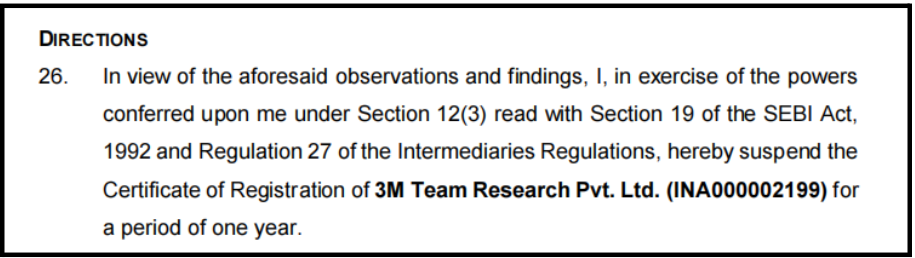
Furthermore, 3M Team Research’s Investment Adviser registration (INA000002199) was separately suspended for one year by SEBI’s order dated September 20, 2023.
Therefore, investors must verify the current registration status on the SEBI portal before engaging with either individual.
SEBI Orders Against Pramod Kumar Jain & Rakesh Sethi
SEBI did not act just once against the 3M Team Research and its directors. Instead, it took multiple actions, building the case from interim restraint to final debarment and registration suspension.
Each order confirmed the same pattern of conduct and added a heavier consequence. The table below captures the complete regulatory timeline.
1. Interim Ex-Parte Order: November 26, 2019
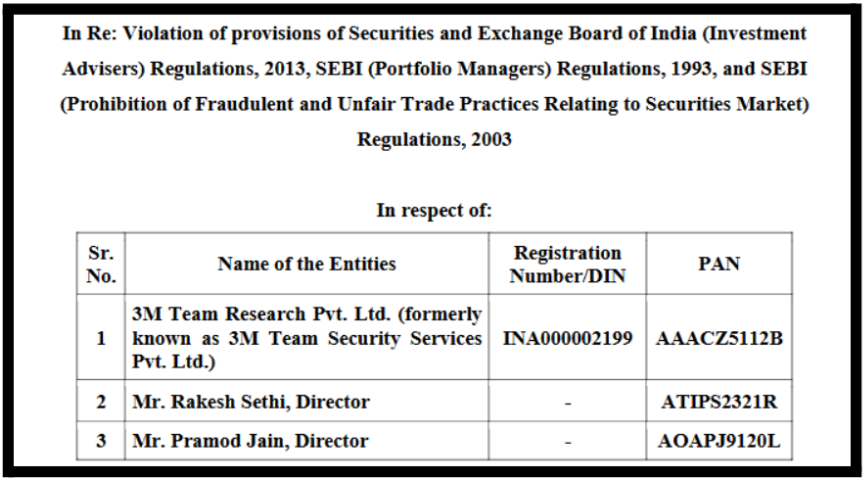
On November 26, 2019, SEBI passed an interim ex-parte order against 3M Team Research Private Limited and its director, Rakesh Sethi, after observing prima facie evidence of serious regulatory violations.
SEBI found that the company was allegedly operating unregistered Portfolio Management Services (PMS) activities despite only holding registration as an Investment Adviser.
The regulator also noted concerns around promises of assured returns to clients, a practice that is generally prohibited in regulated advisory services because investment outcomes cannot be guaranteed.
Considering the potential risk to investors and the urgency of the matter, SEBI immediately restrained the company and associated individuals from accessing or dealing in the securities market until further directions.
2. Confirmatory Order: December 7, 2020
Following the interim action, SEBI provided the noticees an opportunity for a post-decisional hearing. After reviewing submissions and examining the case further, SEBI issued a confirmatory order on December 7, 2020.
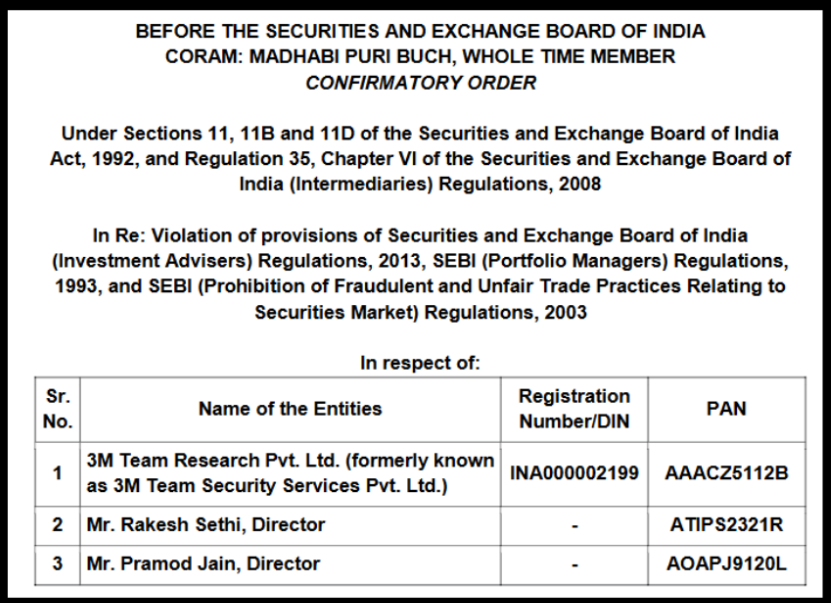
In this order, the regulator upheld the findings of the earlier interim order and concluded that the concerns identified initially continued to remain valid.
After the post-decisional hearing, SEBI confirmed all interim order findings and maintained full restrictions on all noticees.
This meant 3M Team Research, and the concerned individuals continued to face market access restrictions while the investigation and enforcement process progressed.
3. Final Order: August 4, 2022
On August 4, 2022, SEBI issued its final order in the matter, formally confirming multiple regulatory violations by 3M Team Research Private Limited and associated noticees.
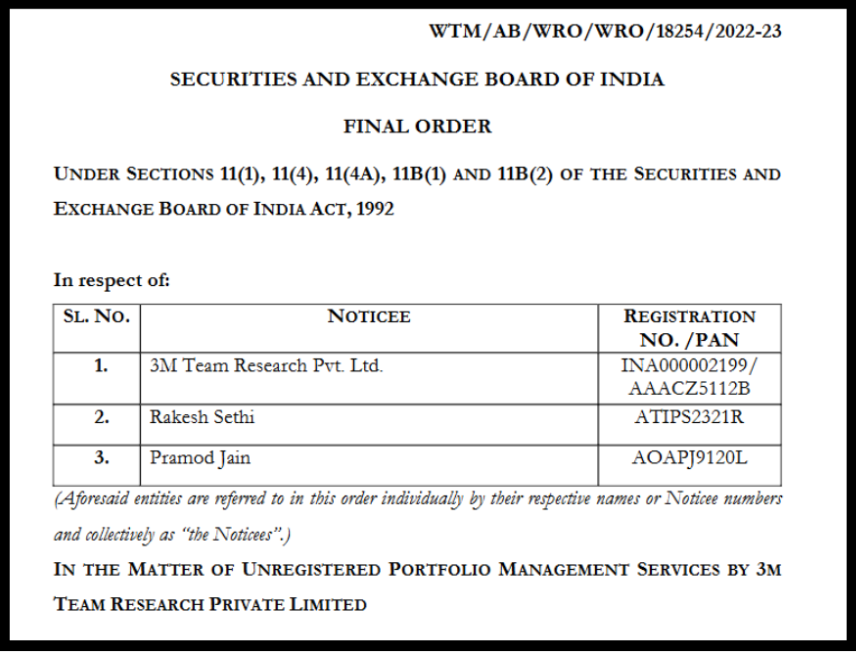
The regulator concluded that the entity had engaged in activities beyond the scope of its registration, including unregistered PMS-like services and misleading conduct involving return assurances.
SEBI imposed a monetary penalty of ₹10 lakh and directed the refund of approximately ₹89.4 lakh collected from clients. In addition, all three noticees were debarred from accessing the securities market for a minimum period of one year.
This final order marked the conclusion of SEBI’s enforcement proceedings on the primary violations.
4. Registration Suspension Order: September 20, 2023
In a separate regulatory action dated September 20, 2023, SEBI suspended the Investment Adviser registration of 3M Team Research Private Limited (Registration No. INA000002199) for one year with immediate effect.
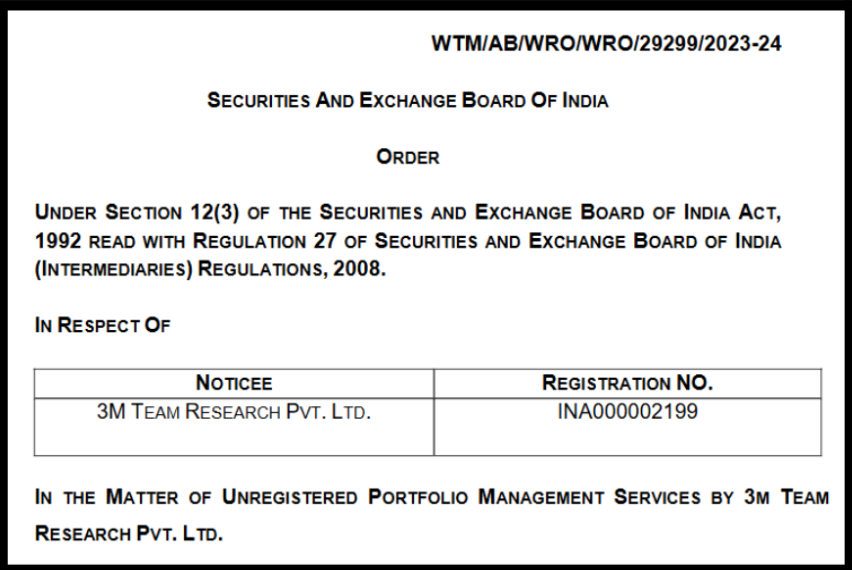
This suspension indicated that the regulator found continued compliance concerns significant enough to warrant action directly against the entity’s registration status.
A registration suspension is a serious regulatory measure, as it prevents the adviser from legally operating as a SEBI-registered Investment Adviser during the suspension period.
This further reinforced the seriousness of the compliance failures identified in earlier proceedings.
The four-stage escalation tells a clear story. SEBI gave multiple opportunities to respond. However, the noticees failed to appear for three consecutive hearing dates in 2023.
Consequently, SEBI proceeded based on written submissions and record evidence alone.
Also Read: Growtheum Investment Advisors has 1 complaint that was marked resolved, but advisory fees and key engagement documents remain unclear.
Violations by Pramod Kumar Jain & Rakesh Sethi
SEBI’s findings reveal multiple clear regulatory violations by 3M Team Research Private Limited across advisory, portfolio management, and client handling practices.
1. Running an Unregistered Portfolio Management Service
Rakesh Sethi and Pramod Kumar Jain ran 3M Team Research as a registered Investment Adviser. However, they operated beyond that scope and positioned their services as PMS.
Moreover, they advertised discretionary portfolio management on their website. They also issued invoices labelled PMS fee and hired for PMS and wealth management roles.

Therefore, SEBI rejected the estimates defence and held these as guaranteed returns. Consequently, it treated them under Regulation 2(1)(c) and Sections 12A(a) to (c).
2. Offering Assured and Unrealistic Returns
Rakesh Sethi and Pramod Kumar Jain pushed aggressive return claims on 3M Team Research’s website; however, they promised 200%–400% annual returns and ₹40,000- ₹50,000 monthly gains.
Moreover, they marketed “sure shot and money-making calls” and projected 100%–200% returns under the Modi 2019–2024 multibagger section.
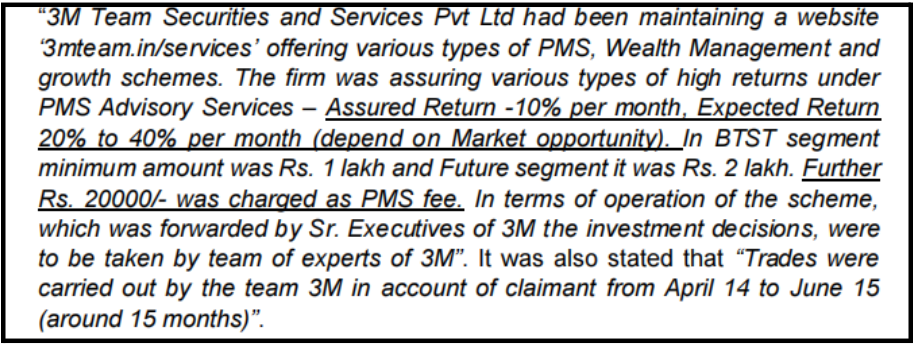
Therefore, SEBI rejected the “estimates” defence, held these as guaranteed returns, and treated them as fraud under Regulation 2(1)(c) of the PFUTP Regulations and Sections 12A(a)–(c) of the SEBI Act.
3. Mixing Advisory and Execution
Rakesh Sethi and Pramod Kumar Jain failed to maintain the separation required under Regulation 22.
However, Sethi acted as CEO of 3M Team while also serving as an Authorised Person of Arihant Capital.
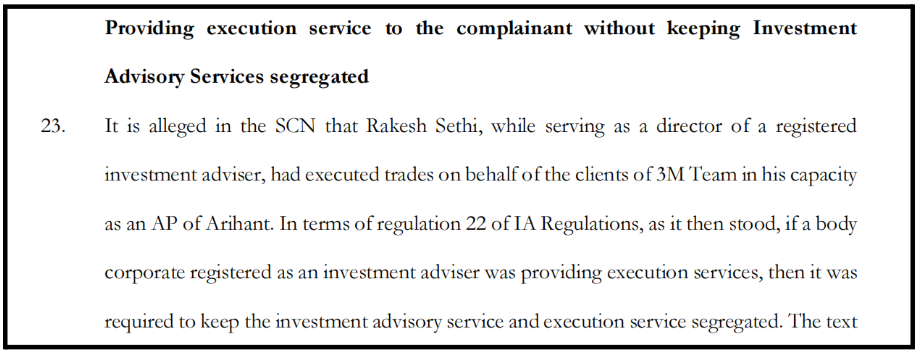
Moreover, they routed clients to the broker, and a 3M employee sent demat forms on February 7, 2014, showing active client funneling.
Therefore, the arbitration award found Sethi controlled the client’s account, confirming a clear violation.
4. Accepting Funds and Operating Without Proper Client Consent
Rakesh Sethi and Pramod Kumar Jain collected ₹89.4 lakh from clients between September 2014 and the interim order.
However, this spanned four years with ₹43.93 lakh, ₹24.49 lakh, ₹17.77 lakh, and ₹3.21 lakh respectively.
Moreover, they failed to provide client master data to separate legitimate advisory fees from unauthorised PMS collections.
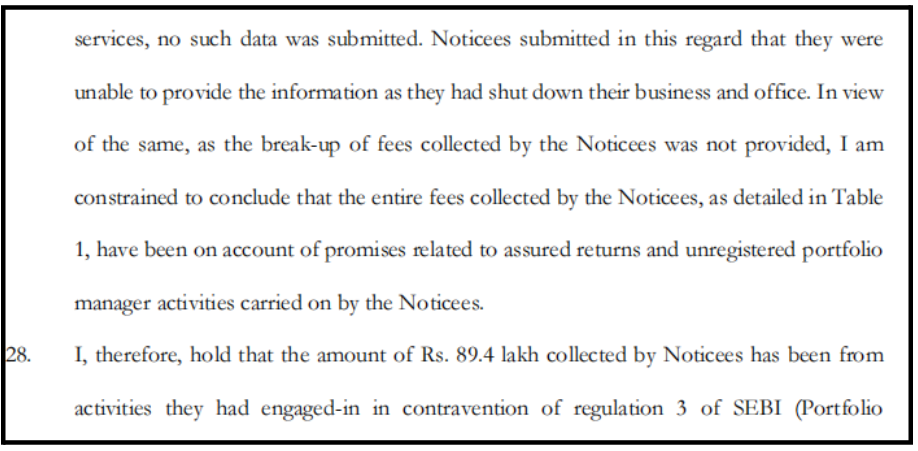
Therefore, SEBI treated the entire ₹89.4 lakh as collected in violation of the IA Regulations, PMS Regulations, and the SEBI Act.
Penalty Imposed
SEBI imposed a ₹10 lakh penalty: ₹8 lakh under Section 15HA and ₹2 lakh under Section 15HB on all three noticees.
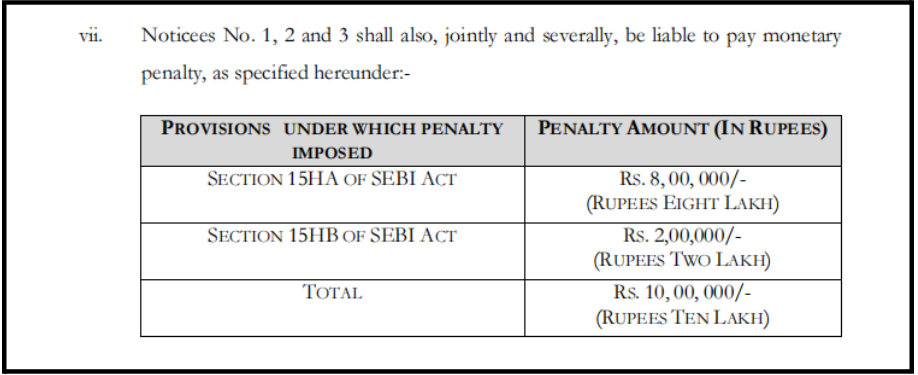
It also ordered a ₹89.4 lakh refund, asset freeze, public notices, and a minimum one-year market ban.
What Investors Must Keep in Mind?
Fraudulent advisers do not always announce themselves. They build legitimate-looking websites, hold real SEBI registrations, and use professional language to project credibility.
Two things expose them every time: their promises defy logic, and their structure serves their own interest more than yours.
- Reject any adviser promising returns above 20-25% per annum. Claims of 100%, 200%, or 400% returns are not ambitious targets. Instead, they are red flags.
- Verify that the adviser’s role and the broker’s role remain completely separate. Otherwise, an adviser working as an AP, sub-broker, or employee creates a direct conflict of interest.
- Demand written, itemised receipts for every payment, never pay a combined “advisory plus trading” fee to a single entity, as this structure replicates exactly what 3M Team used
- Cross-check any IA or RA registration on the SEBI website directly, do not rely on registration numbers printed on brochures or websites, as these can be fabricated or may belong to suspended entities
If your adviser promises the impossible, charges a bundled fee, and controls your trading account, you do not have an adviser.
You have someone operating an unregistered portfolio management service. Recognising this distinction early is the single most powerful protection available to any investor.
Also Read: Finnovate Financial Services website cites an unverified claim of 3,500+ families served and 35,000+ families empowered, while listing a 0.50% bond/NCD transaction charge.
What To Do In Such Cases?
If you have already paid an investment adviser or research analyst who promised guaranteed returns, controlled your trading account, or mixed advisory with execution, you have clear legal recourse.
Act quickly, because delays weaken your case.
Step 1: Preserve All Evidence Immediately
First, collect every document you hold. This includes payment receipts, invoices, emails, WhatsApp messages, account forms, and website screenshots.
Organise them chronologically. This documentation forms the backbone of every escalation step that follows, and every day you delay risks losing digital records.
Step 2: File a Formal Written Complaint with the Adviser
Next, send a detailed written complaint to the firm’s compliance officer. Clearly state the misconduct, violated regulations, dates, and amounts involved.
Keep copies of everything you send. If the firm fails to respond within 21 days or dismisses your complaint, treat that response itself as grounds for escalation.
Step 3: File a Complaint in SCORES
File your complaint on SEBI’s SCORES platform, which compels the registered intermediary to engage and respond under SEBI’s direct monitoring.
SEBI assigns a complaint ID and tracks every update. Many investors recover amounts at this stage, particularly when the firm realises SEBI is actively watching.
Step 4: Register a Complaint with SMART ODR
If SCORES does not resolve the dispute satisfactorily, escalate to SMART ODR, SEBI’s Online Dispute Resolution platform for structured conciliation and arbitration.
Step 5: Stock Market Arbitration
If your losses arise through a broker’s trading account, file for exchange arbitration at NSE or BSE, which delivers a legally binding award carrying the force of a court decree.
Need Help?
If you have faced losses, unauthorised charges, or deceptive advisory practices from any investment adviser, our team guides you through the entire recovery process.
- We review your case, identify specific SEBI violations, and build a structured complaint file from your documentation
- We draft formal complaint letters to the firm, SEBI SCORES, and relevant exchanges on your behalf
- We guide you through SMART ODR and arbitration proceedings step by step
Silence protects fraudsters. Documentation and legal action protect you.
Conclusion
Pramod Kumar Jain & Rakesh Sethi built 3M Team Research on false promises and regulatory violations. Over nearly four years, SEBI dismantled it through four separate orders.
The case confirms one truth that every investor in India must internalise: a SEBI registration does not prevent fraud; it only creates accountability after the fact.
Your protection comes from knowing the rules, recognising the red flags, and acting the moment something feels wrong.





 Add us as a preferred source on Google »

