

Quick Summary
A SEBI Registered Investment Advisor (RIA) is licensed to give personalised advice based on your goals and risk profile, for a fee capped at ₹1,51,000 per client family per year. Registration confirms entry-level compliance, not ongoing good conduct, and 10 real SEBI orders below, penalties from ₹1 lakh to ₹30 lakh, show registered advisors still promising guaranteed returns, overcharging fees, and running unregistered portfolio management on the side. Verification takes two minutes on official SEBI website and should happen before every payment, not after a loss.
Have you ever wondered whether the confident voice on the phone, promising a “life-changing portfolio,” is even legally allowed to say what they’re saying?
Most retail investors can’t answer that, and the gap in awareness costs them, sometimes lakhs of rupees.
Who Is a SEBI Registered Investment Advisor?
A SEBI Registered Investment Advisor (RIA) is an individual or firm registered with SEBI under the Investment Advisers Regulations, 2013, authorised to give personalised investment advice based on your income, financial goals, and risk appetite.
This is different from a Research Analyst (RA), who publishes general market research and stock calls to a broad audience rather than advice tailored to you specifically.
Working with a registered RIA means access to mandatory conflict disclosures, structured fee regulations, and a formal grievance redressal mechanism. But the supply is thin.
As of mid-2026, India has only 1,042 SEBI Registered Investment Advisors against more than 18 crore demat accounts, roughly one RIA for every 1.7 lakh investors.
That shortage is exactly why Telegram tipsters, YouTube gurus, and unregistered advisors find such an easy audience, and why verifying registration before paying anyone should always be step one.
What Can a SEBI Registered Investment Advisor Do?
An RIA can provide research-based investment advice, backed by data, financial analysis, and a clear time horizon, with the rationale and risks explained so you act with awareness rather than blindly.
They can publish reports, model portfolios, and market commentary, provided any assumptions or limitations are disclosed, and nothing is presented as a guaranteed outcome.
An RIA can offer standardised advisory services like model portfolios and asset-allocation plans, guiding your decisions without ever executing trades or controlling your demat account.
They must disclose conflicts of interest in writing if they or their group holds a financial stake in what they’re recommending.
The RIA can charge fees within SEBI’s limits, transparent, agreed in writing, never tied to your profits.
And they can play an educational role, explaining risk management and diversification to newer investors who still want to make their own execution decisions.
What a SEBI Registered Investment Advisor Cannot Do
This is where the violations that cost investors real money happen, even with registered entities.
- They cannot promise guaranteed returns. Any fixed profit or assured-income claim is treated as a fraudulent and unfair trade practice under SEBI’s PFUTP Regulations, 2003.
- They cannot handle or operate your trading account. No RIA can place trades on your behalf, request your login credentials, or touch your demat account in any capacity; that is the boundary a Portfolio Management Service exists for, and it requires a separate registration entirely.
- They cannot push unsuitable products for commission, steering a low-risk retiree into high-risk F&O just to earn a subscription upgrade.
- They cannot charge profit-linked or hidden fees; fees must be transparent, agreed upfront, and within SEBI’s ceiling.
And they cannot offer “loss recovery” schemes, one of the most common traps, where an advisor promises to recover your losses if you just pay a bit more.
SEBI Registered Investment Advisor Fee Limits
| Fee Basis | Permitted Limit |
|---|---|
| Fixed fee per client family, per year | Up to ₹1,51,000 per annum |
| Assets Under Advice (AUA)-based fee | Up to 2.5% of AUA per annum |
| Profit-linked fee | Not permitted, under any structure |
An advisor must pick one model and cannot switch between them for the same client within a year.
If someone quotes a fee well above these limits, or structures it around your profits, that’s a compliance breach worth reporting, and it can be checked in twenty minutes against your own payment records.
Is a SEBI Registered Investment Advisor Safe or Not?
Yes, with caution.
Registration confirms an advisor cleared minimum eligibility, education, NISM certification, net worth, and a fit-and-proper declaration, and it gives you formal recourse through SCORES and arbitration if something goes wrong.
What it does not confirm is ongoing conduct.
A registered IA can still churn your portfolio, push unsuitable products, or promise guaranteed returns years after receiving that registration, and even when SEBI proves violations and orders refunds, actual recovery depends on the firm’s finances and cooperation.
In the worst cases, a rogue registered entity can cross the line from a simple compliance breach into a full-scale investment advisor scam, leaving retail investors struggling to recover their capital.
Several orders below directed refunds investors never fully received because the entity had already dissolved or liquidated assets.
Think of SEBI as a watchdog, not a guarantee. It investigates, it penalises, but by the time it steps in, the damage to investors has usually already happened.
Your own verification, fee-structure checks, and written agreements are what actually protect your money day to day.
Ten Real SEBI Enforcement Cases Against Registered Advisors
Every case below involved a firm that held, or claimed to hold, a valid SEBI registration at the time of the violation.
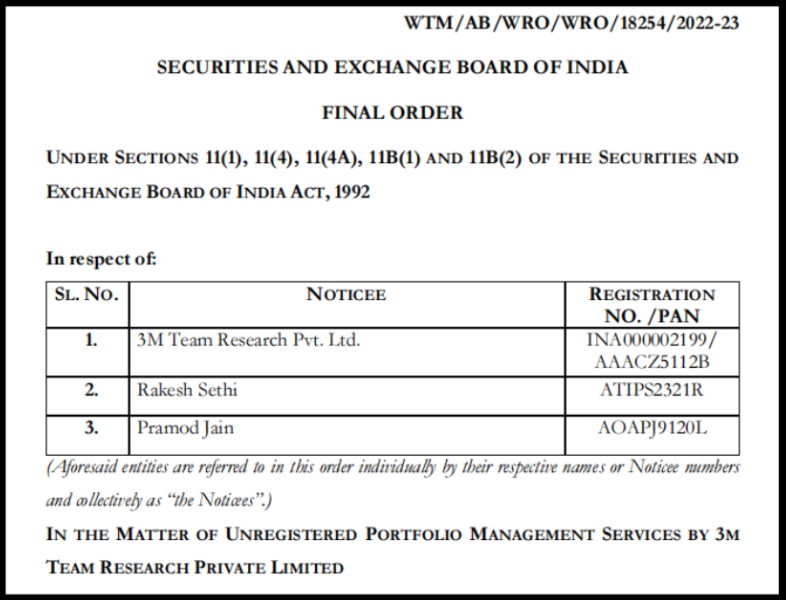
1. 3M Team Research Private Limited (Indore, INA000002199) ran an unregistered portfolio management operation, promised 200 to 400 percent annual returns, and mixed advisory with broker execution through a connected authorised person.
SEBI found it had collected ₹89.4 lakh from clients between 2014 and 2019.
Penalty: ₹10 lakh, plus a ₹89.4 lakh refund order and a one-year market ban.
2. Ayushi Chauksey (Mumbai, INA000008075) continued giving advisory services after her certification had expired, and charged some clients fees beyond SEBI’s permitted limit.
Penalty: ₹7 lakh, plus restriction from taking new clients for a period.
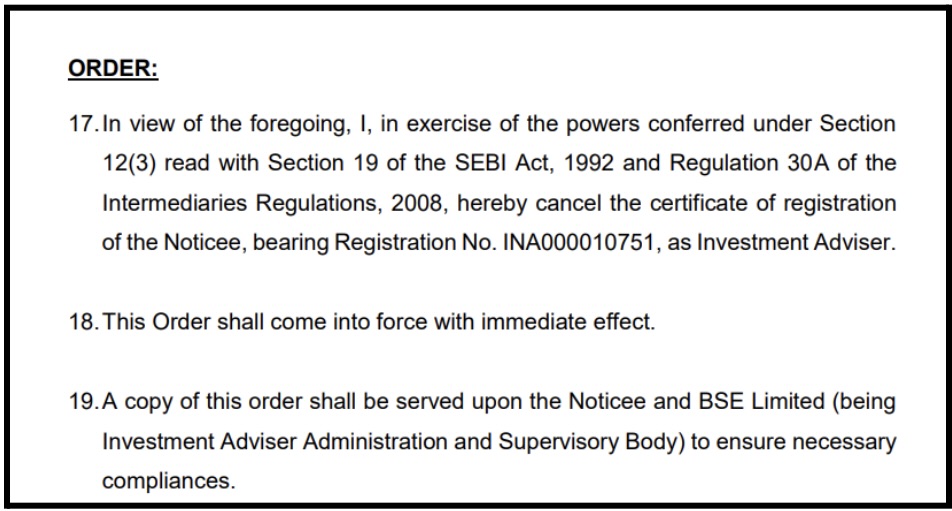
3. WealthMax Solution (Piyush Jain, Indore) was found missing client agreements before charging fees, running expired NISM certifications, and failing to produce key documents during inspection.
Outcome: registration cancelled, stopping the firm from operating as an investment adviser entirely.
4. Highlight Investment Research offered unrealistic assured profits, including a specific promise of “₹5 lakh guaranteed in 4 months,” while downplaying risk to attract investment.
Penalty: ₹7 lakh, and the IA registration was effectively cancelled.
5. Lifeinspire Knowledge Solutions Private Limited ran bogus loss-recovery services targeting already-desperate investors.
Outcome: registration revoked, collected fees disgorged, and promoters banned from intermediary roles.
6. Monetary Solutions (Prop. Ankit Vyas) used fake testimonials on its website, collected fees into a personal bank account rather than the firm’s, skipped client agreements entirely, and ran with 7 unqualified staff.
Penalty: ₹25 lakh (July 2024).
7. Manu Chhabra charged ₹5.16 lakh from a single client in one month and failed to maintain PAN details for 107 of 157 clients.
Penalty: ₹4 lakh (September 2023).
8. Sai Proficient Research Investment Advisory (Meeshika Vishwakarma, INA000002504) failed to maintain proper records of advisory activity, skipped mandatory client agreements, and had inadequate documentation of services.
Penalty: ₹19 lakh.
9. Niveshicon Investment Advisor (Veerendra Gupta) did not adhere to expected norms of conduct and had gaps in transparency and client servicing.
Penalty: ₹25 lakh, alongside additional directions.
10. Shilpa Garg claimed a small investment could generate extremely large daily returns, a clear breach of fiduciary responsibility.
Outcome: barred from the securities market, with additional regulatory restrictions.
How to Verify a SEBI Registered Investment Advisor?
Verification takes under two minutes and should never be skipped.
- Visit SEBI’s website, navigate to the Intermediaries Portal, and select registered intermediaries.
- Search by the advisor’s name or registration number, which starts with “INA” for an Investment Adviser (an “INH” prefix means Research Analyst instead, a different category with different rules).
- Confirm the registration is active, not suspended or cancelled, and that the entity name matches exactly, since fraudsters sometimes borrow a legitimate firm’s registration number to look credible.
- Check for pending SEBI action by searching the advisor’s name in SEBI’s published enforcement orders.
- Demand a written agreement before any payment; a legitimate RIA always has one ready, and resistance to providing it is itself a red flag.
If you’re dealing with a Research Analyst instead and want to understand exactly where their permitted scope ends, SEBI registered research analyst vs investment advisor breaks down the distinction in full.
How to Report a Violation By an Investment Advisor?
Start by collecting every payment receipt, agreement, chat record, and call recording chronologically, and working out how much of your claim is fees versus trading loss, since that split, covered in stock advisory refund, shapes what you can realistically expect back.
Raise the issue with the advisor’s compliance officer in writing first, then escalate to SEBI SCORES if unresolved, then SMART ODR for structured conciliation, and finally exchange arbitration if the dispute still stands.
If your situation involves an advisor who actually took over your account rather than just overcharging or overpromising, that’s a distinct violation covered in our guide on registered advisor managed my account.
Paid a registered advisor who overcharged, overpromised, or crossed a line you weren’t sure was a violation?
We check the advisor’s actual registration and enforcement history, map your situation to the specific SEBI rule involved, and build your complaint around it.
Register with us to get support around your case.
Conclusion
A SEBI registered investment advisor is definitely more credible than an unregistered operator, but that does not mean you should trust them blindly.
The reality is that SEBI registration only confirms that the advisor is allowed to operate under regulatory rules, not that every action they take will always be perfect or compliant.
SEBI does take strict action when violations are found, as seen in multiple real cases, but that action usually comes after the issue has already impacted investors.
This is why your responsibility does not end at checking registration. It actually begins there. And if something feels off, raise it immediately through SCORES.
Report. Recover. Stay Fraud Free.
Frequently Asked Questions
No. Registration confirms the advisor met entry-level requirements, education, certification, net worth, and agreed to follow SEBI's rules. What happens afterward depends entirely on the firm's own conduct, and several cases above show registered advisors violating the rules years after registration.
Up to ₹1,51,000 per client family per year on a fixed-fee basis, or up to 2.5% of Assets Under Advice annually, whichever model the advisor chooses. Profit-linked fees are never permitted under any structure.
Not always in full. Several cases above show SEBI directing refunds that investors never fully received because the firm's assets had already been dissipated or the entity stopped cooperating. Acting early and documenting everything improves the odds of actual recovery.
A Research Analyst (INH registration) publishes general research and recommendations to a broad audience. An Investment Advisor (INA registration) gives personalised advice after assessing your specific financial situation and risk profile. The two carry different rules, especially around fees and suitability.
A request for your trading account login, OTP, or password, for any reason. No legitimate RIA needs account access, since their role is strictly advice, not execution. That single request is the boundary between legal advisory and an illegal arrangement.





 Add us as a preferred source on Google »

