
SEBI action against IA is not a warning for the future; it is happening right now.
Investment Advisers across India face penalties, debarment, and refund orders when they cross regulatory lines.
And the violations SEBI finds are not obscure technicalities.
They are practices that directly harm the investors paying for advice: guaranteed return promises, fake reviews, fee cap breaches, and employee misconduct.
Understanding SEBI action against IA gives every investor the tools to identify warning signs before they lose money.
SEBI Guidelines on Investment Advisers in India
SEBI regulates all Investment Advisers under the SEBI (Investment Advisers) Regulations, 2013.
These regulations set strict obligations around qualification, conduct, fees, agreements, and grievance redressal.
When evaluating a firm, it is vital to understand what a SEBI registered Investment Advisor do under these rules.
The IA framework is more stringent than the RA framework because an IA provides personalised advice after risk profiling, directly shaping where an individual’s money goes.
Consequently, SEBI requires:
- Every employee providing advisory services must hold NISM Investment Adviser Level 1 and Level 2 certification.
- Every client is to undergo formal risk profiling and suitability assessment before receiving any advice.
- Every fee charged to stay within ₹1.25 lakh per annum per client, with no exceptions.
- Every client interaction is to be recorded and maintained for regulatory inspection.
These requirements exist because personalised investment advice carries enormous responsibility.
When an IA breaches these standards, the harm to the investor is direct and often substantial.
That is why SEBI action against IA registrations tends to carry heavier penalties than action against other intermediary categories.
Common Violations by Investment Advisers
SEBI’s enforcement record reveals clear, repeating patterns across IA adjudication orders. These are not isolated incidents.
| Type of Violation | Description |
| Promising guaranteed returns | Employees verbally promising “60-70% profit,” “daily ₹1,500-2,000,” or “no loss” to induce subscriptions. |
| Fake reviews and testimonials | Publishing fabricated positive reviews on blogs and websites to mislead prospective clients. |
| Fee cap violations | Charging fees exceeding ₹1.25 lakh per annum per client, sometimes reaching ₹18+ lakh from a single client. |
| Unqualified employees | Using uncertified staff for risk profiling, suitability assessments, and client advisory without NISM certification. |
| No agreements before collecting fees | Collecting payment from clients before executing a formal advisory agreement. |
| Free trials to prospective clients | Offering free trial services, prohibited under SEBI’s December 2019 circular |
| Handling client demat/trading accounts | Executing trades or managing accounts on behalf of clients, an activity outside IA authorisation. |
| Failure to maintain call records | Not recording or deliberately destroying records of client interactions sought during SEBI inspection. |
These violations do not appear in isolation. SEBI’s inspection record shows that an IA committing one violation almost always commits several others simultaneously.
Together, these patterns define what SEBI action against IA proceedings looks like in practice.
How Does SEBI Take Action Against IA in India?
SEBI action against IA follows a structured process.
Understanding each step helps investors know what happens after they file a complaint and helps IAs understand that violations do not stay hidden.
Step 1: SEBI Initiates an Inspection
SEBI’s department conducts periodic inspections of registered IAs. Inspectors examine call recordings, client agreements, fee invoices, risk profiling records, bank statements, and social media activity.
Inspections typically cover two years.
Importantly, SEBI also initiates inspections directly from investor complaints filed on SEBI SCORES, making every complaint a potential trigger for regulatory scrutiny.
Step 2: SEBI Communicates Inspection Findings
After completing the inspection, SEBI sends its findings to the IA in writing.
The IA then responds with their explanation.
SEBI’s department analyses both the findings and the IA’s response to prepare a Post-Inspection Analysis (PIA) report identifying confirmed violations.
Step 3: SEBI Issues a Show Cause Notice
If the PIA confirms violations, the Adjudicating Officer (AO) issues a Show Cause Notice (SCN) to the IA.
The SCN specifies every alleged violation, the relevant regulation, and asks the IA to explain why SEBI should not impose a penalty.
The IA must respond within the stipulated timeframe.
Step 4: SEBI Grants a Personal Hearing
Following the SCN reply, the AO grants the IA a personal hearing.
The IA or their authorised representative presents their defence and submits supporting documents.
The AO considers all material before the hearing and applies the principles of natural justice throughout.
Step 5: AO Issues the Adjudication Order
After evaluating all evidence, the AO issues a formal adjudication order. The order records every fact, every violation established, the IA’s defence, and the penalty imposed.
Penalties under Section 15EB for IA defaults can reach ₹1 crore. Fraudulent trade practice violations under Section 15HA attract an additional separate penalty.
Published on SEBI’s website, the order becomes a permanent part of the public enforcement record.
Step 6: Recovery Proceedings Follow Non-Payment
If the IA does not pay within 45 days of the order, SEBI initiates recovery proceedings under Section 28A of the SEBI Act, including attachment and sale of property, arrest, and civil imprisonment in the most serious cases.
SEBI Orders Against Investment Advisers
Many investors assume registration guarantees safety.
However, the real question is: SEBI registered investment advisor safe or not?
The answer depends on compliance behaviour, transparency, and whether the advisor follows SEBI regulations in practice.
SEBI’s enforcement database contains a growing number of adjudication orders against registered IAs.
The three documented cases below illustrate the most serious and instructive patterns of SEBI action against IA registrations, all drawn from officially published orders.
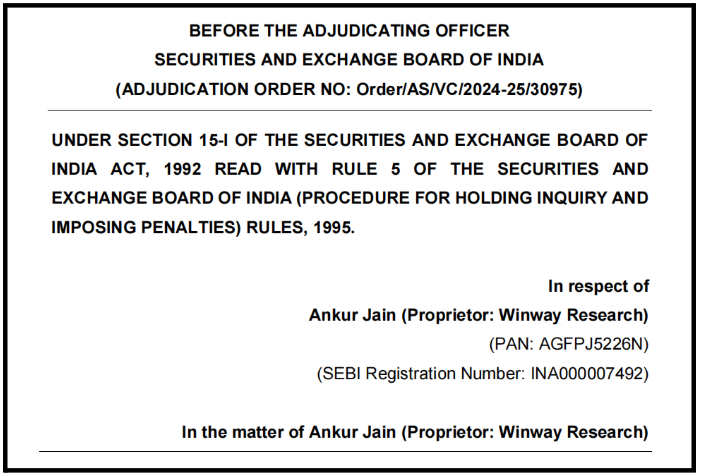
Case 1: Winway Research / Ankur Jain Order
SEBI Adjudication Order No. Order/AS/VC/2024-25/30975 | November 14, 2024 IA Registration No. INA000007492
Winway Research, run by Ankur Jain, faced multiple SCORES complaints that triggered SEBI’s examination into its advisory operations and internal conduct practices.
What Was the Case?
The Securities and Exchange Board of India established three violations in the case involving Winway and Ankur Jain.
An employee received client payments in his personal account, and the AO held the firm’s leadership vicariously liable.
- A client was charged twice for the same service period, resulting in overlapping fees.
- The firm failed to maintain first-interaction call recordings and gave an unproven “data corruption” excuse.
- ATRs filed on SCORES claimed resolution despite complaints actually remaining unresolved.
The AO clarified that filing an ATR alone does not count as complaint resolution under SEBI rules.
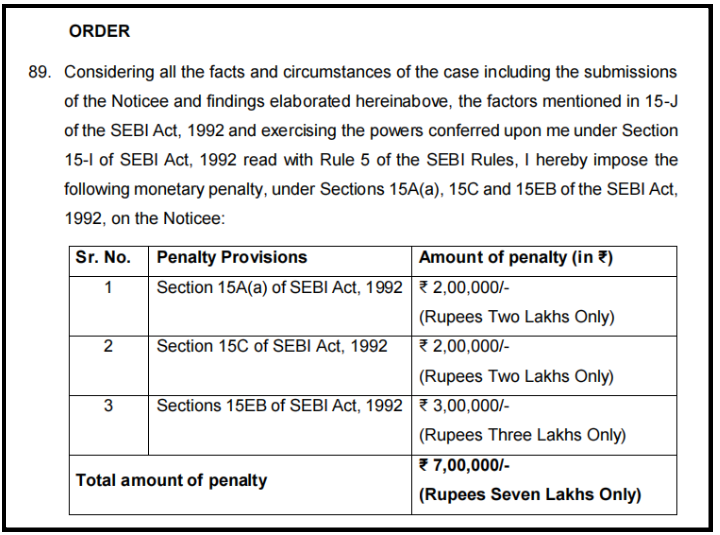
Penalty
₹7,00,000 total: ₹2,00,000 under Section 15A(a) for failure to furnish information, ₹2,00,000 under Section 15C for failure to redress investor grievances, and ₹3,00,000 under Section 15EB for default by an Investment Adviser.
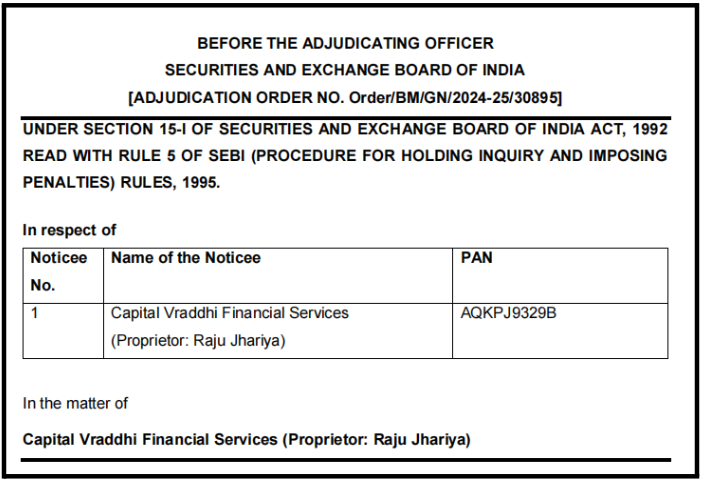
Case 2: Capital Vraddhi Financial Services / Raju Jhariya Order
SEBI Adjudication Order No. Order/BM/GN/2024-25/30895 | October 22, 2024 IA Registration No. INA000005291
Capital Vraddhi Financial Services, run by Raju Jhariya, underwent a comprehensive SEBI inspection covering April 2020 to March 2022.
What the inspection found was one of the most extensive lists of violations in a single IA order.
What Was the Case?
The Securities and Exchange Board of India established thirteen violations in this case.
Most critically, 36 of 38 employees gave advisory services without NISM Level 1 and Level 2 certification.
- First, the firm charged above the ₹1.25 lakh cap in 1,355 cases, and one client paid ₹18.22 lakh.
- Next, the firm collected fees from 209 clients before agreements and served 29 clients without any agreement.
- Then, call recordings showed claims of “₹1,500–2,000 daily profit,” no stop-loss advice, false “SEBI-approved” risk profiling, free trials to 116 clients, use of personal SIMs, and fake positive reviews.
Finally, SEBI treated these claims and actions as clear violations, including fraud under PFUTP regulations.
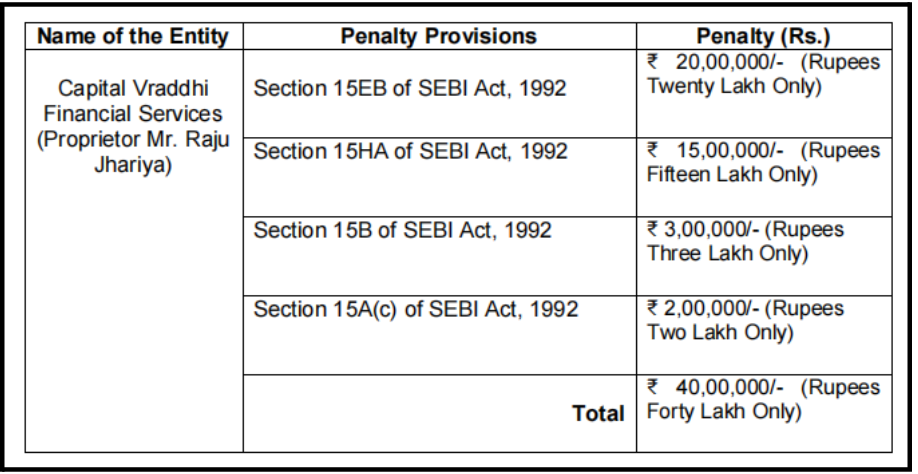
Penalty
₹40,00,000 total: ₹20,00,000 under Section 15EB, ₹15,00,000 under Section 15HA for fraudulent and unfair trade practices, ₹3,00,000 under Section 15B for failure to enter into agreements with clients, and ₹2,00,000 under Section 15A(c) for failure to maintain records.
Case 3: Capital Ways Investment Adviser / Deepak Ostwal Order
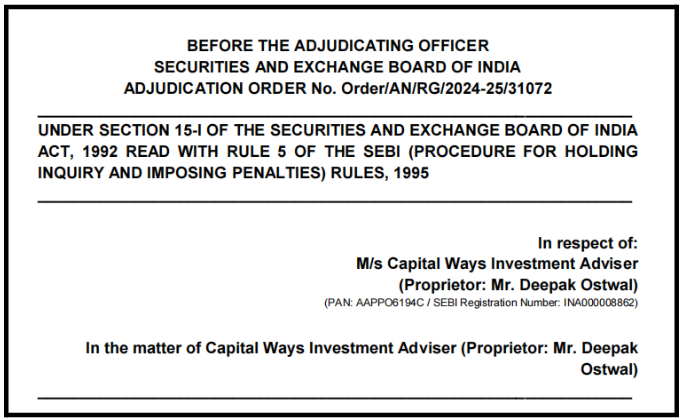
SEBI Adjudication Order No. Order/AN/RG/2024-25/31072 | December 26, 2024 IA Registration No. INA000008862
Capital Ways Investment Adviser, run by Deepak Ostwal, faced a SEBI inspection for the period April 2020 to October 2021.
The firm had 96 employees, and SEBI’s findings demonstrated systematic, multi-layered misconduct across the entire operation.
What Was the Case?
The Securities and Exchange Board of India established eight violations using the firm’s own call recordings.
Most seriously, employees acted as advisors and even handled client accounts without proper certification or authorisation.
- First, 35 executives lacked NISM XB; yet they advised, mis-sold high-risk products, coerced risk upgrades, and submitted altered agreements.
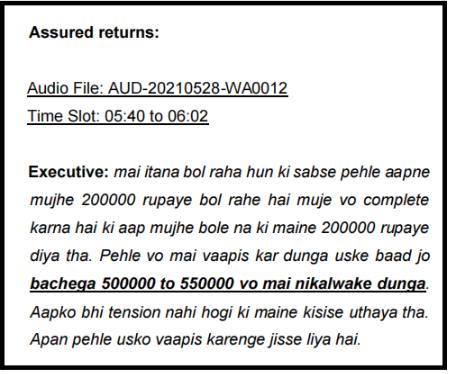
- Next, employees claimed “60–70% profit,” “₹3,000–4,000 daily,” “₹15,000 daily,” promised ₹5–5.5 lakh assured returns, discussed profit-sharing, and forced extra payments.

- Then, an employee handled Narinder Kaur’s demat without PMS registration; meanwhile, the firm gave no PMLA/AML training, kept no records, and failed to produce recordings for Rani Rani’s SCORES complaint.
Finally, SEBI treated these claims and actions as serious violations across advisory and compliance norms.
Penalty
₹10,00,000 total penalty imposed across multiple violations.
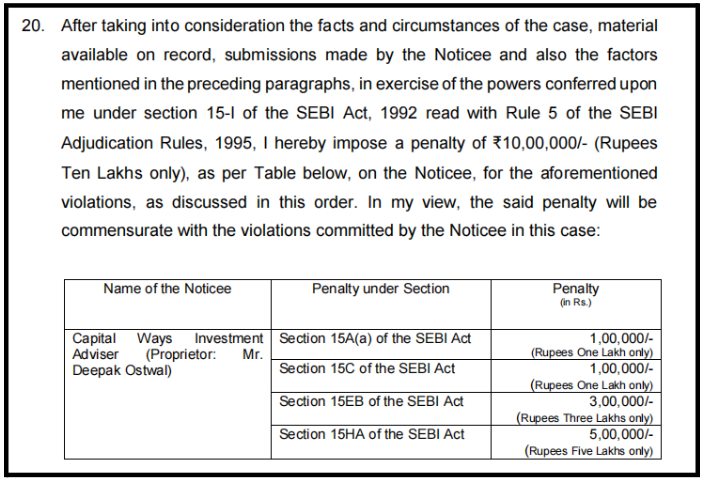
₹1,00,000 (Section 15A(a)), ₹1,00,000 (Section 15C), ₹3,00,000 (Section 15EB), and ₹5,00,000 (Section 15HA for fraudulent and unfair trade practices).
Lessons for Investors
These three cases, drawn directly from SEBI’s published enforcement record, reveal patterns that repeat across advisory scams in India.
Recognising these patterns before you subscribe is your most effective protection against SEBI action against IA situations becoming your problem too.
- Fee quotes exceeding ₹1.25 lakh annually are a direct regulatory breach; walk away.
- Employees promising daily returns, guaranteed profits, or no-loss outcomes are committing PFUTP violations on the firm’s behalf.
- Free trials are prohibited; any IA offering a free trial already violates SEBI’s circular.
- A risk profile “approved by SEBI” is a fabrication; SEBI does not approve individual risk profiles.
Investors must report an IA to SEBI when they observe any of the following:
- The firm charges fees above ₹1.25 lakh per year without a written explanation.
- Any employee promises a specific daily, monthly, or annual return figure.
- The firm requests access to your demat account, broker login, or trading credentials.
- Complaints filed on SEBI SCORES receive ATR responses, but the underlying issue remains unresolved.
Reporting is not complex. It requires documentation: payment receipts, call recordings, WhatsApp messages, invoices, and any promises made verbally or in writing.
SEBI action against IA proceedings in all three cases above began from investor complaints and inspection triggers. Your complaint matters, and it protects every future client of that firm.
Trapped by a Bad Investment Advisor? Here is How to Fight Back and Get a Refund
If you have experienced financial losses due to misleading claims, fee cap violations, or unauthorized account handling by an investment adviser, documenting every interaction is your strongest first step.
Securing evidence like payment receipts, agreements, call recordings, and chat history ensures you have a solid foundation before escalating the matter through official channels.
To navigate the exact steps required to report misconduct and pursue a refund, you can read our complete, step-by-step roadmap: complaint against SEBI registered investment advisor.
Need Help?
Drafting a complaint that correctly identifies PFUTP violations and cites the specific IA regulation breached requires specialised knowledge.
Further, following the correct escalation path through SCORES, Smart ODR, and arbitration demands expertise most investors do not have and should not have to develop alone.
Our services include:
- Case assessment: We review your payment records, agreements, call evidence, and invoices to determine which specific violations apply to your situation
- Complaint drafting: We prepare a precise complaint citing the exact regulatory provisions applicable to your case
- SCORES and Smart ODR filing: We guide you through every step of the submission process and ensure the right evidence reaches the right platform
- Arbitration and conciliation support: We represent your interests in formal dispute resolution and pursue the strongest possible outcome
Every SEBI IA action starts with a complaint; document it right, and you can register with us for help.
Conclusion
SEBI action against IA is real, documented, and accelerating.
Many investors still ask, can I trust SEBI registered investment advisor? The answer depends on their compliance history, transparency, and conduct.
Registration should be treated as a starting checkpoint, not the final decision-making factor.
Profit guarantees, fake reviews, demat account handling, fee cap violations, and unqualified employees are not edge cases; they are the findings that appear repeatedly in SEBI’s published orders.
The three cases in this blog resulted in penalties ranging from ₹7 lakh to ₹40 lakh. SEBI registration does not shield an IA that violates these rules.
And every investor complaint filed correctly brings the regulator one step closer to the next inspection.
Know the warning signs. Document everything. File your complaint. SEBI action against IA exists to protect you, but only if you use the mechanism SEBI built for that purpose.