

Quick Summary
SEBI action against a research analyst is neither rare nor reserved for obvious frauds. Registered analysts with active registrations face penalties, debarment, and refund orders when they cross the rules. What most investors do not know is how that action actually happens: a structured process of inspection, notice, hearing, and a published order, often set off by a single investor complaint. Understanding that process is what turns you from a victim into someone who can trigger it. This page explains how SEBI acts, what pushes it to act, and three real orders that show exactly what it treats as serious.
SEBI action against a research analyst is not rare, and it is not reserved for obvious fraudsters.
Even registered analysts with active registrations face penalties, debarment, and refund orders the moment they cross regulatory lines.
Knowing how SEBI acts, what triggers that action, and what a real order looks like gives you something powerful: the ability to spot a violation early, and the knowledge that your complaint can set the whole machinery in motion.
What Rules Does SEBI Set for Research Analysts?
Before looking at how SEBI enforces, it helps to know what it enforces.
Every research analyst operates under the SEBI (Research Analysts) Regulations, 2014, and accepts those obligations the day they register.
The rules span three core areas: honest conduct, full disclosure, and truthful advertising.
An analyst must act honestly, keep proper records, disclose conflicts of interest, avoid guaranteed-return or accuracy claims, and give every client access to the Investor Charter and the SCORES grievance system.
Those obligations are the yardstick SEBI measures an analyst against in every enforcement case.
We break the full conduct code down in our guide: SEBI guidelines for research analysts.
The Violations That Repeat Across SEBI’s Orders
SEBI’s enforcement record is not random.
The same handful of violations appear again and again, and once you know them, you can spot a firm heading for trouble before you pay it.
The table below sums up the patterns that recur across orders.
Read them as a warning list, since a firm doing one of these is usually doing several.
| Type of Violation | What It Looks Like |
|---|---|
| Offering assured returns | “Free money for all,” “344% return,” or “75% accuracy” claims on social media or websites. |
| Fake testimonials | Fabricated client reviews, or Quora and social feeds managed by paid agents to simulate praise. |
| Handling client accounts | Executing trades using a client’s login credentials, which only a Portfolio Manager may do. |
| Unregistered advisory | Giving personalised, fee-based investment advice without holding a SEBI IA registration. |
| Outsourcing KYC | Leaning on third-party platforms for onboarding without keeping proper KYC records. |
| Misleading advertising | Superlatives like “most successful stock advisor in India,” with nothing to back them. |
These rarely occur alone.
A firm that posts guaranteed-return claims usually also has incomplete KYC records and fake testimonials.
One compliance failure, once SEBI starts looking, tends to reveal others.
Before trusting any advisory, the first move is always to check SEBI registered research analyst status directly on SEBI’s own database, because a number on a website means nothing until it is verified at the source.
How SEBI Actually Takes Action Against an Analyst?
Here is the part almost no investor understands, and it is genuinely useful to know.
SEBI does not simply issue a fine one day.
Every action under the SEBI registered research analyst regulations follows a defined sequence, and knowing it tells you exactly what happens after you file a complaint.
The process moves through six stages, from the first inspection to the recovery of an unpaid penalty.
Each stage builds a formal record, which is why SEBI’s orders hold up.
Step 1: SEBI Initiates an Inspection
SEBI periodically inspects registered analysts, examining records, research reports, client data, social media, WhatsApp messages, and bank statements.
An inspection usually covers about two years, and crucially, SEBI also launches them in response to investor complaints filed on SCORES.
Step 2: Findings Go to the Analyst
After inspecting, SEBI puts its findings to the analyst in writing and gives them a chance to respond. Both the findings and the reply feed into a Post Inspection Analysis report.
Step 3: A Show Cause Notice Is Issued
If that analysis finds violations, SEBI’s Adjudicating Officer issues a Show Cause Notice, listing each alleged violation, the regulation breached, and asking the analyst to explain why no penalty should follow.
Step 4: A Personal Hearing Is Granted
The analyst then gets a personal hearing, appearing before the officer to present their defence and documents. This follows the principles of natural justice, so the analyst is genuinely heard before anything is decided.
Step 5: The Adjudication Order Is Passed
Weighing all of it, the officer issues a formal adjudication order recording the facts, the violations established, the defence, and the penalty.
Penalties under Section 15EB can reach ₹1 crore for compliance failures, and PFUTP breaches attract penalties under Section 15HA. The order is published on SEBI’s site and becomes public record.
Step 6: Recovery If the Penalty Goes Unpaid
If the analyst does not pay within 45 days, SEBI begins recovery under Section 28A, which can extend to attaching and selling property, and in serious cases, to arrest or civil imprisonment.
Real SEBI Orders Against Research Analysts
The process above is not theoretical.
The three orders below, all from SEBI’s published record, show what actually triggered the action and what it cost the analyst.
Read together, they map the exact conduct SEBI treats as serious.
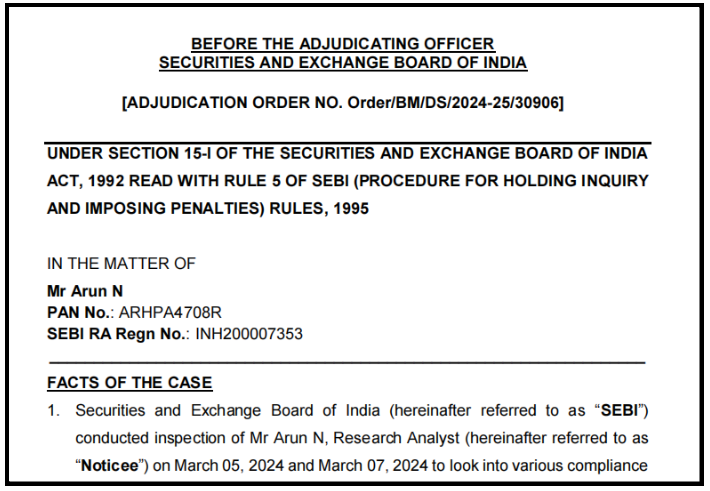
1. Arun N and the HarmonicsTraders Case: ₹7 Lakh
Arun N was a properly registered research analyst who ran his advisory through a platform called Gap-up, with 390 clients on his books.
SEBI looked closely at how he operated between April 2022 and February 2024, and two problems stood out.
The first was about client records.
Every registered analyst has to keep proper identity and verification records, the standard KYC paperwork, for each client they take on.
When SEBI asked Arun N for his, he could produce them for only 38 of his 390 clients.
He had left the onboarding to the Gap-up platform and never kept the records himself. But handing the task to someone else did not hand off the responsibility, and that gap alone was a clear breach.
The second problem was how he advertised.
On his X account, @HarmonicsT, he posted promises of guaranteed profits, and his Gap-up page boasted “75% accuracy.”
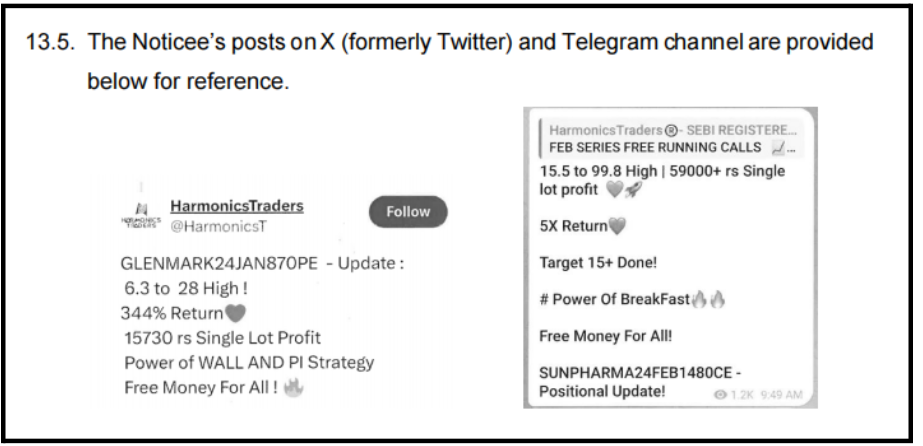
Here is the reasoning SEBI used, and it comes up again and again, so it is worth holding onto.
The regulator said this kind of language plants the idea of safe, guaranteed returns in an investor’s head, and that is exactly what the rules forbid, no matter what fine print sits elsewhere.
Promising profits in a market where nothing is certain is treated as misleading the public.
For all of this, SEBI fined him ₹7,00,000 in an order dated 24 October 2024.
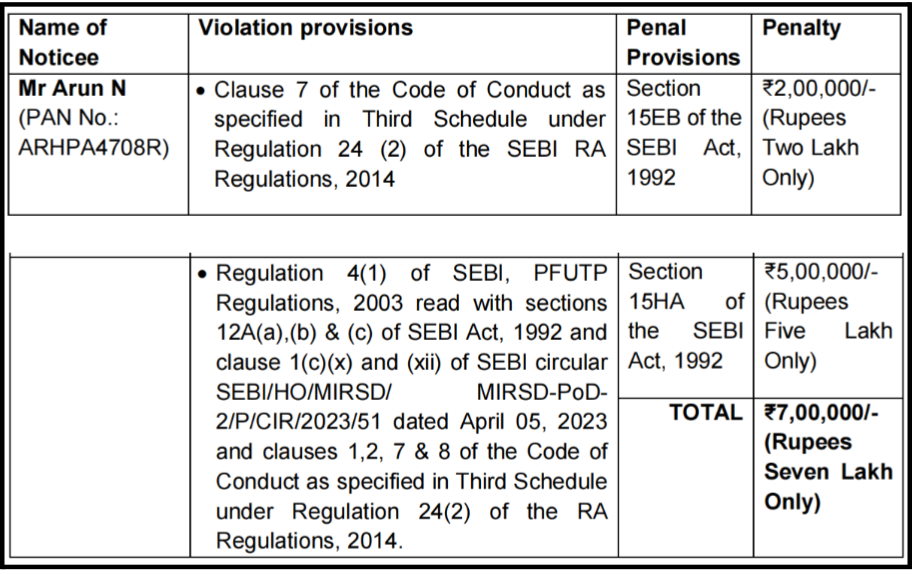
Part of the fine was for the record-keeping and conduct failures, and a separate part was for the false advertising. SEBI treated those as two different wrongs, not one.
The fuller picture of this analyst is on our guide: Arun N research analyst.
2. Mir Uniserv: ₹10 Lakh, and How One Problem Uncovered Many
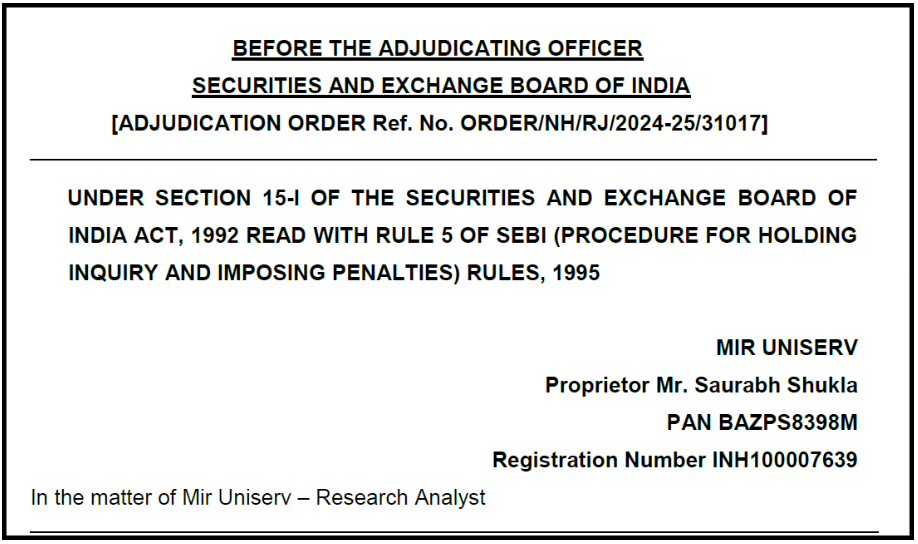
Mir Uniserv was a one-person firm run by Saurabh Shukla.
When SEBI examined its operations from April 2022 to December 2023, it found not one issue but a whole chain of them.
If you have ever wondered why SEBI says a single violation usually leads to others, this case is the clearest example there is. The failures ran across five separate areas.
The records were missing.
The firm had no proper KYC for 190 of its clients.
Grievances were ignored.
It took Mir Uniserv two full years after registering just to set up its SCORES ID, the thing that lets clients even file a complaint.
And when complaints did come, they were resolved long after the deadline, one of them taking 94 days.
The whole business was handed to salespeople.
This is the part that stands out. Mir Uniserv gave its client onboarding, servicing, and record-keeping to commission-based telecallers, and paid them ₹2.54 crore without a single written contract.
The core work a registered analyst is supposed to control was being run by an unaccountable sales team.
Those salespeople promised the world.
During onboarding calls, the telecallers told clients they would earn ₹50,000 to ₹60,000 a month, with “100% profits”, exactly the kind of guaranteed-return promise that is banned.
The firm tried to hide the evidence.
On the very day it submitted its pre-inspection paperwork to SEBI, it wiped its website clean. It also declared it had made no third-party payments, even though those payments sat in plain sight in its own accounts.
When cornered, the firm argued that a disclaimer on its website cancelled out the guaranteed-return promises.
SEBI rejected that flatly, for the same reason as in Arun N’s case: a disclaimer buried on a page does not undo a direct promise of guaranteed monthly income made to a client’s face.
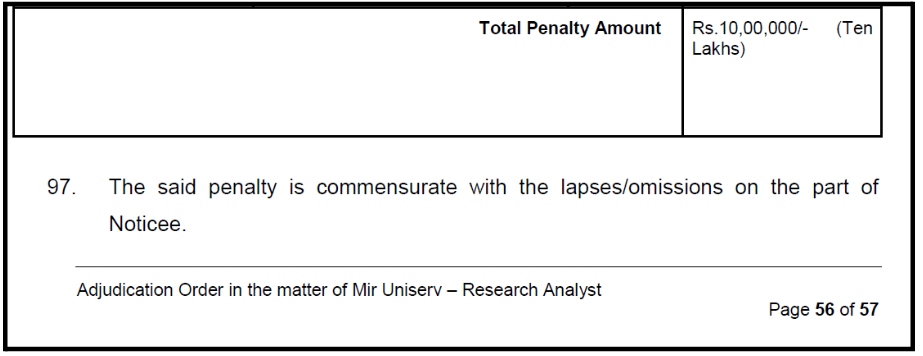
The total fine, in an order dated 29 November 2024, came to ₹10,00,000, made up of separate amounts for each type of failure, all payable within 45 days.
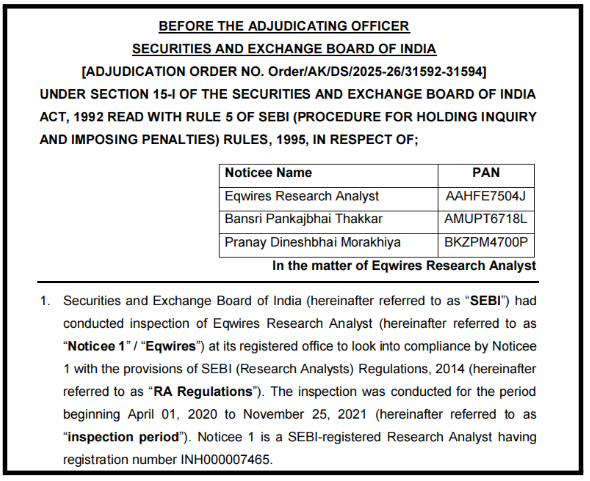
3. Eqwires Research Analyst: ₹6 Lakh for Doing a Job It Was Not Licensed For
Eqwires was a partnership firm.
When SEBI reviewed its work from April 2020 to November 2021, the picture that emerged was of a research analyst behaving like something it was never registered to be.
It gave personal advice it had no licence to give.
A research analyst is allowed to publish general research for everyone. Eqwires went much further, it profiled clients individually and then handed them tailored, personal buy-and-sell advice.
That is the job of an investment adviser, a completely separate registration Eqwires did not hold. Operating without the right licence is a direct breach of the law.
It ran a client’s account itself.
The firm logged into a client’s trading account using her own credentials and placed trades for her, something only a licensed Portfolio Manager can do.
Worse, it leaned on clients by making continued service conditional on them taking down negative reviews.
Its glowing reviews were fake.
SEBI found that testimonials like “90 to 95% accuracy and ₹1 lakh profit in one month” were not from real clients at all. They were written and posted by paid marketing agents.
Eqwires effectively admitted this, which is why the case is so often held up as proof that online testimonials can be entirely invented.
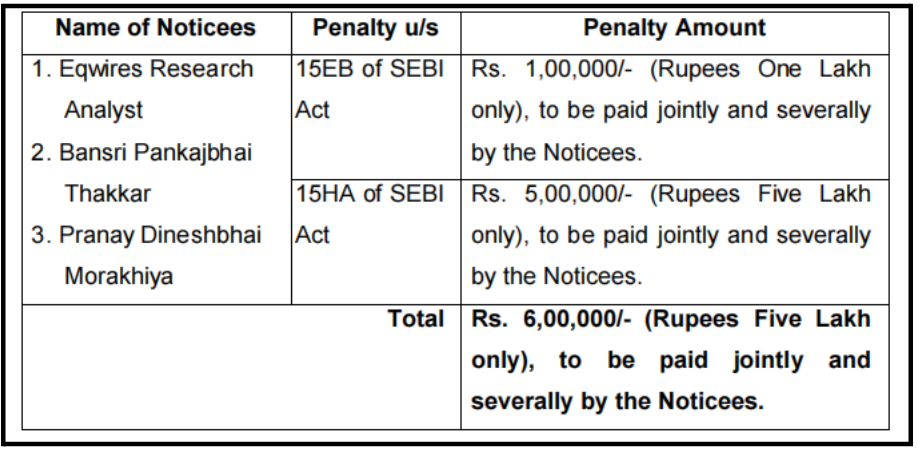
For all of this, in an order dated 13 August 2025, SEBI fined the firm ₹6,00,000, and made all three partners responsible for paying it together, so none of them could push the blame onto the others.
For the full review of this firm, check our guide: Eqwires research analyst.
What Investors Can Learn From SEBI’s Action?
Taken together, these three orders reveal patterns that repeat across advisory scams, and knowing them is your first line of defence.
A registration number guarantees nothing about conduct, since all three firms were registered. “Free money” and percentage-return claims are warning signs SEBI treats as implied assured returns.
Fake testimonials are a documented tactic; Eqwires admitted using an agency for all its reviews.
And any offer involving your trading account login is illegal, because no analyst holds the authority to trade on your behalf.
You should report an analyst to SEBI the moment you see any of these: claims of specific accuracy or guaranteed returns, a request for your trading login, fees charged for personalised advice with no IA registration, or testimonials that look generic and suspiciously uniform.
Filing needs no lawyer, only documentation, payment records, screenshots, call recordings, and any written promises. And it matters more than you think: SEBI’s inspections often begin with a single investor complaint, so yours can trigger the action that protects every future client too.
If you believe a SEBI registered RA cheated you, that complaint is where enforcement starts.
Spotted a registered analyst doing exactly what these orders describe?
We will assess what you have, match the conduct to the specific SEBI provisions it breaches, and build the complaint that can put it on the regulator’s radar.
Reporting a Research Analyst: How to Recover Your Money?
If you lost money following misleading claims, fake testimonials, illegal account handling, or unregistered advice, you have a clear route, and it starts with your records: payment receipts, subscription details, recommendations, and every written or WhatsApp promise.
From there it is a matter of escalating in order. You raise a formal, dated complaint with the firm’s grievance officer first, which starts the 21-day resolution clock, and a non-response itself becomes evidence.
If that fails, the matter moves through SEBI SCORES, then SMART ODR conciliation, and finally exchange arbitration for a binding outcome.
We lay out how each stage works, and what it can realistically recover, in our guide: how to file a complaint against research analyst.
And if you want to see where that route leads, our share market fraud recovery record shows what these complaints have actually returned to investors.
Conclusion
SEBI action against research analysts is real, documented, and rising across recent orders.
Social-media return claims, fake testimonials, account handling, and unregistered advisory work are clear violations that have brought penalties, refund orders, and market bans. A registration does not shield an analyst who does these things.
And the mechanism that catches them very often starts with one investor who noticed a red flag and filed it. Know the warning signs, document your experience, and file. The enforcement system works, but it works best when investors use it.
Frequently Asked Questions
Usually a periodic inspection or an investor complaint filed on SCORES. Once SEBI examines a firm's records, social media, and communications, one violation often exposes others, which then leads to a show-cause notice and, if established, a penalty.
Penalties under Section 15EB can reach ₹1 crore for compliance failures, and PFUTP breaches attract penalties under Section 15HA. SEBI can also order refunds, debar the analyst, and, if a penalty stays unpaid, begin recovery including attachment of property.
Yes. Every order discussed here involved a registered analyst. Registration is a licence to operate under SEBI's rules, not protection from them, and SEBI penalises registered names regularly for guaranteed-return claims, fake testimonials, and account handling.
Often, yes. SEBI's inspections are frequently triggered by investor complaints on SCORES. A single well-documented complaint can start the inspection that leads to enforcement, protecting not just you but every future client of that firm.
Save payment receipts, subscription records, trade recommendations, WhatsApp and email messages, call recordings, and any promise of returns or accuracy. Documentation, not legal knowledge, is what makes a complaint stick, so preserve everything before you approach the firm.





 Add us as a preferred source on Google »