

Quick Summary
Dayalstreet Financial Services Pvt. Ltd. runs on a SEBI Research Analyst registration, INH000015118, that belongs to one individual, Abhishek Dayal, not the private limited company collecting your fee. The same network operates four other branded fronts, Corporation, Research, Academy, and RTA, while its own disclosure page claims “no associates.” Pricing sits behind a login wall, the refund page states a flat policy of no refunds that conflicts with SEBI’s mandatory pro rata refund rule, and complaint data disclosure has not been updated since May 2025.
If you are reading a Dayalstreet Financial Services review before paying for research calls, start with one number. The firm’s SEBI registration, INH000015118, sits in the name of one individual.
Not the private limited company on the invoice.
That gap runs under almost everything else on the site, from a “no associates” disclosure that ignores four sister brands to a payment page that quietly accepts US dollars.
This blog walks through what the public pages actually show, one by one.
Dayalstreet Financial Services Review: Is the Registration What It Claims to Be?
Short answer: not as published. The certificate names one individual, while five branded fronts share a single banner.
Here is what that actually means for anyone paying a fee.
The SEBI Certificate Names One Individual
The first question that comes to mind: Is Dayalstreet SEBI registered? Short answer: Yes.
SEBI registration INH000015118 is held by Abhishek Dayal, an individual, valid from 14 February 2024 to 13 February 2029. It is not held by a company.
SEBI’s RA rules require the entity that contracts with, bills, and collects fees from a client to match the name on the certificate exactly.
If Dayalstreet Financial Services Private Limited is the entity billing you, as the corporate site implies, while the certificate sits with an individual, that is a registration entity mismatch.
It counts as a serious violation, because the client ends up contracting with, and paying, a different legal person than the one SEBI actually certified.
If you want to check any research analyst’s registration yourself before paying a rupee, the steps for doing that are covered here: How to Check a SEBI Registered Research Analyst.
Five Brands, One “No Associates” Disclosure
The Disclosure page states plainly that Dayalstreet has no associates. Yet the site’s own footer, on every single page, lists several sister brands operating under common ownership.

Before deciding what to make of that, look at what those five fronts actually are.
- Dayalstreet Financial Services Pvt. Ltd., the corporate site
- Dayalstreet Corporation, named in the footer copyright line
- Dayalstreet Research, the research analyst subdomain
- Dayalstreet Academy, a paid education arm
- Dayalstreet RTA, a separate SEBI regulated Registrar and Transfer Agent activity
Not disclosing these as associates is a material gap under Regulation 3 read with the Third Schedule Code of Conduct, which requires conflict of interest disclosure.
Dayalstreet RTA matters here in particular, since a Registrar and Transfer Agent runs under its own distinct SEBI registration, separate from a research analyst license.
Taken together, an individual level certificate and an undisclosed five brand network set up a pattern that shows up again on nearly every page of the site.
Also Read: First Trade Research reviews, the timelines on its own site don’t agree with each other.
What Dayalstreet’s Own Pages Get Wrong
Once the registration question is on the table, the next place to look is what each page actually discloses to a visitor.
Several pages fall short of what SEBI requires an RA to show.
The Homepage Buries the Registration Number
The dayalstreet.com homepage carries almost no content beyond a navigation bar and a footer.

There is no SEBI registration number, no registered office address, and no CIN anywhere on this page.
SEBI requires that RA registration details, including name, registration number, validity, and address, sit on the home page or be one click away and clearly visible.
Burying that information three clicks deep on a different subdomain does not meet that standard.
The About Us Page Says “We Are Analysts”

The about us page states the firm is made up of “SEBI registered research analysts,” using the plural. Only one individual actually holds a registration.
Referring to multiple registered analysts when only one exists is misleading under the Advertisement Code for IAs and RAs, a circular dated 5 April 2023 that bars exactly this kind of claim.
That same page mixes RA services with Business and Management Consulting and Technology Innovation Services under the Dayalstreet brand, with no line drawn between them.
SEBI requires strict segregation between RA activity and any other business line an individual analyst runs, along with a disclosure of the other activity as a potential conflict.
Neither the segregation nor the disclosure is visible here. The page also never mentions the SEBI registration number at all, despite claiming SEBI status, leaving a visitor no way to verify the claim on the spot.
Services and Consulting Blur Together
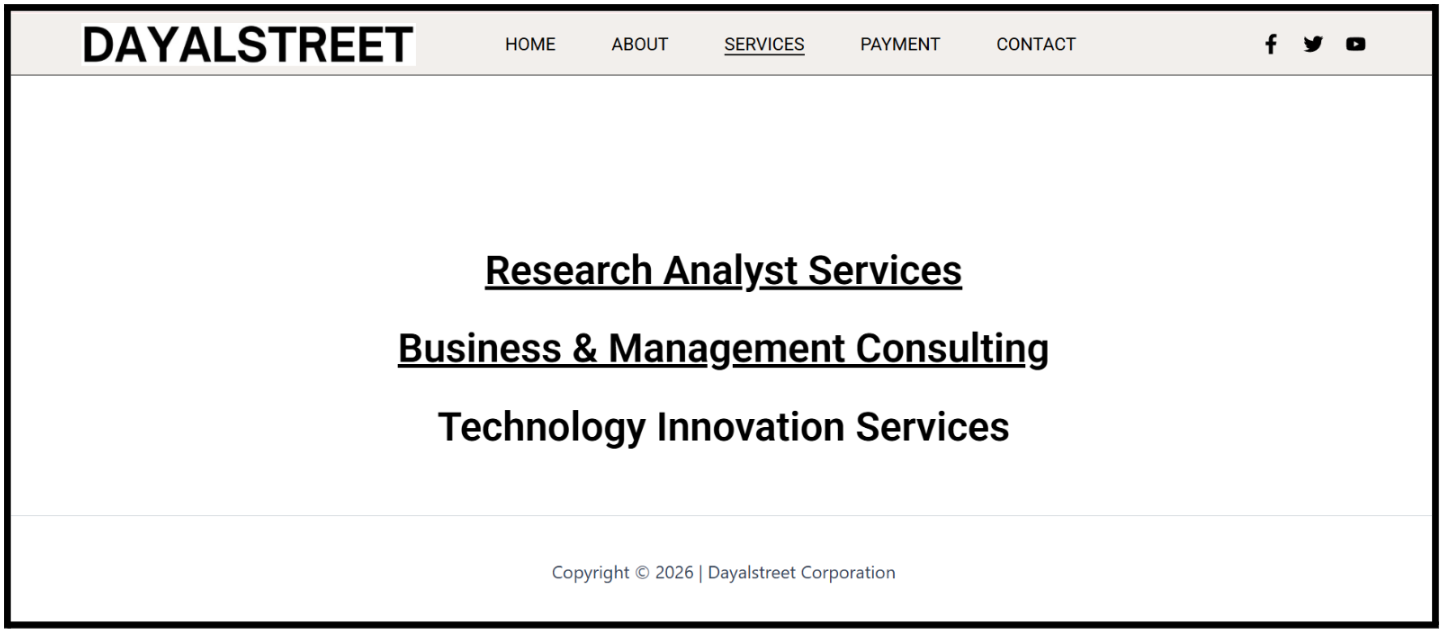
The services page offers three link tiles only, RA Services, Business Consulting, and Tech Innovation, with no description, no fee indication, and nothing else disclosed to a prospective client.
A separate page on the business and management consulting arm confirms unrelated, non securities lines including HNI tax and residency planning, mergers and acquisitions.
And what the site calls Luxury and Alternative Assets, all running under the same brand and the same promoter as the SEBI registered RA activity.
This sharpens the associates problem raised above. These businesses ought to be named, and the potential conflict disclosed, to anyone considering the RA service.
A site that skips its own front page disclosures tends to skip the same details further down the funnel, including on the page that actually takes your money.
Also Read: Trading With Karol review, why crypto losses can’t go through SEBI SCORES.
The Dayalstreet Payment Page Contradicts the Firm’s Own Terms
Money is where vague disclosure stops being a formatting issue and starts being a real risk. Dayalstreet’s payment setup raises two separate problems worth walking through in order.
Stripe, US Clients, and a Terms Page That Says the Opposite
The payment page shows two buttons only, Razorpay and Stripe, the latter described as being for “US and Indian clients.”
There is no visible pricing, no invoice or GST detail, and no mention of which legal entity actually receives the money.

Here is the direct contradiction.
The Terms and Conditions on the research site state that services are “not directed for access or use by anyone in any other country than India, especially the USA, Canada, or the European Union.”

Yet this same network’s payment page is built to accept US client payments through Stripe, and its contact page lists a New York phone number.
One part of the network says it does not serve the US. Another actively invites and processes US payments.
No Way to Know Whose Account Receives the Money
Cash payment is banned under RA rules, and Razorpay or UPI collection is fine on that front.
Stripe is different, since it implies foreign currency collection in US dollars, which raises FEMA and RBI cross border payment questions that the site never addresses anywhere.
More basic than that, a visitor cannot tell from this page whose bank account the money actually lands in, the individual RA or the private company.
That ambiguity is exactly what SEBI’s KYC and fee rules exist to prevent. A payment button with no named payee is not a small gap. It is the first thing a client should be able to see clearly.
Stock Baskets and the A.I. Research Service Cross a Line
The research subdomain, dayalstreetresearch.com, correctly carries the mandatory SEBI standard warning and SCORES and ODR links in its footer. That part checks out.
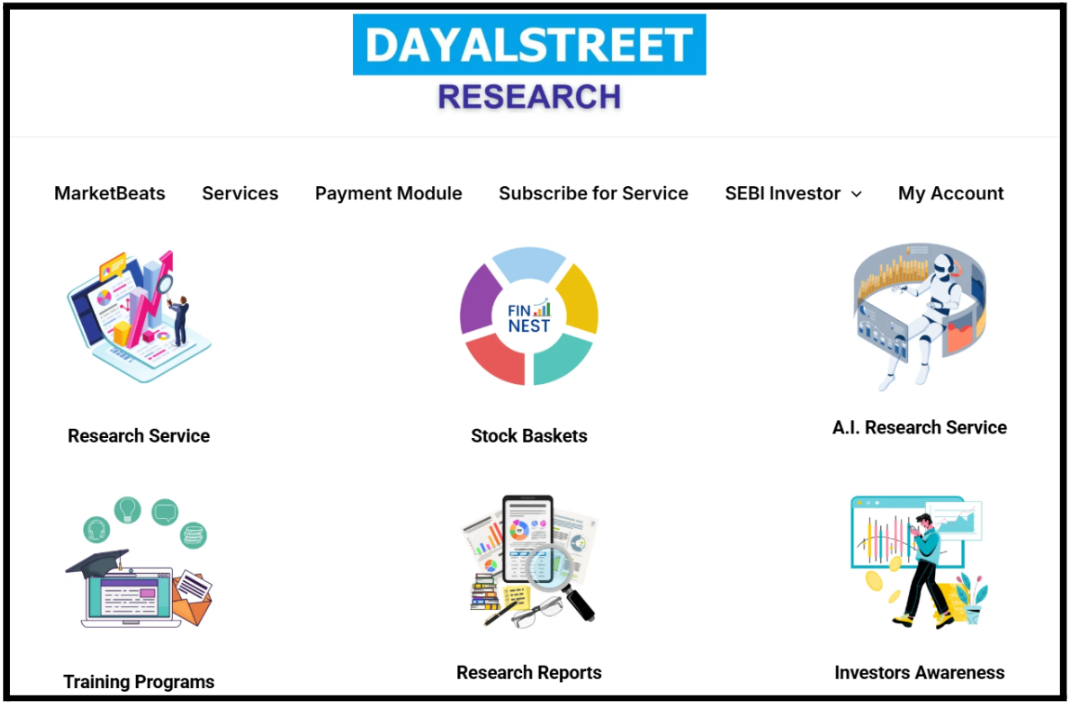
The two flagship products advertised on its homepage do not.
Where Research Ends and Portfolio Advice Begins
The homepage advertises “Stock Baskets” and an “A.I. Research Service” as distinct offerings.
A packaged, ready made portfolio style product like Stock Baskets edges into Investment Adviser territory, since RAs are barred from portfolio advisory or asset allocation services.
The site’s own Disclosure page even states the firm “shall not be involved in any advisory or portfolio allocation services,” which sits uneasily next to a product marketed by that name.
Calling something a Stock Basket needs very careful language to stay on the research side of that line, and as marketed here, it does not.
The exact boundary between what a research analyst can offer and where an investment adviser license kicks in is explained in full here: SEBI Guidelines for Research Analysts.
An A.I. Research Service With No A.I. Disclosure
SEBI’s 2025 Master Circular and the revised Investor Charter, dated June 2025, require RAs to disclose the extent of AI tool use in generating research or recommendations.
Nowhere on the site is that disclosure present, even though the “A.I. Research Service” is advertised by name.
The same homepage links out to Dayalstreet Academy, for paid courses, and Dayalstreet RTA, reinforcing the associate disclosure gap already raised above.
Between an ambiguous portfolio style product and a missing AI disclosure, the research site carries its own set of gaps. The pages meant to protect investor rights fare no better.
The Dayalstreet Financial Services Investor Charter Still Promises 30 Days
The Investor Charter page states investor grievances will be “resolved within 30 days.” SEBI revised the Investor Charter for RAs by circular dated 2 June 2025, cutting that window to 21 days.
This page was last edited in August 2024 and was never updated for the June 2025 change, meaning a currently published page carries an outdated timeline.

It gets more confusing from there. A separate Grievance Redressal Mechanism page, updated in January 2025, says 21 working days rather than 21 days.
SEBI’s own circular language says 21 days, not 21 working days, a subtle difference that could quietly stretch the real deadline by close to a week.
Two official pages on the same site disagree with each other on a statutory number, and neither one mentions the AI disclosure or right to exit language the revised charter requires.
Dayalstreet Complaints Data Disclosure Frozen Since May 2025
An outdated charter is one thing. A frozen complaint data page is a separate, ongoing problem, and it is worth looking at the numbers directly.
The table below shows the annual complaint disposal trend as published on the site.
| Year | Complaints Received | Resolved | Pending |
|---|---|---|---|
| 2022-23 | 0 | 0 | 0 |
| 2023-24 | 0 | 0 | 0 |
| 2024-25 | 10 | 10 | 0 |
All 10 complaints in FY 2024-25 came through SEBI SCORES directly, and the site states an average resolution time of 5 days.
Those specific numbers are not the problem. The problem is timing.
The month by month table on the same page only runs through May 2025, despite the page itself being marked as last modified in June 2025.
SEBI requires RAs to publish complaint data every month, by the 7th of the following month, without exception.
As of July 2026, that leaves roughly 14 months of mandatory monthly disclosures missing. This is not a one time gap. It is a standalone, ongoing violation of the disclosure circular that keeps growing every month it stays unfixed.
Dayalstreet Financial Services Pricing You Cannot See Before You Pay
A stale complaint page at least shows historical numbers. The pricing pages show nothing at all, and that gap is arguably the more immediate one for a prospective client.
The lack of transparency is itself the compliance problem, independent of what the hidden prices turn out to be.
The subscribe for service page, ekyc consent, is also an empty shell with no visible KYC or fee acknowledgment text.
A Refund Policy That Breaks SEBI’s Own Rule

A Privacy Clause That Reads Backwards
Refund terms that conflict with SEBI regulations raise serious compliance concerns. The privacy policy contains another significant issue.
The published clause states that the company may sell, rent, exchange, transfer, or share client data without consent.

The wording appears to contain a drafting mistake that completely changes its intended meaning. However, regulators or lawyers may still question such language in a publicly available legal document.
The policy also omits any reference to the Digital Personal Data Protection Act, 2023. It does not specify a data retention period.
It also fails to identify a grievance officer or data protection officer. Additionally, the policy treats mobile number registration as consent for promotional calls and SMS.
This approach may conflict with TRAI’s consent framework, especially for numbers registered under DND.
The Dayalstreet Terms Page Also Contradicts Itself
The Terms and Conditions read like a generic liability template rather than one drafted for an RA, and two problems stand out clearly.
- A blanket indemnity and total liability exclusion covers the firm’s own research errors, requiring the client to fully protect Abhishek Dayal, described as a research analyst, from any lawsuit over research quality. SEBI’s Code of Conduct requires an RA to act with due skill, care, and diligence, and to own responsibility for its own research. A clause that tries to contract out of that duty sits uneasily against it.
- The same page repeats the claim that the service is not directed at anyone outside India, especially the USA, Canada, or the European Union, directly contradicting the Stripe payments and New York contact number covered earlier.
The page also refers to “Abhishek Dayal Research Analyst firm” and to “owner, directors” in the plural, corporate language that sits oddly against an individual level registration.
It is the same identity gap raised at the start of this review, showing up again in the fine print.
What Should Be on The Dayalstreet Site and Is Not?
Pulled together, the individual findings above map onto a simple checklist of what SEBI expects an RA to publish, and whether Dayalstreet actually does.
| Required item | Present on site? |
|---|---|
| SEBI reg. number and validity visible near the home page | No, buried inside a menu on a different subdomain |
| Consistent registered office address | No, different pin codes appear across pages |
| MITC in full prescribed format | Partial, missing the fee ceiling clause and trade execution disclaimer |
| AI tool use disclosure | Missing entirely |
| Public fee schedule before onboarding | Hidden behind a login |
| Investor Charter with the 21 day timeline | No, still shows 30 days |
| Monthly complaint data, current within 7 days of month end | No, stale since May 2025 |
| Refund terms matching the no breakage fee rule | No, states a flat no refunds policy |
| Disclosure of associate entities | No, says no associates despite visible sister brands |
Every row on this list traces back to a specific page reviewed above. Knowing what is missing matters less than knowing what to do about it, which is where the next section picks up.
How to File a Complaint Against Dayalstreet Financial Services?
If any of the gaps above match your own experience with this firm, filing a complaint is a reasonable next step, and the process does not need to feel overwhelming.
- Gather your documentation first: the payment receipt, any written communication, and screenshots of the specific page or claim you are disputing.
- File on SEBI SCORES against registration number INH000015118, citing the exact gap, whether that is the registration mismatch, the refund policy, or the fee disclosure.
- If the response is unsatisfactory or the matter involves a financial dispute, escalate to SMART ODR for a structured, regulator backed resolution process.
- If SMART ODR does not resolve it, NSE or BSE arbitration is the final formal step available to you.
The full walkthrough for registering and submitting a SCORES complaint step by step is covered here: How to Lodge a Complaint in SCORES.
Filing the complaint correctly, citing the right regulation each time, matters more than filing it quickly.
If the registration mismatch, the hidden pricing, or the refund policy has left you unsure what to do next, you do not have to work through it alone.
Our team reviews your specific documents, tells you plainly whether you have a valid regulatory grievance, and drafts a SCORES complaint built around the exact clause or gap involved.
Conclusion
Dayalstreet’s SEBI certificate is real, but it belongs to one individual sitting under a five brand network that calls itself something else on every invoice.
Pricing stays hidden until after you commit, the refund policy contradicts a rule SEBI has made mandatory, and complaint data has sat frozen for over a year.
None of this proves bad intent on its own. It does mean a prospective client cannot verify the basics that SEBI requires to be public.
Before paying anyone connected to this network, get every fee and every entity name in writing, and verify the registration yourself using the number above.
Our team files your SEBI SCORES complaint, prepares the documentation, and represents you through SMART ODR and arbitration. Register for a free consultation today.
Frequently Asked Questions
No. A Registrar and Transfer Agent activity runs under its own separate SEBI registration category, distinct from the research analyst license INH000015118 held by Abhishek Dayal. Dayalstreet RTA operating under the same brand name does not mean it shares the RA certificate, and a client should ask for its own separate registration details before engaging with that arm of the network.
Yes, in principle. SEBI's rule on proportionate refunds for early termination is mandatory and applies regardless of what a firm's own website states. A published no refunds clause does not override a regulation, so a client exiting early can still raise the pro rata refund entitlement directly with the firm, and cite it again if the matter reaches SCORES.
Ask the firm directly, in writing, for its current fee schedule before you pay anything, and request written confirmation that the total charge across all its research plans stays within the ₹1,51,000 per family per year limit. If the firm will not put pricing in writing before payment, that reluctance is itself worth treating as a warning sign.





 Add us as a preferred source on Google »