

Quick Summary
SEBI passed a final order on May 27, 2026 against Amit Guruh Sachdeva, a registered Research Analyst holding registration INH100005190. SEBI reviewed call recordings from his surprise inspection and found his relationship managers repeatedly telling prospects they would earn 18-20% profit on their capital. SEBI held this was mis-selling and fraud under the PFUTP Regulations. His defence, that the RMs acted without his authorisation, was rejected. The outcome was a regulatory censure, not a ban. He had already paid a ₹2 lakh penalty in a separate order for the same inspection period.
SEBI showed up at the office of Amit Guruh Sachdeva without warning on March 14, 2024.
Two days of surprise inspection. And what they took away included his call recordings.
Those recordings are the whole case. SEBI’s order dated May 27, 2026, records that his relationship managers were telling people who filled a form on his website that they would make 18-20% profit on their capital.
Here is what the order found, and what it means if you were one of the people on those calls.
Amit Guruh Sachdeva SEBI Order: What the Regulator Found
The order establishes two violations. One is about what his team told clients. The other is about what happened during the inspection itself.
Start with the calls.
SEBI’s inspection covered April 1, 2022 to February 29, 2024. The regulator pulled call recordings and reviewed them on a sample basis.
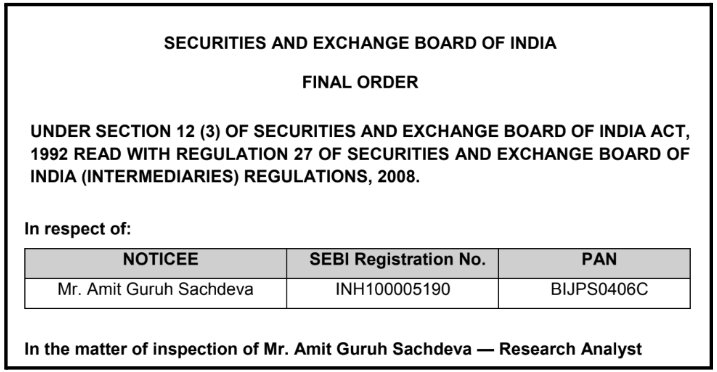
The modus operandi, in the order’s words, was straightforward. Someone gives their contact details on the website www.stockbenfits.com. A relationship manager calls them back.
Then this happens. The order records the phrase repeatedly used on those calls: “try karte hai 18-20% profit nikal ke de sake”.
One RM went further and told a client they would try to earn 20-25% profit.
The Enquiry Report also cites a transcript of a conversation with a prospective customer named Akshay, where the RM said “Aapki capital par 18 se 20% ka munafa nikal sake”.
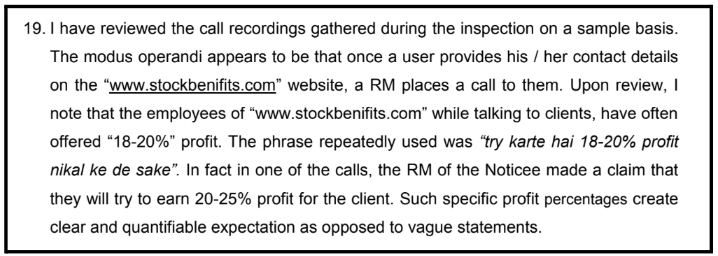
SEBI’s reasoning on why this matters is worth reading:
“Such specific profit percentages create clear and quantifiable expectations as opposed to vague statements.”
That is the line that decides the case. A vague claim about good returns is marketing. A specific number is a promise. And promising a number on a market investment is not something any registered analyst is allowed to do.
Sachdeva never disputed the recordings were real.
But before going further, as SEBI investigated this case, did Amit Guruh Sachdeva even have a license?
Well, yes, he does hold SEBI registration INH100005190 as a Research Analyst. The registration is real, and it was live throughout the period SEBI inspected.
Read detailed information on Amit Guruh Sachdeva SEBI registered and know what he can actually do legally.
Being registered did not save him from the finding. But it does mean he sits inside SEBI’s grievance system, which matters if you have a complaint. More on that below.
If you are checking any adviser before paying, the registration question is the first one. Our page on the unregistered advisory scam covers what happens when the answer is no.
Stockbenefits SEBI Case: Why “My Staff Did It” Did Not Work
Sachdeva’s defence was that his relationship managers went rogue.
He argued that the promises had been made by certain Relationship Managers (RMs) without his knowledge or authorisation, claiming they had acted independently in an overzealous pursuit of client acquisition.
According to him, making such assurances was strictly prohibited under the firm’s internal training manuals and compliance policies.
Three RMs were identified as being involved in these practices, and their services were subsequently terminated. He further claimed that they had adopted these practices from their previous employers.
SEBI rejected all of it. And the reasoning is the most useful part of this order for any investor.
The 3 Legal Reasons SEBI Rejected His Defense
First, the definition of “research analyst” in the RA Regulations includes any associated person who reports to the analyst. The RMs were covered by the definition. They were, legally speaking, part of the RA.
Second, Clause 7 of the Code of Conduct puts primary responsibility on the RA for maintaining standards of conduct. Not on the staff.
Third, SEBI applied Section 237 of the Indian Contract Act, 1872. The principal-agent rule. If a principal’s conduct leads third parties to believe an agent had authority, the principal is bound by what the agent did.
The order puts it plainly:
“By allowing the RM to handle client communications without any evidence of training rendered, the Noticee ‘held out’ that the RM had the authority to promise returns.”
And then the finding that ends the argument:
“To a third party, there was no distinction between the RMs and the Noticee.”
SEBI also noted he produced neither the training manuals he referred to, nor any evidence of action taken against the RMs he said he had removed. He claimed both and proved neither.
He acknowledged owning the website. The client service agreement on stockbenifits.com carried his name and his SEBI registration number.
So the case was closed. If someone calls you from a registered analyst’s website and promises you 18-20%, that promise belongs to the analyst.
The Second Finding: What Happened During the Inspection
SEBI alleged three things about the inspection itself. One was dropped. Two stuck.
Dropped: the CCTV allegation. The inspection team alleged he had installed high-capacity audio and video CCTV to record SEBI officers’ conversations.
He produced purchase receipts dated October 30, 2023, months before the inspection, and said the cameras were for monitoring his own RMs. SEBI accepted this and found no recordings on record to support the allegation.
Established: the delay. On the last day of inspection, he kept the SEBI team waiting two hours.
His explanation was extraordinary. He said he was under a “digital arrest” for 90 minutes by people impersonating TRAI and Andheri Police, being interrogated about money laundering.
SEBI did not buy it. The order notes he never filed an FIR or complaint about the alleged digital arrest. The WhatsApp screenshot he produced carried no date. The letter he produced from the CBI was undated.
Established: the deleted emails. Data from the account [email protected] was deleted.
He said it was a technical glitch. SEBI noted he could not explain what the glitch was, produced no evidence for it, and called the contention an afterthought.
The order’s finding is that by deleting data and delaying the meeting, he failed to extend the co-operation an inspection requires.
Apart from these, there are complaints on different portals against this RA. Check our detailed blog to get the whole view: Amit Guruh Sachdeva Complaints
Penalty Against Amit Guruh Sachdeva
Here is where you need the honest version.
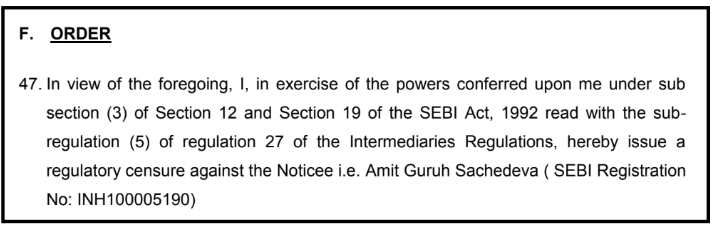
SEBI issued a regulatory censure. Nothing more.
The Designated Authority had recommended two things: a censure, plus a two-month prohibition on taking new clients. SEBI accepted the first and rejected the second.
The reasons are set out in the order:
- He had already paid a ₹2 lakh penalty under an Adjudication Order dated August 28, 2025, for the same set of violations.
- The DA had noted mitigating factors: violations were non-repetitive, he claimed action against the errant employees, and there were no documented Amit Guruh Sachdeva complaints in the context of these allegations.
- He argued a client ban would affect his means of subsistence, since he had already applied to surrender his IA registration.
He also argued double jeopardy. SEBI dealt with that directly:
“Enquiry and Adjudication proceedings are separate and independent of each other. Even if a penalty is imposed, directions under section (3) of section 12 of the SEBI Act can also be passed.”
And then, notably:
“The violations established in the present case viz. assurance of return to the clients and non-cooperation with the inspection team cannot be considered as trivial, and there is a need for non-monetary enforcement action under the law.”
So SEBI said the violations were not trivial. Then issued a censure.
A censure is a formal warning on the record. It does not stop him operating. It does not stop him taking new clients. His registration remains live, and he can continue as a Research Analyst.
Stockbenefits Complaints: What to Do If Your Money Is Stuck
Be clear about what this order gives you, because it is less than the headline suggests.
What the order does not do. There is no refund direction. No disgorgement. No compensation mechanism. SEBI did not order him to return a rupee to anyone.
The ₹2 lakh penalty from the August 2025 adjudication order went to SEBI, not to clients.
What the order does do. It puts a finding on the public record that SEBI examined his call recordings and concluded his team was mis-selling through assured return promises. That finding is now a documented fact you can point to.
And this is the part that matters: he is registered. Registration means routes exist.
Your actual options:
SEBI SCORES. He is a registered RA, so he is inside the SCORES system and obligated to respond to complaints filed there. If you paid for his research and were sold on a promise of 18-20%, that is a complaint SCORES accepts.
SMART ODR. The online dispute resolution portal covers disputes with registered intermediaries. This is the route with actual teeth, because it can end in an award.
Documents to gather now:
- Your payment record to him or to stockbenifits.com
- The client service agreement, if you signed one
- Any call recording, WhatsApp message or email where a return figure was mentioned
- Screenshots of what the website promised when you signed up
- Notes on what the RM told you on the phone, with dates if you have them
An honest view of the odds. SEBI’s own order records that there were no investor complaints against him in the context of these allegations. That cuts both ways.
It helped him get a lighter penalty. But it also means the field is open. There is no queue of existing claimants and no established pattern of complaints for a case to build on.
You would be filing your own facts. The SEBI finding on his call recordings supports you, since the regulator has already established the practice existed from April 2022 to February 2024.
If you paid in that window and were promised a return figure, the finding is contemporaneous with your experience.
Were you promised a return figure before you paid for research?
Our team maps your call records and payment trail against SEBI’s findings, then files through SCORES or SMART ODR depending on which route fits your amount and timeline. Register with us to get assistance.
Timeline of SEBI Action Against Amit Guruh Sachdeva
Now, as you know what the violations were and how you too can complain about any of them, you must be curious about the timeline of this entire documented case.
The SEBI action against Amit Guruh Sachdeva followed a multi-year regulatory process, beginning with an inspection of his research analyst activities and ending with a censure order in May 2026.
| Date | Event |
| April 1, 2022 | Start of the period SEBI inspected. |
| October 30, 2023 | CCTV cameras purchased. Later cleared as unrelated to the inspection. |
| March 14 and 15, 2024 | Surprise onsite inspection. The two-hour delay and the deleted emails happen here. |
| February 29, 2024 | End of the inspection period. |
| June 27, 2024 | SEBI communicates its findings to him. He replies two days later. |
| October 31, 2024 | Designated Authority issues the pre-enquiry show-cause notice. |
| May 26, 2025 | Personal hearing before the DA. |
| August 28, 2025 | Adjudication Order imposes ₹2 lakh penalty. He pays it. |
| August 29, 2025 | DA submits the Enquiry Report recommending censure plus a two-month client ban. |
| January 1, 2026 | Post-enquiry show-cause notice issued. |
| May 27, 2026 | Final order. Censure issued. The client ban is rejected. |
Just over two years from the inspection to the order. The 18-20% calls were happening for at least the two years before that.
Conclusion
SEBI’s May 27, 2026 order establishes that Amit Guruh Sachdeva’s relationship managers were promising clients 18-20% profit, that this was mis-selling and fraud under the PFUTP Regulations, and that he was liable for it regardless of whether he personally authorised it.
The principal-agent point is the one worth remembering. When staff at a registered analyst’s firm promise you a return, the analyst owns that promise. Saying the employee acted alone is not a defence, and SEBI has now said so on the record.
What the order does not give you is money. A censure is a regulatory warning that makes you ask yourself again, “Can you trust Amit Guruh Sachdeva?”, not a remedy.
But the finding is public, it is dated, and it covers April 2022 to February 2024. If you paid in that window and heard a number on the phone, SEBI has already established that the practice existed.
Report. Recover. Stay Fraud Free.
Frequently Asked Questions
No. SEBI issued a regulatory censure, which is a formal warning on record. His registration INH100005190 remains active. The Designated Authority had recommended a two month ban on taking new clients, but SEBI declined to impose it.
SEBI found his relationship managers repeatedly offered 18-20% profit to prospective clients who submitted details on stockbenifits.com. One call promised 20-25%. SEBI held these specific percentages, created quantifiable expectations and amounted to mis-selling.
Yes. Registered analysts fall under SEBI SCORES and SMART ODR. Guaranteed return promises breach the Code of Conduct and PFUTP Regulations. Keep your payment proof and any recording or message where a figure was mentioned.
SEBI had already imposed a ₹2 lakh penalty for the same violations through a separate August 2025 adjudication order, which he paid. The order also cites mitigating factors including non-repetitive violations and no investor complaints in the context of these allegations.




 Add us as a preferred source on Google »

