

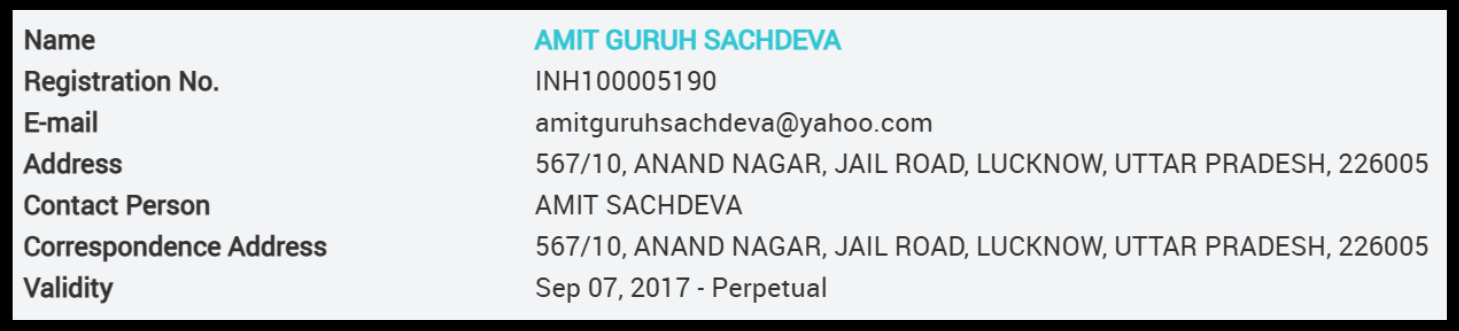
Amit Guruh Sachdeva User Complaints
The SEBI order establishes the regulatory record.
What user reviews across platforms like Trustpilot, JustDial, and consumer complaint forums add is the ground-level picture, what clients actually experienced when they paid for his services.
The pattern across independent reviews is strikingly consistent: promising free calls before payment, loss-making recommendations after, pressure to add more money, and eventually silence.
1. Lack of Research-Backed Trading Recommendations
Vipin described AGS as a fraud advisory company with inefficient staff who provide calls without any research basis.
When trades went wrong and clients lost money, the response from the team was that it was simply “bad luck”, not a failure of research or judgment.
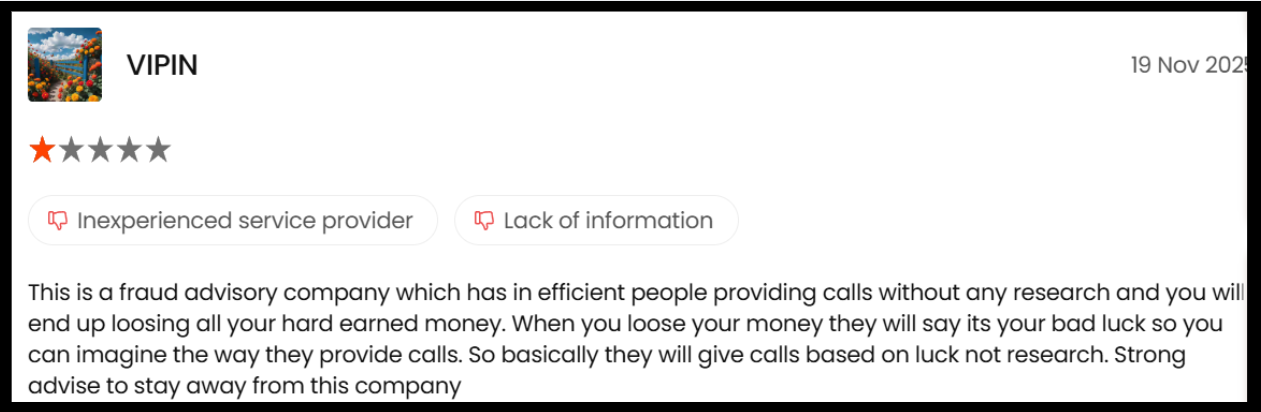
He noted that the calls appeared to be based on guesswork rather than any systematic analysis, and strongly advised other traders to stay away from the company entirely.
This complaint aligns directly with what SEBI found during inspection: no research rationale existed behind any of the calls being sold to clients.
2. Pressure Selling and Profit-Linked Fee Practices
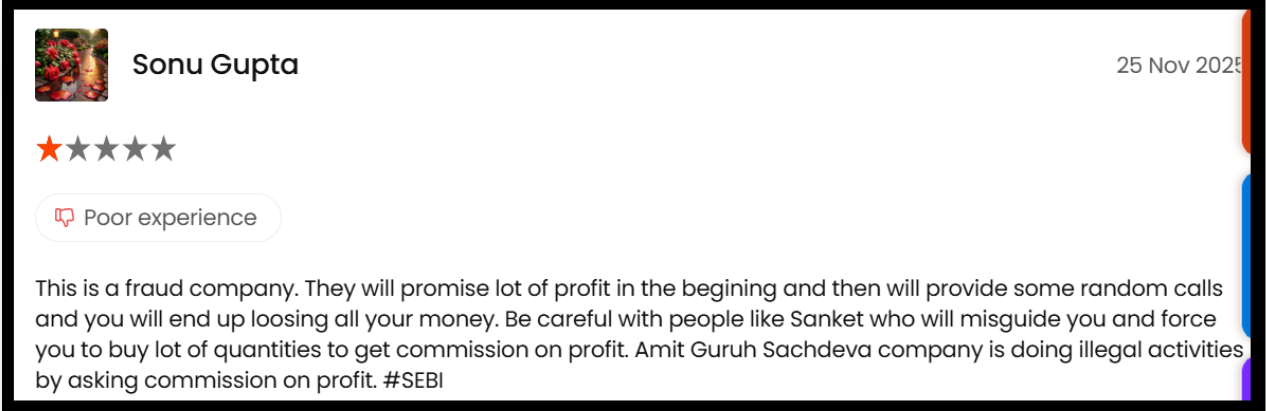
Sonu Gupta described a clear pattern: the firm promises high profits at the start to attract the client, and then begins providing random calls that lead to losses.
3. Failure to Provide Risk Management and Stop Loss Guidance
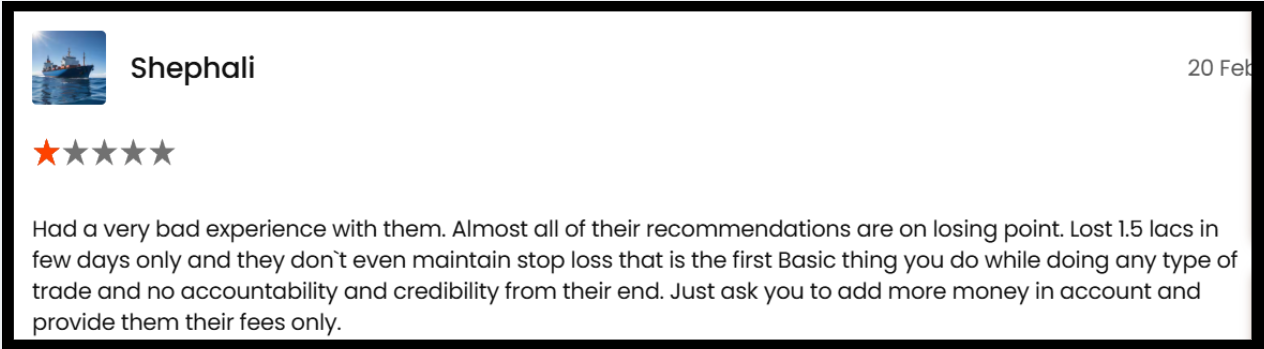
Shephali reported a very bad experience, noting that almost all of the recommendations she received resulted in losses.
She specifically lost ₹1.5 lakh in just a few days following their calls.
4. Service Discontinuation and Non-Responsive Client Support
Mukhtiyarul Hasan’s experience is among the most detailed on record.
He registered for a premium service on April 11, for which he was charged ₹88,500, despite the website displaying a price of ₹72,500 for the same package.
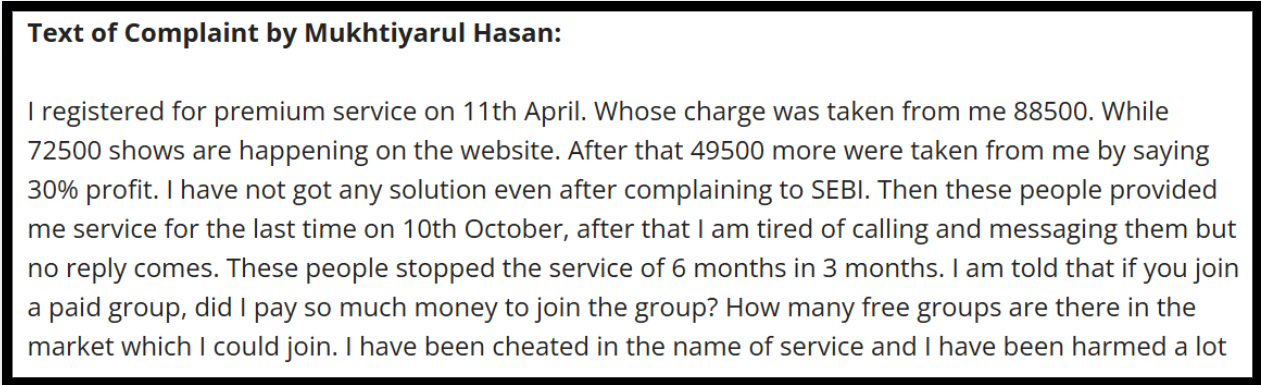
Shortly after, he was asked to pay an additional ₹49,500 with the promise of a 30% profit. He paid. Service was promised for six months, but stopped after just three months. His calls and messages went unanswered.
He filed a complaint with SEBI, but received no resolution even after that. In his own words: “I have been cheated in the name of service, and I have been harmed a lot.”
Together, these accounts describe the same cycle, independently and from different time periods: an attractive entry, promises that don’t hold, losses that go unaddressed, and then silence or further upselling.
Also Read: Fiscal Solution and Research reviews, a two-day window, and a five-figure loss.
SEBI Action Against Amit Guruh Sachdeva
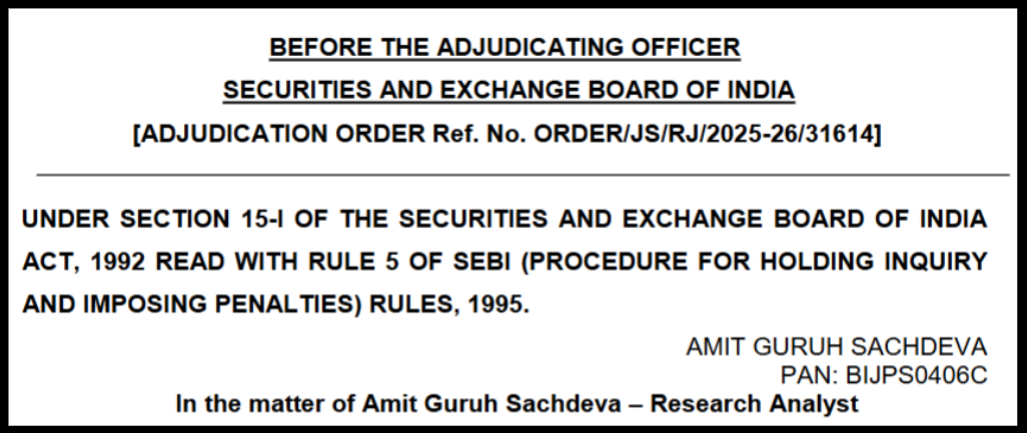
SEBI conducted an on-site inspection of Amit Guruh Sachdeva’s registered office in Lucknow on March 14–15, 2024.
The inspection covered his Research Analyst operations for nearly two years, from April 2022 to February 2024.
What the regulator found was not a paperwork technicality. It was a pattern of non-compliance that directly affected every client who paid for his services during that period.
The Adjudication Order, bearing reference number ORDER/JS/RJ/2025-26/31614, was passed by Adjudicating Officer Jai Sebastian on August 28, 2025.
Here is a breakdown of every violation SEBI documented.
Violation 1: No Research Records Maintained
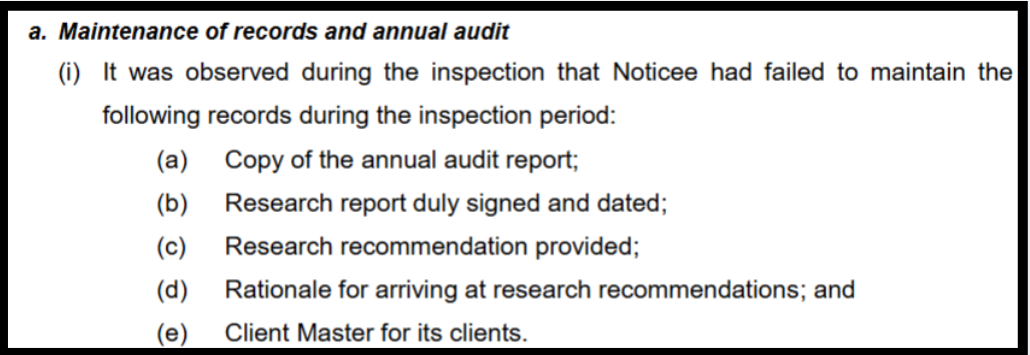
The only document he eventually offered was a single email screenshot dated June 2024, weeks after the inspection had already concluded.
SEBI noted that despite multiple notices and a formal hearing, he failed to furnish any evidence of compliance.
This is significant for every paying client. Without records, there is no way to verify what was recommended to you, why, or on what basis, and no paper trail if you want to challenge a bad call or file a formal complaint.
Violation 2: Claiming No Website While Running One Actively
SEBI’s December 2021 circular requires Research Analysts to prominently display the Investor Charter on their website, or, in the absence of a website, to send it directly to all clients.
Sachdeva claimed he had no website. On the basis of that claim, he argued he was not obligated to display the Investor Charter or the mandatory disclosures.
However, SEBI’s inspection team found that his website, stockbenifits.com, was actively displaying his RA registration number, user agreement, payment details, and promotional content for research advisory services.
In other words, he was using the website to attract and onboard paying clients while simultaneously claiming it didn’t exist to avoid disclosure obligations.
SEBI’s order concluded that this was a deliberate attempt to acquire clients through the website while avoiding the very disclosures those clients had a right to receive.
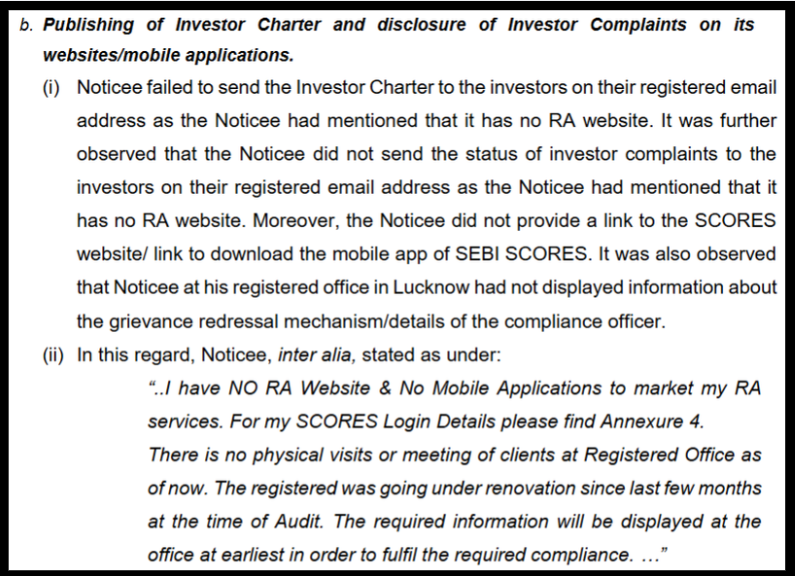
Violation 3: Investor Charter Not Shared, Grievance Access Blocked
Building on the website misrepresentation, SEBI also found that Sachdeva had never shared the Investor Charter with his clients through any channel, neither on the website nor by email, as the circular alternatively permits.
More critically, he did not provide clients with access to the SEBI SCORES grievance platform.
SEBI regulations require Research Analysts to share a link to SCORES so clients know exactly how and where to complain if they face an issue.
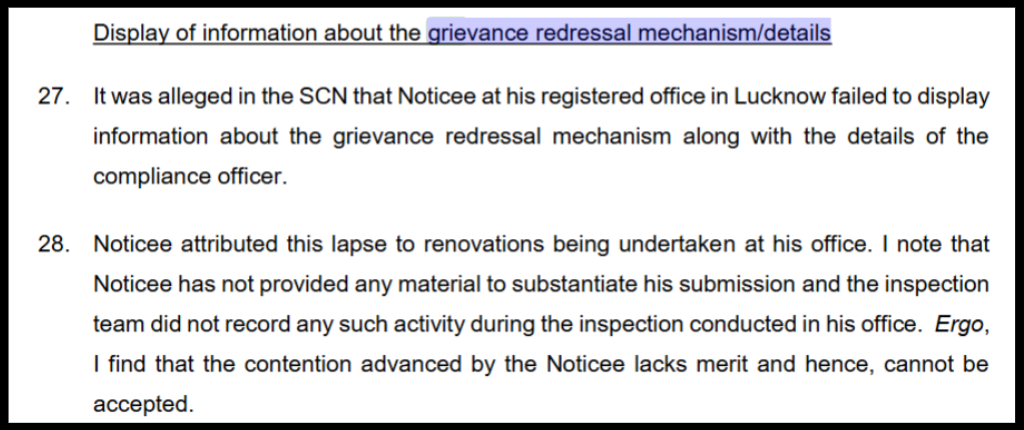
At his registered office in Lucknow, he also failed to display the required details about his grievance redressal mechanism and compliance officer, information that every registered RA must make visible at their place of business.
When asked about this during inspection, he cited ongoing renovations as the reason. SEBI found no evidence of any such renovation activity.
Together, these violations left clients exposed.
They paid for a SEBI-registered service without understanding their rights. Moreover, they received no access to SEBI’s grievance mechanism. In addition, the firm failed to maintain verifiable records of the advice provided to clients.
SEBI Penalty on Amit Guruh Sachdeva
After reviewing the full evidence from the inspection, SEBI’s Adjudicating Officer imposed a monetary penalty of ₹2,00,000 (Rupees Two Lakh) on Amit Guruh Sachdeva under Section 15EB of the SEBI Act.
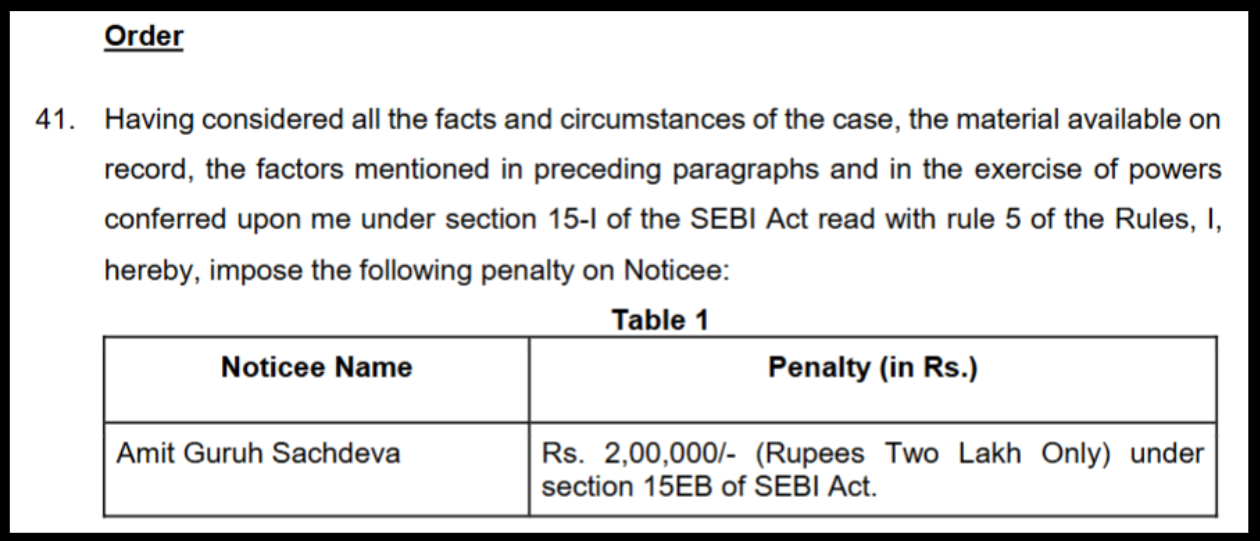
The penalty covered violations of:
- Regulations 25(1) and 25(2) of the SEBI (Research Analyst) Regulations, for failure to maintain research records.
- Clauses 1, 2, 6, 7, and 8 of the RA Code of Conduct, for conduct unbecoming of a registered intermediary.
- Clauses 2 and 4 of the SEBI Circular dated December 13, 2021, for non-display of the Investor Charter and non-provision of SCORES access.
The order is public and on record on SEBI’s official enforcement portal, dated August 28, 2025.
How to Register a Complaint Against a Research Analyst?
Since Amit Guruh Sachdeva is a SEBI-registered Research Analyst, filing a complaint against him follows a clear, structured escalation path.
Move through each step in order, with complete documentation at every stage:
Step 1: Compile and Organise Your Evidence
Before filing anything anywhere, gather every piece of relevant documentation.
This includes payment receipts, bank transfer records, WhatsApp or Telegram messages with trade calls, email threads with support, screenshots of promises made, and any call recordings if available.
Organise everything in date order so the timeline is immediately clear to anyone reviewing it. Without solid documentation, even a genuine case becomes difficult to pursue.
Step 2: Submit a Formal Written Complaint to AGS Directly
First, submit your complaint through Amit Guruh Sachdeva’s official support channels.
Clearly mention your subscription details, promised services, experience, and the financial amount involved. Also, specify the resolution you expect.
Next, wait 7 to 10 working days for a reply. However, if you receive no response or an unsatisfactory one, keep a record of it. This documentation can strengthen your case during further escalation.
Step 3: File a Complaint in SCORES
If you do not receive a satisfactory resolution, file a formal complaint on SEBI’s centralised investor grievance platform.
Since Amit Guruh Sachdeva is a SEBI-registered Research Analyst, your complaint is fully eligible to be filed on SCORES.
Register using your PAN, search for Amit Guruh Sachdeva or AGS Research Advisory, describe your issue in specific detail, and attach all supporting documents.
Step 4: Lodge a Complaint with SMART ODR
If SCORES does not resolve your issue properly, escalate the matter to SEBI’s Online Dispute Resolution platform. Here, a neutral conciliator helps both sides attempt a structured settlement.
Moreover, the process is quicker and less formal than court proceedings.
SEBI also requires all registered intermediaries to participate. If conciliation fails, the dispute automatically proceeds to formal arbitration.
Step 5: File Share Market Arbitration
If all prior mechanisms fail, formal arbitration under NSE or BSE rules is available as the final recourse.
At this stage, strong, detailed, and well-organised documentation is the single most important factor in how your case is received.
Every submission you make, every acknowledgement you receive, and every response from any party should be saved and backed up from the very beginning.
Need Help?
If you are unsure how to begin or the process feels difficult to navigate on your own, you do not have to handle it alone.
Our team assists investors in organising evidence, preparing structured complaint filings, navigating SCORES and SMART ODR, and pursuing arbitration when required.
Register with us, and we will guide you through every step.





 Add us as a preferred source on Google »

