

If you follow the world of SEBI-registered research analysts in India, you may have come across the name Options King Research Analyst.
Recently, SEBI passed an adjudication order against this firm.
And as a retail investor, it is worth understanding what happened, why it matters, and what lessons you can take away.
Let’s break it all down, simply and honestly.
What Is Options King?
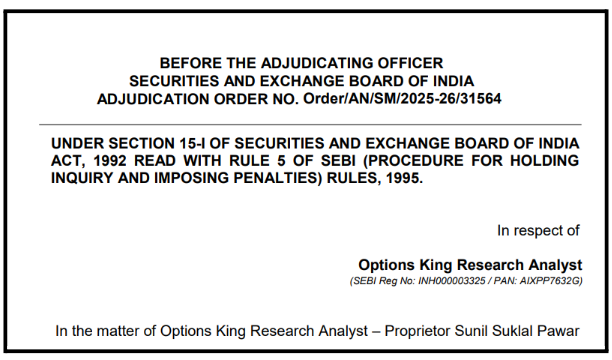
Options King SEBI-registered research analyst firm (SEBI Registration No. INH000003325), operated as a proprietorship by Mr. Sunil Pawar.
The firm is based in India and provides investment research and recommendations to clients primarily around options and equity markets.
The firm operated as an SEBI-registered intermediary.
The order does not record fraud findings or quantified investor harm.
This context matters when you read the order.
Why Did SEBI Investigate Options King?
The short answer: Options King’s proprietor was operating as a SEBI-registered research analyst for over five years without holding a valid NISM certification, which is a mandatory qualification under SEBI regulations.
SEBI’s Market Intermediaries Regulation and Supervision Department (MIRSD) conducted a thematic inspection of Options King Research Analyst.
The inspection covered the period from April 1, 2023 to September 30, 2024.
Thematic inspections are focused checks SEBI conducts across a specific type of intermediary to verify compliance with regulations.
They are not triggered by a complaint necessarily; they are part of SEBI’s routine supervisory process.
The findings of this inspection were shared with the firm on December 16, 2024, and Mr. Sunil Pawar submitted his response on December 20, 2024.
After reviewing the reply, SEBI initiated formal adjudication proceedings.
Options King SEBI Order
Mr. Sunil Pawar, the proprietor of Options King Research Analyst, did not hold a valid NISM (National Institute of Securities Markets) Research Analyst certification from June 7, 2019 to December 30, 2024, a period of over five and a half years.
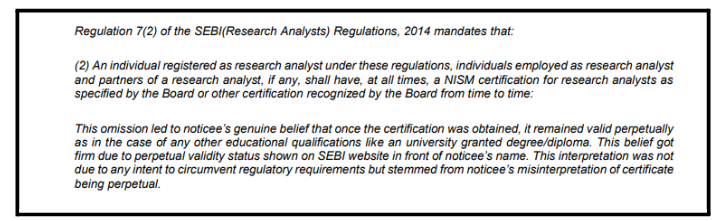
This was a violation of Regulation 7(2) of the SEBI (Research Analysts) Regulations, 2014, which mandates that every individual registered as a research analyst must hold a valid NISM certification at all times.
During this entire period, Mr. Sunil Pawar continued to operate as a SEBI-registered research analyst and provide recommendations to his clients.
Major Reasons SEBI Took Action Against Options King
SEBI reportedly observed multiple regulatory and compliance-related concerns involving Options King, including issues linked to advisory activities, promotional practices, and investor-related conduct.
The action highlighted how aggressive return-related claims and alleged non-compliance with regulatory requirements can attract serious scrutiny from market regulators.
1. Lapsed NISM Certification
This is the heart of the matter. The NISM Research Analyst certification is not a one-time requirement.
It has a validity period, and registered research analysts are required to renew it before it expires.
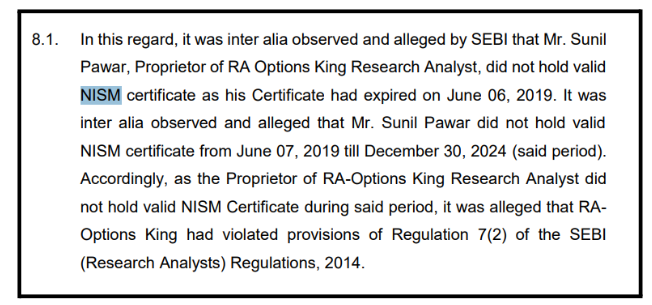
Mr Sunil Pawar’s certification expired on June 6, 2019. He did not renew it until December 30, 2024, that is, more than five years later.
During this entire period, he continued to serve as a SEBI-registered research analyst and was providing investment recommendations to clients without possessing the mandatory qualification.
2. The “Perpetual Registration” Misunderstanding
Mr Sunil Pawar’s explanation was that he misunderstood the implications of his “perpetual” registration status shown on the SEBI website.
He believed that since his SEBI registration was marked as “perpetual” (as opposed to having an expiry date), his NISM certification was also effectively perpetual.
He also stated that when he renewed his registration in August 2021, a SEBI official verbally told him that as a perpetual registrant, he did not need to submit additional documents, including the NISM certificate.
SEBI rejected this argument. The Adjudicating Officer noted clearly that:
- NISM certificates explicitly state a “Valid Till” date.
- SEBI registration and NISM certification are two distinct requirements.
- Regulation 7(2) is unambiguous: fresh certification must be obtained before the existing one expires.
- A registered intermediary is responsible for staying aware of the regulations that apply to them.
The AO’s conclusion: the misunderstanding, whether genuine or not, does not excuse non-compliance with a clear regulatory requirement.
3. COVID-19 Argument Was Not Accepted
Sunil Pawar told SEBI that the COVID-19 pandemic caused confusion around certification renewals and that NISM had extended certification validity by three months due to the lockdown.
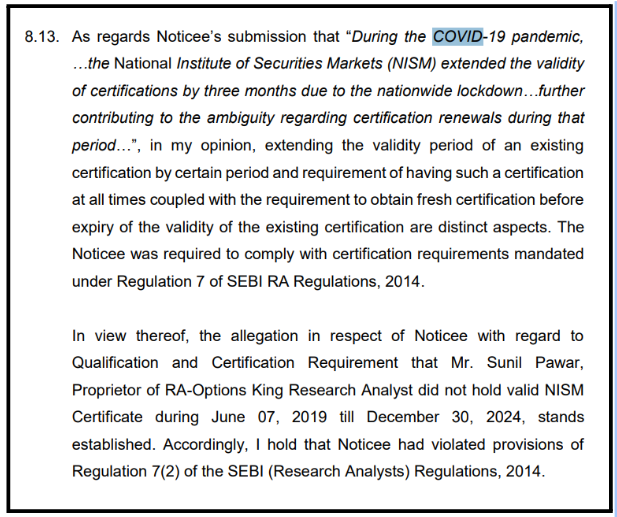
However, SEBI noted that extending an existing certification’s validity by a few months during a pandemic is entirely different from the requirement to obtain a fresh certification when the existing one expires.
The COVID extension, even if applicable, would have only pushed the deadline slightly, not excused a five-year lapse.
4. The 2025 NISM Notification Argument Was Also Rejected
Options King also argued that since SEBI only formally introduced the “NISM-Series-XV-B: Research Analyst Certification (Renewal) Examination” via a notification dated February 14, 2025, the requirement to renew wasn’t clearly communicated before that.
SEBI disagreed.
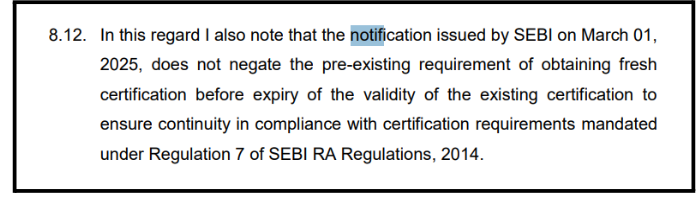
The AO confirmed that the obligation to hold a valid NISM certificate at all times and to renew it before expiry was already embedded in Regulation 7(2) since 2014.
The 2025 notification simply introduced a dedicated renewal exam; it did not create a new obligation that didn’t exist before.
Penalty on Options King
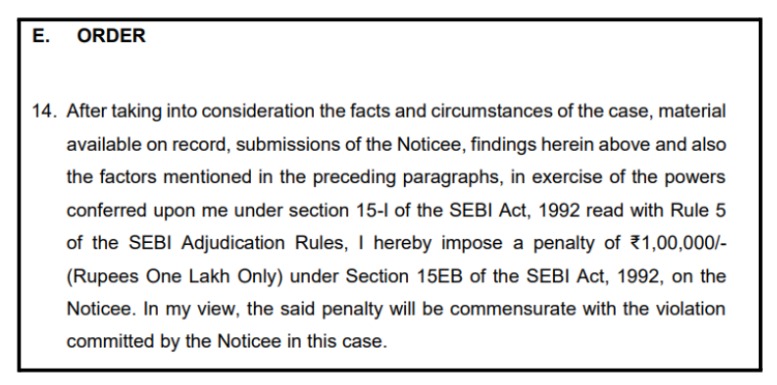
After considering all arguments, the Adjudicating Officer imposed a monetary penalty of ₹1,00,000 (Rupees One Lakh Only) on Options King Research Analyst under Section 15EB of the SEBI Act, 1992.
Important context on the penalty amount:
Section 15EB permits substantially higher penalties, subject to statutory limits.
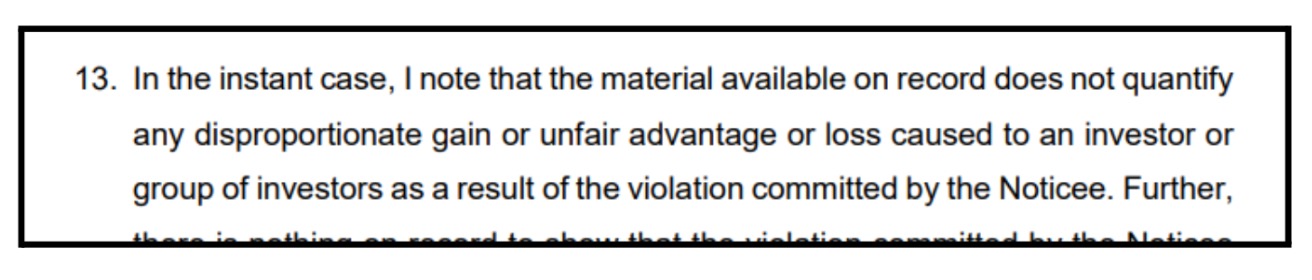
The order notes factors such as lack of quantified gain/loss, which may have influenced penalty assessment:
- No disproportionate gain or unfair advantage was found or quantified.
- No investor losses were established as a result of the violation.
- The violation was not found to be repetitive in nature.
- Mr. Sunil Pawar immediately renewed the NISM certification once the lapse was pointed out.
- There were minimal investor grievances on record.
After reviewing SEBI’s findings, many investors naturally ask: can you trust Options King?
The answer depends on whether you are comfortable relying on a firm that continued providing advisory services during a prolonged certification lapse later identified by the regulator.
What Can Investors Learn From This?
This case offers some important lessons for you as a retail investor.
-
Check your advisor’s credentials
When you subscribe to a research analyst service or take investment advice from any SEBI-registered entity, always verify their registration and certification status.
You can do this directly on SEBI’s website under the intermediary search section.
-
Regulatory compliance isn’t the same as quality of advice
In this case, there is no allegation that Options King gave bad advice or harmed investors.
The violation was purely a compliance one.
This is a reminder that regulatory compliance and investment quality are different things. An advisor can be technically non-compliant but still give good advice, and vice versa.
But non-compliance still matters. Because certifications like NISM exist for a reason. They ensure minimum standards of knowledge.
When an advisor operates without one, there is no formal assurance that they meet these standards, even if they practically do.
As an investor, you have the right to deal only with fully compliant intermediaries.
-
SEBI’s enforcement machinery works
The fact that SEBI caught this through a thematic inspection without any investor complaint shows that the regulator is actively monitoring registered intermediaries.
That is reassuring. SEBI is not just reactive; it proactively checks on market intermediaries.
-
Penalties act as deterrents
Even though ₹1 lakh may seem modest given the length of the violation, the adjudication process itself is a serious matter.
The order is public, the penalty is real, and it sends a signal to all research analysts: maintain your certifications or face consequences.
How To File a Complaint Against a Research Analyst?
If you are a subscriber or client of a research analyst and you discover or suspect a regulatory violation, here is what you can do:
1. Start by Gathering Evidence
This should include payment receipts, advisory recommendations, WhatsApp chats, email correspondence, call recordings, account statements, and any agreements you may have signed.
2. Contact the Firm Directly in Writing
Send a formal complaint through email, retain a copy for your records, and specify a reasonable deadline for their response.
If they fail to address the matter, you may then consider escalating further.
3. File a Complaint in SCORES
SEBI’s centralised online investor grievance portal.
Once submitted, your complaint becomes part of an official record, the concerned firm is expected to respond, and the matter comes under SEBI’s regulatory review.
4. Lodge a Complaint in SMART ODR
If earlier resolution attempts do not work, investors can proceed with formal arbitration under SEBI’s dispute resolution framework, where an independent panel reviews the evidence and delivers a binding decision.
Need Help?
Professional assistance can be highly valuable when dealing with SEBI complaint procedures, which can often be complex and time-consuming.
We could provide you with the right guidance that can help you:
- Identify possible regulatory breaches.
- Organise your evidence effectively.
- Prepare a strong and factual complaint.
- Manage any follow-up submissions or responses during the process.
Seeking experienced support at an early stage can save time and significantly improve your chances of a favourable resolution.
Register with us today.
Conclusion
The SEBI adjudication order against Options King Research Analyst is not a case of a rogue operator cheating investors.
It is a case of a registered intermediary failing to comply with a basic but important regulatory requirement for over five years.
The firm’s proprietor, Mr. Sunil Pawar, believed he had perpetual certification status.
SEBI considered but rejected the explanation. The regulation was clear; the obligation existed; and it was not followed.
SEBI imposed a penalty of ₹1 lakh acknowledging the absence of investor harm, the lack of fraudulent intent, and the prompt corrective action taken once the violation was flagged.
For you as an investor, the takeaway is simple: always verify credentials before trusting any advisor with your money.
A fully compliant advisor is not automatically a great one, but an advisor who isn’t compliant is one you don’t need to take chances on.





 Add us as a preferred source on Google »

