

Quick Summary
Delight Financial Services genuinely holds two active SEBI registrations, both tracing back to the same proprietor and Indore address, with no mismatch between them. Where the picture gets more complicated is its own marketing, an unverified 88% accuracy claim and a 97% renewal rate figure, neither backed by published data, both restricted under SEBI’s Advertisement Code. Registration confirms the firm is real. It doesn’t confirm every claim it makes is accurate.
Two websites. Two registration numbers. One phone number appearing on both.
If you’re trying to figure out whether that’s a genuine setup or something worth being cautious about, you’re asking exactly the right question.
Delight Financial Services fake or real isn’t a simple yes-or-no answer, because both things turn out to be true in different ways. The registrations are real.
What the site claims about its own performance isn’t something SEBI’s records back up.
This page separates the two: what’s genuinely verified and what’s worth checking yourself before you decide anything.
How Real Is Delight Financial Services?
Three things make this firm genuine at the registration level.
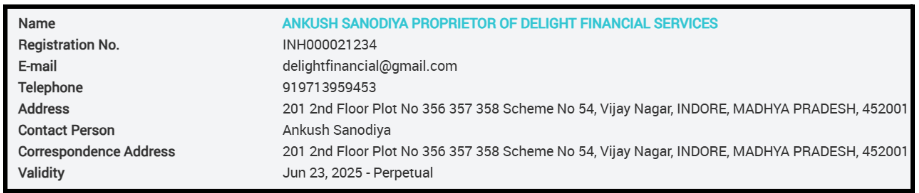
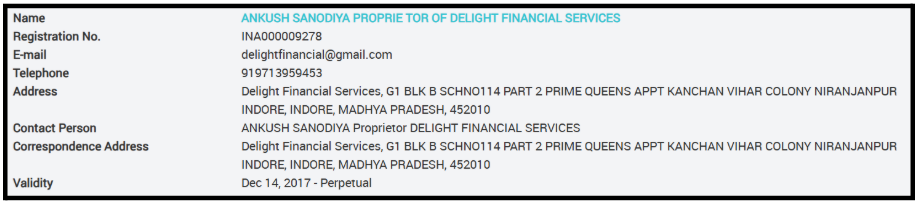
Both its SEBI numbers are active. Both trace back to the same proprietor and the same Indore address, with no mismatch between them.
The Research Analyst number runs through June 22, 2030. The Investment Adviser number has stayed open since December 2017, with no fixed end date.
Older public records from 2023 confirm INA000009278 was genuinely issued to the same person, Ankush Sanodiya, at the same Indore address, independently of what the firm’s own site claims.
What Does Delight Financial Services’ Own Site Reveal?
A real registration is only part of the story here. Some claims on the firm’s own site go well past what that registration actually permits.
An unproven claim of 88% accuracy and loss recovery. The About page promises that clients will recover losses “with more than 88% accuracy,” but provides no data to back that claim.

The loss recovery claim is a direct compliance concern because it creates a false impression for investors.
A 97% renewal rate claim. This figure appears with no audit or source attached to it, in the same line as the 88% accuracy claim.
Mismatched complaint disclosures. One site shows a resolved complaint. The other shows zero for the same month.
These claims become a problem the moment they’re published as fact with nothing to support them.
That’s exactly where the next check comes in.
Also Read: is Alpha Wealth Research genuine? See what our review found about the service.
Does SEBI Registration Make These Claims Genuine?
Delight Financial Services holds two active numbers.
INH000021234 covers its Research Analyst services.
INA000009278 covers its Investment Adviser services.
A SEBI registration allows a firm to legally offer research or advisory services under a specific licence category. It does not allow a firm to publish guaranteed or quantified performance claims in its marketing.
The 88% accuracy claim is a direct example of this.
SEBI’s Advertisement Code for Investment Advisers and Research Analysts specifically restricts advertisements from stating or implying assured returns, guaranteed recovery, or specific performance percentages without independently verifiable backing.
A renewal rate or growth-rank claim falls under the same restriction if it isn’t backed by a verifiable, dated source.
This isn’t just a website issue. Several public reviews describe users being told about guaranteed or higher returns during sales calls, the same kind of claim the Advertisement Code restricts on paper.
One reviewer describes being moved to a costlier plan specifically on the promise of better returns, echoing the same accuracy language used on the site itself.
The complete breakdown of what those users actually experienced is covered in full on our Delight Financial Services reviews page.
Also Read: Is Eqwires Research Analyst SEBI Registered, a different firm’s full registration record.
Why Does Delight Financial Services Run Two Websites?
Delight Financial Services isn’t one website. It’s two, and each one is registered under a different SEBI category.
One site holds a Research Analyst registration. The other holds an Investment Adviser registration. Both licences are genuine, and both belong to the same person.

Both sites list the identical office, 201, 2nd Floor, Plot No. 356, 357, 358, Scheme No. 54, Vijay Nagar, Indore 452001, and the same two phone numbers, just with a different support email for each domain.
This split creates a real problem for anyone trying to compare plans or verify a payment, because of the reduced clarity around which registration governs which specific subscription.
A client can’t easily tell which registration applies just by looking. A client filing a complaint later needs to name the correct licence category from the start, or risk delays.
A few things worth checking before you pay anything:
- Check which site your payment page actually sits on.
- Note the registration number shown on that specific page.
- Save a screenshot of it before you pay anything.
The two sites use the same address, same phone numbers, and same proprietor, so the confusion isn’t about identity. It’s about which rulebook applies to your money.
A Research Analyst plan and an Investment Adviser plan carry different conduct rules, so paying into the wrong one changes what protections actually apply to you.
Knowing this in advance saves time if you ever need to raise a formal complaint. It’s far easier to get this right before you pay than to untangle it afterward.
Also Read: Dealwisepro real or fake, a registration that’s real, a business model worth questioning.
What Should You Keep in Mind Before Engaging Anywhere?
A few simple habits close most of the gaps described above.
None of these require legal knowledge, just a bit of care before you commit.
- Verify every performance claim independently before trusting it.
- Confirm which registration number applies to your exact plan.
- Get the licence category confirmed in writing before paying.
- Keep every claim, screenshot, and message the firm sends you.
These four habits cover both problems raised above, the unverified numbers on the About page and the two-site registration split. None of them takes more than a few minutes, and each one leaves you with proof if a dispute comes up later.
Also Read: Dream Wealth Research fake or real, real registration, complaint pattern worth its own scrutiny.
What Should You Do If Delight Financial Services Acts Otherwise?
A SEBI registration check and a red-flag list only take you so far.
If something you were promised doesn’t hold up, or a claim you relied on turns out to be false, you have a formal path to raise it.
SEBI treats unsubstantiated performance claims and misleading sales conduct as valid grounds for a complaint, separate from any registration question.
The right first step is documenting exactly what was claimed, when, and by whom, before you approach any platform.
The firm’s own Research Analyst site reports resolving its one logged SCORES complaint within 21 days.
That’s a useful benchmark to hold it to if you file one of your own and the response drags on longer.
Not sure whether what you were told crosses into a real violation?
Tell us exactly what was said or promised, and we’ll help you identify the specific issue before you decide what to do next.
The complete filing process, from your first written complaint through SCORES and beyond, is covered in full in our guide on how to file a complaint against Delight Financial Services.
Conclusion
Delight Financial Services holds two genuine SEBI registrations, tied to one proprietor and one address. That much checks out, and both numbers hold up against independent records, not just the firm’s own disclosure.
What doesn’t hold up as cleanly is an 88% accuracy claim and a renewal rate figure, neither backed by public data.
Registration answers whether the firm is real. It doesn’t answer whether every claim it makes is true. If any of this matches what you were told before paying, document it and take action.
Report. Recover. Stay Fraud Free.
One covers its Research Analyst business, valid through 2030. The other covers its Investment Adviser business, open since 2017. Both belong to the same proprietor, at the same address. No. Registration confirms the firm is licensed. It doesn't cover or excuse claims like guaranteed accuracy or assured recovery made outside that licence's rules. Save the message or call details where the promise was made, then file a complaint through SEBI SCORES, since assured-return claims are a direct compliance concern.Frequently Asked Questions





 Add us as a preferred source on Google »

