

Quick Summary
Delight Financial Services’ own complaint disclosure shows six formal complaints since mid-2025, five resolved and one pending. Beyond that formal record, detailed one-star reviews describe five repeating patterns, climbing fees, losses immediately after payment, pressure to upgrade plans, unclear documentation, and silence after payment clears. None of these accounts have been tested against a formal SEBI order, but the specific, repeated detail across separate reviewers makes this worth taking seriously if your own experience matches.
₹91,000 lost right after a ₹25,000 payment. A monthly fee of ₹28,000 that kept getting pushed higher.
Heard of such Delight Financial Services reviews?
These aren’t generic complaints; they’re specific numbers from specific people, and this page lays out every one of them, alongside the firm’s own officially disclosed complaint data, mapped against what SEBI actually permits.
Delight Financial Services Complaints
Delight Financial Services is an Indore-based Research Analyst and Investment Adviser, run as a sole proprietorship. That’s the business on paper.
What actually shows up in complaint records and public reviews is a different measure of the firm, and it’s the one that matters most before you pay a subscription fee.
| Year | Carried Forward | Received | Resolved | Pending |
| 2025 to 2026 | 0 | 2 | 2 | 0 |
| 2026 to 2027 | 0 | 4 | 3 | 1 |
| Grand Total | 0 | 6 | 5 | 1 |
The firm’s own SEBI-mandated complaint disclosure lists six formal complaints since mid-2025, five resolved and one still pending.
That’s a real, non-zero number, but it only counts complaints that reached SEBI SCORES or a similar formal channel, not the disputes that stayed on Google Reviews or ended in a client simply walking away.
That gap between formal records and public reviews is exactly where the next section picks up.
Related RA Review: If you’re exploring similar SEBI-registered advisory reviews, you can also check out our detailed breakdown of Streetgains reviews to see how their subscriber experiences compare.
What Users Are Complaining About Delight Financial Services?
Detailed one-star reviews describe experiences with Delight Financial Services in specific rupee amounts and specific incidents.
Each one is checked below against what a SEBI-registered Research Analyst or Investment Adviser is actually allowed to do.
Five patterns repeat clearly enough to break out on their own.
1. Fees That Kept Climbing After Enrollment
A reviewer says he was quoted ₹5,000 to start, then asked for ₹20,000, then ₹30,000, as his intraday calls kept producing losses instead of the profits he was told to expect.

SEBI’s RA Code of Conduct requires advisors to exercise due care and diligence toward clients, not extract repeated payments after performance has already failed.
Asking a losing client for more money, rather than addressing why the calls failed, runs against that standard directly.
This pattern also shows up in how the firm’s own pricing plans are structured, with several plans crossing the annual fee cap on renewal.
2. Losses Reported Immediately After Payment
A reviewer was allegedly forced to pay ₹25,000 as a fee and lost ₹91,000 almost immediately after, and also claimed the staff was abusive.
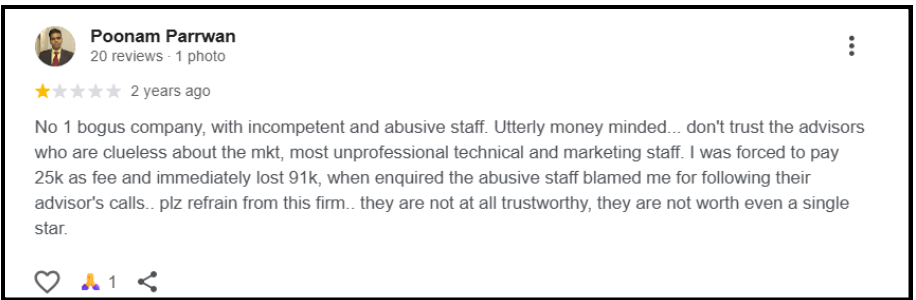
When the investor questioned this, it was said that the staff blamed the investor directly for following the advisor’s own recommendations.
Blaming a client for acting on paid advice contradicts the basic premise of a Research Analyst relationship, where the analyst is accountable for the calls issued.
The fee-escalation reviewer above also reports a loss of ₹60,000 overall, alongside the fee that grew from ₹5,000 to ₹30,000.
3. Pressure to Convert to Premium or “Higher Profile” Plans
A reviewer paying ₹28,000 a month says he was repeatedly pushed to convert his plan for the promise of higher returns, and was handed off to another representative specifically for higher-profile plans.
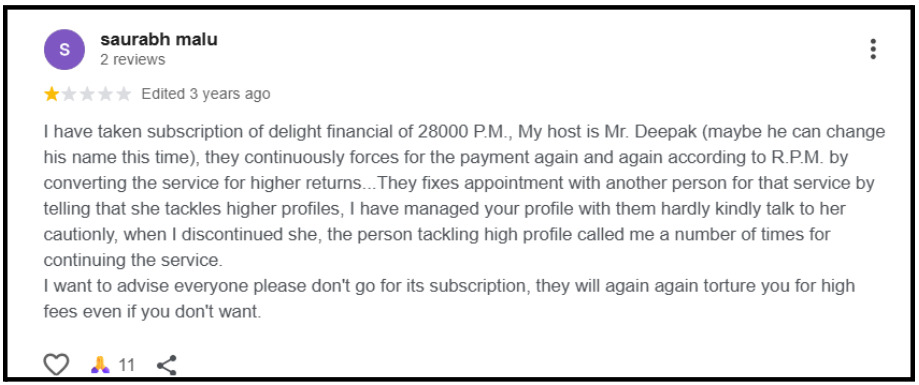
He says resubscription calls continued even after he had already cancelled.
Offering a plan upgrade to the promise of better returns edges directly into assured-outcome language, which the RA Code of Conduct does not permit under any framing.
4. Documents Signed Under Unclear or Shifting Terms
One reviewer describes a broader pattern behind the fee increases: being asked to sign documents under one explanation, only to have those documents used for something else later.
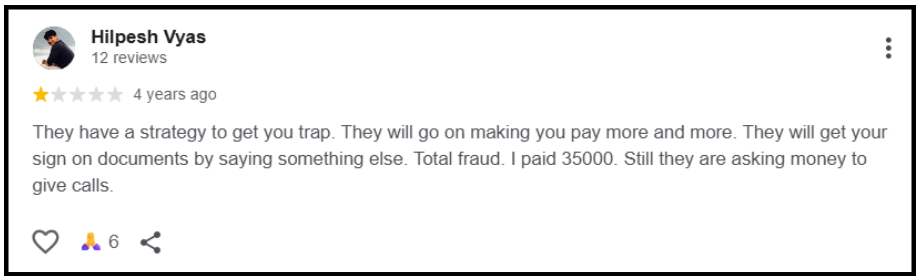
He says he paid ₹35,000 in total and is still being contacted for further payment.
Any agreement a client signs with a Research Analyst should reflect exactly what service and fee it authorises, and a client should be able to point to that document if a dispute arises later.
This same reviewer’s fee amount and continued solicitation also appear under the first complaint category above.
5. No Service or Response After Payment
A reviewer says his first payment produced no service at all, and that his assigned advisor was supposed to follow up with a solution but never returned contact for three months.
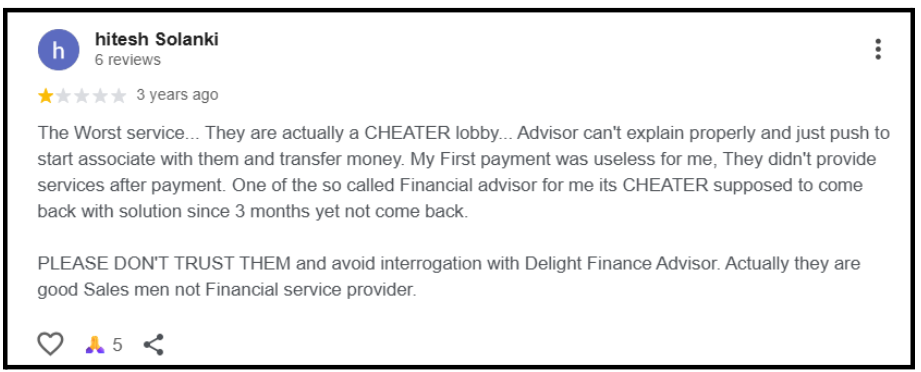
He describes the experience as purely sales-driven rather than advisory once the money had cleared.
A registered adviser is expected to maintain ongoing communication with subscribed clients, not disappear after the transaction completes.
The premium-plan reviewer above also touches on this pattern indirectly, describing a firm that leans on its registration status rather than on responsive, personal follow-up once a complaint is raised.
If your experience matches what’s described above, the full step-by-step filing process, from your first written complaint through SEBI SCORES, SMART ODR, and arbitration, is walked through in complete detail in our guide on how to file a complaint against Delight Financial Services.
Also Read: Shreeji Research Reviews where reviewers alleged promised monthly profits, recovery assurances after losses, and one investor reported losing nearly ₹40,000.
How Can You Avoid Experiencing What These Users Did?
Every one of these reviewers started with a straightforward subscription and ended up disputing either the fee, the result, or the follow-up.
None of them describe the problem showing up on day one; it built up over weeks or months of continued contact and continued payment.
If your own subscription matches any of the warning signs below, it’s a compliance issue worth addressing immediately:
- Escalating fee demands. A subscription that starts low but demands repeated, rapid cost increases after enrollment is a major concern.
- Unverified premium upgrades. Being pressured into a “higher profile” plan with promises of better or guaranteed returns violates the basic RA Code of Conduct.
- Unclear document explanations. Signing any agreement or digital consent form under vague or shifting verbal terms can easily be used against you later.
- Sudden communication silence. Prolonged silence or a lack of response after your money clears is a clear failure of advisory service standards.
The critical mistake is waiting to see if the situation resolves on its own. If you recognise these patterns, the next step is putting your dispute on record formally.
If you’re also trying to work out whether the firm’s registration, disclosures, and regulatory status hold up, that’s covered separately on our Delight Financial Services fake or real page.
Experienced something similar with Delight Financial Services?
Tell us what happened, repeated fee demands, losses after following paid recommendations, pressure to upgrade, or silence after payment. We’ll help you build a clear record before you raise a formal grievance.
Conclusion
Reviewers describe five distinct problems with Delight Financial Services: climbing fees, losses right after payment, pressure to upgrade, unclear documentation, and silence once the money clears.
None of these accounts have been tested against a formal SEBI order as of July 2026, but the specific amounts and repeated details across separate reviewers make this worth taking seriously if your own experience matches.
If any part of what you’ve read here matches your own subscription, start documenting it today.
Report. Recover. Stay Fraud Free.
No. SEBI caps Research Analyst fees at ₹1,51,000 per client family per year, and repeated fee increases tied to underperforming calls conflict with the RA Code of Conduct's due-care standard. Yes. SCORES doesn't require an active subscription. Fee disputes, conduct during your subscription, and continued solicitation after cancellation are all valid grounds to file. A service or communication failure is a valid, standalone basis for a SCORES complaint. Document the dates you tried to reach your advisor and any reply you received. Not on its own. A review helps you remember what happened, but SEBI SCORES and arbitration panels rely on your actual receipts, messages, and signed documents, not the review text itself.Frequently Asked Questions





 Add us as a preferred source on Google »

