
Quick Summary
The firm’s own mandatory complaint table shows zero complaints for 2022-23 and 2023-24, both periods that largely predate its March 2024 registration, then replaces the next two years with a placeholder. Two public comments on its own Instagram page describe losses after profit promises. A formal SMART ODR conciliation documented fees collected into personal accounts, trade calls beyond RA scope, and recovery pressure after losses. The firm settled at Rs. 1,35,000 against roughly Rs. 3,35,000 paid. This page shows you what each record contains and where the recovery gap came from.
Most people searching for DG Share Market Research reviews are standing at one of two points.
Either a representative has called, and you want to know what happened to people who said yes. Or you already said yes, something went wrong, and you want to know whether your experience is a pattern or just yours.
There is more on record here than reviews. There is a formal conciliation case with findings and a settlement figure.
Everything below traces to one of four sources: the firm’s own published material, SEBI public data, named public reviews on the firm’s own platform, or the conciliation record itself.
What Does DG Share Market Research’s Own Complaint Disclosure Show?
Every SEBI-registered Research Analyst is required to publish its investor complaint data annually on its website.
This data shows how many complaints were received, how many were resolved, and how many remain pending.
It is mandatory under SEBI’s RA regulations.
DG Share Market Research published this data for two periods.
| Year | Carried Forward | Received | Resolved | Pending |
| 2022-23 | 0 | 0 | 0 | 0 |
| 2023-24 | 0 | 0 | 0 | 0 |
| 2024-25 | Not published | Not published | Not published | Not published |
| 2025-26 | Not published | Not published | Not published | Not published |
Two observations about this table are worth making before reading further.
1. Zero Complaints Before Legal Registration
The firm received its SEBI registration in March 2024, which means the 2022-23 and 2023-24 rows both predate or overlap with the registration period.
Zero complaints in a period when the firm had no registered operations is not evidence of good service. It is evidence that the reporting period predates the product.
What that registration covers, and what it does not, is set out on our page: is DG Share Market Research SEBI registered.
2. The Placeholder Covers the Operating Years
The “Coming Soon” placeholder covering 2024-25 and 2025-26 means the firm stopped updating its mandatory disclosure while continuing to operate and collect subscriptions.
Under SEBI’s RA regulations, complaint disclosure is not optional. Replacing current data with a placeholder for two consecutive years is a specific compliance gap.
Also Read: Wealth Guru reviews, where investors can look beyond the platform’s own presentation.
What Investors Have Said Publicly About DG Share Market Research?
The following accounts are from public posts on the firm’s own social media pages.
We are describing what these users wrote on a public platform.
We are not independently verifying these accounts. No SEBI order confirming or denying the specific conduct described has been issued as of July 2026.
Two comments are covered below.
The first describes a specific amount and outcome. The second is a general warning with no transaction detail, which matters when weighing what each one can support.
1. The First Comment
On a post published on DG Share Market Research’s official Instagram page, a user with a verified profile left a public comment describing their experience with the firm.
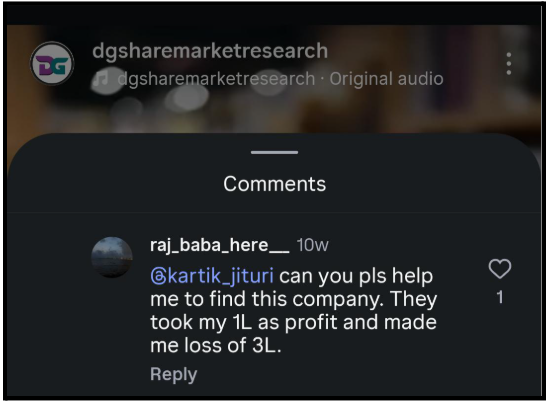
The comment stated that they had invested approximately Rs. 1 lakh after being promised high profits and instead incurred losses of approximately Rs. 3 lakh.
The commenter warned others not to trust the firm.
2. The Second Comment
A second public comment on the same Instagram post, from a different user with a named profile, described the firm as untrustworthy and urged others not to engage with it.
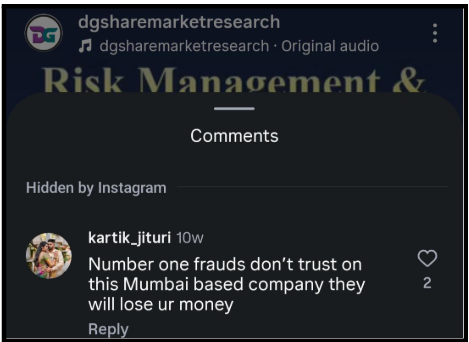
The comment did not specify an amount paid or a specific transaction.
These two public accounts describe the pattern most commonly seen in formal complaints against this firm: a profit promise attracting initial payment, followed by trading outcomes that did not match the promise, followed by a loss.
Whether these specific accounts qualify as formal complaint grounds depends on whether the investor preserved communication records of the promises made.
If so, the formal complaint process is available regardless of whether anyone else has reviewed the firm publicly.
The SMART ODR Conciliation Case: What the Record Shows
This is the most significant documented account of investor experience with DG Share Market Research.
It is not a public review.
It is a formal conciliation proceeding under SEBI’s SMART ODR framework, with an independent conciliator, submissions from both sides, and a binding settlement outcome.
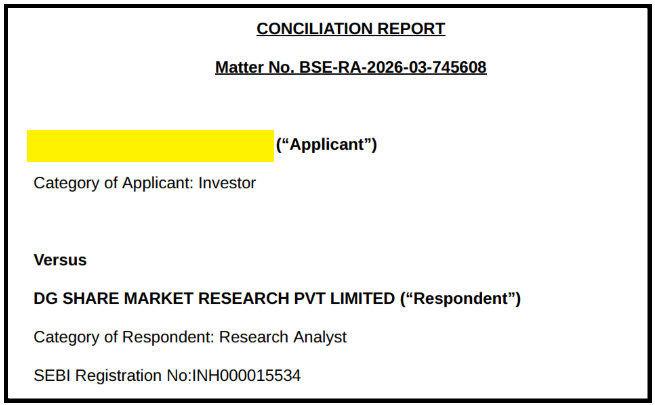
We are reporting the facts as documented in the conciliation record. This is not an allegation.
It is a case that proceeded, produced findings, and ended with a financial settlement paid by the firm.
The case is set out below in three parts: what the investor went through, what the conciliator concluded from the evidence, and what the settlement actually covered.
The third part explains the gap between the two figures.
What the Investor Experienced
The investor was contacted by a representative of DG Share Market Research who showed profit screenshots from other clients as part of the sales pitch.
On the basis of those screenshots and a verbal profit promise, the investor subscribed to the firm’s services and made an initial payment.
Following the initial payment, the investor was contacted by multiple representatives over subsequent weeks.
Each contact resulted in a new payment request, with each request framed as necessary for access to a higher-value tier of service, a recovery trade, or a short-term opportunity.
The payments were directed to different accounts across the sequence.
Some went to a corporate account in the firm’s name. Others went to personal UPI IDs and personal bank accounts belonging to individuals who identified themselves as firm employees.
The representatives gave specific buy and sell instructions with quantities and lots, calling these out during live market hours via WhatsApp and phone.
After those trades produced losses, representatives contacted the investor again with a recovery offer requiring additional payment. The investor paid the recovery fee. Further losses followed.
By the time the investor engaged our team, the total fees paid across all stages were approximately Rs. 3,35,000, when trading losses were included.
The investor had preserved WhatsApp conversations, payment screenshots, and a bank statement showing each transfer.
What the Conciliator Found
The conciliator reviewed the evidence submitted by both sides.
The following violations were documented in the conciliation record:
1. Fee collection into personal accounts
The conciliation record confirms that a portion of the investor’s payments went to personal accounts of individuals who identified themselves as firm employees, rather than to the firm’s official corporate account.
The firm did not deny this in its submissions but characterised it as an error by individual employees rather than a firm-level practice.
2. Trade-level instructions beyond the RA scope
The WhatsApp messages submitted by the investor showed specific execution calls with exact quantities during live market hours.
These messages were attributed to firm representatives.
Providing personalised execution calls of this nature falls outside what a Research Analyst is permitted to provide under SEBI’s RA regulations.
The conciliation record notes this finding.
3. Use of profit screenshots for solicitation without mandated disclosures.
The initial sales pitch involved showing the investor profit records of other clients.
SEBI prohibits using past client performance as a solicitation tool without specific mandated disclosures that were absent here.
4. Recovery agent pressure after losses
The investor received repeated contacts after losses appeared, each requesting additional payment for a recovery trade.
5. No Research Analyst can legally promise to recover trading losses
These contacts constituted a continuation of the conduct pattern rather than a correction of it.
What the Settlement Produced
After the conciliation proceedings ran through the documentation submitted by both parties, the firm agreed to a settlement.
DG Share Market Research paid Rs. 1,35,000 to the investor as settlement of the dispute.
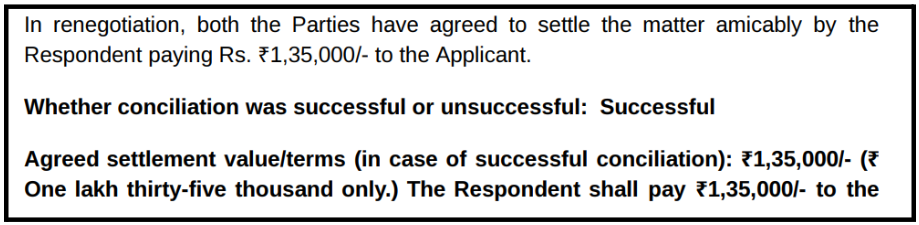
The settlement did not cover the full amount the investor paid across all stages.
Not all payments could be directly linked to the registered entity because some went to personal accounts where the firm’s liability was contested.
The portion directly attributable to the firm under the RA framework was the basis for the settlement amount.
This outcome illustrates a consistent principle across every case this team has handled.
The evidence collected before and during filing determines what can be recovered.
Payments to personal accounts are harder to recover than payments to the firm’s official account. The gap between total loss and recoverable amount is almost always a documentation gap.
What to Consider Before Paying DG Share Market Research?
The mandatory complaint disclosure, the two public Instagram comments, and the SMART ODR conciliation case together describe a consistent pattern.
Profit screenshots used to attract payment. Multiple payment requests across a sequence. Some payments directed to personal accounts.
Specific trade calls given beyond the RA scope. Recovery offers were made after losses appeared.
If a representative of this firm has contacted you and any part of that description matches what you are being told, the pattern is documented, and the formal escalation path through the SEBI SCORES complaint portal exists for investors who experience it.
If you have already paid, the escalation path and the evidence checklist are set out in our guide on how to file a complaint against DG Share Market Research.
The recoverable amount depends on what your payment trail can prove, which is exactly where the documented case lost ground.
Need help working out what your evidence can actually recover?
We audit the payment trail, separate what links to the firm from what does not, and build the file the conciliator acts on.
Also Read: Eqwires Research Analyst Reviews, including one account cited directly inside the formal SEBI adjudication order against the firm.
Conclusion
DG Share Market Research’s own complaint disclosure is incomplete.
Two years of mandatory data show zero complaints, covering a period that largely predates the firm’s registration, and the subsequent two years show a placeholder instead of required data.
Two public Instagram comments on the firm’s own page describe loss experiences following profit promises.
A formal SMART ODR conciliation case documented fee collection into personal accounts, personalised trade instructions beyond the RA scope, use of profit screenshots without mandated disclosures, and recovery agent pressure after losses.
The firm settled that case by paying Rs. 1,35,000 to the investor.
These are not rumours or unverified allegations. The Instagram comments are public, named, and on the firm’s own page. The SMART ODR case is a formal proceeding with documented findings.
The complaint disclosure gap is a regulatory compliance failure visible on the firm’s own website.
Frequently Asked Questions
Zero complaints for 2022-23 and 2023-24, then a placeholder for the two years after. The zero years largely predate the March 2024 registration, so they cover a period with no registered operations to complain about.
Four violations: fees collected into employees' personal accounts, trade execution calls beyond RA scope, profit screenshots used for solicitation without mandated disclosures, and recovery fees demanded after losses. The firm settled at Rs. 1,35,000.
Roughly Rs. 3,35,000 went out across all stages. Payments into personal accounts had contested liability, so only the portion directly attributable to the registered entity formed the settlement. The gap is evidentiary, not legal.
No. They are public comments from named profiles on the firm's own official page, which is why they are reported here. We have described what they say and named the platform. We have not verified the transactions behind them.
Yes, and the payment itself is a complaint ground, since RA fees must go to the firm's corporate account. Include the screenshot showing the UPI ID or account name. Recovering that specific amount takes extra evidentiary work.





 Add us as a preferred source on Google »

