
Quick Summary
DG Share Market Research holds SEBI registration INH000015534 as a Research Analyst, which puts it inside SEBI’s formal complaint system. The route runs five steps: collect evidence, write to the compliance officer, file on SCORES under the Research Analyst category, escalate to SMART ODR, and go to arbitration if conciliation fails. One documented conciliation against this firm settled at ₹1,35,000. Fee recovery is realistic. Trading loss recovery is harder and needs a different argument. This page shows you what to prepare, where each stage can stall, and what the process can actually return.
Are you at a loss because of promises made by a DG Share Market Research representative? Have you faced any other unethical practices while dealing with them?
You do not have to sit with this quietly, and you are not the first investor to face it.
This blog walks you through exactly how to file a complaint against DG Share Market Research, step by step.
How To File a Complaint Against DG Share Market Research Pvt Ltd?
Filing a complaint is a structured, step-by-step process backed by SEBI.
You do not need a lawyer to get started, just your evidence and the right channel at each stage.
Step 1: Collect Your Evidence First
Before writing to anyone, spend time organising your documentation.
Evidence collected now is evidence that works later. Evidence gathered under pressure after the process starts is often incomplete.
The documents you need fall into three categories.
Each one answers a different question a conciliator will ask: where the money went, what was said to get it, and what happened to your account afterwards.
1. Payment Proof
Every bank transfer screenshot, UPI transaction record, or payment receipt showing what you paid, when you paid, and which account received the money.
If any payment went to a personal account rather than a corporate account in the firm’s registered name, flag that separately. It is one of the clearest violations a Research Analyst can commit under SEBI regulations.
2. Communication Proof
Every WhatsApp message, email, call recording, or Telegram message from any representative of the firm.
The message where a return was promised. The message where a recovery was offered. The message where you were told to hold a position. Each of these is a potential complaint basis.
Do not delete anything. Screenshot entire conversations, not just individual messages, so the context is visible.
3. Trading Records
Your account statement or ledger showing what trades were executed, the dates, and the financial outcome during the period you subscribed to the firm’s services.
Contract notes for specific disputed trades if applicable.
Once these three categories are organised, write a one-page chronological summary of events.
Date of first contact. What was said? Date of payment. Amount paid. What happened after? When things went wrong. When you raised the issue. What the firm said in response.
This summary becomes the basis for every complaint description you file across all five steps.
Step 2: Write to the Firm’s Compliance Officer
Before SEBI will process most complaints, you must show that you attempted internal resolution first.
Write a formal email to the firm’s compliance officer stating your grievance specifically.
The challenge with DG Share Market Research is that the firm lists three different individuals as compliance officers across three separate pages on its own website: Bhagyashree Malgavi, Chandra Kumar Dubey, and Radha Krishna Pandey.
A role SEBI allows only one person to hold at a time.
For the complaint to be correctly routed, check the firm’s current regulatory disclosures page for the name listed as the active compliance contact at the time you write.
If no updated disclosures page exists, write to all three names at the firm’s registered email address and keep copies of every message sent.
In the email, state your full name, the dates and amounts of all payments made, the specific conduct you experienced, and the resolution you are seeking.
Give the firm 21 calendar days to respond. If they do not respond or their response does not address the actual grievance, move to Step 3.
Which of those three names holds any confirmed position, and which appears in no corporate record at all, is set out on our page on the DG Share Market Research owner name.
Step 3: File SEBI SCORES complaint online
Go to scores.sebi.gov.in. Register with your PAN number and a verified mobile number. Once registered, file a new complaint.
When selecting the intermediary type, choose Research Analyst.
Do not choose Investment Adviser or Stock Broker. Selecting the wrong category routes the complaint to the wrong department and delays resolution significantly.
In the registration number field, enter INH000015534. This is the SEBI registration number for DG Share Market Research Private Limited.
Entering the correct registration number ensures the complaint reaches the firm directly through SEBI’s system.
In the complaint description, use the chronological summary you wrote in Step 1.
Keep the language factual and specific.
State the date of each payment, the amount, and which account received it. State the specific promise made and when. State what the actual outcome was.
Reference your attached documents by name in the description.
Upload your payment proofs, communication screenshots, and trading records. The portal accepts PDF files and JPG or PNG images. Compress large files before uploading if they exceed the size limit.
After submission, you will receive a unique reference number. Save it.
This number tracks your complaint through SCORES and into SMART ODR if the matter escalates.
The intermediary has 21 days to respond. Log in after 21 days and check the SEBI SCORES complaint status.
If the firm’s response does not resolve your grievance, mark it as unsatisfactory.
The complaint then moves into SCORES Level 2 Review before transferring to SMART ODR.
Step 4: Escalate to SMART ODR
After the SCORES process is exhausted without a satisfactory resolution, the complaint is transferred to SMART ODR.
In SCORES 2.0, this transfer happens within the system itself.
Your SCORES reference number follows the case automatically.
This ensures a smooth transition into the official SMART ODR complaint procedure, meaning you won’t need to register or upload your documents all over again.
On the platform, an independent conciliator is assigned to your case.
This conciliator is not a SEBI employee. They are an independent professional who facilitates structured dialogue between you and DG Share Market Research.
The process runs in two stages:
- Pre-conciliation allows both sides to reach an agreement through the platform before the conciliator becomes actively involved. Many cases settle here, particularly when the firm’s liability is documented clearly, and the evidence is organised.
- Formal conciliation follows if pre-conciliation does not produce agreement, with the conciliator facilitating sessions and proposing settlement terms.
The conciliation against DG Share Market Research ran this path and ended with the firm agreeing to pay ₹1,35,000 to the investor.
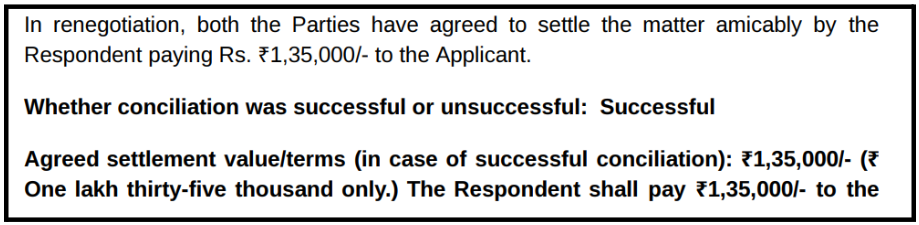
The outcome was possible because the payment trail across personal and corporate accounts was documented, the trade instruction messages were preserved, and the recovery agent communications were part of the case file.
Evidence gaps at this stage are the most common reason cases that should win do not.
Step 5: Arbitration in Stock Exchange
If conciliation does not produce a settlement, the matter moves to formal arbitration.
An arbitrator reviews all submitted evidence from both parties and issues a binding award.
The award is legally enforceable as a civil court decree under the Arbitration and Conciliation Act, 1996.
For claims below ₹10 lakh, the investor pays no arbitration filing fee. The intermediary bears the cost.
This means you can pursue a binding arbitration outcome without a financial barrier even when the disputed amount is relatively small.
The key to arbitration outcomes is the same as that of every earlier stage.
Documentation submitted at the start determines what the arbitrator can decide.
An arbitrator cannot award recovery for payments that have no paper trail. Every rupee you paid needs a corresponding record.
What a binding award means and how to enforce it if the firm does not pay is covered in our guide to SMART ODR settlement and arbitration.
Can You Legally Complain Against DG Share Market Research?
Yes. DG Share Market Research Private Limited holds SEBI registration number INH000015534 as a Research Analyst.
That registration places the firm under SEBI’s regulatory authority and gives investors a formal channel to report violations.
Not every disappointing outcome is a violation. What counts is whether the firm crossed a line SEBI actually draws, and those lines are specific.
The situations that qualify as complaint grounds under SEBI’s Research Analyst regulations include:
- Guaranteed or assured return promises made verbally or in writing during the sales process.
- Fee collection into a personal bank account or UPI ID rather than the firm’s official corporate account.
- Trade-level instructions giving exact buy, sell, or quantity calls, which fall outside what a Research Analyst is permitted to provide.
- Pressure to pay additional fees to recover earlier losses.
- Services that materially differed from what was described before payment.
If any of these match your experience with DG Share Market Research, you have grounds to file.
A documented SMART ODR conciliation case against the firm confirmed these violations, with the conciliator finding that the firm’s employees collected payments into personal accounts, gave personalised trade instructions beyond the RA mandate, and directed an investor to hold losing positions while extracting additional fees through unofficial recovery agents.
What the conciliation found and how each violation was documented is set out in our DG Share Market Research reviews.
What Can Your Complaint Realistically Recover?
This is the question investors ask most and get the least honest answer to.
The framework treats two kinds of money very differently, and knowing which one you are chasing changes how you file.
Fee recovery is realistic when you have payment proof, and the fee collection violated SEBI regulations, specifically payments to personal accounts, fees above the SEBI annual cap of ₹1,51,000, or fees collected without a prior written agreement.
Trading loss recovery is harder. SEBI complaint channels are most effective for recovering fees paid to the advisory firm.
Recovering market losses caused by bad recommendations requires demonstrating that the advice violated a specific SEBI regulation, not just that it did not produce profit.
This distinction matters when setting expectations before you file.
The ₹1,35,000 settlement in the documented case involved fee recovery and compensation for regulatory violations, not full market loss recovery.
Understanding the difference helps you enter the process with realistic expectations and focus your complaint on the strongest grounds.
Knowing the five steps is the easy part. Knowing which of your payments the firm will try to disown, and closing that door before it opens, is what moves the number.
Do you need help filing your complaint against this firm?
We build the evidence file, write the complaint SEBI acts on, and carry it through every stage to conciliation.
Conclusion
DG Share Market Research is accountable to SEBI as a registered Research Analyst.
That accountability gives investors a formal five-step path from internal grievance through SCORES, through SMART ODR, through arbitration.
The path works when evidence is complete and filed correctly. The documented ₹1,35,000 settlement confirms the process produces real outcomes for investors with organised documentation.
Start with evidence collection. Write to the compliance officer. File on SCORES with the correct intermediary category and registration number.
Escalate to SMART ODR if SCORES does not resolve the matter.
Do not wait. Messages get deleted. Call records expire. The sooner the documentation is preserved and filed, the stronger the case.
Frequently Asked Questions
Yes. Registration does not shield a firm from complaints. It creates accountability to SEBI for how the firm operates. The documented conciliation against this firm confirms the process applies here specifically.
Yes, and it is one of your strongest pieces. RA fees must go to the firm's registered account, so payment to a personal ID is itself a violation. Screenshot the transaction showing the recipient ID and the amount.
A call recording works if you have one. If not, write down the date, approximate time, the person's name, and the wording you recall, as soon as possible. It weakens the case without ending it, especially where other evidence is strong.
Twenty-one days for the firm to reply internally, another 21 at SCORES, two to four weeks for Level 2, then six to twelve weeks at conciliation. Four to nine months if arbitration is needed. The documented case settled at conciliation.
No. Failing to respond within 21 days puts a registered entity in regulatory non-compliance, which SEBI monitors and records. Non-participation at the SMART ODR stage is more serious still, with consequences for the firm's registration.





 Add us as a preferred source on Google »

