

You come across an advertisement for Dream Wealth Research, and to learn more, you check social media, but you can’t find any verified presence, while most communication appears to happen through WhatsApp.
This naturally raises one question: Is Dream Wealth Research fake or real?
This blog answers exactly that.
We’ll walk you through the factors that contribute to this question and explain what you can do if you encounter any unauthorised activity along the way.
Dream Wealth Research Fake or Real in India
To determine whether a stock advisory firm is genuine, it is essential to look beyond marketing claims and examine hard regulatory data.
By evaluating official registration records, compliance metrics, and transparent data disclosures, we can uncover the operational reality of the service.
Let’s break down the core factors that reveal whether Dream Wealth Research is operating legitimately in India.
1. Dream Wealth Research SEBI Registration
Dream Wealth Research Financial Services holds SEBI registration number INH000016083 as a Research Analyst, granted on May 7, 2024.
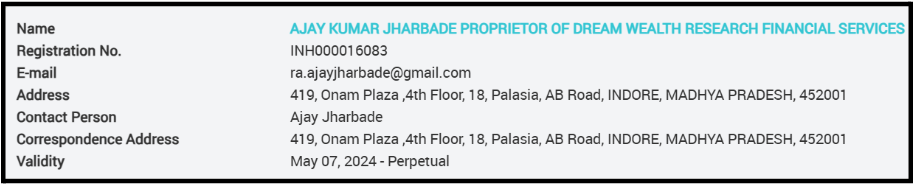
Ajay Kumar Jharbade is the proprietor behind this registration.
This confirms the firm genuinely exists under the SEBI (Research Analyst) Regulations, 2014.
But registration alone, though, doesn’t guarantee safety or good conduct going forward.
2. Disclosures and Investor Charter Published
Dream Wealth Research publishes both a disclosure document and an investor charter on its website, exactly as SEBI mandates for registered research analysts.
These documents lay out the firm’s conflict-of-interest stance, fee terms, and an investor’s rights and responsibilities.
Publishing them is a basic compliance step rather than proof of quality, but it does show the firm meets this minimum transparency requirement.
3. Dream Wealth Research Complaint, Data
The firm discloses its complaint data, broken down by month and by year, which is more transparent than what several similar firms offer.
| S.No. | Year | Carried Forward | Received | Resolved | Pending |
| 1 | 2023-2024 | 0 | 0 | 0 | 0 |
| 2 | 2024-2025 | 0 | 3 | 3 | 0 |
| 3 | 2025-2026 | 1 | 4 | 3 | 1 |
| 4 | 2026-2027* | 1 | 6 | 5 | 2 |
| Grand Total | 1 | 13 | 11 | 3 |
*Figures for 2026-2027 cover only a few months of 2026, since this financial year is still in progress.
One complaint logged under the 2025-2026 cycle, however, still shows as pending, and the monthly breakdown through May 2026 doesn’t clearly reflect it being closed out.
A complaint sitting unresolved for this long is worth noting, even with the overall complaint count staying low.
4. No Social Media Presence and Limited Reviews
Despite running an active website, Dream Wealth Research shows no verified presence on social media.
The Facebook, Twitter, LinkedIn, and YouTube icons on its site link straight to each platform’s generic homepage, not to any account actually belonging to the firm.
Additionally, very few independent user reviews are available online, leaving investors with limited real-world experiences to assess the firm’s services and reliability.
For an entity built on public trust, this lack of verifiable online presence and limited public feedback makes it harder for investors to confirm who they’re really dealing with and make informed decisions before subscribing.
5. Major Communication Through WhatsApp
A WhatsApp link sits prominently across the website, suggesting WhatsApp works as the firm’s primary channel for reaching clients.
The firm’s own homepage even warns that scammers misuse its name on WhatsApp, Telegram, and Instagram to collect payments.
That warning, paired with WhatsApp being the main point of contact, leaves investors with little way to confirm they’re speaking to the verified entity.
Dream Wealth Research Reviews
Till now, we know two things: this firm shows no verified social media presence, and most communication runs through WhatsApp.
A complaint surfaced on Reddit around this exact issue.

A user described receiving a call about Dream Wealth Research, joining the service, and then getting blocked on Instagram within a few weeks.
The firm’s account disappeared from Instagram shortly after, and the user reported no further support, though they also confirmed no financial losses.
This is one unverified account, not a verdict, but it does echo the same communication and presence concerns raised above, which makes it hard to lean firmly toward any one way of conduct.
Now that you know every factor related to the firm, there are a few steps that can save you from a fake entity and from unauthorised activity by a real one.
Dream Wealth Research: Crucial Red Flags to Check Before You Pay
Before any payment goes out, a few checks can protect you regardless of whether the firm turns out to be trustworthy or not.
These aren’t complicated steps, just habits every investor dealing with a research analyst should build.
1. No One Can Promise Guaranteed Returns
SEBI regulations don’t allow any research analyst to promise fixed or guaranteed profits.
If a pitch includes assured returns, that’s a violation worth reporting on its own.
Treat any guarantee as a warning sign, not a selling point.
2. Never Share Trading or Demat Login Credentials
A research analyst only provides recommendations; there’s no legitimate reason for one to ask for your trading or demat login.
Sharing these credentials hands over control that an analyst should never have.
Keep this access strictly to yourself, no matter how convincing the request sounds.
3. Pay Only Through Verified Banking Channels
Payments should always go to an account held in the firm’s registered name, through traceable banking channels.
Avoid personal UPI IDs, third-party accounts, or anything that doesn’t match the firm’s official name.
Dream Wealth Research itself warns about this exact risk on its own website.
4. Verify the Registration Independently
Don’t rely solely on a registration number quoted during a call or message.
Cross-check it directly on SEBI’s website, where every registered research analyst is listed. A few minutes of verification can save a lot of regret later.
None of these steps demands special expertise, just a habit of pausing before acting. A cautious investor makes a much harder target for any kind of misconduct.
Following these points can save you from any type of firm’s unauthorised activity.
But if you’re already in a loss or have witnessed something like this play out, here’s what to do.
How to Report Against a Research Analyst?
When a registered analyst violates regulations or fails to deliver promised services, investors do not have to remain helpless.
The Securities and Exchange Board of India (SEBI) has established a structured grievance mechanism to help you escalate disputes and seek a formal resolution.
Here are the steps to report:
Step 1: Document the Communication
Save every call recording, chat screenshot, and payment receipt connected to the engagement.
Note down dates, amounts, and exactly what was promised during onboarding. This record becomes the backbone of whatever complaint follows.
Step 2: Send a Formal Notice to the Analyst
Before escalating, send a written notice directly to the research analyst describing the issue. SEBI’s Investor Charter gives the analyst 30 days to resolve a grievance at this stage.
This step also creates a paper trail showing you gave the firm a fair chance to respond.
Step 3: Lodge the Complaint on SEBI SCORES
If the analyst doesn’t resolve things within that window, file a complaint on SEBI’s SCORES portal.
Include the registration number, a clear description of the issue, and the evidence gathered earlier.
SCORES assigns the complaint to the firm and tracks its response on a set timeline.
Step 4: Lodge a Complaint with SMART ODR
If SCORES does not provide a satisfactory resolution, you can escalate the matter further.
Understanding how to file complaint in Smart ODR is straightforward; this online platform offers digital conciliation and mediation to help investors and intermediaries resolve disputes more efficiently.
It can often lead to a quicker resolution without the need for lengthy proceedings.
Step 5: Stock Market Arbitration
If the dispute remains unresolved even after SMART ODR, the case can move to arbitration through the stock exchange.
An arbitration award is legally binding and carries more weight than any informal assurance or settlement.
Investors can seek compensation or relief based on the final award issued by the arbitrator.
Need Help?
If you’ve subscribed to a research analyst and are facing issues such as unresponsive representatives, difficulty obtaining refunds, misleading promises, or uncertainty about whether a violation has occurred, it can be difficult to determine the right course of action.
We help investors review their communication records and assess whether there are grounds for a complaint.
We also prepare the documentation required for SEBI SCORES, SMART ODR, or arbitration proceedings.
Reach out to us to understand your options before taking further steps.
Disclaimer: This review is based entirely on publicly available records and disclosures. It is for informational purposes only and is not authorized or endorsed by SEBI or any other regulatory body.
Conclusion
Is Dream Wealth Research fake or real?
The SEBI registration, the published disclosures, and the investor charter all point toward a genuinely existing, registered entity, not a fabricated one.
But a long-pending complaint, no verifiable social media presence, WhatsApp-driven communication, and oddly generic website content all sit in a grey zone that a registration number alone doesn’t resolve.
Treat this review as a starting point, verify independently, stay alert, commit any money, and don’t hesitate to report if needed.
Frequently Asked Questions
1. Can I trust a SEBI-registered research analyst completely?
No. SEBI registration confirms that the entity is authorised to operate as a research analyst.
Investors should still evaluate the firm’s communication, transparency, and service quality before subscribing.
2. What should I do if a research analyst stops responding after taking payment?
Keep records of all payments and communications, send a written grievance to the analyst, and escalate the matter through SEBI SCORES if the issue remains unresolved.
3. Should I avoid a research analyst who has no social media presence?
Not necessarily, but a lack of verified online presence can make it harder to independently verify the firm’s identity and reputation.
Investors should exercise additional caution and verify all details before making any payment.





 Add us as a preferred source on Google »

