

Quick Summary
EquityPandit Financial Services holds SEBI Investment Adviser registration INA000006688, valid from 15 November 2016 on a perpetual basis. Its disclosures list 18 complaints across the years shown, with one still pending. The annual table’s resolved total does not match its own rows. SEBI also issued a 2018 adjudication order about the period before registration. Pricing sits behind a mobile login, and the terms include a 25 percent breakage fee. This blog sets out what the records show and what to confirm in writing.
You see an ad on your phone, a friend forwards a stock idea, and a polished app promises a “long term partner”. Then you search for EquityPandit Financial Services and wonder who is actually behind it.
That pause is healthy. Before you enter a mobile number or pay a subscription, it helps to read the registration record, the complaint tables and the terms side by side.
This blog does exactly that, using the firm’s published disclosures and public SEBI records. It does not tell you what to decide.
What Is EquityPandit Financial Services?
EquityPandit Financial Services Private Limited is a company registered with SEBI as a non individual Investment Adviser.
Its website says it offers investment recommendations to individual investors, institutions and family offices.
The firm describes a data driven approach, ongoing alerts and updates, and mobile apps for Android and iOS.
It also says it has more than 20 years of experience and active pages on Instagram, Facebook, LinkedIn and Twitter.
That is the firm’s own description, so treat it as a starting point.
The research material we reviewed lists three services, and the table below shows how each one reads on the pricing page.
Use the table to see what you would actually buy and what the firm asks you to commit. Each row repeats the firm’s wording in plain terms.
|
Service |
What the listing says | Minimum investment |
|
Alpha India Portfolio |
A curated set of 18 to 20 stocks across large, mid and small cap companies, with quarterly rebalancing and a personal dashboard | ₹2 lakh |
| EP Multibagger | One high growth stock every month, with a research report and a live performance dashboard |
₹20,000 per stock |
| WealthX | A long term portfolio, monthly stock ideas and ETF recommendations across sectors and themes |
Not disclosed on the pricing page |
Notice that the last column says “minimum investment”.
That is the money you put into stocks, not the fee you pay the adviser.
Two quick sums show why that matters. If you spread ₹2 lakh evenly over 18 to 20 stocks, each position is roughly ₹10,000 to ₹11,100.
If you followed every monthly EP Multibagger idea at ₹20,000 each for a year, you would put in ₹2,40,000.
The advisory fee would sit on top of that, and the listing we saw does not show it.
Is EquityPandit SEBI Registered?
Yes, the firm appears in SEBI’s intermediary records as an Investment Adviser.
The details below come from the registration entry as reproduced in our research material.
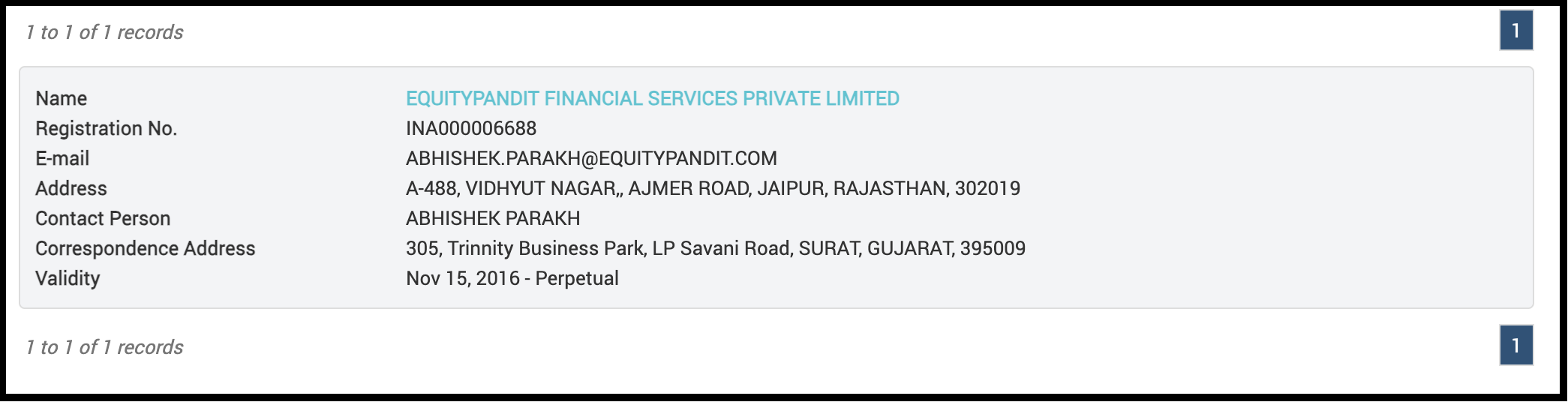
- Registration number is INA000006688, and the prefix INA marks an Investment Adviser. Research Analysts carry an INH prefix instead.
- Validity runs from 15 November 2016 with no end date, which SEBI records as perpetual.
- Name on the record is EquityPandit Financial Services Private Limited. SEBI lists the contact person as Abhishek Parakh, with an email address at the firm’s own domain.
- Address on the SEBI record is in Ajmer Road, Jaipur, Rajasthan, 302019.
- Correspondence address is on LP Savani Road, Surat, Gujarat, 395009.
The firm’s website gives the Surat address as its registered one, while its contact section shows Jaipur.
One firm can run offices in two cities, so this is not a problem on its own.
Still, when you plan to send documents or a legal notice, ask the firm in writing which address it treats as its registered office.
Keep the reply with your subscription papers.
Also Read: Marathon Trends Advisory shows “30+ years” experience claim that raises a simple question: whose experience, exactly?
EquityPandit SEBI Order and Penalty History
Registration tells you the firm may advise today. It does not tell you what happened before it was registered, so we searched for orders as well.
We found one SEBI adjudication order dated 2 April 2018 naming the firm.
The order examined the period from 14 June 2013 to 6 October 2016, before the current registration took effect.
SEBI held that the firm provided investment advisory services during that period without registration. It imposed a penalty of ₹40 lakh.
The current registration dates from 15 November 2016.
We could not confirm whether the penalty was paid or challenged, and the research material did not mention the order at all.
We also did not find any later SEBI order against the firm in the sources we checked, though that is not a clean certificate.
If this history matters to you, read the order on SEBI’s website yourself. Then ask the firm what changed in its compliance practices after registration.
Why Is EquityPandit’s Pricing Gated, and What Are the Fees?
Fees decide whether a plan suits your budget, yet this is where readers meet their first obstacle.
The website does not show service fees openly.
To see prices, a visitor enters a mobile number and logs in before reaching the purchase step.
That is what the research material found when it checked the pricing page.
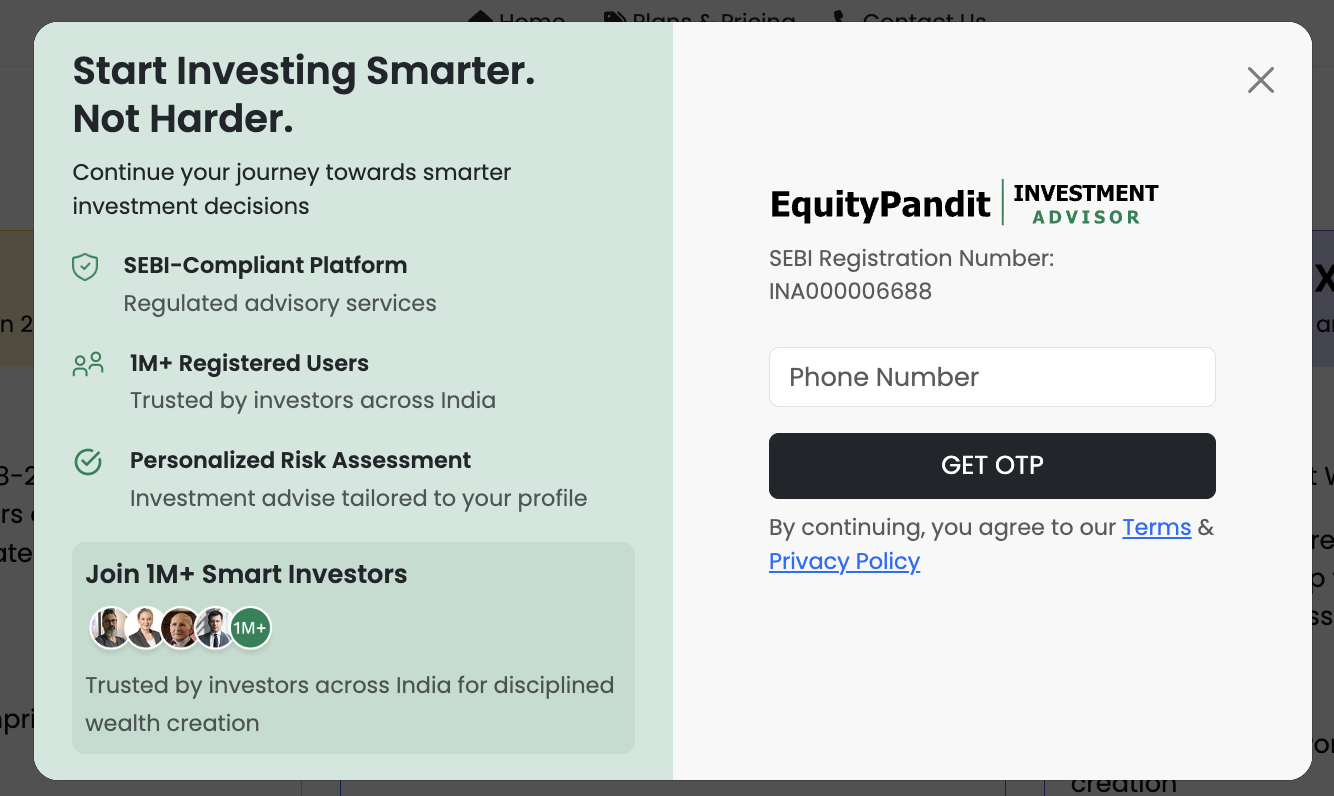
A login wall is not against any rule we know of. But it makes price comparison harder, and it means your number may be used for follow up calls or messages.
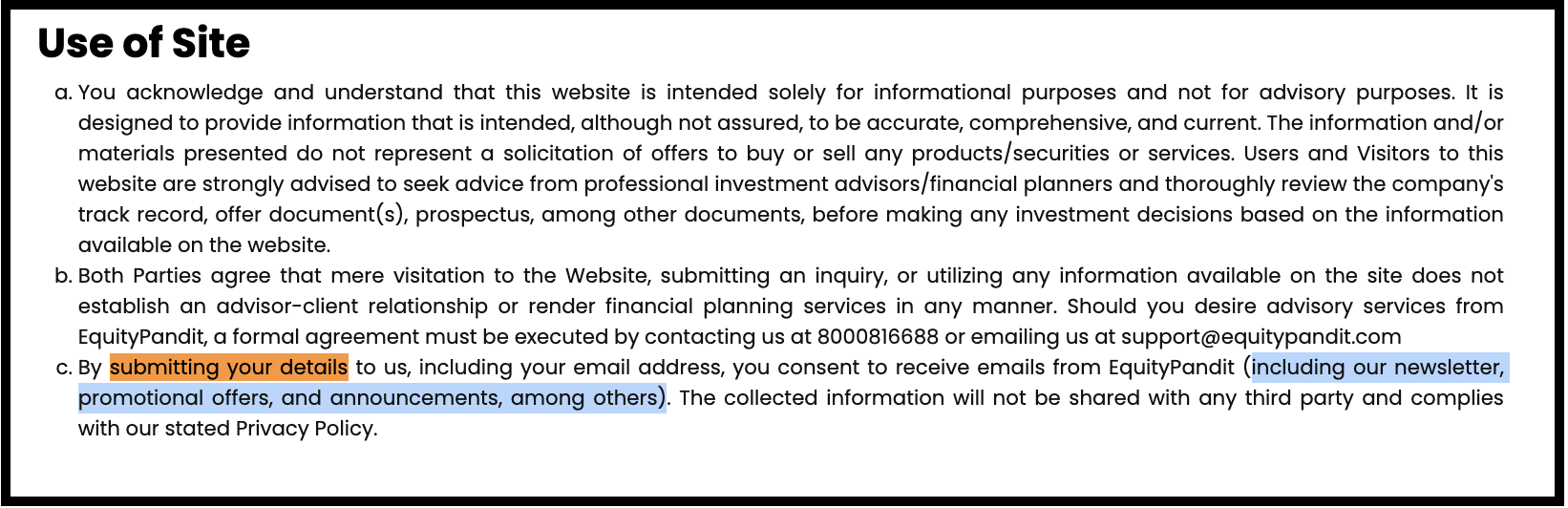
The terms also say that submitting your details counts as consent to receive newsletters, promotional offers and announcements. So the wall and the consent clause work together.
Here is a simple way to handle it.
Ask the firm to send the fee for each plan by email, with the plan period and the GST treatment spelled out.
SEBI caps what an Investment Adviser can charge in fixed fee mode at ₹1,51,000 per client family per year.
When a quoted price is higher, it may be that GST is added on top, since ₹1,51,000 plus 18 percent GST comes to ₹1,78,180.
We have no plan price from the firm to test against that cap. So treat the cap as a question to ask, not a finding.
Also confirm that you receive a risk profile assessment, a signed agreement and the Most Important Terms and Conditions document before any payment.
Those steps should come before fees, not after.
What Do EquityPandit’s Complaint Records Reveal?
Complaint tables tell you how often investors approached the firm or SEBI, and how fast problems closed.
SEBI requires advisers to publish this monthly by the seventh, so the as of date matters.
The firm’s page we reviewed carries the heading “August 2026”. Three tables follow, and we added up each of them below.
Start with the month ending August 2026. Read each row as “where the complaint came from”, then check the pending columns on the right.
|
Received from |
Pending at start | Received | Resolved | Pending at end | Pending over 3 months |
|
Directly from investors |
0 | 0 | N/A | 0 | 0 |
|
SEBI (SCORES) |
1 | 0 | 0 | 1 |
0 |
| Other sources | 0 | 0 | N/A | N/A |
0 |
| Grand total | 1 | 0 | 0 | 1 |
0 |
The monthly trend table is next. It shows one complaint received in May 2026 and carried forward as pending through June and July.
|
Month |
Carried forward | Received | Resolved | Pending |
|
Apr 2026 |
0 | 0 | 0 | 0 |
| May 2026 | 0 | 1 | 0 |
1 |
| Jun 2026 | 1 | 0 | 0 |
1 |
| Jul 2026 | 1 | 0 | 0 |
1 |
| Total | not applicable | 1 | 0 |
1 |
The annual table is the longest, so read it year by year. We added the columns ourselves and note the totals under the table.
|
Year |
Carried forward | Received | Resolved | Pending |
|
2018-19 |
0 | 3 | 3 | 0 |
|
2019-20 |
1 | 3 | 4 | 0 |
|
2020-21 |
0 | 2 | 2 |
0 |
| 2021-22 | 0 | 1 | 1 |
0 |
| 2022-23 | 0 | 0 | N/A |
0 |
| 2023-24 | 0 | 0 | 0 |
0 |
|
2024-25 |
0 | 5 | 5 | 0 |
|
2025-26 |
0 | 3 | 3 | 0 |
| 2026-27 | 0 | 1 | 0 |
1 |
| Grand total shown | not applicable | 18 | 17 |
1 |
Received complaints add up to 18 (3+3+2+1+0+0+5+3+1).
Resolved rows add up to 18 (3+4+2+1+0+0+5+3+0), while the grand total row shows 17.
The sums leave a few points a careful reader may want the firm to explain.
1. The Resolved Total Does Not Match Its Rows
Eighteen resolved rows against a printed total of 17 is a one complaint gap.
The 2019-20 row carries one complaint forward from the year before, yet 2018-19 closes with none pending.
Count that carried item and the firm handled 19 complaints, which would match 18 resolved plus the one pending.
Without it, 17 resolved plus one pending equals the 18 received. Either way, one number needs a correction or an explanation.
2. One Complaint Is Pending
The May 2026 complaint stays open in June, July and August, with zero resolved across those months.
The August table places it in the SEBI (SCORES) row, and the directly from investors row shows zero throughout.
That pattern means every complaint logged in the latest table reached the regulator, not the firm directly.
It does not say why, so ask the firm how its own grievance channel works.
3. The Over Three Months Column Shows Zero
A complaint received in May and still open at the end of August has been open for roughly three to four months, depending on the exact day.
The August table still shows zero under pending over three months.
The firm may count age from a different date, such as the date it received the SCORES notice.
A short written question will clear that up.
4. The History Starts Later Than the Registration
The annual table starts at 2018-19, while the registration dates from November 2016.
That leaves 2016 17 and 2017 18 unreported.
Those years may simply fall outside the disclosure format.
Still, you cannot judge the full record from nine rows alone.
5. The Reporting Period Does Not Line Up
The page is headed August, but the monthly trend stops at July.
The table also reports average resolution time as N/A or zero, even with one case open.
So you cannot tell from this page how quickly the firm normally settles a case.
Eighteen complaints over about eight years is a figure to weigh against the firm’s client count, which the research material does not give.
Also Read: Fluid Fincap has four complaints that appear in the monthly and annual disclosures, while the grand-total row shows zero.
What Does EquityPandit Claim About Its Users, Global Reach and Algorithms?
Advertising language shapes expectations long before you read a risk disclosure.
The firm’s website uses several big numbers and awards, so it helps to see them listed once.
The site cites more than 1 million registered users, over 32 countries, more than 350 research algorithms, 20 plus years of experience and 11 plus awards.
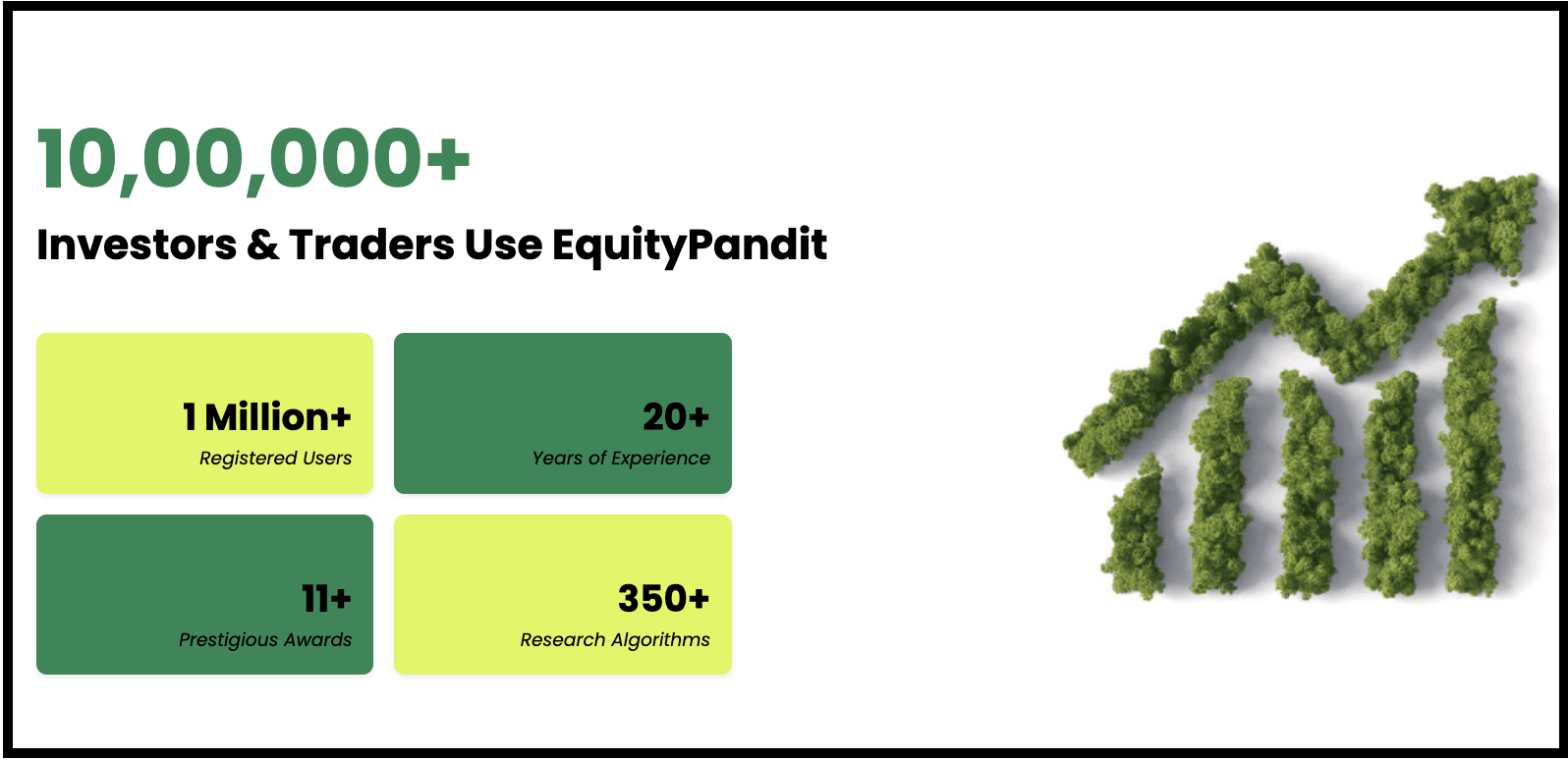
It also uses phrases such as “India’s Most Popular Investment Services” and says its insights “give you an edge”.
None of these figures came with a method note in the material we reviewed.
A registered user count does not tell you how many are paying clients, and an algorithm count does not tell you how the recommendations performed.
Awards and media mentions raise a similar point.
The site names publications and a title for innovation in financial services, but an award rarely reflects results an individual investor received.
SEBI’s rules ask advisers not to promise or imply assured or guaranteed returns.
Words like “results”, “succeed” and “committed to your financial success” are general, so a reader can decide how much weight to give them.

A sensible habit is to ask for the track record in writing.
SEBI expects advisers who share past performance to follow a prescribed format, so request the data behind any accuracy or success figure before you pay.
What Do EquityPandit’s Terms and Conditions and Refund Policy Say?
Terms decide what happens when a plan does not suit you.
They matter most for the person who subscribes, then changes their mind a few weeks later.
The research material points to four clauses worth reading closely. Take them one at a time.
1. One-Month Plans Are Non-Refundable
The terms say a one month subscription cannot be refunded.
If the plan does not suit you in week one, the fee for that month stays with the firm.
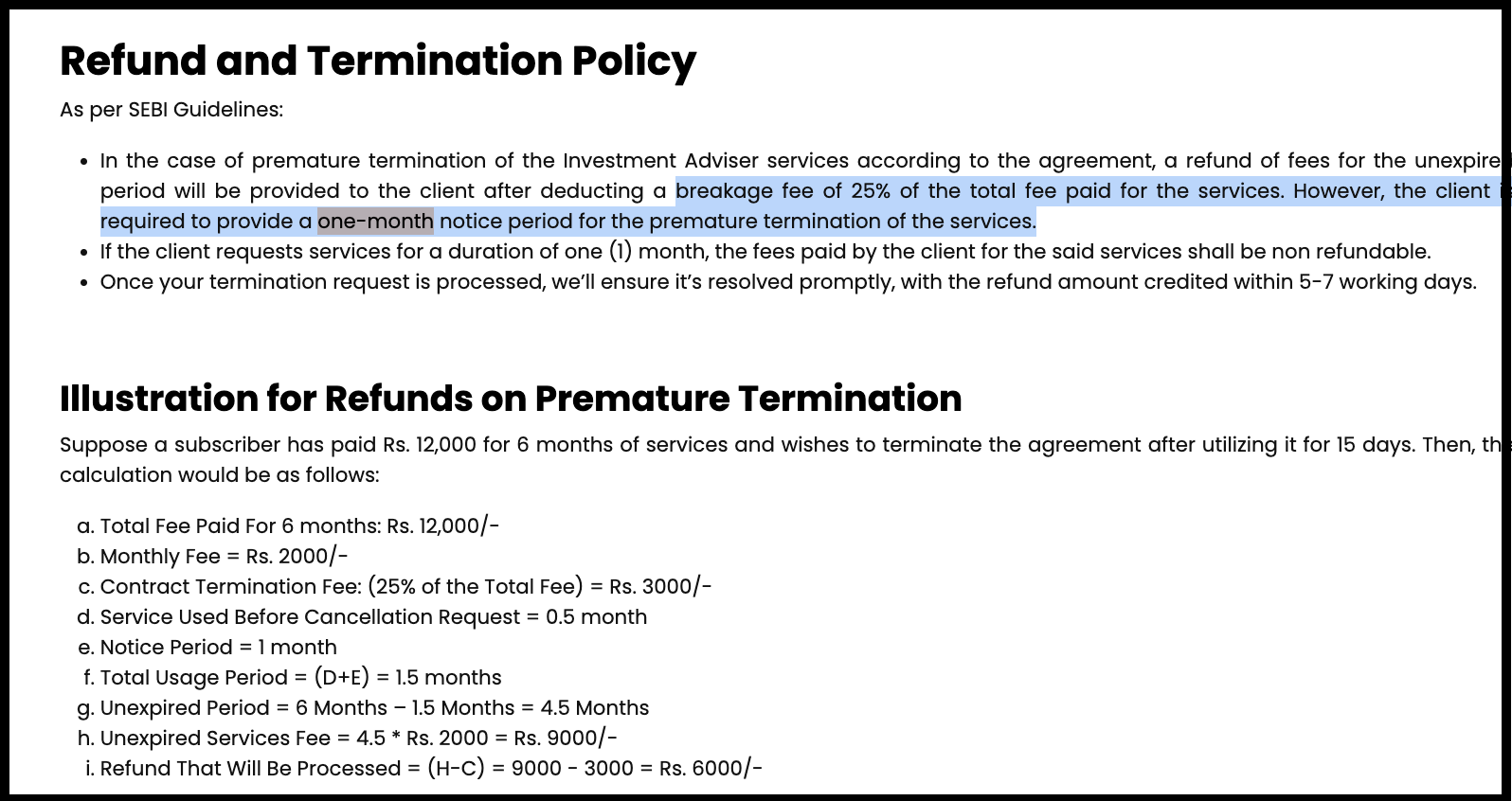
2. Early Exit From Longer Plans Carries a Charge
Ending a longer plan early triggers a 25 percent breakage fee and a one month notice period.
The wording we saw does not say whether the 25 percent applies to the whole fee or only the unused part.
Here is an illustration, not firm data.
On a hypothetical three month plan of ₹12,000, 25 percent of the whole fee is ₹3,000, while 25 percent of the two unused months is ₹2,000.
Ask which method applies, and whether the notice month is paid for as well.
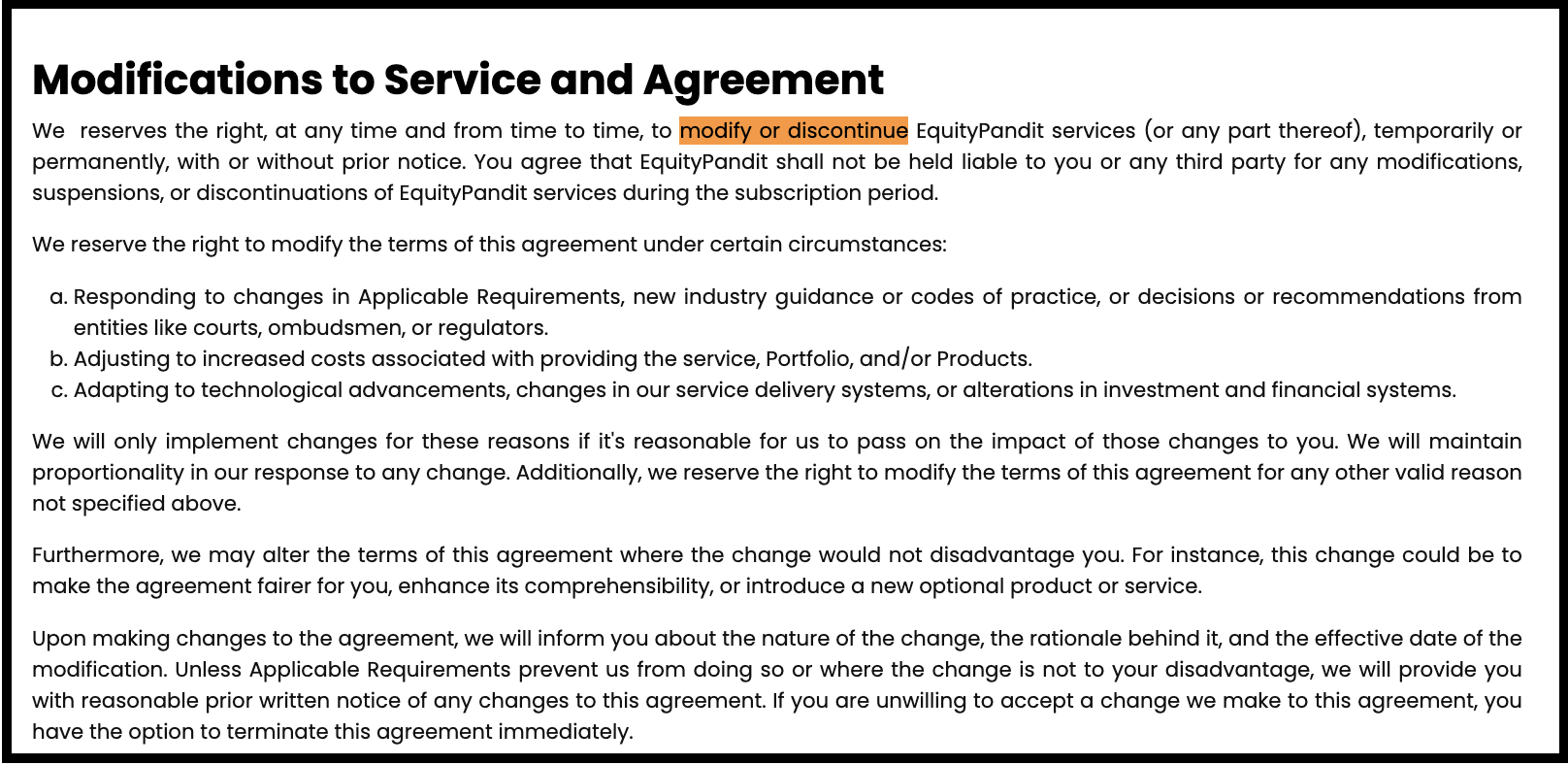
3. Services Can Change Without Notice
The terms let the firm change or stop services, temporarily or permanently, with or without notice, and limit its liability for that during your subscription.
A paid user may want to know what happens to the unused portion if a service ends.
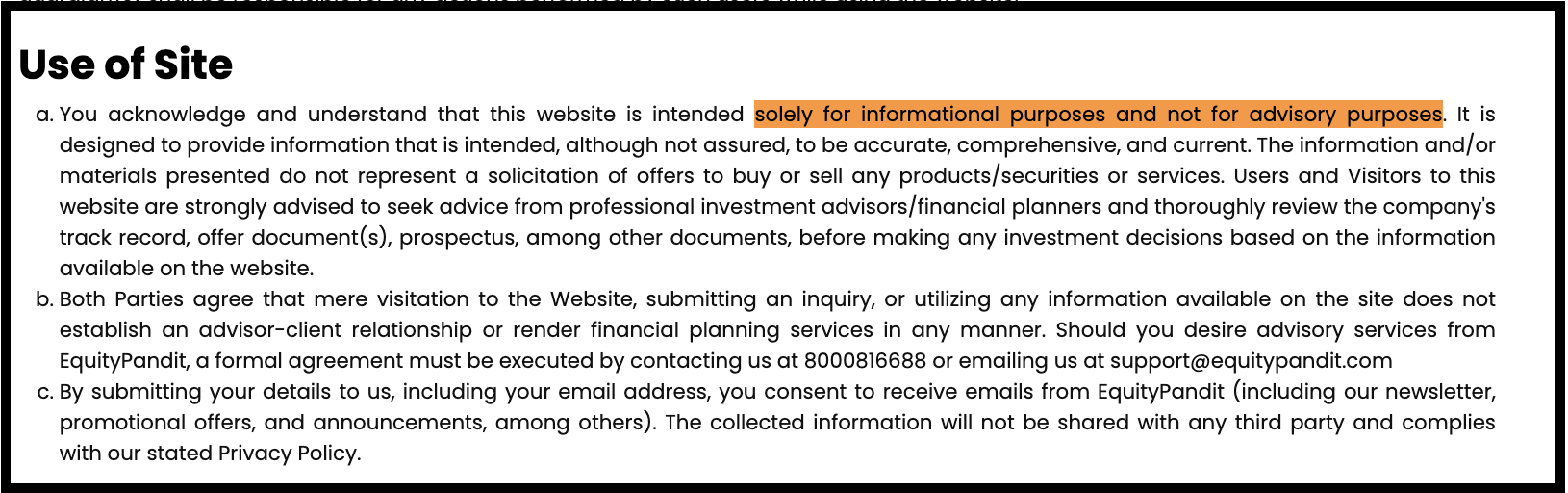
4. The Website Is Described As Informational
The terms say the website is for information and not for advisory purposes, while the site markets recommendations and personal solutions.
These two descriptions can sit together only if the paid advice is delivered under a separate agreement.
So ask for that agreement and the Most Important Terms and Conditions document.
Those papers, not the website, should define what you are buying.
Also Read: Moneycontrol terms include a ₹1,000 liability cap and arbitration in Mumbai, details worth reading.
EquityPandit Reviews on App Stores and Google
Reviews show what some customers felt after paying, but they are only individual opinions.
We have not verified any of them, and the firm may dispute them.
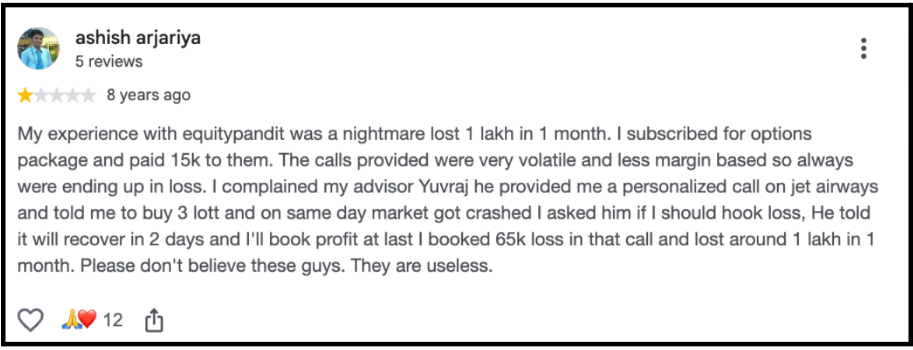
The research material gathered lower rated reviews from the app listing and from Google.
We reproduce at most a couple of short phrases and paraphrase the rest.
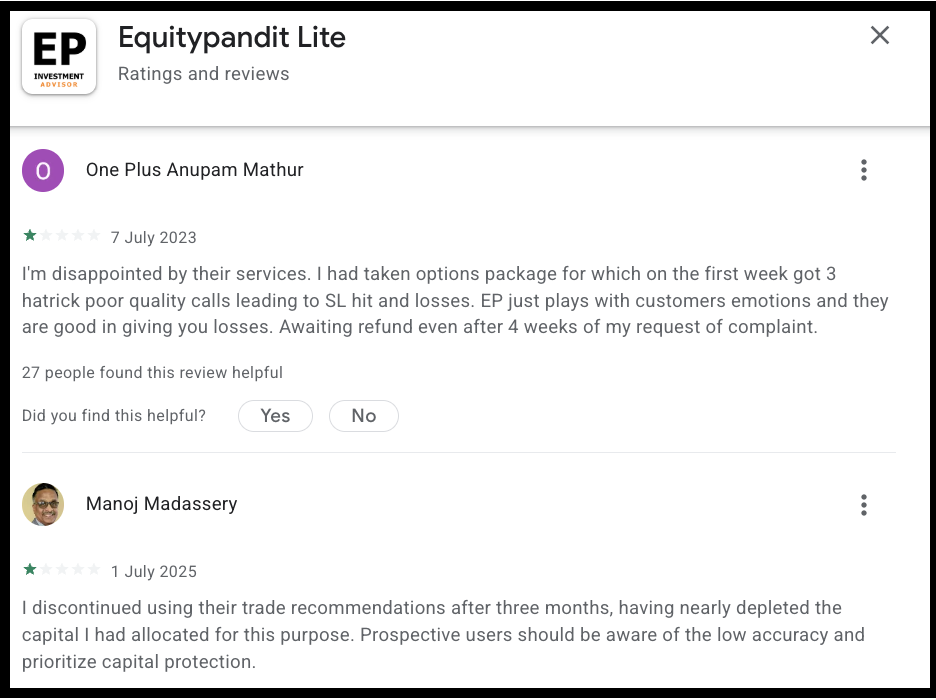
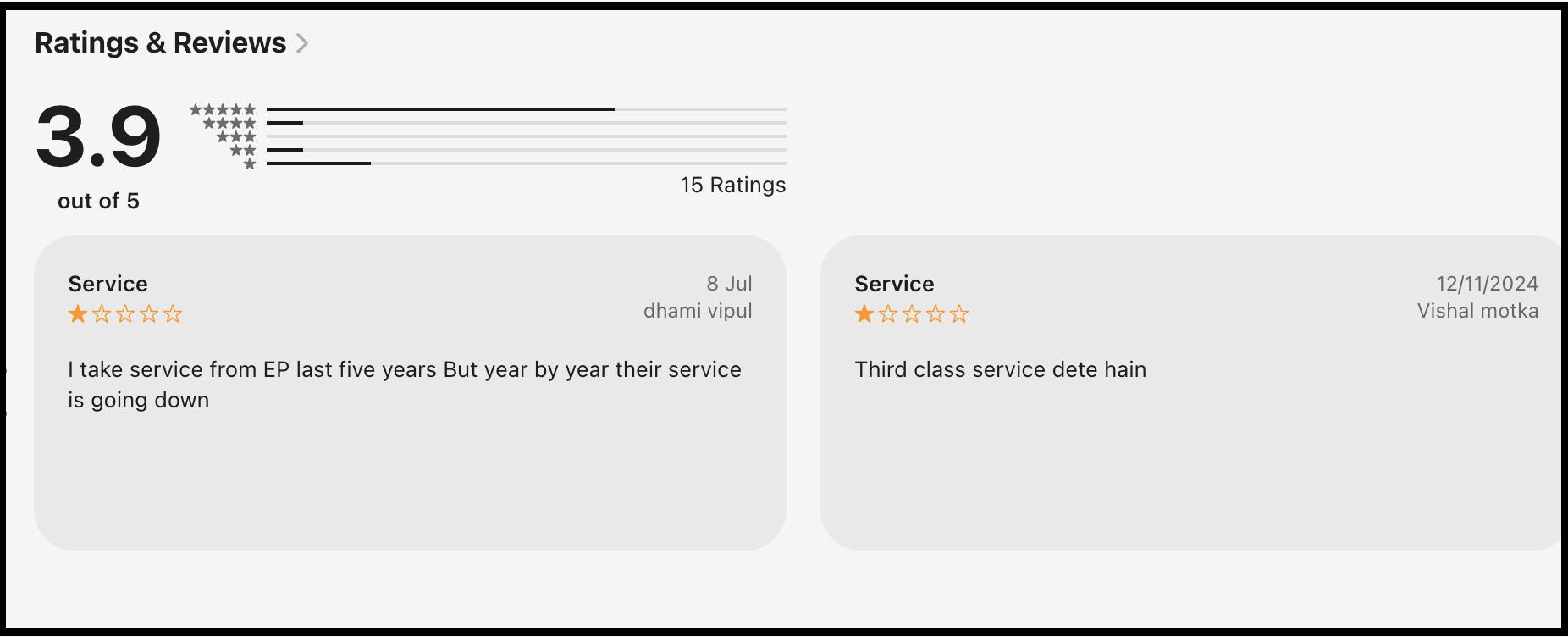
App reviewers wrote mainly about losses on option packages and recommendations that did not match the success level they expected.
One reviewer described “low accuracy” after three months, while another said they were still waiting for a refund four weeks after raising a request.
A long time user said the service has weakened year by year.
On Google, reviewers raised similar points about outcomes, refund rules and customer care.
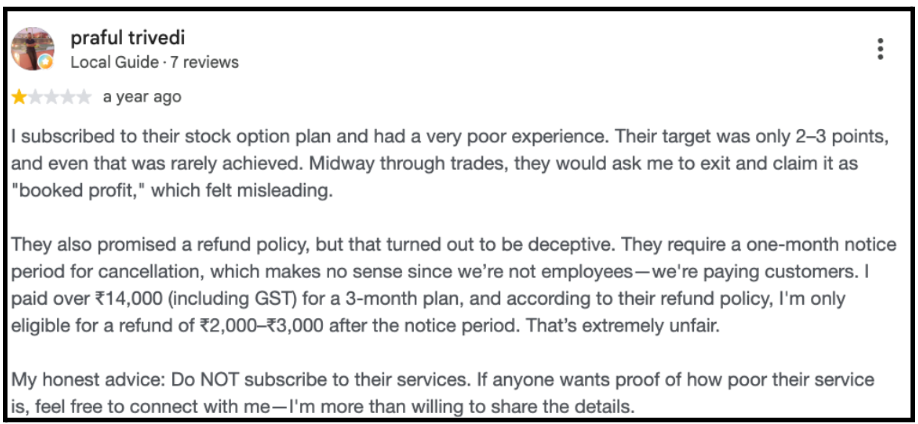
One said they had a “poor experience” with a stock option plan, and described being asked to exit trades midway.
That reviewer also said they paid over ₹14,000 including GST for a three month plan, and read the refund terms as returning only ₹2,000 to ₹3,000 after the notice period. We cannot confirm those figures.
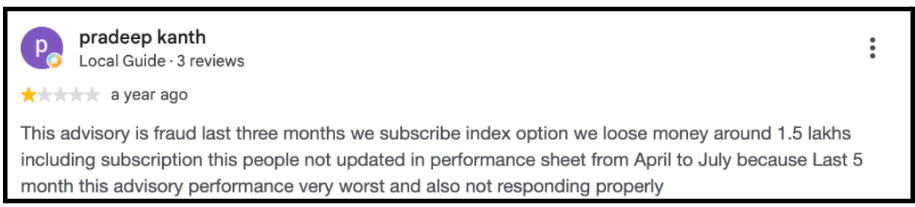
Another Google reviewer said the firm’s performance sheet had not been updated from April to July.
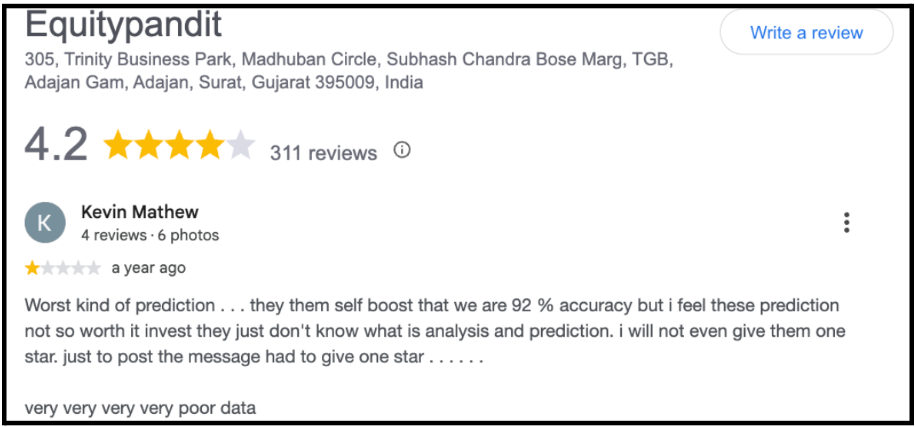
A different reviewer referred to an accuracy percentage they said the firm promotes, which we did not see in the material we reviewed.
One more review makes personal allegations about an individual employee.
We have left that out because we cannot verify claims about a named person.
Refunds, notice periods and performance disclosure come up again and again in these accounts.
Those are the terms worth getting in writing before you pay.
Still waiting on a refund you asked for?
Our team reviews your subscription papers, messages and payment proof, and prepares the complaint for the right forum. Register with us for a free consultation.
How Can You Contact EquityPandit and Escalate a Complaint?
Start with the firm. SEBI’s record lists a contact person and an email address, and the website has a contact section, so write to both and keep a dated copy.
State the plan, the amount paid, the date, and what you want, such as a refund or a corrected record.
Ask for a written reply within a stated number of days.
If the reply does not settle the matter, the regulator’s own system is the usual next stop.
Our guide to complaint on SEBI SCORES shows how the portal tracks a case from filing to closure.
The firm’s complaint tables show how often investors have used that route.
A complaint filed there reaches the firm, which then has to reply on the record.
Some disputes end better through a formal online process.
The SMART ODR portal explains how conciliation and arbitration work for investor disputes with SEBI registered entities.
Keep your paperwork in one folder while a case runs, because every forum asks for the same plan details, payment proof and dated messages.
Which route fits an Investment Adviser in particular depends on your facts.
Our page on a SEBI complaint against investment advisor lays out the options for that registration type.
Each route has its own timelines, so note the dates when you file and when the firm replies.
Those dates help you decide when to move to the next step.
Some disagreements move beyond conciliation. Our explainer on arbitration in share market covers what that step involves and when investors consider it.
Disclaimer
This blog is based on the firm’s published disclosures and publicly available SEBI records as of 10 October 2026. It does not allege wrongdoing, and the firm is welcome to share its side. We could not independently confirm the website’s claims, the review accounts, whether the 2018 penalty was paid or appealed, or the firm’s current fee schedule.
Conclusion
EquityPandit Financial Services is registered with SEBI as an Investment Adviser, and its registration is perpetual.
That settles one question, but it leaves the rest of your homework with you.
Before you pay, request the fee in writing, the signed agreement and the MITC.
Ask how the 25 percent breakage fee is calculated and what happens if a service changes.
Check the complaint page again each month, and ask the firm to explain the resolved total, the zero in the over three months column and the missing early years.
Read the 2018 SEBI order yourself, then decide how much weight it carries for your situation.
If you do subscribe, keep every message, receipt and call note in one folder.
Report. Recover. Stay Fraud Free.
Frequently Asked Questions
SEBI lists the company as a non individual Investment Adviser under INA000006688, valid from 15 November 2016 with no end date. You can match the name, number and address on SEBI's intermediary search before sharing any personal details.
We found one SEBI adjudication order from 2 April 2018 covering advisory activity before the firm's registration, with a ₹40 lakh penalty. We did not find a later order in the sources checked, and we could not confirm payment or appeal status.
The fee is not shown openly because the pricing page asks for a mobile number and login first. The listing shows minimum investments of ₹2 lakh and ₹20,000 per stock, but those are amounts invested, not advisory fees.
The terms say one month plans are non refundable, and early exit from longer plans carries a 25 percent breakage fee with a one month notice period. Ask the firm for a written worked example before you subscribe.
SEBI's record shows a Jaipur address and a Surat correspondence address, while the website points to Surat. Both may be genuine offices. Ask the firm which one it treats as its registered office for notices.





 Add us as a preferred source on Google »