
Quick Summary
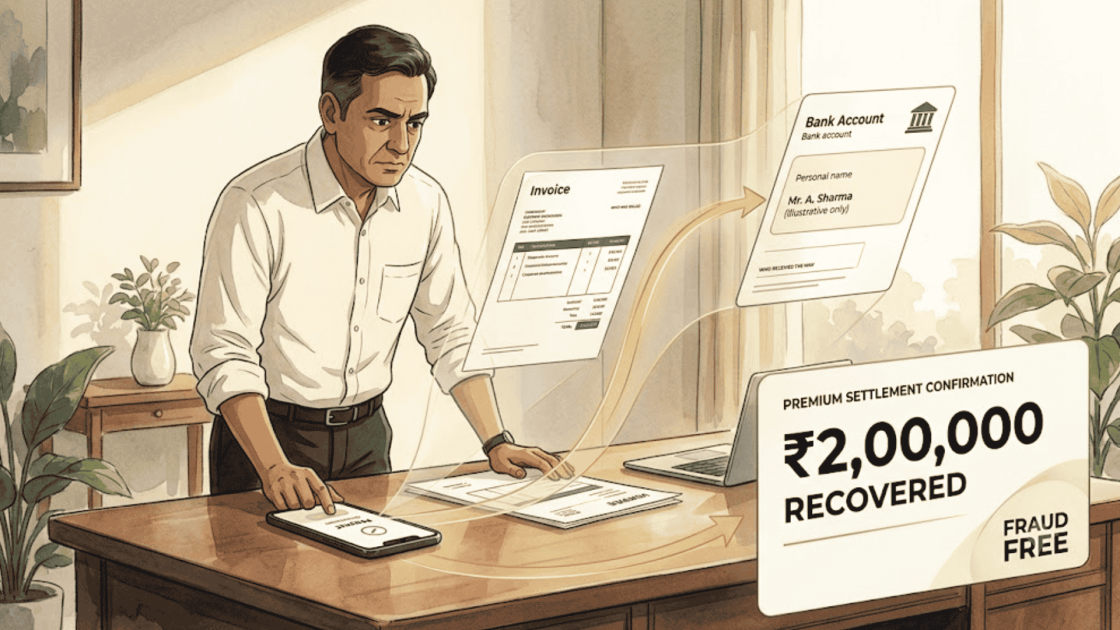
Deepak Nair (name changed) paid his advisory fees into what turned out to be a personal bank account rather than the registered firm’s account. His claim totalled 3,00,000. That single fact, verified through bank statements, became the anchor of the file. Our team recovered 2,00,000 for Deepak, a 66.7 percent share.
Deepak (name changed) signed up with a research analyst firm after attending a webinar in late 2024. During onboarding, he was given a UPI ID and bank account number for payment. Both, however, were held in an individual’s name, not the firm’s.
Over the next four months, Deepak made three instalment payments totalling ₹3,00,000. Each payment went to the same personal account details provided at the beginning.
For a SEBI-registered research analyst, client fees should be collected through an account held in the registered entity’s name. Routing payments to an individual’s personal account raises a serious compliance concern.
The issue became clearer when Deepak later asked for a formal invoice carrying the firm’s registration number. The document he received contained mismatched details. The name on the invoice did not match the account holder shown on his bank statement.
That left a straightforward but important question: if the invoice belonged to the firm, why had the money been sent to someone else’s account?
Most clients never check the name behind a UPI ID before making a payment. During a quick onboarding call, a partially displayed name can easily go unnoticed.
Deepak discovered the mismatch only months later, when he tried to reconcile his bank statement with the firm’s invoice for tax purposes. By then, all three payments had already been made.
4-Step Recovery Strategy: Using Bank Proof to Hold the Adviser Accountable
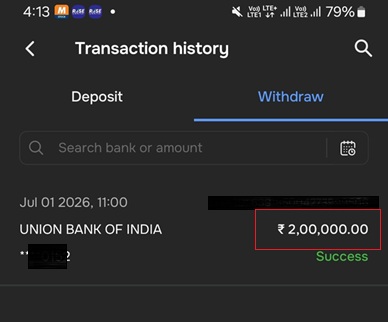
We started with Deepak’s bank statements, since they showed the account holder name attached to every transfer he had made.
Step 1: Uncovering the Account Holder’s True Identity
We obtained the account holder name behind the UPI ID and account number Deepak had used, confirming it did not match the registered firm.
Step 2: Cross-Checking the SEBI Authorized Signatory List
We checked the firm’s SEBI registration details and confirmed the individual receiving payment was not listed as an authorised signatory for client funds.
Step 3: Documenting the Discrepancy Between Invoice and Payment Destination
We placed the invoice next to the bank statement to show the discrepancy between the billed entity and the actual payment recipient in one document.
Step 4: Escalating the Complaint via the SEBI SCORES Portal
Our complaint through the SEBI SCORES centred on the account mismatch, supported by bank statements and the mismatched invoice as primary evidence.
The firm initially claimed the personal account belonged to an authorised staff member collecting payments on its behalf.
We pointed out that SEBI rules require client fees to reach a registered entity account, not an individual’s personal account, regardless of role.
The Outcome: ₹2,00,000 Recovered
Once the bank records clearly established the payment mismatch, the firm agreed to settle rather than contest the evidence further.
Deepak recovered ₹2,00,000 of his ₹3,00,000 claim, representing 66.7% of the amount claimed.
The matter was settled within ten weeks of filing the complaint, bringing the dispute to a close.
Suspect your advisory fees went to an unauthorized personal account?
Register with us, we’ll assist you end-to-end with case drafting, account verification, and regulatory escalation.
Conclusion
Where your fee actually lands matters as much as how much you pay. A mismatched account name is a fact, not an opinion, and facts are easy to prove.
Take five minutes to check the account holder name behind every advisory payment you have made. It is one of the simplest checks that can protect you early.
When the entity behind a payment is genuinely unclear, our team also handles general complaints against SEBI-registered intermediaries to keep the file moving.
Report. Recover. Stay Fraud Free.
Frequently Asked Questions
Compare the account holder name on your bank statement against the registered entity name shown in the firm's SEBI registration details.
Your bank statement usually reveals the linked account holder name even for UPI payments, which our team can help you trace.
Not automatically, but it is a clear compliance breach on its own and often points to deeper issues worth investigating further
Yes. Bank statements alone often carry enough weight to establish where your fee actually went.





 Add us as a preferred source on Google »

