
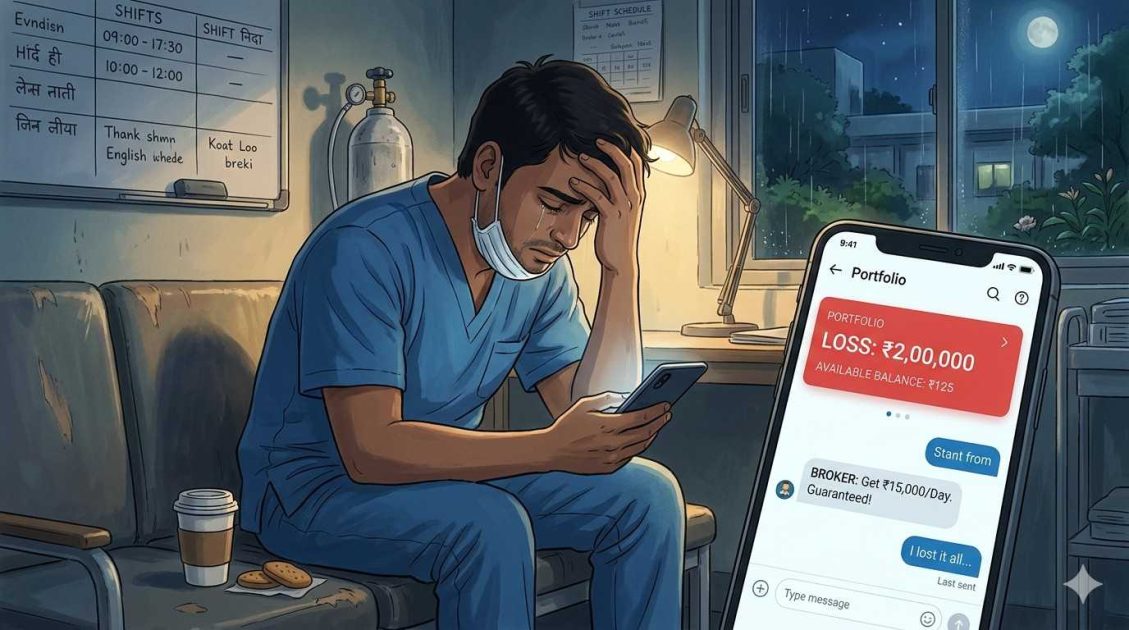
Ramesh (name changed) works at a hospital and takes home somewhere between ₹10,000 and ₹15,000 a month.
The calls came at him relentlessly, four times a day, until the pressure itself became exhausting.
Ramesh kept putting them off, telling them the simple truth: I work full days at a hospital, my salary is small, I do not have the time for this.
The callers, from a SEBI-registered broker, had an answer for that too.
You will not have to do anything, they said. We will appoint a dealer for you. We will give you the profit.
And then they named the number that was designed to break his resistance: a guaranteed ₹15,000 a day.
Sit with that against his payslip. They were promising him, in a single day, slightly more than he earns in an entire month.
That is not an opportunity. That is a measurement of how much hope a tired man can be sold.
How the Trap of Promised Daily Returns Was Set?
The offer was built to remove every objection. No charges, they said.
You do not even need to learn to trade, because we will appoint a dealer to do it for you.
An OTP will arrive, and the trade will go through on that OTP, and the profit will be yours. To make it feel real, they sent him fake trading profit screenshot.
So Ramesh tried, cautiously.
They had told him the minimum was ₹50,000, and he put it in, starting small, even from a couple of hundred rupees at a time.
On the first day, the screen showed a tidy ₹1,000 to ₹2,000 profit. Belief, purchased cheaply.
The very next day, the script turned, as it was always going to.
The capital was “short,” they said. For proper position sizing he would need to make it ₹1.5 to ₹2 lakh.
Do that, and the guaranteed ₹15,000 a day would begin.
The trading itself sat on a separate app run by their “trading firm,” and the money did not move through any regulated broking account.
It went out through Google Pay and PhonePe, into their accounts. He never sent call recordings, but he kept the WhatsApp chats and the transaction and OTP records.
Signs of an Unauthorized Account Handling Scam in This Case
Almost every promise they made was a rule being broken, and you can see it by simply lining up what they said against what is allowed.
1. A guaranteed ₹15,000 a day is a promise no one is permitted to make
No registered intermediary may assure you a profit, because in a market nobody controls, a guarantee is always a lie. The cruelty here is in the sizing: the figure was set just above his monthly wage, because the bait is always cut to fit the person.
A number that good, said that confidently, is the warning, not the offer.
2. “We will appoint a dealer so you don’t have to trade” is account handling
A broker exists to execute the instructions you give, not to put a stranger at the controls of your account. The moment they offered a “dealer” to trade for him, and asked that trades run through an OTP he would share, they were taking the wheel.
Sharing that OTP is handing over the keys, and no genuine broker needs them.
3. “Make it ₹2 lakh for position sizing” tells you what the plan was really about
The jargon sounds technical, but the function was simple: get more money in. When yesterday’s ₹50,000 is suddenly “too little” and today’s demand is ₹2 lakh, the product was never the trading.
It was the deposit.
4. Money through GPay and PhonePe, into their accounts, on a separate app, is the brightest flag of all.
When you trade through a real broker, your trades sit in your own account and your money stays inside the regulated system.
Funding a private app by transferring to someone’s personal payment handle means your money has quietly left that system altogether, which is exactly where it becomes impossible to get back, unless it is documented.
And it is documented.
His WhatsApp chats carry the guarantee and the escalating demands in their own words, and his transaction and OTP records show where the money actually went.
Ramesh does not need a recording when the promises are sitting in writing.
What Retail Traders Can Learn From This Case?
The tell in this whole story is arithmetic, and it needs no market knowledge at all.
When someone guarantees you in one day what you earn in a month, they are not offering you work, they are taking your measure.
The bigger and more certain the daily number, the more certain you should be that it is bait.
Many victims look at these setups and ask: Is account handling legal? Under SEBI regulations, the answer is a definitive no.
And the instant the plan becomes “deposit more, share an OTP, and let our dealer trade it for you,” the money was always the point, not your profit.
A real broker places trades in your own account, on your own instruction, and never needs you to fund an app through a payment handle or hand over a code so a stranger can act in your name.
For a man on ₹15,000 a month, the safest ₹15,000 a day is the one nobody ever promised him.
How to File a Complaint Against a SEBI Registered Broker?
Step 1: Secure Your Chat and Transaction Evidence
Immediately back up and export your entire WhatsApp chat history with the broker. Secure screenshots of their guaranteed profit promises, screenshots of the private app, and the messages where they demanded your OTP.
Download your Google Pay or PhonePe transaction receipts showing exactly where your ₹2 lakh was sent.
Step 2: Escalate to the Broker’s Principal Officer
Send a formal, written grievance email to the Compliance Officer and Principal Officer of the SEBI-registered broker.
State clearly that their representatives used high-pressure tactics to solicit a ₹2 lakh deposit, promised an illegal “guaranteed daily profit of ₹15,000,” and engaged in prohibited account handling via OTP sharing.
Step 3: File a complaint in SCORES
If the broker rejects your grievance, ignores your emails, or blames market risk, you need to know how to lodge complaint in SCORES to escalate the matter effectively.
Lodging a formal dispute on the SEBI SCORES portal is your next immediate step.
Once there, upload your payment screenshots, the written profit guarantees, and evidence of OTP demands to prove the intermediary violated the SEBI Code of Conduct.
Step 4: Request Device and IP Terminal Logs
Contact your stockbroker’s main compliance team and demand the technical log fingerprints (IP addresses and Device IDs) for every trade executed during the fraud.
Proving that the trades were placed from the dealer’s location, and not from your own phone or hospital workstation, dismantles their defense that you placed the trades yourself.
Step 5: Raise a Complaint in SMART ODR
If the SCORES response is unsatisfactory or the firm denies operating the private app setup, move your dispute to the SMART ODR platform.
This online marketplace dispute mechanism places your transaction trails and terminal logs in front of an independent arbitrator for a binding resolution.
Step 6: File for Stock Market Arbitration
During the virtual arbitration hearings, do not let the firm distract you by claiming you gave them permission. Focus entirely on the regulatory breach: brokers and dealers are strictly prohibited from guaranteeing fixed returns or executing unauthorized trades via client OTPs.
Once the arbitrator verifies the illegal setup, they can issue a binding award to refund your capital.
Need Help Navigating Your Recovery Case?
Many retail investors feel helpless because they voluntarily shared their OTP or transferred money via UPI.
You might believe that your misplaced trust means you have lost your right to fight back. This is absolutely false.
We help victims cut through the jargon and hold rogue intermediaries accountable.
A SEBI registration is a badge of responsibility, not a license to exploit working-class individuals with fake promises of ₹15,000 a day.
Our team will audit your chat records, map your payment trails to unauthorized accounts, pinpoint the exact regulatory violations, and build an airtight file for your recovery case.
If a broker trapped you with “guaranteed daily profits” and wiped out your savings, reach out to us today to evaluate your legal options.
Conclusion
Frequently Asked Questions
1. Can a broker appoint a “dealer” to trade my account through an OTP?
No. A broker executes the instructions you give. Putting someone else at the controls of your account, with trades run on an OTP you share, is account handling, which is not permitted, and sharing that OTP hands over control.
2. Is a guaranteed daily profit ever real?
No. No registered intermediary can guarantee a profit. A confident, specific daily figure, especially one near or above your income, is bait.
3. They want me to deposit ₹2 lakh for “position sizing.” Should I?
Treat it as a stop sign. When the required deposit keeps climbing and the money goes to personal payment handles or a separate app, the deposit, not your profit, is the goal.


 Add us as a preferred source on Google »

