
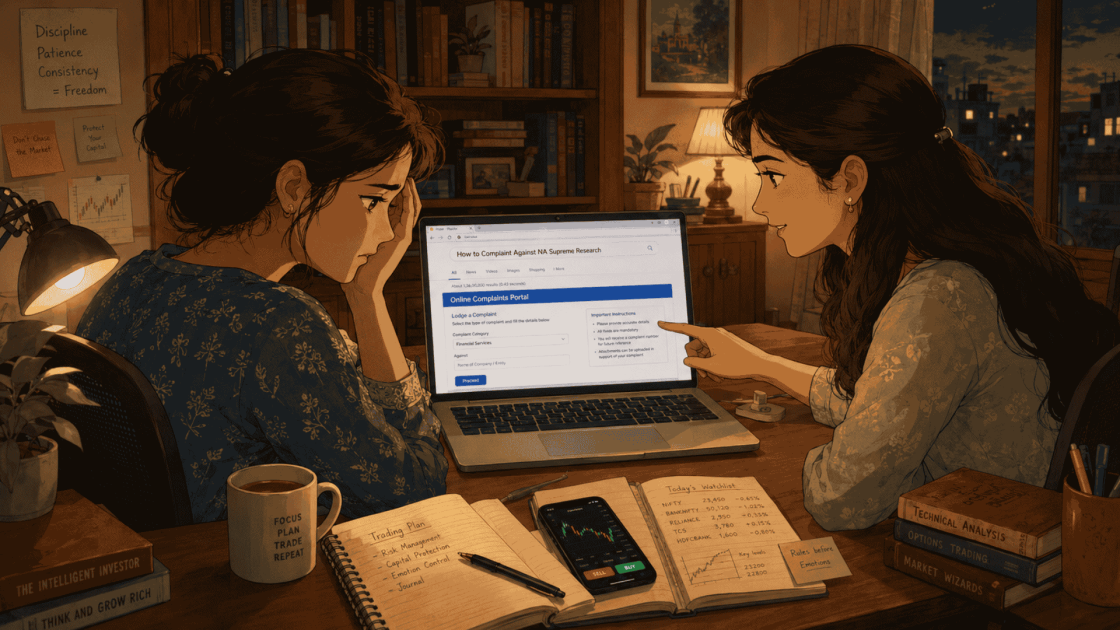
Have you ever trusted a research service, only to feel disappointed when the results did not match the promises?
What starts as hope for better investment decisions can quickly turn into frustration when losses pile up, support disappears, or constant pressure begins to take over.
If that sounds familiar, you may already be searching for how to complaint against NA Supreme Research.
The good news is that you do not have to stay confused about what to do next. There is a proper process available to raise your concerns and seek redressal.
In this blog, you will learn the steps you can take, the documents you should keep ready, and the options available if your issue remains unresolved.
How to Complaint Against NA Supreme Research Online?
If you are dealing with NA Supreme Research, the first thing to know is that there is a structured way to file a complaint against a registered research analyst.
The process becomes much stronger when you follow each step carefully and in the correct order.
Step 1: Save Your Evidence
This is the most important step and the one most investors skip.
Before you contact NA Supreme Research, before you reply to any message, before you raise any dispute, save everything you have.
Save all of the following immediately:
- Payment receipts and the original service agreement or subscription confirmation.
- All WhatsApp messages, voice notes, and Telegram messages with timestamps intact.
- Screenshots of any guaranteed return promises, loss recovery pitches, or upgrade offers.
- Call recordings, if you have them, from your phone.
- Trading account statements showing the specific trades and the losses.
- All emails sent to NA Supreme Research and any replies received.
- Contract notes for the disputed trades.
- The name and date of every call where promises were made.
Do this before contacting anyone. Once a formal dispute is raised, communication patterns change, and documents become harder to collect.
2. Register the complaint with the NA Supreme Research
Send your complaint directly to NA Supreme Research through their grievance process.
Complaints can be raised in writing, orally, telephonically, or via email, and the company is expected to reply within 10 business days.
NA Supreme Research Email
Email is the most reliable option as it creates a written, timestamped record.
Include your name, account details, a clear description of the issue, supporting attachments, and the resolution you expect.
Save a copy once sent, and if no reply comes within 10 business days, that silence becomes part of your evidence.
3. Raise a Complaint with SEBI SCORES
If NA Supreme Research does not respond within 30 days, or if the response does not resolve the actual issue, file on SEBI SCORES at scores.gov.in.
Note that many investors mistakenly look for a direct SEBI SCORES mail ID to send their grievances, but SEBI processes these complaints strictly through its online portal or mobile app to ensure proper tracking
When filling the SCORES form:
- Select Research Analyst as the intermediary type.
- Enter NA Supreme Research Private Limited as the firm name.
- Enter INH000017745 as the registration number.
- Attach all your evidence in organised, clearly labelled files.
- In the complaint description, describe the sequence of events factually: what you paid for, what was promised, what happened, and what specific SEBI regulation was violated.
Filing on SCORES creates a formal regulatory record.
NA Supreme Research is required to respond within a defined period. Non-response or inadequate response by the firm triggers SEBI’s direct intervention.
4. Lodge a Complaint in SMART ODR
If SCORES does not produce resolution within the mandated response window, escalate to SEBI’s SMART ODR portal.
SMART ODR is SEBI’s Online Dispute Resolution platform. It provides structured mediation between the investor and the registered intermediary, with defined timelines and binding outcomes.
It is accessible directly after the SCORES process and before arbitration.
SMART ODR has produced binding recovery awards in similar RA cases.
The process is online, does not require physical attendance, and is accessible to retail investors without a lawyer.
5. Stock Exchange Arbitration
If the dispute remains unresolved, arbitration becomes the final formal step. Arbitration is a structured legal process where the matter is reviewed and decided according to the available records and claims from both sides.
This step usually becomes relevant when losses are significant or when the earlier complaint and resolution routes do not bring relief.
For claims below Rs. 10 lakh, there is no investor filing fee for exchange arbitration.
Time limit: File your initial complaint and initiate the process within 3 years of the incident. The earlier you act, the stronger your evidence trail and the easier it is to reconstruct the sequence of events.
When Should You File a Complaint Against NA Supreme Research?
Not every disappointing trading outcome is a complaint.
These are the specific situations where you have grounds for a formal SEBI complaint against NA Supreme Research.
1. File if a representative promised guaranteed returns or loss recovery.
Under SEBI Research Analyst Regulation 15(9), guaranteed return promises are prohibited.
Any representative who told you losses would be recovered, returns were assured, or the next set of calls would definitely make up for previous losses made a prohibited representation.
That promise, if documented, is the starting point of your complaint.
2. File if you were given trade recommendations outside your subscribed plan.
If you paid for the Prime Index Hub (index options) and received stock options recommendations, or paid for the Quantum Stocks Trade and received futures tips, the service delivered was outside the contract scope.
This is a specific complaint basis regardless of whether the trades were profitable or not.
3. File if fees were escalated beyond the original agreement without a new written contract.
If your subscription started at one price and you were charged more, whether through an upgrade sold after losses or additional charges added without a fresh written agreement, the excess amount was collected without proper disclosure.
4. File if a loss recovery upgrade was pitched after you incurred losses.
A representative specifically offering an upgrade programme as a solution to your losses is using prohibited language.
The upgrade pitch implies that the higher fee will recover previous losses. That implication is a form of a guaranteed return promise under SEBI regulations.
5. File if the firm is not responding to your written refund request.
A firm that does not respond to a formal written complaint within 30 days triggers the next escalation step.
You do not need to wait indefinitely for a response before escalating to SCORES.
How to Build a Strong Evidence Package?
Across all five steps, the strength of your case depends on what you can document.
If you look at online NA Supreme Research reviews, many investors face similar issues with unfulfilled promises. To ensure your complaint stands out, you need a solid file.
Here is the specific evidence package that makes an NA Supreme Research complaint most effective.
- The original service agreement or subscription confirmation email: This establishes what you paid for, the service scope, and the agreed-upon fee.
It is your baseline for everything that follows. - The promise documentation: The WhatsApp message, voice note, or call recording in which a guaranteed return or loss recovery was promised.
If it was verbal and unrecorded, note the date, time, name of the representative, and the exact words used as soon as possible after the call. - The out-of-scope recommendation documentation: The specific message or alert where you were recommended your contracted plan, with the date and the trade details.
- The trading statement: Your brokerage account statement showing the specific trades entered based on NA Supreme Research recommendations, the dates, the amounts, and the losses incurred.
- The upgrade pitch documentation: The message or call record where the loss recovery upgrade was offered, with the upgrade fee and the language used to describe it.
- The unanswered refund request: Your written refund request with the date sent, and either the response received or the absence of one.
A strong complaint starts with the right preparation.
Our team helps organise your evidence, maps it to the relevant regulations, and prepares your complaint for the appropriate authority.
Conclusion
Filing a complaint is important because silence often protects the wrong side, not the investor.
When a service creates losses, pressure, or false promises, your records become your strongest support.
The complaint process is not random, and following the correct order improves your chances of a proper response.
Start with evidence, then complain to the company, and escalate to SCORES if needed. If the issue remains unresolved, SMART ODR and arbitration can provide further redressal.
Timely action matters because delays can weaken proof and slow down relief. A complaint also helps other investors by creating accountability and visible records.
If the story felt familiar, taking action now is better than carrying the loss silently.
Frequently Asked Questions
1. What is the first step to complaint against NA Supreme Research?
Save all your evidence before doing anything else. WhatsApp messages, payment receipts, trading statements, and any documented promises or upgrade pitches.
Do this before contacting the firm or raising any dispute. Once a formal complaint begins, communication patterns change, and documents become harder to collect.
2. What registration number do I use when filing on SEBI SCORES?
Enter NA Supreme Research Private Limited as the firm name, Research Analyst as the intermediary type, and INH000017745 as the registration number.
These three details must be entered accurately for the complaint to be routed correctly.
3. How long does SEBI SCORES take to resolve a complaint?
SEBI requires the registered intermediary to respond to SCORES complaints within a defined period, typically 21 to 30 days. If the response is unsatisfactory or does not come within the window, you can escalate to SMART ODR.
The full process from SCORES to SMART ODR resolution typically takes 2 to 6 months, depending on the complexity of the case.
4. Can I file a complaint even if I signed a no-refund agreement?
Yes. A no-refund clause in a subscription agreement cannot override SEBI regulatory obligations.
If NA Supreme Research violated SEBI’s Research Analyst Regulations during your engagement, the clause does not protect them. SEBI adjudicators and arbitration tribunals have upheld investor complaints in these circumstances.
5. What is the time limit to file a complaint against NA Supreme Research?
File within 3 years of the incident. Acting early is significantly better because your evidence is freshest, communication records are easier to retrieve, and the sequence of events is easiest to reconstruct.
If you experienced issues in 2023 or 2024, you can still act.
6. Do I need a lawyer to file on SEBI SCORES or go to arbitration?
You do not need a lawyer for SCORES filing.
For arbitration, you can represent yourself, but having expert support significantly improves your chances of a favourable award, particularly when it comes to organising evidence correctly and responding to the firm’s submissions.
Our team provides this support without requiring you to engage a formal legal firm.





 Add us as a preferred source on Google »

