

NA Supreme Research Private Limited is SEBI registered under INH000017745. That registration is real.
What is also real is that the firm handled 51 investor complaints in 2025-26, that 22 of those were carried forward unresolved from the previous year, and that at least one documented case shows an investor losing Rs. 65,000 across fee escalation and a loss recovery pitch.
This page covers that case in detail, what the complaint trend actually tells you when you read it as a pattern rather than a statistic, and what to do if your experience matches what is described here.
NA Supreme Research Reviews: The ₹65,000 Investor Loss Case Explained
This is a real case from a formal complaint record.
It is documented here in full because it is the clearest illustration of how the complaint pattern at NA Supreme Research unfolds in practice.
The investor paid Rs. 40,000 for NA Supreme Research’s index options plan. The service was supposed to provide research recommendations for Nifty and Bank Nifty index options trades.
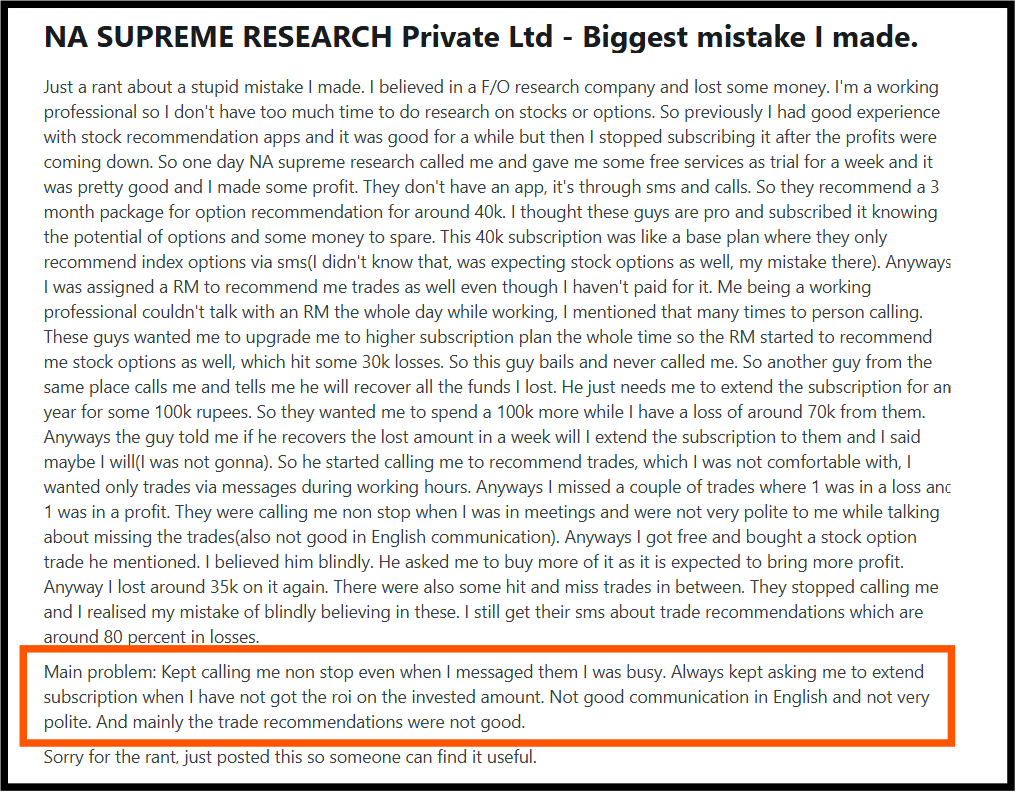
Within a few weeks of subscribing, the assigned representative began recommending stock options trades. This is a different segment from index options.
The investor was not told that stock options were outside the scope of the plan they had paid for. They followed the recommendation.
The stock options trades resulted in a loss of Rs. 30,000.
At this point, the representative introduced a recovery pitch. The investor was told that the losses could be recovered through a premium upgrade programme.
The upgrade was priced at Rs. 1,00,000. The investor, already down Rs. 30,000 and wanting to recover those losses, paid a portion of the upgrade amount.
The trades that followed the upgrade resulted in a further loss of Rs. 35,000. The investor attempted to get a refund. The firm pointed to the subscription agreement.
Total documented loss across the engagement: Rs. 65,000.
The three violations present in this case:
- First, recommending trades outside the subscribed service without disclosure. The investor paid for index options and was given stock options advice.
The service delivered did not match the service purchased. - Second, using loss recovery promises to sell a higher-cost programme. Under SEBI Research Analyst Regulation 15(9), an RA cannot promise to recover past losses through future recommendations.
The upgrade pitch, framed as a solution to the losses already incurred, is a prohibited representation. - Third, refusing a refund when services were not delivered as agreed. When the delivered service does not match the purchased service, the no-refund clause in the agreement does not automatically protect the firm.
SEBI regulatory violations override private contract clauses.
If your experience with NA Supreme Research followed a similar pattern, the sequence of events above is what your complaint should describe.
The specific services paid for, what was actually delivered, the recovery pitch, the language used, and the total amount lost across each stage.
If you recognise this pattern in your own experience, our team prepares your documentation and files your complaint with the specific violations identified above.
What Does the NA Supreme Research Complaint Data Show?
As a SEBI-registered entity, NA Supreme Research is required to maintain transparency regarding client grievances by publicly disclosing its dispute history.
Looking closely at these official metrics reveals critical patterns about how efficiently investor issues are processed and resolved over time.
Here is a breakdown of the firm’s complete complaint data:
| Year | Carried Forward | Received | Resolved | Pending |
|---|---|---|---|---|
|
2024-25 |
0 | 0 | 0 | 0 |
| 2025-26 | 22 | 29 | 26 |
1 |
|
Grand Total |
22 | 29 | 26 |
1 |
Most investors look at this table and see the 96% resolution rate and stop there.
That reading misses the most important signal in the data.
What the 22 carried-forward complaints actually mean: The firm entered 2025-26 with 22 complaints already open from the previous period.
These were investors who had raised formal grievances and had not received a resolution by the end of 2024-25.
A firm that carries 22 unresolved complaints into the next financial year is not a firm where complaints are resolved quickly.
It is a firm where the backlog from the previous year equals or exceeds the new complaints received in the current year.
What the 51 total complaints mean for a firm of this size: NA Supreme Research is a relatively small SEBI-registered RA firm operating from Indore.
51 total complaints in a single financial year is a significant volume relative to the firm’s likely subscriber base.
The actual number of investors who experienced issues is higher than 51.
Industry experience consistently shows that formal complaints represent a fraction of total dissatisfied investors, because many investors do not know the complaint process, believe it will not work, or feel the amount is too small to pursue.
What the complaint data does not tell you: The data does not break down complaint categories.
You cannot tell from this table how many complaints were about guaranteed return promises, how many were about fees outside the agreed amount, or how many involved trades recommended outside the subscribed service.
The Rs. 65,000 case above gives you one example of what these complaints look like in practice.
Also Read: Eqwires Research Analyst Complaints, covering six separate cases and the exact recovery steps that follow.
Red Flags to Watch For: The Common Pattern Across NA Supreme Complaints
Reading the Rs. 65,000 case and the complaint trend together, a specific pattern emerges. It is not unique to this firm.
It is a documented pattern across small SEBI-registered RA firms.
- Stage 1: A trial period shows early positive results, or the service seems to work as described.
- Stage 2: Recommendations begin to diverge from the subscribed service scope, either into different trading segments or into higher-risk trades not discussed at sign-up.
- Stage 3: Losses appear. The representative attributes them to market conditions.
- Stage 4: A recovery pitch is introduced. A higher-fee programme is offered with the implicit or explicit suggestion that it will recover the previous losses.
- Stage 5: Further losses appear after the upgrade. Refund requests are declined by pointing to the subscription agreement.
- Stage 6: Formal complaints are raised. Many investors stop here without filing on SEBI SCORES because they do not know it is an option or because they have already lost significant time and money.
If you are at Stage 4, 5, or 6 in this pattern, you are not too late to file a formal complaint.
The 3-year time limit for SEBI complaints means investors who experienced issues in 2023 or 2024 can still act.
Also Read: Waves Strategy Advisors reviews. See what public feedback says about the firm’s services and trading claims.
Is NA Supreme Research Worth Trusting?
Whether you should trust NA Supreme Research depends on more than its SEBI registration alone.
While regulatory registration is an important starting point, it is only one factor to consider.
Investors should also look at the firm’s complaint record, how it responds to customer issues, the quality of its communication, and whether its practices remain consistent with SEBI’s Research Analyst Regulations.
Before making a decision, consider these key points:
- The firm holds a valid registration under number INH000017745.
Official records list the NA Supreme Research owner name as Neeraj Sen, meaning the entity operates within a recognized regulatory framework. - Most formally filed complaints have been resolved, showing that investors have access to an established grievance redressal mechanism.
- The complaint volume and unresolved backlog indicate that some investors have experienced issues that required regulatory intervention.
- The documented ₹65,000 loss case highlights the importance of carefully reviewing the services being offered and maintaining proper records of all communications and payments.
- The company’s website has been found to contain links to offshore gambling platforms in its footer. Whether this resulted from a security compromise or another issue, it raises questions that prospective subscribers should consider before making a payment.
A SEBI registration confirms that a firm is authorised to operate as a Research Analyst, but it should not be treated as a guarantee of service quality or investment success.
Before subscribing, take the time to verify the firm’s registration, understand exactly what the service includes, and evaluate whether it meets your expectations and risk tolerance.
Lost Money with NA Supreme Research? Here is Exactly How to Recover It
Filing correctly from the beginning builds the evidentiary record you need for any escalation.
Here are the steps you can follow to file a complaint against NA Supreme Research:
Step 1: Document Everything Before You File
Collect all payment receipts, WhatsApp screenshots, call recordings (if any), email correspondence, written recommendations received, and your trading account statements showing losses on trades taken based on their calls.
This is your evidence base; do not file without it.
Step 2: Write to the Firm’s Compliance Officer/Grievance Desk First
SEBI requires investors to raise the complaint with the firm first.
Email with a clear statement of your grievance, including the amount paid, the specific assurances made during sales, and the outcome you experienced.
Request a response within 15 days. Keep all sent emails and any replies.
Step 3: File Complaint in SCORES
If the firm does not respond satisfactorily within 15 to 21 days, file on SEBI’s SCORES portal.
Select “Research Analyst” as the intermediary type, enter the SEBI registration number INH000017745, and describe the complaint with specific dates, amounts, and the nature of the assurances made. Attach your evidence documents.
Step 4: File complaint in Smart ODR
SEBI’s Online Dispute Resolution platform, launched in 2023, handles disputes with SEBI-registered intermediaries including Research Analysts.
SMART ODR produces a binding award, meaning the outcome is enforceable without going to court.
This is particularly effective for fee recovery disputes.
Step 5: Stock Market Arbitration
If the dispute remains unresolved after the grievance process, investors may invoke the exchange’s arbitration mechanism.
Arbitration is a formal dispute-resolution process where an independent arbitrator or panel reviews the evidence submitted by both parties and issues a binding decision based on the facts and applicable exchange regulations.
Conclusion
NA Supreme Research handled 51 investor complaints in 2025-26, with 22 carried forward as unresolved from the previous year.
One documented case shows an investor losing Rs. 65,000 across an index options subscription, stock options trades recommended outside that plan, and a loss recovery upgrade pitch that resulted in further losses.
The complaint data, read as a pattern rather than a statistic, shows a firm with a complaint backlog and a complaint volume that is significant for its size.
The Rs. 65,000 case shows what the mechanics of that pattern look like in practice.
If your experience matches any stage of this pattern, the formal complaint process is available. Use it with proper documentation and the right escalation path.
Frequently Asked Questions
1. Has anyone lost money with NA Supreme Research?
Yes. At least one documented case from a formal complaint record shows an investor losing Rs. 65,000 across an index options subscription, stock options trades recommended outside the plan’s scope, and a premium recovery programme that resulted in further losses rather than recovery.
2. How many complaints has NA Supreme Research received?
NA Supreme Research’s own complaint disclosure shows 51 total complaints in 2025-26.
Of these, 22 were carried forward unresolved from the previous financial year, and 29 were newly received. 26 were resolved during the year, and 1 remains pending.
3. What is the most common complaint pattern at NA Supreme Research?
Based on the documented case and the complaint trend, the most common pattern involves trades recommended outside the subscribed service scope, loss recovery pitches offered after losses appear, and refund requests declined by pointing to the subscription agreement.
4. Can I complain about NA Supreme Research even if I signed a no-refund agreement?
Yes. A no-refund clause cannot override SEBI’s regulatory obligations. If the firm recommended trades outside your subscribed service, used loss recovery promises to sell an upgrade, or collected fees without proper disclosure, these are regulatory violations.
SEBI adjudicators and arbitration tribunals have upheld investor complaints in exactly these circumstances.
5. What evidence do I need to file a complaint against NA Supreme Research?
You need your payment receipt and the original service agreement, all WhatsApp and email communications with the representative, contract notes and trading statements showing the disputed trades, any communications where recovery promises were made, and evidence of what you paid for versus what was recommended.
Collect everything before raising a dispute. Evidence is easiest to preserve before a formal complaint is filed.





 Add us as a preferred source on Google »

