Most people don’t think much about their broker in the beginning. You open an account, place a few trades, everything works fine, and you assume you made the right choice.
The problem shows up later.
Maybe your withdrawal takes longer than expected. Maybe something in your account doesn’t look right. You raise a complaint, and now you’re waiting.
That’s the moment when you actually understand what kind of broker you’re dealing with.
Because at that point, the real question becomes: can you trust a Stock Broker?
IIFL Securities is a known name. A lot of people use it. But instead of going by reputation, it makes more sense to ask a simple question- what happens when users face issues?
That’s exactly what we’re going to look at here.
We’ll go through official complaint data, see how many issues actually get resolved, check whether cases reach arbitration, and understand what real users are saying.
Because choosing a broker is easy. Dealing with one when things go wrong, that’s what really matters.
IIFL Complaints Overview
IIFL Securities is one of those brokers you’ll hear about quite often.
It offers everything in one place: trading, investments, research, and advisory.
For a lot of investors, especially beginners, that sounds convenient. You don’t have to figure everything out on your own.
But convenience only matters as long as things run smoothly.
The moment you face an issue, your experience depends completely on how the broker responds.
That’s where complaints start to matter. Now, let’s be clear: every broker gets complaints. That’s not the problem.
The real question is: what kind of issues do users keep reporting, and how frequently do they show up?
When you go through user feedback around IIFL Securities, a few patterns start to appear.
- Delays in fund withdrawals
- Account-related discrepancies
- App or platform glitches during trading
- Slow or unclear customer support responses
- Charges or deductions that users didn’t fully understand
Again, none of this is unusual on its own.
But when the same issues repeat, it tells you where users actually struggle. And that’s important, because this is exactly what you might face if something doesn’t go as expected.
For now, this gives you a basic idea.
But instead of relying only on user feedback, it makes more sense to look at official data from the exchanges, where complaints and resolutions are recorded properly.
Let’s look at that next.
Exchange Complaint Data
Instead of guessing, let’s look at official data.
Stock exchanges like NSE track complaints against brokers, how many get resolved, and whether cases move to arbitration.
This gives you a clearer picture of how things actually work.
Here’s the complaint data for IIFL:
| Financial Year | Total Clients | No. of Complaints | % of Complaints | Resolved Complaints | % Resolved | Arbitration |
|---|---|---|---|---|---|---|
| 2022–23 | 948,372 | 354 | 0.037% | 343 | 96.89% | 5 |
| 2023–24 | 948,372 | 371 | 0.039% | 360 | 97.04% | 3 |
| 2024–25 | 1,062,551 | 588 | 0.055% | 588 | 100% | 1 |
| 2025–26 | 1,018,744 | 533 | 0.052% | 486 | 91.18% | 0 |
At first glance, the complaint percentage looks very low. It stays below 0.06% across all years. But don’t stop there.
Look at the actual number of complaints. It increases from 354 to 588 within two years.
That’s a clear rise. Even after client growth, the complaint rate itself also moves up. That tells you more users started facing issues, not just that the platform added more users.
Now look at the resolution. IIFL resolves most complaints. The numbers stay above 96%, and in 2024-25, the company closes 100% of complaints.
But then 2025–26 tells a different story.
The resolution rate drops to 91.18%. That means dozens of complaints remain unresolved. This shift matters more than the earlier perfect numbers.
Now come to arbitration.
The data clearly shows arbitration cases: 5, 3, 1, and then 0. So yes, disputes do reach arbitration. But don’t misread the decline.
Low arbitration does not mean users don’t face serious issues. Most investors don’t go that far. They either settle earlier, lose interest, or don’t know the process.
Also, exchanges don’t publish detailed arbitration case files.
These proceedings stay confidential. So even when arbitration happens, you won’t find case documents in the public domain.
So, how should you see this overall?
- Complaints increased over time
- Resolution stayed strong but dropped recently
- Arbitration remained low but present
Put this together, and you get a balanced picture.
IIFL handles most complaints, but issues do come up, and the experience may not stay consistent for every user.
That’s where numbers stop helping. To understand the real experience, you need to look at what users actually say.
IIFL Securities User Reviews
So far, you’ve seen the data. But numbers don’t always tell you what actually happens when someone uses the platform daily.
That’s where user reviews help. They show you what people experience in real situations; especially when something doesn’t work the way it should.
Let’s look at a few real user experiences and understand what they actually mean.
1. Frequent App Issues and No Resolution
Many users don’t just complain about minor glitches; they talk about repeated technical issues that affect actual trades.
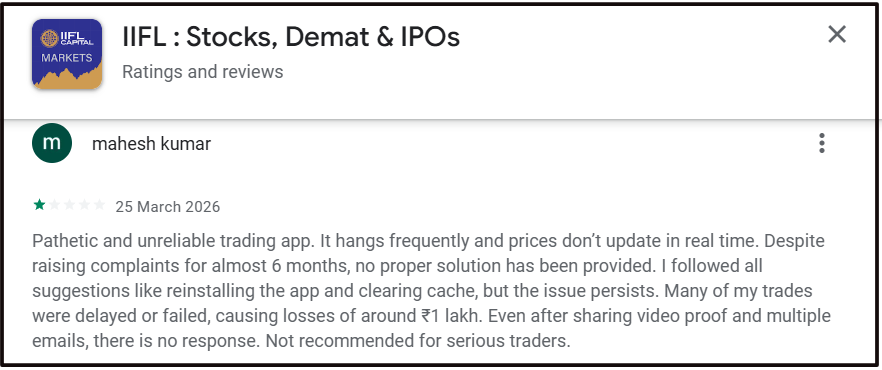
This review highlights a serious concern. The user clearly says the app hangs frequently and fails to update prices in real time. That’s not a small issue, that directly affects trading decisions.
What stands out more is the timeline. The user followed up for 6 months, shared proof, and still didn’t get a proper resolution.
When a platform issue continues for months without a fix, it raises questions about how efficiently the company handles technical complaints, especially when money is involved.
2. App Stability Problems During Market Hours
Some issues become more serious when they happen at the worst possible time, during market hours.
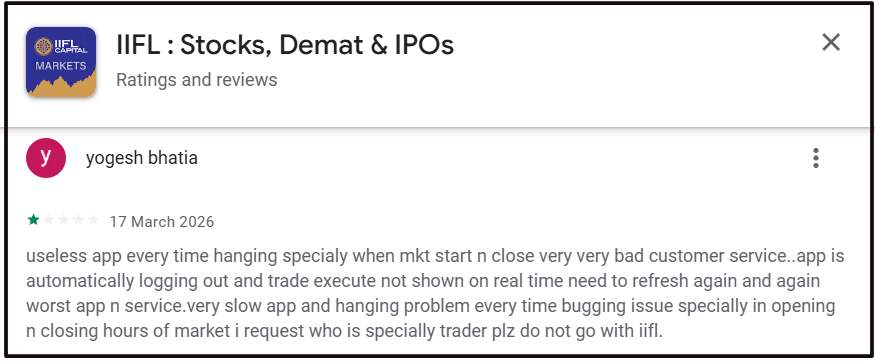
Here, the user points out that the app hangs mostly during market opening and closing hours.
That’s when traders need the app the most. The review also mentions:
- Automatic logouts
- Delayed trade updates
- Constant need to refresh
Frequent logouts sometimes overlap with what users describe as an IIFL securities login issue.
If the platform struggles during peak trading time, it can directly impact execution and timing, which matters a lot for active traders.
During peak hours, even a small IIFL trading platform technical glitch can impact execution.
3. Platform Limitations and Confusing Account Data
Not all issues come from performance. Some come from how the platform is designed.
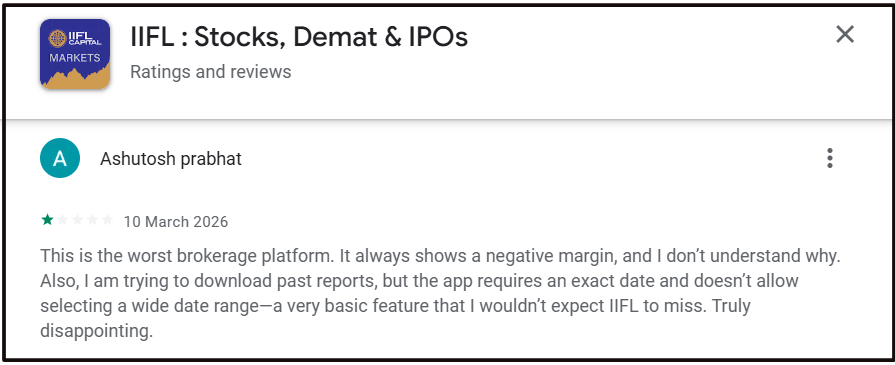
This user talks about:
- Constant negative margin display
- Difficulty downloading reports
- Lack of basic features like selecting a date range
These are not high-level technical problems, but they affect usability. When basic features feel restrictive or confusing, it makes it harder for users to track their own data and manage their accounts confidently.
4. Charges, Withdrawals, and Trust Issue
This is where concerns become more serious, when users question money-related aspects.
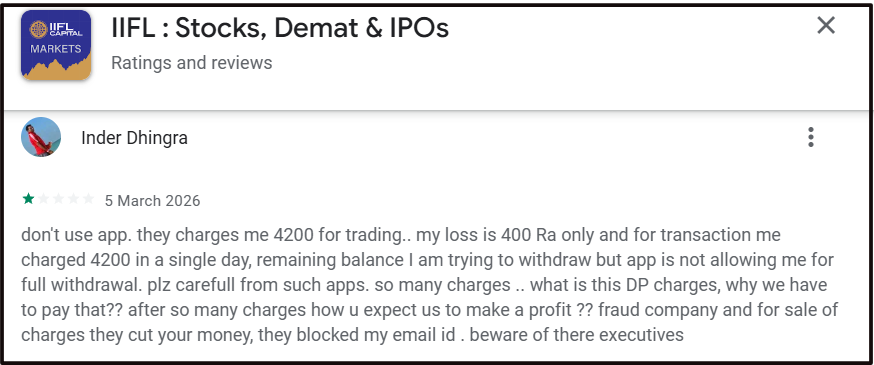
The user claims:
- Very high charges compared to actual loss
- Difficulty withdrawing full balance
- Lack of clarity around fees like DP charges
- Poor response from support
This kind of feedback flags issues regarding IIFL securities excess charges.
Some users even raise concerns around IIFL securities unauthorised trading, which makes quick action critical.
Even if some charges are valid, the platform must explain them clearly and handle withdrawals smoothly.
Don’t treat these reviews as isolated complaints. Look at the pattern:
- App performance issues
- Problems during critical trading hours
- Lack of clarity in charges
- Weak response to complaints
This doesn’t mean every user faces these issues. But it does tell you where things can go wrong. And that’s exactly what you need to know before choosing a broker.
When To Take Action Against Brokers?
Not every issue with your broker needs escalation. Delays happen, Apps glitch, Support sometimes takes time to respond.
But you shouldn’t ignore everything and assume it will fix itself.
The real skill is knowing when to wait and when to act. Here are situations where you should stop waiting and take things seriously:
1. When your money gets stuck
If you request a withdrawal and the money doesn’t arrive within the expected time, don’t ignore it. Follow up once.
If you still don’t get a clear answer, treat it as a red flag. Your funds should never stay stuck without a proper explanation.
2. When you see trades you didn’t place
This is not something you observe for a few days. If you notice any unauthorised trade, act immediately.
Take screenshots and raise a complaint right away. Delaying this can make things worse.
3. When the broker avoids your complaint
If you keep receiving vague replies or no response at all, don’t keep waiting.
A reliable broker gives clear updates within a reasonable time. If that doesn’t happen, you need to escalate.
4. When charges don’t make sense
If you see deductions in your account and you can’t clearly understand them, don’t assume they are correct.
Ask for a proper breakdown. If the explanation still feels unclear, push further.
5. When your issue doesn’t move forward
Every complaint should show progress. If days pass and nothing changes, stop depending only on the broker. That’s your signal to take the issue beyond them.
You don’t need to panic over every small issue. But you also shouldn’t stay passive. If something affects your money, your trades, or your account access, take action at the right time.
Because in the end, no one follows up on your issue as seriously as you do.
Where to Complaint Against Stock Broker?
If you face an issue with your broker, don’t jump straight to legal action.
Follow the process step by step. Each level exists for a reason, and if you skip steps, your complaint may not get proper attention.
Here’s how you should approach it:
Step 1: Raise a Complaint with IIFL Support
- Visit the broker’s support portal.
- Call to their customer care
- Send an email drafting your complaint.
Keep records of your complaint ID and email acknowledgment.
Step 2: File a Complaint in SCORES
If your issue is not resolved within 15 working days, file a complaint in SEBI at the SCORES portal. Make sure you keep following details handy:
- Client ID
- Broker name
- Trade or transaction proof
- Written complaint trail
Step 3: File a Complaint in SMART ODR
You can also raise complaints with NSE or BSE grievance portals if the issue pertains to trading or demat transactions.
The SMART ODR platform provides an update within 21 days of filing a complaint.
Make sure you submit details of your concern and also the screenshots related to filing it in the broker’s and SEBI portals.
Step 4: Arbitration in Share Market
If you’re seeking financial compensation, you can opt for Exchange Arbitration, a quasi-legal process to resolve unresolved claims.
Here, you can put your case in front of the legal team of SEBI and the stock exchange, who, after hearing both sides, provide a fair resolution and award.
Need Help?
If your complaint isn’t moving or you’re not getting clear answers, don’t keep waiting and guessing.
Most investors get stuck because they don’t know the next step or how to present their issue properly.
If you’re facing a problem with IIFL Securities (or any broker), you can get help with:
- Understanding your situation
- Deciding the next step (exchange, ODR, or arbitration)
- Structuring your complaint with the right proof
Because how you present your case directly affects how fast it gets resolved. Register with us and get the right guidance for your complaint.
Conclusion
IIFL Securities is a well-known broker, and on the surface, everything looks structured. But when you look deeper, a few things stand out.
Investors report complaints, and the numbers have increased over time.
IIFL resolves most of them, but the recent drop in resolution rate shows that the experience may not stay consistent for every user.
Very few cases reach arbitration, but that doesn’t mean issues don’t escalate. Most investors simply don’t take that final step.
So what should you take from all this? Don’t rely only on brand name or features.
Look at how a broker handles problems. Pay attention to complaint trends. And most importantly, understand what you can do if something goes wrong.
Because choosing a broker is easy. Handling one when things don’t go as expected, that’s what actually matters.