

You have probably seen the ads. Bold claims, screenshots of green candles, someone telling you their portfolio changed after they found this one app.
And now you are here, typing the same question thousands of Nifty and Bank Nifty traders type every week.
Is Bulls AI good, or is it just another platform riding the AI wave with a nice landing page?
The answer is not a simple yes or no, and anyone who gives you one without showing evidence is not being fully honest with you.
What follows is what real subscribers actually experienced, laid out plainly so you can decide for yourself.
Is Bulls AI Good in India?
Before anyone can judge whether Bulls AI is good, it helps to separate what the platform actually gives you from what the marketing quietly suggests.
What Bulls AI actually delivers:
- Nifty and Bank Nifty options trading signals with an entry price, a target, and a stop loss.
- Signals sent through the Bulls AI app and platform.
- API integration with select brokers such as Dhan and Finvasia, allowing semi-automated trade execution.
- Backtested strategy data is shown as accuracy numbers.
- Educational material explaining options trading strategies.
What the marketing hints at, without ever fully promising:
- That being “AI-driven” means it beats manual analysis.
- That returns stay consistent, no matter what the market is doing.
- That automation removes human error from trade entry.
- This can become a passive income source with little effort.
That gap, between what you are given and what you are led to expect, is where most complaints against the Bulls AI platform begin.
Understanding this gap before you subscribe can save you money.
Understanding it after you have already lost money helps you figure out whether you have grounds for a formal complaint.
Also Read: Is Supreme Investrade Safe? Understand why investors may want to examine its history carefully.
Real User Experiences With Bulls AI
These are not vague impressions picked up from forums.
These are specific, detailed accounts from actual Bulls AI subscribers, checked against what the platform promises.
Experience 1: A Refund Promise That Was Never Kept
A user named Koti Reddy left a one star review after buying the trading course sold alongside the Bulls AI platform, describing the entire purchase as money wasted.
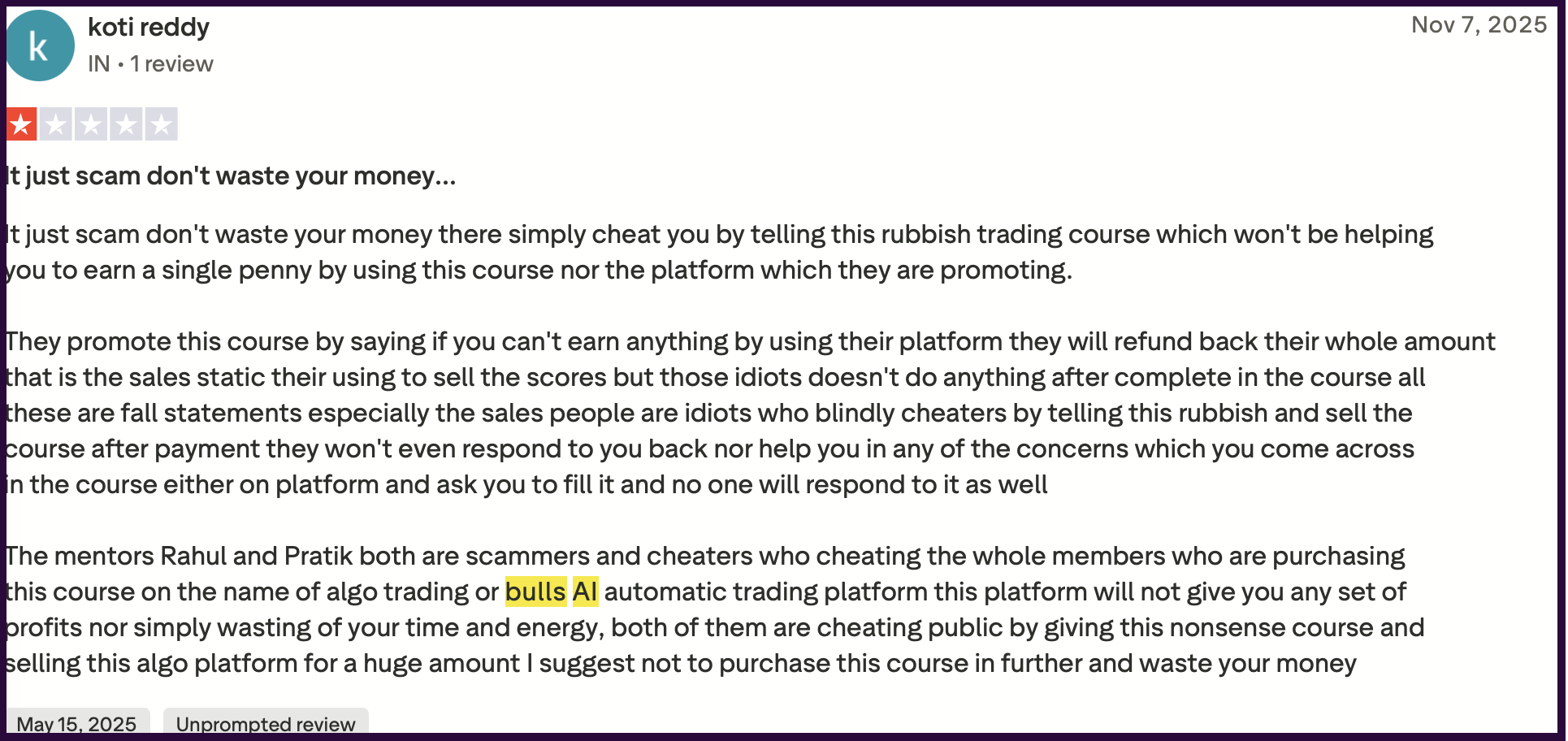
His specific complaint: the course was sold with a promise that if a buyer could not earn using the strategies taught, the full amount would be refunded.
He said this promise was simply a sales line used to close the deal, since once payment went through, that offer was never honored in practice.
His conclusion: neither the course content nor the platform helped him earn anything.
He said questions raised during the course, and later on the platform itself, went unanswered, with no one following up to help resolve his concerns.
What this means for prospective buyers: Koti Reddy named two individuals, Rahul Chandra and Pratik Chakraborty, as the people running this course under the algo trading and Bulls AI name.
His advice to others considering the same course was direct: do not buy it, since in his experience it delivered no trading benefit and no real support once payment was made.
Experience 2: A Workshop Built On Sales Talk, Not Proof
A user named Sanjay Gupta attended a live workshop run by the same company and wrote his review as a warning to other prospective buyers, titling it a warning against what he called an AI trading scam.
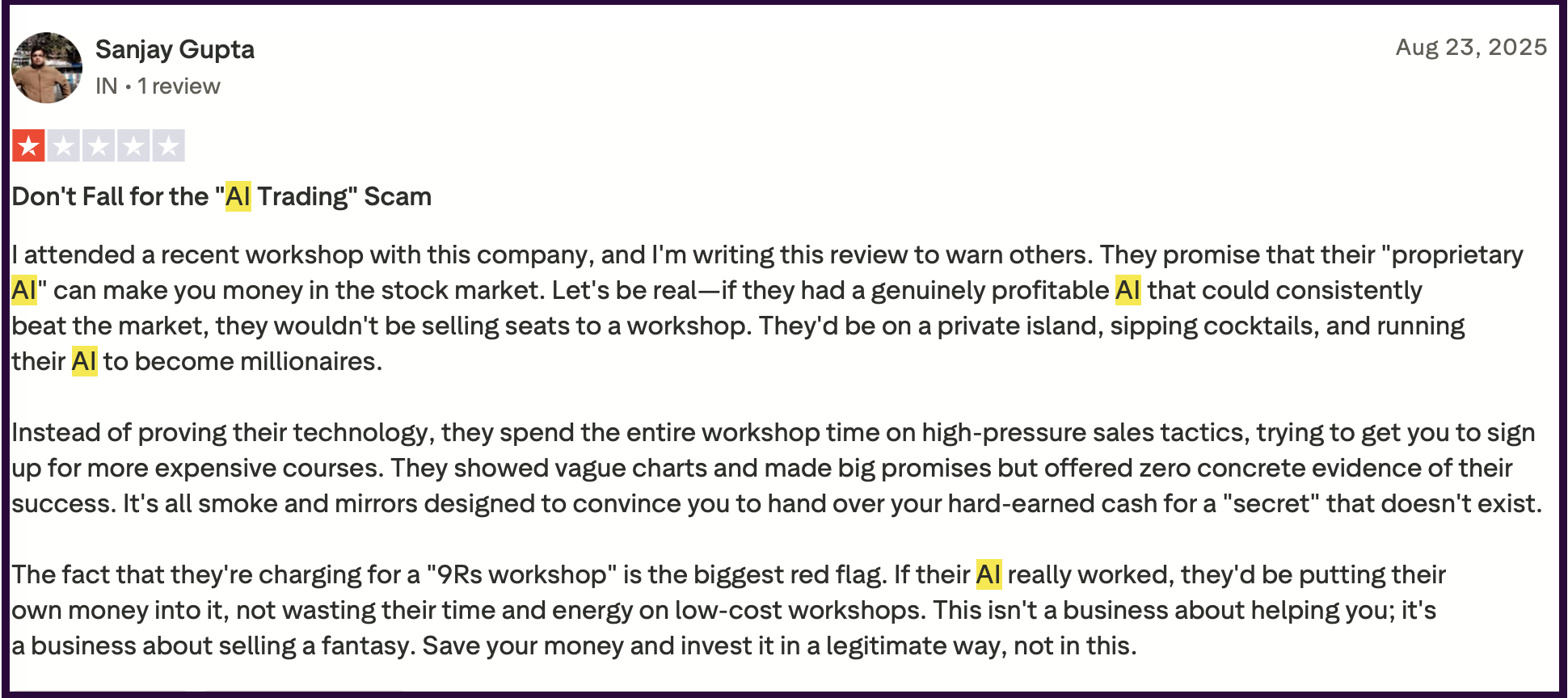
His specific observation: if the company’s AI genuinely produced consistent, market-beating results, there would be no real need to sell workshop seats as a source of income, since the technology itself would already be generating money for its creators.
Instead of demonstrating actual performance, he said the session spent most of its time pushing attendees toward a more expensive paid course, backed by vague charts and confident claims rather than any verifiable evidence.
His conclusion: the fact that the company charges for something called a nine Rs workshop was, in his view, the clearest warning sign.
He argued that a genuinely working AI system would not need to fund itself through low-cost workshops and follow-up course sales.
What this means for prospective buyers: Sanjay closed his review urging people to keep their money away from this offer entirely and put it toward something legitimate instead, calling the whole setup a business built around selling a fantasy rather than a real result.
Experience 3: A Course Fee Near One Lakh Rupees, With No Independent Proof
A user named Debolina Chakraborty rated the course one star, describing the total fee, close to one lakh rupees, as not justified by what the course actually delivered.
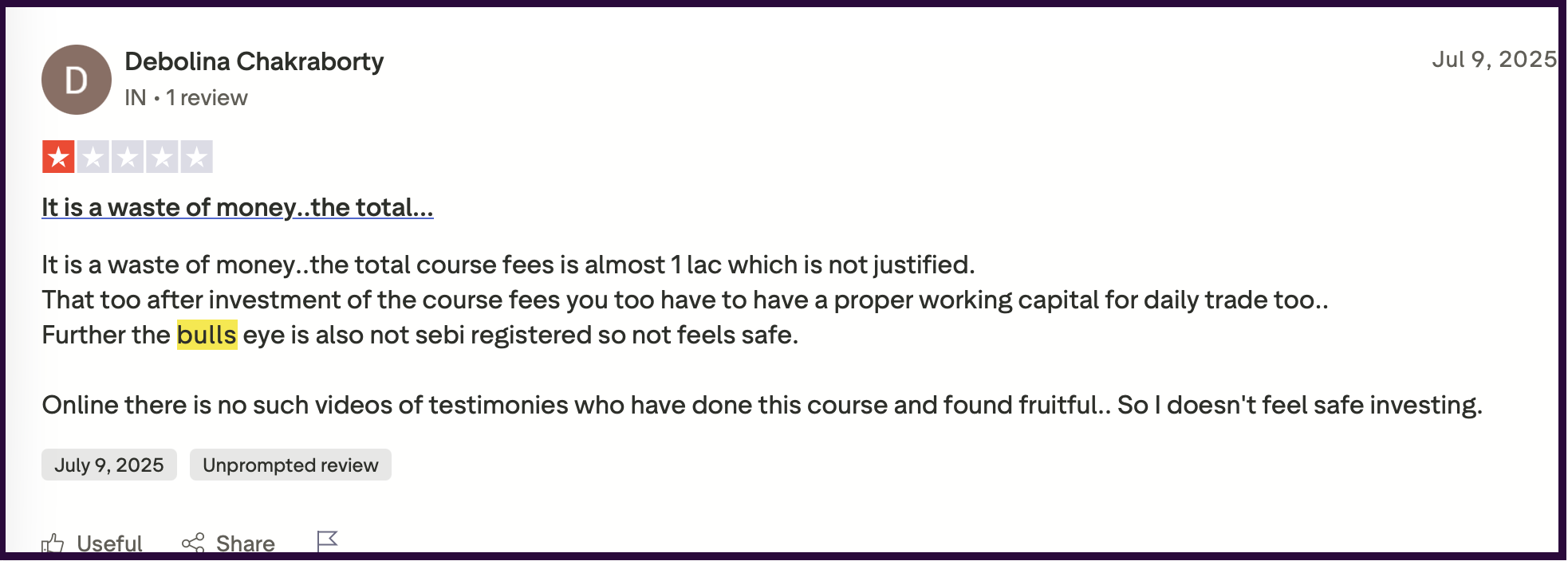
Her specific complaint: paying this fee does not even cover the cost of trading itself, since a buyer still needs separate working capital to place daily trades after completing the course, meaning the course fee sits on top of trading capital rather than replacing it.
She also raised a second concern, noting that the platform referred to in her review as bull eye did not appear to carry SEBI registration, which made her uneasy about trusting it with her money.
Her conclusion: she could not find any testimonial videos online from past students who had actually used the course and benefited from it.
Without that kind of visible, independent track record, she said she did not feel safe investing in it.
What this means for prospective buyers: her review reads as a caution specifically around the lack of verifiable outcomes and unclear regulatory standing, rather than a claim of active fraud, but the absence of both was enough for her to walk away feeling unsafe.
For the complete regulatory gap analysis that explains why the lack of exchange certification matters for complaints like this, you can check our guide: Is Bulls AI SEBI registered?
Lost money using Bulls AI?
If your experience is similar to the cases above or you’ve faced any of these issues, you may have grounds for a formal complaint. Our team reviews your case, identifies the applicable regulatory violations, prepares the necessary evidence, and files your complaint correctly from the very first submission.
Checking Bulls AI Across Three Crucial Fronts
The common question “Is Bulls AI good?” is actually three completely different questions rolled into one.
Rather than looking for a simple yes or no, splitting this evaluation into distinct pillars, performance, data transparency, and regulatory compliance, cuts through the marketing hype and sets realistic expectations.
Examining the service across these three crucial fronts reveals exactly where it delivers value and where it falls short:
1. Is Your Money Safe?
The honest answer is, it depends. Bulls AI’s signal accuracy changes with market conditions.
Both user experience and the platform’s own backtesting point to better accuracy when the market is trending and weaker accuracy when it is moving sideways or swinging wildly.
Trading options on AI signals during unfavourable conditions carries the same risk as any options trade, including the chance of losing 100 percent of the premium you paid.
How safe your money is as a subscriber depends on a few things:
- Whether you can judge if current market conditions actually suit the strategy.
- Whether you are willing to skip a signal that does not match what you are seeing live.
- How much of your total capital do you risk per trade, since a trader who treats signals as one input among many is in a very different position than one who follows every signal blindly?
Treating Bulls AI as a passive income source, with no active judgment on your part, has not worked out well based on documented user accounts.
Treating it as one signal source among several, with clear position sizing and your own read on the market, is a much safer approach.
2. Is Your Data Safe?
Honestly, this is unclear, and that lack of clarity is itself something to be concerned about.
To work, Bulls AI needs access to your trading account through a broker API connection.
That means handing a third-party platform access to your brokerage account.
There is little clear disclosure about:
- What exact data is pulled from your account through this connection?
- How that data is stored and secured.
- Whether it gets shared with anyone else.
- What happens to your data once you cancel your subscription?
Given that this access includes your trading history, account balance, and the ability to place orders on your behalf, the lack of detailed data handling disclosure is something worth asking about directly before you connect your account.
3. Are You Protected By Regulation?
The protections here are limited. Bulls AI runs without its own independent SEBI registration, without any publicly shown exchange algo trading certification, and without disclosed regulatory approval for its broker API feature.
Practically, this means investors who trade on Bulls AI signals and lose money have fewer formal protections than they would with an exchange-certified algo tool.
You can still file a complaint through the parent RA registration route, and that path is real and usable, but it does not offer the same level of protection as the full exchange algo trading framework would.
In short, regulatory protection here sits lower than an exchange-certified tool, but it is not zero. The parent RA registration still gives you a formal route to complain.
Also Read: Can you trust Investobazar, how a real registration gets borrowed by someone else.
The Reality Check: Where Bulls AI Works and Where It Fails?
Based on everything above, here is the clearest summary.
Bulls AI is genuinely useful for:
- Learning how Nifty and Bank Nifty options strategies work.
- Getting a signal source to compare against your own market reading.
- Getting introduced to algorithmic trading concepts if you are new to options.
Bulls AI is not something you should rely on for:
- Being your main signal source for live trading without your own judgment.
- Generating passive income with little to no active monitoring.
- Replacing a fully SEBI-registered, exchange-certified algo trading system with complete regulatory protection.
- Automated execution through the broker API without a solid understanding of the system’s limits.
The Honest Bottom Line
Bulls AI is a real platform with real technology behind it.
Some subscribers find educational value in it. Others have documented significant losses following its signals in live market conditions.
The marketing creates an expectation of consistent AI-driven profitability. The live experience, across multiple documented accounts, does not consistently match that expectation.
That gap between marketed and actual performance is the core issue, and it is a specific complaint basis under SEBI’s advertising guidelines for research analysts.
If you are evaluating Bulls AI before subscribing, approach it as a learning tool with a defined monthly budget you can afford to lose entirely, not as a profit-generating investment.
If you have already subscribed and lost money, document your losses, the signals that caused them, and any marketing material that created the expectation of profitability.
That documentation is the starting point of a formal complaint.
For the complete complaint and escalation process for Bulls AI subscribers, read: how to complaint against Bulls AI →
Frequently Asked Questions
1. Is Bulls AI good for live options trading?
Based on documented user experiences, Bulls AI’s signal accuracy is market-condition dependent, higher in trending markets, lower in sideways or high-volatility conditions.
It is more reliably useful as a learning tool for understanding options strategies than as a standalone signal service for live trading without independent judgment.
2. Is Bulls AI safe to use with broker API integration?
The safety of broker API integration depends on the risk controls the platform has in place.
Bulls AI does not publicly disclose exchange-approved algorithmic trading certification, which is the regulatory framework that mandates specific risk controls for automated trading systems.
Subscribers using automated execution through broker API have fewer formal protections than users of exchange-certified algo tools.
3. Does Bulls AI provide guaranteed returns?
No SEBI-registered entity can legally guarantee returns. Bulls AI and Springpad AI’s marketing has used performance claims and accuracy metrics that imply consistent profitability, but user experience documents significant variability in live conditions.
If you were shown a guaranteed return claim before subscribing, that claim violates SEBI RA Regulation 15(9) and is a specific complaint basis.
4. What should I do if I lost money following Bulls AI signals?
Document the signals that caused losses, the marketing material that created your return expectation, and your subscription payment details.
File a complaint on SEBI SCORES against SpringPad Wealth Solutions Private Limited (INH000022950) citing misleading performance claims.
If the complaint is unresolved, file complaint in SMART ODR and then initiate arbitration.
5. Is Bulls AI better than manually trading options?
For investors who treat it as one educational input among several, not as an automated profit generator, some subscribers report improvement in their understanding of options strategies.
For investors who follow signals passively without independent market assessment, documented losses suggest it does not reliably outperform careful manual trading.
6. Can I get a refund from Bulls AI if I’m not satisfied?
Refund eligibility depends on your subscription agreement terms.
However, if your dissatisfaction stems from performance that significantly mismatched what was marketed, particularly if guaranteed return claims influenced your decision to pay, you have a formal complaint basis beyond the subscription agreement’s refund policy.
EBI regulatory violations override private contract clauses.





 Add us as a preferred source on Google »

