

Quick Summary
Jupiter crypto is a real decentralized exchange aggregator on Solana that has operated since 2021. It is not regulated by any traditional government authority, and users carry full responsibility for their own keys. Because it is popular, scammers copy its name with fake airdrop sites, fake recovery agencies and fake investment schemes. This page explains what Jupiter is, the risks, one police case from Jaipur, and what to do if you lose money.
You may have heard the name from a friend, a trading group, or a pop-up that promised free tokens.
Here is the catch. Jupiter crypto is a genuine platform, and that is exactly why so many fake pages borrow it.
The real product and the copycats can look alike on a phone screen, and one wrong tap on a fake link can empty a wallet.
Let us separate what is real from what is not, so you know what to trust and what to avoid.
Jupiter Crypto Exchange
Jupiter is a crypto platform built on the Solana blockchain. It started life as a swap tool and has grown into a wider set of products.
Crypto explainers describe it as a decentralized exchange (DEX) aggregator. That means it does not hold a central order book of its own.
Instead, it searches multiple decentralized markets and routes your swap to find the best rate.
Beyond swaps, Jupiter also offers perpetual futures, staking, and a mobile wallet app.
CoinGecko’s explainer says it was founded in October 2021, and its JUP token launched in January 2024.
It is open source, and Jupiter’s official website is jup.ag.
Is Jupiter Crypto Real or Fake?
Jupiter is real, operating, and widely used. It is not a Ponzi scheme or a fake trading app.
But real does not mean risk-free, and real does not mean regulated.

The research note describes Jupiter as an open-source DeFi project that has been running since 2021.
The danger is not usually the real site. It is the fake sites, fake support, and fake offers built around it.
Risks of Using Jupiter Crypto
Even the real Jupiter carries risks that new users often miss. Here is what the research note flags, in plain words.
- No regulator. Jupiter is not regulated by any traditional government authority. Nobody official stands behind your trade if something goes wrong.
- Full responsibility. Like other decentralized platforms, you carry 100% of the responsibility for your private keys and for smart contract risks. If you lose your keys or approve a bad contract, there is no helpline to reverse it.
- Jupiter offers perpetual futures. CoinGecko says leverage goes up to 250x on some pairs, so a small price move can wipe out a position.
- Fake airdrops. Because Jupiter is popular, scammers create fake airdrop and reward websites, such as jupgifts.com, to trick users into handing over their wallet seed phrases.
- Official site only. Always check that you are on the official website, ag, and never type a seed phrase into any site or chat.
Jupiter Related Crypto Scams
The research note groups the scams that use Jupiter’s name into four types. Three are covered here.
The fourth, involving an Indian fintech app, has its own section below.
1. Fake Asset Recovery Agencies
This one targets people who have already lost money somewhere else.
Scammers pose as representatives of “Jupiter Limited” or similar consulting agencies.
They claim they can help victims recover crypto or fiat funds lost on other platforms.
They then demand an upfront conversion fee, or a signature on a fake “Recovery Agreement”, and vanish once paid.
2. Cloned Websites and Fake Client Portals
Here the fraud lives on a screen that looks real. Fraudsters run cloned websites, fake client portals, and social media accounts.
Some use real employee names or claim an affiliation.
The research note also flags platforms that falsely claim ties to Jupiter Fund Management, which is an unrelated asset manager.
A scammer’s page can look polished, so it helps to know the signs of a fake crypto exchange before you log in anywhere.
3. JUP Token Confusion
The JUP token is Jupiter’s real governance token on Solana.
That popularity creates a gap for imitators.
Unaffiliated third parties and speculative tokens use JUP, or similar names, to lure retail investors into pump-and-dump or imitation schemes.
Before buying any token that only looks like JUP, learn how to identify fake cryptocurrency, because a similar name proves nothing.
Jaipur Fake Call Centre Case: A Scheme Called JUPITER
This news report shows how a scheme can use the Jupiter name with no link to the real platform.
It is a police case, so every detail below is as reported.
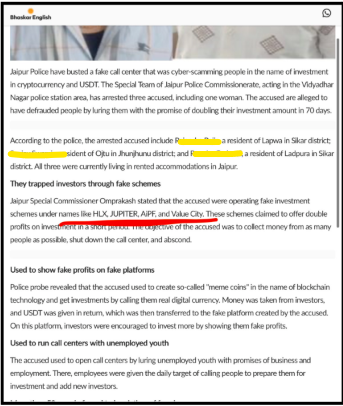
Bhaskar English reported that Jaipur Police busted a fake call centre running a cryptocurrency and USDT investment fraud.
Three people, including one woman, were arrested.
The Special Commissioner said the accused ran fake investment schemes under names like HLX, JUPITER, AiPF and Value City.
The schemes claimed to double investments in 70 days.
Police said the accused took money from investors, gave USDT in return, and moved it to a fake platform.
There, investors were shown fake profits and pushed to invest more.
The report also says the accused created so-called “meme coins” and presented them as real digital currency.
They ran call centres staffed by unemployed youth, who were given daily targets to call people and add new investors.
More than 50 people are suspected to have been cheated, and the accused operated from rented accommodation in Jaipur.
Police are still working out the total amount and identifying victims across states.
This is a textbook case of how crypto scams work: a big promise, a fake coin, a fake dashboard and a team paid to bring in new money.
What the Police Warned Investors About
The report ends with four warnings that apply to any crypto offer, Jupiter or not.
- Do not trust schemes that promise guaranteed or unusually high returns.
- Always verify a crypto platform before investing.
- Avoid transferring money or USDT to unknown platforms or people.
- If you become a victim of cyber fraud, report it at once on the cybercrime helpline.
Jupiter Money and Jupiter Edge Are Not Jupiter Crypto
One more name gets mixed up with the crypto platform.
Jupiter Money is an Indian neobank app, and it has nothing to do with the Solana exchange.
The research note says scammers have tried to exploit Jupiter Money’s Buy Now Pay Later feature, Jupiter Edge.
The methods named are stolen IDs, app cloners, and multi-device attacks.
The note also includes a user review.
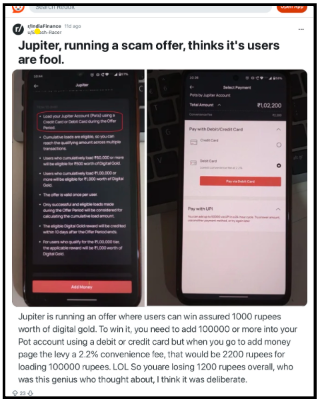
A Reddit user on r/IndiaFinance described a Jupiter Money offer of ₹1,000 in digital gold for loading ₹1,00,000 into a Pots account by card.
According to the post, the add money page charged a 2.2% convenience fee, which is ₹2,200 on ₹1,00,000.
The user calculated a net loss of ₹1,200 and called the offer unfair.
That is one customer’s complaint about fees, not a finding of fraud.
Read the fee screen before you accept any offer that needs a large load.
How to Check a Jupiter Link, App or Contact?
A few quick checks catch most of these scams. Run them before you connect a wallet, pay a fee, or share any detail.
- Website: the official site is ag. A reward or gift page on another address is not it.
- Seed phrase: never type it into a website, chat, or form, for any reason.
- Recovery offers: an agency that asks for a conversion fee to get your money back is a warning sign.
- Returns: a promise to double your money in a fixed number of days, as in the Jaipur case, is a red flag.
- Tokens: a name that looks like JUP proves nothing about the token.
- Company: Jupiter Money, the Indian app, is a different business from Jupiter crypto.
If even one of these fits, stop and speak to someone you trust before doing anything else.
What to Do If You Lost Money in a Jupiter Crypto Scam?
Speed helps in crypto cases, so act in the first hours if you can. If you are unsure where to begin, here is what to do if online fraud happens to you.
- Stop sending money. Do not pay any “release”, “conversion” or “verification” fee, even if it is described as the last one.
- Save everything. Keep screenshots, website addresses, wallet addresses, transaction IDs, chats, and bank references.
- Report it formally. Call the cyber fraud helpline. Then learn how to file a cyber crime complaint and keep your proof ready when you do.
- Secure your wallet. If you shared a seed phrase, move any remaining funds to a new wallet created on a clean device.
- Be careful with recovery offers. Anyone asking for an upfront fee to get your money back may be the next scammer.
If your money moved as crypto, a crypto fraud complaint in India is stronger when your wallet addresses and transaction IDs are in order.
Did a fake Jupiter site, agent or scheme already take your money?
You do not have to work through it alone. We review cyber fraud cases where the loss is above ₹30,000 and explain the options open to you. Register with us and share what happened.
Conclusion
Jupiter crypto is a real platform, but real is not the same as regulated or risk-free.
Most of the harm comes from copycats: fake airdrop sites, fake recovery agencies, and fake schemes that borrow the name.
Verify the website, guard your seed phrase, and be wary of any promise of fast returns.
If something has gone wrong, report it quickly.
Report. Recover. Stay Fraud Free.
Frequently Asked Questions
Yes, Jupiter is a real DeFi platform on Solana that has operated since 2021. Legit does not mean risk-free, and fake sites use its name.
The research note says it is not regulated by any traditional government authority, so you carry the risk for your keys and contracts.
Fake airdrop sites exist to steal seed phrases. Check the official website, jup.ag, and never enter a seed phrase anywhere.
Jupiter Money is an Indian neobank app. Jupiter crypto is a Solana exchange aggregator.
Stop paying, save your proof, file a cyber crime complaint. Avoid anyone who asks for a fee to recover your money.





 Add us as a preferred source on Google »