
Quick Summary
An OLX scam is online fraud in which criminals use the marketplace to trick buyers and sellers into losing money or sharing sensitive details. They pose as genuine buyers, sellers or delivery agents, create urgency and push you off the platform. OLX itself is a legitimate marketplace, but like any open platform it can be misused. This page lists the common scam types, four reported cases, victim stories and the steps to take if you have already paid.
You list an old phone or a sofa, and within minutes a buyer is ready to pay.
That speed feels like luck, but it is often the first step of an OLX scam.
The same fraud works on the other side too, when a cheap car or a flat for rent turns out to be a trap that asks for money first.
Here is how these scams work, which types are most common, and how to protect yourself.
What Is OLX and Is It Safe to Use?
OLX is an online classifieds marketplace where people list and buy second-hand goods, vehicles, property, and more. It is a legitimate platform.
But it is an open marketplace, which means anyone can post an ad or message you. Fraudsters rely on that openness.
OLX provides safety guidance, yet the final safety check is yours.
Even a simple listing for old books, a smartphone, or a household appliance can attract scammers posing as interested buyers.
What Is an OLX Scam?
An OLX scam is a type of online fraud where criminals exploit the platform to trick buyers and sellers.
They often pose as genuine buyers, sellers, or delivery representatives so their requests seem legitimate.
They may offer to pay immediately, claim they need to arrange delivery, or create urgency so you follow instructions without checking the details.
The common safe habits are simple.
Never share OTPs, verify payments directly through your bank or UPI app, and be wary of anyone who insists on moving the chat outside OLX or makes an offer that seems too good to be true.
How Do OLX Scams Work?
Most OLX scams follow a similar pattern. Fraudsters combine impersonation, social engineering, and deceptive payment requests.
It usually begins when a scammer contacts someone who has posted a listing or shown interest in a product. The profile looks convincing.
The scammer may claim to be a military officer, a business owner, or a buyer from another city.
Once contact is made, they often ask you to continue on WhatsApp or another messaging app.
That makes it easier to share payment links, fake screenshots, and pressure you without the marketplace safeguards.
The way an OLX WhatsApp scam unfolds on a seller’s phone has telltale signs of its own.
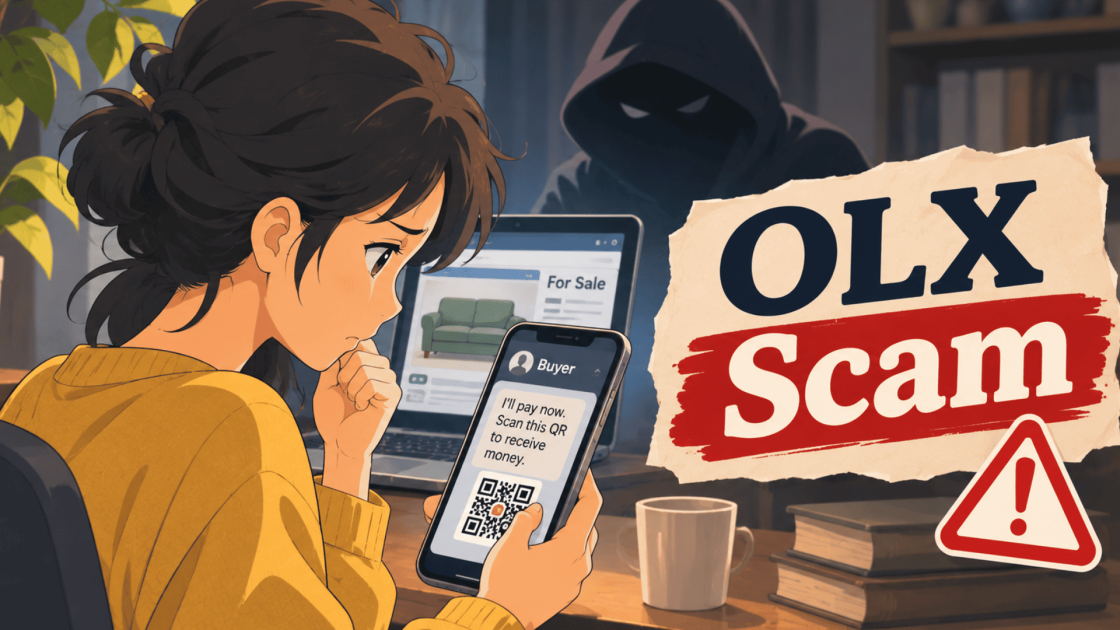
The request for money comes next. A fraudster might send a fake payment confirmation, a malicious link, or ask you to scan a QR code to “receive” money.
In reality, scanning a payment QR code and authorising it can take money out of your account.
Then comes urgency. By presenting each step as routine, scammers try to stop you from verifying the payment or questioning their instructions.
Common Types of OLX Scams
OLX fraud is not one trick. It is a set of tricks that suit different listings, from phones to flats to jobs.
Here are the types most often reported, with what happens in each.
| Scam type | What happens |
| Fake advance payment | A fake buyer or seller asks for an advance by bank transfer, wallet or payment link before the product is delivered or collected. |
| QR code scam | A fraudster sends a QR code and asks the seller to scan it to receive money. Authorising it takes money out instead. |
| Fake product listing | An attractive listing at an unusually low price collects advance payments, then the seller disappears. |
| Impersonation | Fraudsters pretend to be OLX staff, military personnel or courier agents to get OTPs, personal details or money. |
| Overpayment and refund | A scammer says they paid too much and asks for the difference back, though the original payment may be fake or failed. |
| Non delivery | A seller takes full or partial payment, then stops replying or keeps delaying delivery. |
| Fake or counterfeit product | A genuine branded product is advertised, but a fake, damaged or different item arrives. |
| Phishing and account takeover | Fake OLX login or payment links arrive by SMS, email or WhatsApp to steal credentials, OTPs and financial details. |
| Fake escrow or payment page | A site that looks like an OLX payment service collects banking or card details to “complete” a deal. |
| Rental and property | Fake listings demand booking fees or security deposits before you can inspect the property or verify ownership. |
| Job and work from home | Fake job ads ask for upfront registration, training or equipment fees, or collect personal information. |
| Courier and fake tracking | Fake courier receipts or tracking details come with requests for extra payments or verification codes. |
| Fake payment screenshot | An edited screenshot “proves” money was sent, pressing the seller to hand over the product before checking their account. |
| WhatsApp redirection | Buyers or sellers are moved from OLX to WhatsApp, where suspicious links, payment requests or QR codes follow. |
| Third party payment | A scammer says a friend, relative or company will pay or collect the item, using confusing arrangements to involve you in fraudulent transactions. |
Most of these share one feature: money moves before the goods or the truth is checked.
Real OLX Scam Cases Reported by Police and the Press
These news reports show that OLX fraud is not always a lone trickster.
It can be a planned network, and it can start with a very small request. Every detail below is as reported, and the accused and victims are not named.
1. ₹18.60 Crore: Rajasthan Network Behind Fake OLX Car Listings
This is the largest figure we found, and it covers a whole network, not one victim.
ETV Bharat (17 October 2026) reported that Rajasthan Police arrested 21 people in an alleged interstate cyber fraud network. Police said 101 complaints on the National Cyber Crime Reporting Portal were linked to it, with fraud of about ₹18.60 crore across several states.
According to police, the accused lured victims with fake OLX vehicle listings offering cars at cheap prices. They also allegedly created fake social media pages and made calls while impersonating law enforcement officials to scare victims.
The network reportedly used mule bank accounts to receive and move the money. Some accused allegedly sold bank accounts for ₹8,000 to ₹10,000 each. Police reported links to cases in Odisha, Karnataka, Tamil Nadu and Uttar Pradesh.
Police recovered phones, cheque books, passbooks, debit cards and fake PAN and Aadhaar cards. They also reported freezing ₹8.84 crore in linked bank accounts. That is frozen money, not necessarily money already returned to victims.
2. ₹11 Lakh: Fake OLX Car Deal and a Third Party Bank Account
This case shows why the account that receives your money may belong to someone who knows nothing about the deal.
The Times of India (13 June 2026) reported the arrest of a man in Tamil Nadu in connection with an alleged ₹11 lakh OLX car scam. According to the report, he allegedly defrauded a buyer who was purchasing a car listed on OLX.
The ₹11 lakh payment was reportedly routed to a gold shop owner’s bank account in Tirupur. Investigators said the accused had obtained the account details by claiming he wanted to buy gold in bulk and would pay the shop directly.
Police reportedly traced the payment using CCTV footage, vehicle details and information from drivers who had carried the accused. The report says he had evaded police for months by changing his appearance, using multiple SIM cards and moving across states. He was also accused in other online cheating cases and had reportedly escaped from a sub jail and a hospital before this arrest.
3. ₹2 Lakh: Bengaluru Seller and a QR Code Trap
This one started with an air cooler priced at just ₹5,200. It shows how small the first request can look.
India Today (3 September 2024) reported that a 27 year old software engineer in Bengaluru lost nearly ₹2 lakh in an OLX QR code scam. He had listed the cooler on 29 August.
Soon after, a caller who said he owned a used furniture showroom in Whitefield offered to pay before arranging pickup. He sent a ₹5 QR code and asked the seller to scan it, and the seller received ₹5.
A second QR code for ₹5,200 followed. What looked like a routine deal turned into a fraud involving QR codes, and the seller lost nearly ₹2 lakh. The same case was also reported by the Times of India.
The report’s lesson is direct: a seller should never scan a QR code or enter a UPI PIN to receive money.
4. ₹88,000: Tamil Nadu Victim and a Fake Army Buyer
Here the fraudster wore a uniform, at least on paper. Posing as army personnel is a common way to win trust fast.
DD News shared a post on Instagram saying cyber fraudsters on OLX often pose as Indian Army personnel to gain trust. It said they use fake IDs, transfer stories, fake payment screenshots and QR code scams to make victims send money or hand over goods.
In one case from Tamil Nadu, the post said, a victim lost ₹88,000 before realising it was a scam. The post is dated 25 May, and the year is not visible in our copy, so please confirm it before publishing.
What Delhi Police Warn About OLX and QR Code Frauds?
Delhi Police Cyber Crime Unit lists OLX and QR code frauds on its public safety page. It warns that the fraudster often poses as Army or paramilitary personnel and insists on paying online.
The Delhi Police page describes the usual flow. The fraudster agrees to buy, says he cannot collect in person and insists on online payment. He then sends a fake payment screenshot and claims a technical issue stopped the money reaching the seller.
Next he shares a QR code and guides the seller through scanning it. When the seller enters the UPI PIN, money is debited from the seller’s account. He may repeat the process with another QR code, claiming it will refund the amount taken earlier. The victim can lose thousands, or even lakhs of rupees.
If you become a victim, the page says to preserve screenshots of messages, advertisements and payment confirmations along with bank transaction records, and to report the incident to the police with the evidence.
Its advice is plain. Verify the buyer or seller before making or receiving payments, be cautious of anyone creating urgency, and never click suspicious links or scan QR codes to receive money.
It also says to avoid advance payments you cannot verify, and to be wary of fake identity documents used to pose as Army or other national institutions personnel.
OLX Scam Stories Shared by Victims Online
These are personal accounts posted on public forums. They are not confirmed by police or the press, but the patterns match the reported cases above.
Usernames, phone numbers and ID photos are left out. Each account is as the poster described it.
1. ₹56,890: From OLX to WhatsApp to QR Codes
A post on r/LegalAdviceIndia, made on behalf of a colleague, described an OLX buyer scam in Bangalore.
She listed furniture on OLX, and the buyer moved to WhatsApp and said he would make the payment. Then came QR codes, a “refund” and a “verification”, followed by fake payment screenshots.
She says she ended up making multiple payments. Her account shows 3 UPI transactions of ₹22,484 and 2 fraudulent Croma transactions of ₹34,406, a total of ₹56,890.
2. ₹3 Lakh: The ₹1 QR Code Trick
Another r/LegalAdviceIndia poster described how a small test payment built trust.
A second hand reseller offered ₹20,000 for several items and said he would pay ₹10,000 first. He sent a QR code for ₹1 marked “receive money” and said the ₹1 would be paid to the poster’s account twice. That worked at first.
When a larger amount was sent, it was debited and nothing came back. The scammers said their payment was stuck because of problems at the poster’s end and made him add several beneficiaries on two bank accounts, promising no deduction.
The poster says the contact sent a photo of an Aadhaar card, but none of the three contact details he tried matched on UIDAI. He reports being about ₹3,00,000 down with no returns.
3. A Seller Who Spotted a Fake Army Buyer
Not every story ends in a loss. One user shared how they caught a scam on OLX and Facebook Marketplace.
Five days after posting a listing, they received a WhatsApp message from a supposed buyer. They already knew about scams where fraudsters pose as Indian Army personnel. When the buyer said he would pay online, they became suspicious.
They took a screenshot of his display picture and searched Google Images. They reportedly found around 10 articles and news reports linking the same picture to scams.
The buyer kept saying his manager would call about the payment. When the user questioned him, there was no reply. Later the alleged manager called, asked impatiently whether the user wanted the money, and offered a ₹5 coupon. The chat also included a forwarded military address and an ID card image.
The user then shared a UPI QR code and warned that scammers ask sellers to scan such codes under the pretext of payment. If the seller authorises it with a UPI PIN, money can go out of the account instead of coming in.
In an update, the user called the number from another phone. According to the user, the person claimed to earn ₹3 lakh to ₹4 lakh and said that if they could not scam one person, they would target someone else.
The user’s advice: be careful when selling on OLX and Facebook Marketplace, report suspicious contacts as spam and do not fall for fraudulent payment requests.
4. The Test Drive Trick on a Two Wheeler
This story involves no QR code at all. It shows that OLX scams can happen in person.
A seller in Bengaluru listed his old scooter on OLX and got many calls within hours. A buyer arrived alone and asked to take it for a test drive by himself.
The seller refused, and asked a neighbour to ride along. Once on the road, the buyer allegedly sped away. The seller chased him, a passer by on a bike helped, and the buyer abandoned the scooter and ran. The seller got it back and later sold it to a dealer.
The seller’s warning: if someone asks for a test drive, go along or do not hand over the keys.
How to Stay Safe on OLX?
A few habits stop most OLX scams before they start. They take seconds, and they work for both buyers and sellers.
- Receiving money:you never need to scan a QR code or enter a UPI PIN to receive money. A PIN authorises a payment going out.
- OTPs:never share an OTP or a WhatsApp registration code with a buyer, seller or “OLX agent”.
- Payments:check the credit in your own bank or UPI app. A screenshot proves nothing.
- Advances:avoid advance payments you cannot verify, whether for a car, a flat or a job.
- Pressure:a buyer or seller who creates urgency is a warning sign.
- Identity:be wary of Army, police or courier ID documents sent over chat, since fake ones are used to build trust.
If an unknown number pushes you off OLX, take a minute to check if a phone number is scam before you reply.
What to Do If You Lost Money in an OLX Scam
Act quickly, and keep calm. If you are unsure where to begin, here is what to do if online fraud happens to you.
- Stop all payments.Do not pay a “refund fee”, “verification amount” or anything else the scammer asks for.
- Save your proof.Keep screenshots of the ad, messages, payment confirmations and your bank transaction records.
- Report it formally.Call the 1930 cyber fraud helpline and tell your bank at once. Then learn how to file a cyber crime complaint and keep your proof ready when you do.
- Block and report.Block the number and report the profile or listing on OLX, but keep the chat history.
- Be careful with recovery offers.Anyone asking for an upfront fee to get your money back may be the next scammer.
If the money left through your UPI app, it also helps to know how to report UPI frauds through the right channels.
Did a fake buyer, seller or listing on OLX already take your money?
You do not have to work through it alone. We review cyber fraud cases where the loss is above ₹30,000 and explain the options open to you. Register with us and share what happened.
Conclusion
An OLX scam usually has one thing in common: money moves before anything is verified. The marketplace is legitimate, but the people who message you may not be.
Check payments in your own app, never scan a QR code to receive money and keep the chat on record. If something goes wrong, report it quickly.
Frequently Asked Questions
OLX is a legitimate marketplace, but it is open to everyone, so fraudsters can misuse it. Stay cautious with strangers and verify every payment yourself.
Scammers pose as buyers, sellers or agents, move the chat to WhatsApp and push you to pay, scan a QR code or share an OTP. Urgency is used to stop you checking.
Scanning and authorising with your UPI PIN can send money out of your account instead of crediting it.
Call helpline, tell your bank, file a complaint with your proof and report the profile or listing on OLX.
Stop paying, save all proof, file a cyber crime complaint. Avoid anyone who asks for a fee to recover your money.


 Add us as a preferred source on Google »