
Quick Summary
Delta Exchange India is an INR-settled platform for crypto futures and options, run by Excelium Technologies. It says it is FIU-IND registered, which is not SEBI approval. In November 2026 the Enforcement Directorate searched premises linked to the company over alleged cross-border transactions, and the company disputes the allegation. Users have also posted complaints about fees, withdrawals and stop-losses, and fake websites copy the brand. This post separates what is reported, what is alleged and what remains unproven, so you can decide before you deposit.
Opened the Delta Exchange India app after the ED news and wondered if your money is still safe?
You are not the only one. Even Google’s search suggestions show people asking if it is legal in India, what the charges are, and which login is real.
At FraudFree, we went through the ED reports, the company’s own pages, and user reviews, so you can see the facts in one place.
We label every claim as reported, alleged, or claimed, and we keep the ED’s side and the company’s side apart.
Let us take it one question at a time.
Delta Exchange India
Delta Exchange India is a trading platform where people trade crypto futures and options. These are contracts based on the price of coins like Bitcoin.
You are not buying the coin itself.
Users add money in Indian rupees and trade and settle in rupees, which is why the platform calls itself an INR-settled exchange.
It runs as an app and a website, and Google Play lists it as “Delta Exchange: Crypto Options”.
In India, it is operated by Excelium Technologies Private Limited.
News reports on the November 2026 ED search also say it offers tokenised stocks of foreign companies.

Is Delta Exchange Legal in India?
Many people search whether Delta Exchange is legal in India, and the honest answer has layers.
It depends on what you mean by legal: not banned, registered somewhere, or approved by SEBI.
Each one is a different question, so we take them one at a time.
Is Delta Exchange Banned in India?
People often mix up “legal” with “approved”. Let us start with the simplest question.
No company page or news report says Delta Exchange India is banned. The company says it operates in line with applicable law.
So far, no court or regulator has announced a ruling or penalty against the platform.
What Does FIU-IND Registration Cover?
The company points to its FIU-IND registration when it talks about regulation.
It helps to know what that registration is and what it is not.
- FIU-IND is the Financial Intelligence Unit India. It tracks financial transactions and works against money laundering and terror financing.
- Crypto exchanges covered by the rules must register and follow anti-money-laundering and reporting duties.
- It is not SEBI registration, and it does not mean SEBI approved every product.
- It is not a guarantee that customer funds are safe. Put simply, it is an ID check, not investor insurance.
The company’s Help Center names Excelium Technologies as an FIU-IND registered reporting entity with registration number VA00041101.
The company says it has held this registration since 2023.
Is Delta Exchange Regulated? What Its Help Center Says
Users noticed the company’s Help Center describing its regulation in two different ways.
Here is what each wording says, and what each one does and does not mean.
One wording says the platform “operates as a self-regulated entity”. That means the company sets and polices its own rules. It does not mean a regulator is overseeing it.
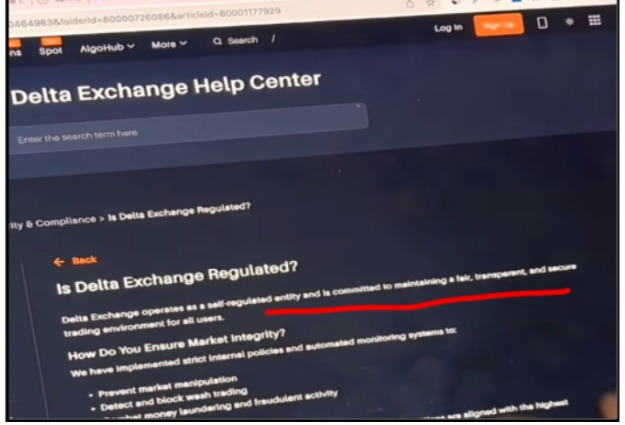
The other wording names Excelium Technologies as an FIU-IND registered reporting entity, with registration number VA00041101.
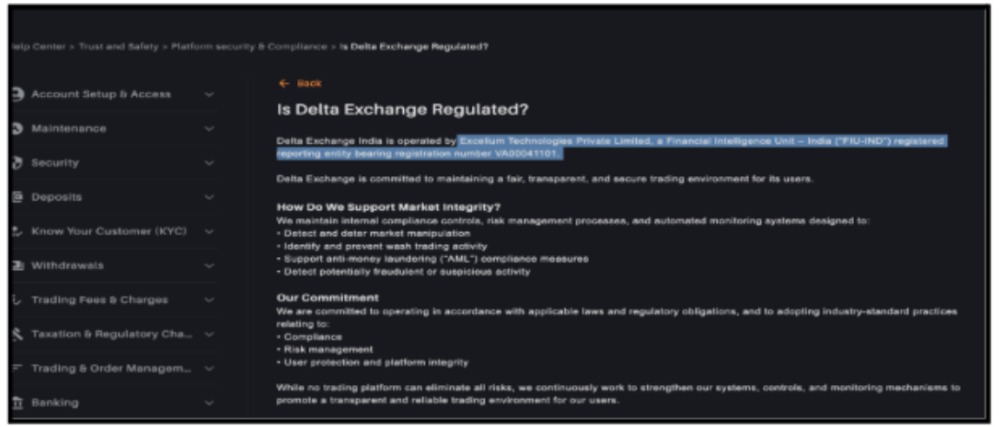
That registration is about reporting suspicious transactions and following anti-money-laundering rules.
Screenshots of both wordings circulated online. Nothing explains why the wording differs, so we draw no conclusion from it.
Neither wording means SEBI approval, so ask which regulator covers the exact product you trade.
Delta Exchange ED Search: What Happened in November 2026?
On 4 and 5 November 2026, the ED searched premises in Bengaluru linked to the company behind Delta Exchange India, a move many reports call a raid.
Most users want one answer first: does it put their money at risk?
Here is what the agency reportedly alleges, what the company says in reply, and what nobody can say yet. We keep both sides apart, so you always know who said what.
1. What Happened on 4 and 5 November?
The Enforcement Directorate (ED) searched premises linked to Excelium Technologies in Bengaluru on 4 and 5 November 2026.
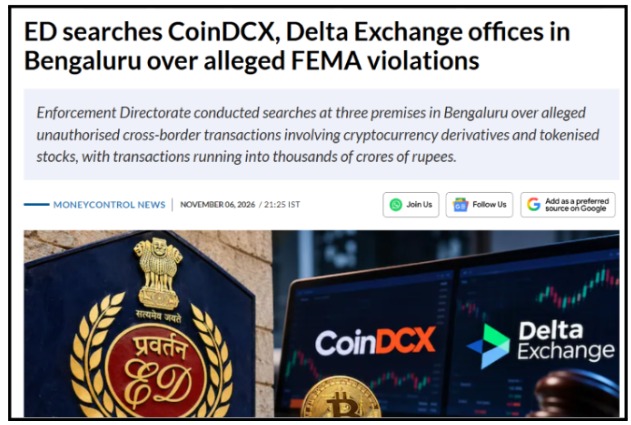
It acted under Section 37 of the Foreign Exchange Management Act (FEMA).
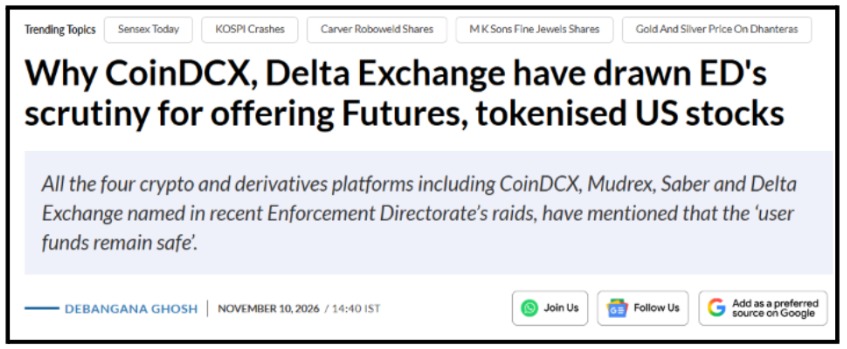
The search is part of an investigation into alleged unauthorised cross-border transactions involving crypto derivatives and tokenised stocks. Reports say CoinDCX premises were also searched.
2. What Is the ED Alleging?
This is the part people repeat the most, and the part where wording matters most.
These are the agency’s reported claims, not proven facts.
- A large volume of Delta-related trades was reportedly routed through another Indian crypto platform, which allegedly executed matching trades on overseas exchanges. Reports name Binance, KuCoin, Gate.io and Bybit.
- The ED also said hundreds of crores went to overseas associate entities, and that these transfers are under investigation.
- The ED’s reported estimate puts the transactions under scrutiny in the thousands of crores. That is the scale of trades being examined. It is not a loss figure, and it is not money seized.
- The ED’s statement said the products prima facie raise questions under the Securities Contracts (Regulation) Act, the SEBI Act and the RBI Act, along with FEMA.
A tokenised stock gives price exposure to a foreign company’s share. Whether you own the underlying share depends on the issuer, the structure, custody, and the contract terms.
These are preliminary observations, not findings by a court or regulator.
3. What Did Delta Exchange Say?
The company has answered the ED’s visit publicly. Its position differs from the reported allegation, so both stand side by side.
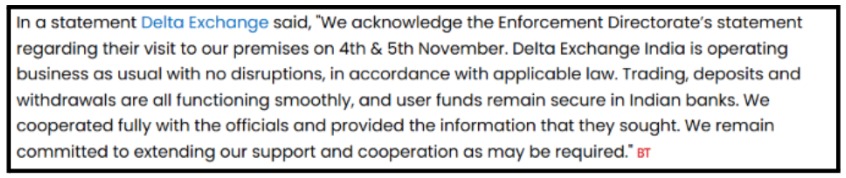
Delta Exchange India said it cooperated fully and that it is “operating business as usual with no disruptions”. It said trading, deposits and withdrawals work normally and that user funds remain in Indian banks.
The company also said its business does not involve cross-border transfers of virtual digital assets, and that it is a dedicated INR-settled exchange for Indian users.
It said Excelium has been FIU-IND registered since 2023 and follows KYC, anti-money-laundering and reporting rules.
That directly differs from the ED’s reported allegation about an overseas execution route.
4. Does FIU-IND Registration Settle the ED’s Questions?
It is natural to ask whether the registration answers the search. It does not, and the reason is simple.
FIU-IND registration and KYC or anti-money-laundering compliance do not, by themselves, show that every product has SEBI or RBI approval.
They also do not show that every cross-border arrangement meets FEMA.
FIU registration deals with financial crime reporting. The ED’s reported questions are about the products on offer and how trades and value were routed and settled.
5. Are User Funds at Risk?
This is the first thing most users ask, and the honest answer has limits.
No report shows that the ED froze customer balances or ordered the platform to suspend operations. A search of premises under FEMA is not an account freeze.
Delta Exchange says trading, deposits, and withdrawals work normally and that user funds sit in Indian banks.
That is the platform’s own statement, not an independent audit of customer balances.
Until an authority says otherwise, keep your deposit, trade, and withdrawal records and follow official platform notices.
6. What Happens Next?
A search is the start of an investigation, not the end. These are the next steps to watch.
The ED has said the investigation is continuing. The next step could be a further official statement, a FEMA notice or adjudication, or action by a relevant regulator.
So far, there is no final adjudication, penalty, prosecution or court finding against Excelium Technologies.
Until that changes, follow official statements from the ED, the company and regulators, and ignore social media rumours.
7. What Should Delta Exchange Users Do Now?
You do not need to panic, and you do not need to ignore it either.
These steps keep you in control:
- Do not read FIU-IND registration as SEBI approval for every product.
- Read the product terms, especially where a tokenised stock gives price exposure rather than ownership.
- Keep records of deposits, withdrawals, order confirmations, fees, and support tickets.
- Use only the official website and support channels. Ignore unsolicited messages offering refunds, withdrawals or special access because of the ED news.
- Follow official updates from the company and regulators, not social media rumours.
Delta Exchange App Reviews and User Complaints
We went through reviews on Trustpilot, X, Google Play and the Apple App Store. Reviewer names are left out, and the company’s replies are included where they exist.
Every review below is one user’s allegation. We have not verified any of them.
The same few themes keep returning, so the table below shows where each one appears.
| Theme users raise | Where it appears |
|---|---|
| High fees, commissions and a share of profits | Trustpilot, App Store, Google Play |
| Stop-losses, slippage and unexpected liquidations | X, Google Play, App Store |
| Slow or pending withdrawals, debit without wallet credit | Trustpilot, Google Play, App Store |
| Referral rewards, cashback and offer terms seen as unclear | Google Play, App Store |
The sample is small, so it does not describe every user’s experience.
1. Delta Exchange Charges and Fee Complaints
Fees are the most common complaint.
The official fee page inside the app is the only number that counts, so check it before you trade.
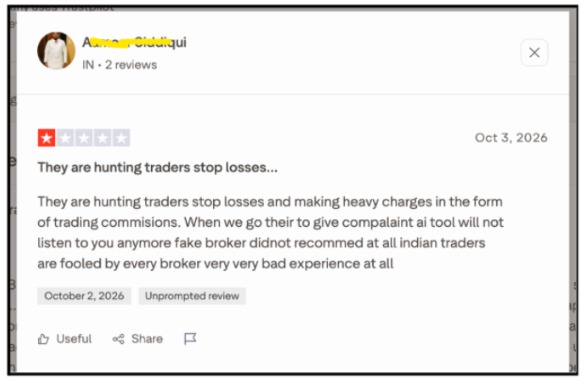
Trustpilot, 3 October 2026. A reviewer alleged stop-loss hunting and heavy trading commissions. They also said the support AI tool stopped responding when they tried to complain.
App Store, 24 January 2025. A review titled “Highest Trading FEES and GLITCHES” alleged that about 40% of profitable amounts went to fees, and that fees doubled when lot size increased.
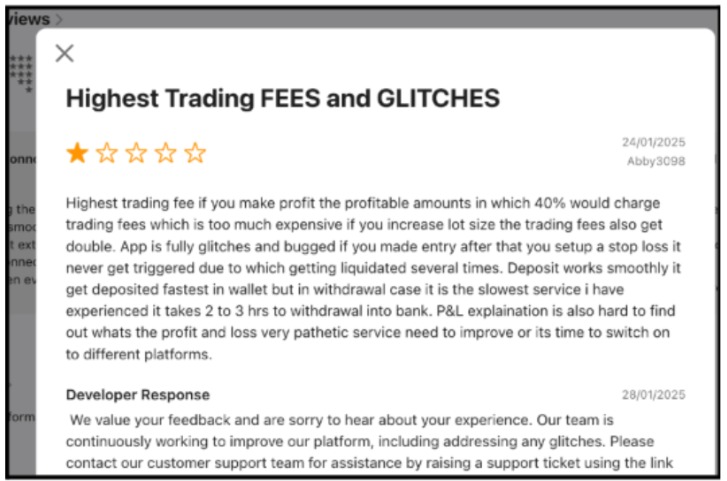
The developer replied on 28 January 2025. It apologised, said the team was working on glitches, and asked the reviewer to raise a support ticket.
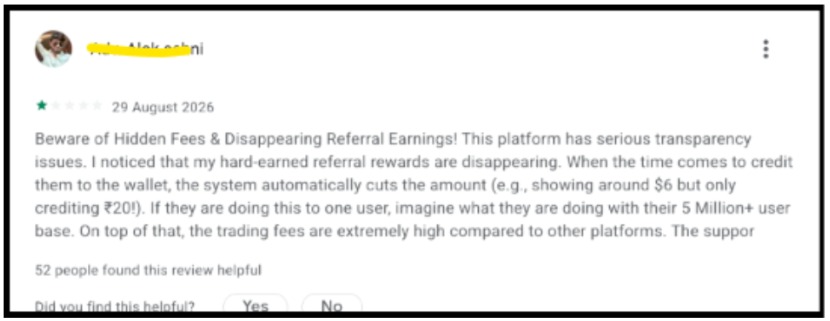
Google Play, 29 August 2026. A reviewer titled the post “Beware of Hidden Fees & Disappearing Referral Earnings” and called trading fees extremely high compared with other platforms. 52 users marked the review helpful.
The screenshot below shows the full review as posted.
2. Orders, Stop-Loss and Liquidation Complaints
These complaints cluster around fast markets, when orders matter most.
The accounts below are allegations, and some got no reply in the screenshots.
X, 25 and 26 March 2025. One user alleged a system failure left exit orders unexecuted and missing from the logs.

A quoting post called the platform a scam and alleged a delisted token, poor liquidity, and a personal loss of USD 20,000.
The post showed about 36.9K views, 347 likes, and 99 reposts. A reply claimed a loss of USD 1,000 to 1,100 in the Deto token, and another reply called it “complete manipulation”.
No Delta Exchange response appears in the screenshots.
Google Play, 29 May 2025. A reviewer alleged positions were liquidated before the stated liquidation point.
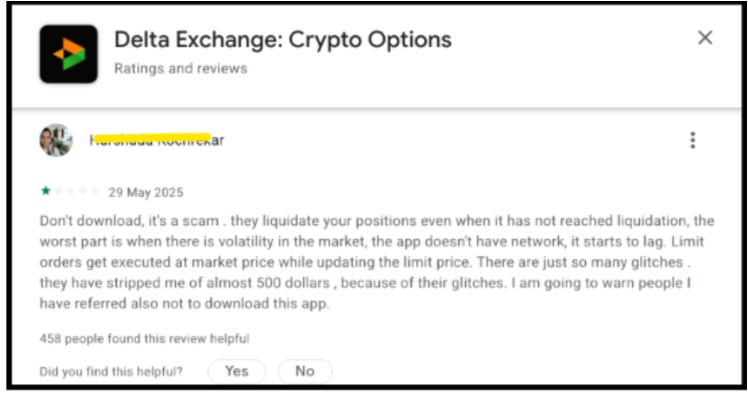
They said the app lagged during network drops and that limit orders executed at market price while the limit was being updated, costing about USD 500. 458 users marked it helpful.
Google Play, 20 August 2026. A reviewer said that after they bought an options premium on expiry day, it moved to ten times the entry price after 4 p.m., yet the trade still showed a loss. 12 users marked it helpful.
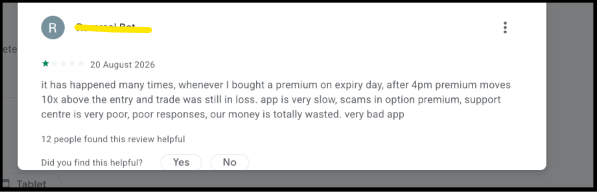
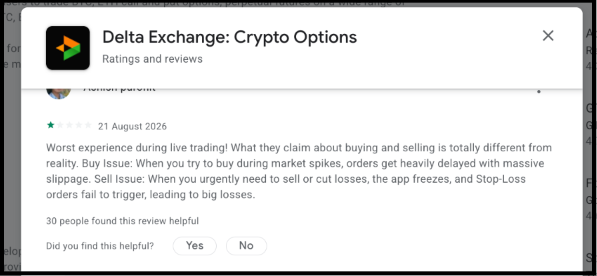
Google Play, 21 August 2026. Another reviewer alleged delayed buy orders and heavy slippage during market spikes. They said the app froze when they tried to sell, and stop-losses failed to trigger.
App Store, 18 August 2025. A review titled “Not trustable” alleged that after six months of use, the app glitched during a market crash and that many trades were liquidated.
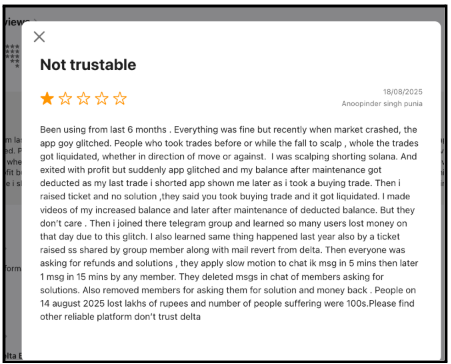
The reviewer said their balance dropped after maintenance, and a ticket did not fix it.
They also alleged that the same thing happened the year before, and that Telegram group administrators replied slowly, deleted messages, and removed members who asked for refunds, and that hundreds lost lakhs on 14 August 2025.
No company reply appears in the screenshot, and none of this is verified.
3. Withdrawal and Deposit Complaints
Stuck money is the complaint that hurts most.
Here is what users reported, along with the company’s replies.
Trustpilot, October 2025. A one star reviewer said money left their bank account but never reached their Delta Exchange wallet.
They said support did not respond and no refund came.
The experience date was 11 October 2025, and they posted on 27 October 2025.
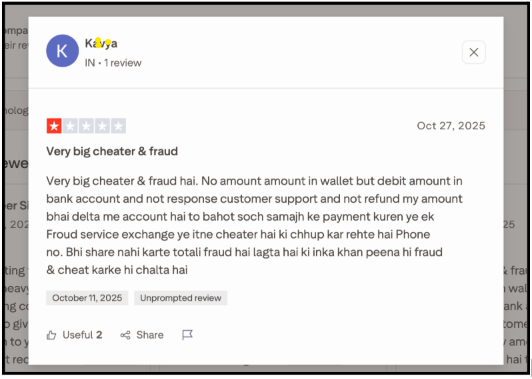
Google Play, 19 October 2026. A reviewer said a withdrawal stayed pending for more than 34 hours, and the support ticket kept asking for more time.
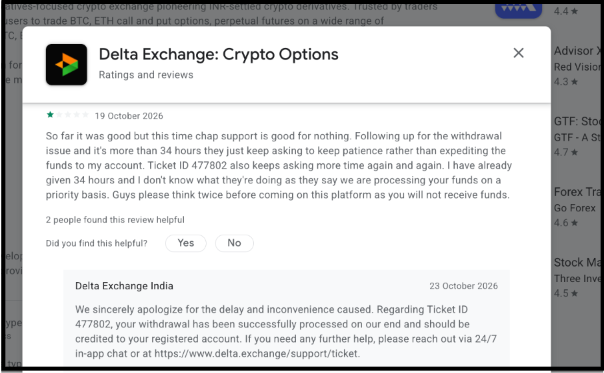
Delta Exchange India replied on 23 October 2026. It apologised for the delay and said the withdrawal had been processed on its end and should reach the registered account.
4. Referral Rewards and the Diwali Scalper Offer
Offers and rewards work only when the terms are clear.
These two complaints are about exactly that.
App Store, offer review dated 11 October. A review titled “Delta Exchange Diwali Scalper Offer Misleading Cashback Advertising” said the ad promised “Zero Closing Fee” and “100% Cashback on BTC Opening Fees”.
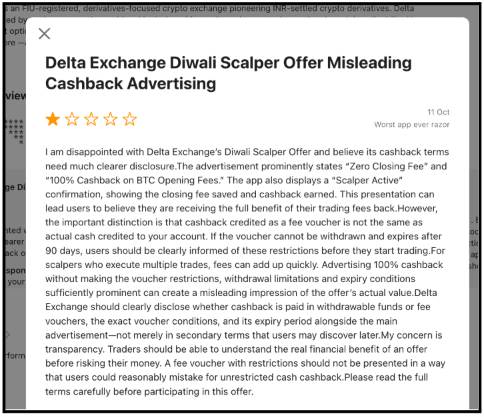
The reviewer said the cashback came as a fee voucher that could not be withdrawn and expired after 90 days. They asked the company to state clearly whether cashback is paid as withdrawable money or as a voucher.
The review does not prove the offer was misleading. It does show why vouchers, cashback, and cash credit are different things.
5. Referral Programme and Conflict of Interest
Someone may have urged you to join through their link. It helps to know how that link pays them.
Under the programme, a referrer earns 10% of the eligible net trading fees paid by the people they refer. Referred users get a 10% fee discount for their first two months.

That means the referrer earns when the people they refer trade, whether those trades make money or not. This is a potential conflict of interest, and it does not prove any recommendation is misleading.
A March 2025 X post alleged that stock market YouTubers kept promoting the platform. That is a user’s claim, and it does not show that any creator acted improperly.
Paid a fake Delta Exchange site or agent and cannot get your money back?
Our team reviews online trading and crypto fraud cases where the loss is above ₹30,000. Send us your payment proof, chats and website details, and we will look at your case.
Delta Exchange Login: Fake Websites and Profiles Using the Name
Most traders reach a platform by typing its name and “login” into Google. Scammers know this, so they build pages to show up in exactly those searches.
If you search for Delta Exchange login or Delta Exchange India login, check the web address before you type anything.
The company has published its own warning about copies of its site. The next sections show what it says and how to spot one.
These copies come from third parties, so they say nothing against the real platform.
Nobody has publicly named the person or company behind them.
Which Websites Does Delta Exchange Say Are Fake?
Copying a real brand is the oldest trick of a fake crypto exchange, and the company’s Help Center has a page warning about unauthorised sites.
It says the listed sites are not associated with Delta Exchange and may try to steal funds or information.
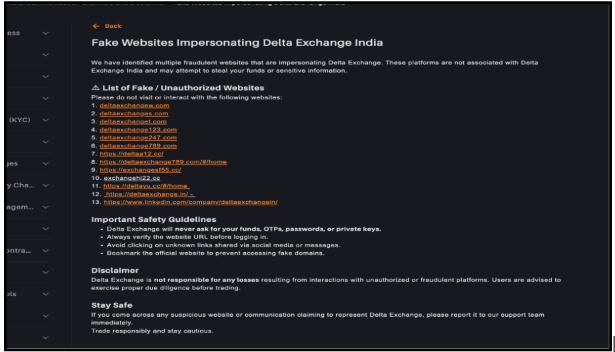
The list has 13 entries. These six lookalike domains are examples from it:
- deltaexchangew.com
- deltaexchanges.com
- deltaexchanget.com
- deltaexchange123.com
- deltaexchange247.com
- deltaexchange789.com
Other entries include short unrelated addresses ending in .cc, a fake LinkedIn company page, and a site on a different .in domain.
Lists like this change, so check the company’s current warning page before you rely on this one.
[Image placeholder: Delta Exchange Help Center page “Fake Websites Impersonating Delta Exchange India” (research Figure 19) | Source: Delta Exchange Help Center, add URL]
How Delta Exchange Impersonation Scams Work: 6 Common Tactics
A Delta Exchange impersonation scam rarely looks suspicious at first, and the same few patterns repeat.
They describe reported methods, and they are not proof that each one was used on Delta Exchange users.
1. Lookalike websites
The address resembles the real brand, often with a small spelling change, extra numbers or an unrelated ending. The page copies the real login screen.
2. Fake social media profiles
A profile poses as the exchange or its staff and invites you into private chats. It can look like a real support desk.
3. Tips and guaranteed profit claims
Unsolicited messages promise guaranteed profits or insider tips, often for a coin you have never heard of. Screenshots of big gains are easy to fake and prove nothing.
Before you touch one, learn how to identify fake cryptocurrency. Screenshots of big gains are easy to fake and prove nothing.
4. Giveaways and bonuses
A free bonus pushes you to deposit, connect a wallet, or share account details.
5. Phishing for credentials
Fake pages and messages ask for passwords, OTPs, private keys, or remote access to your phone. Real support does not.
6. Urgency and limited time pressure
Lines like “act now” or “limited offer” push you to move before you check who is on the other end.
What Does Delta Exchange Say It Will Never Ask For?
The company has published its own safety rules.
They are short and worth following even if you never had a problem.
- It says it will never ask you to transfer funds or share OTPs, passwords, or private keys.
- Check the website address before you log in.
- Avoid unknown links shared on social media or private messages.
- Bookmark the official website instead of opening it from links others send.
- Report suspicious sites and messages to its support team.
The company also states that it is not responsible for losses from dealings with unauthorised platforms, and it asks users to do their own checks before trading.
Delta Exchange Customer Care Number: Where Real Support Is
Searching Google for a customer care number is a common way people end up talking to a scammer. Here is where the platform itself points users.
We have not confirmed any phone number, so we are not printing one.
In a public reply on Google Play, the company points users to 24/7 in-app chat and its support ticket page at delta.exchange/support/ticket.
Numbers on random websites, ads, or social media comments are a risk. Delta Exchange says it will never ask for your OTP, password, or private keys, so treat anyone who does as a scammer.
What Should You Do if a Withdrawal Is Pending?
A pending withdrawal is stressful, and the first few steps are simple.
Doing them in order also builds a record you may need later.
- Take a screenshot of the pending status, with the date and amount visible.
- Raise a ticket through the in-app chat or the official support page.
- Save the ticket number. Users who got replies mention it in their reviews.
- Keep every message, email, and notice in one folder.
How to Register a Complaint Against Delta Exchange Online?
If you paid a lookalike site or a fake support agent, speed matters more than anything.
The first hours decide how much a bank can still do.
These steps also work if the money went to someone claiming to represent the platform.
1. Stop Paying and Stop Sharing Details
Do not send “release fees”, “tax,” or “verification” amounts to get your money out.
A second payment only adds to the loss.
2. Save Everything
Screenshot the website address, the profile, chats, payment receipts, and transaction IDs before anything disappears.
These records are also what a crypto fraud complaint in India is built on.
3. Tell Your Bank Right Away
Ask the bank to flag the payment. If you paid by UPI, read how a UPI cyber crime complaint works and act while the trail is fresh.
4. Report the Site to Delta Exchange
The company asks users to report suspicious websites and messages to its support team. Send them the address and your screenshots.
5. File a Cyber Crime Complaint
Keep your proof ready before you file a cyber crime complaint on the national portal, or call the cyber crime helpline 1930.
If you are not sure what comes after the complaint, here is what to do if online fraud happens in the days that follow.
Conclusion
Three things are true at once. The company says it is FIU-IND registered, and that is not SEBI approval or a guarantee of safe funds.
Users have posted unverified complaints about fees, orders, withdrawals, and offers, and the ED is investigating alleged cross-border transactions, which the company disputes.
Fake sites using the name are a separate risk. Use only the official website, keep your records, and treat every claim as an allegation until an authority decides.
Also ask whether anyone recommending a platform earns from your trades.
Report. Recover. Stay Fraud Free.
Frequently Asked Questions
Nothing we reviewed says it is banned, and the company says it is registered with FIU-IND. That registration is not SEBI registration or approval of each product.
No. A search is an investigative step, and the company disputes the allegation about cross-border transfers. No final finding has been reported in the material we reviewed.
Our research does not include a fee schedule, so check the fee page in the app before you trade. Users have complained that fees are high compared with other platforms.
Check the full address against the company's warning list and bookmark the official site. Never enter OTPs, passwords or private keys on a page you reached from a message.
We could not confirm a phone number. Use the in-app chat or the official support ticket page, and avoid numbers from random websites or ads.





 Add us as a preferred source on Google »