
Quick Summary
An RBI impersonation scam happens when fraudsters use the Reserve Bank of India’s name, logo or fake officers to make a lottery, a stuck fund or a money laundering threat look real. Victims are asked to pay release fees, processing charges or to move money to a “safe account”. RBI says it never holds funds for individuals and never asks for deposits. This page covers six reported cases, from ₹15 lakh to ₹2.35 crore, and the steps to take first.
The call sounds official. The letter has a logo. The caller knows your name and talks about crores of rupees waiting for you.
That is how an RBI impersonation scam usually begins, and it has worked on retired engineers, businessmen, and senior citizens across India.
The scammers do not need to be clever.
They only need you to believe that the country’s central bank is on the other end.
So let us look at what RBI actually does, what the reported cases look like, and how you can tell a real contact from a fake one.
Who Is RBI and What Does It Never Do?
The Reserve Bank of India is the country’s central bank.
It regulates banks and lenders, and it does not deal with individual customers the way your bank branch does.
That single fact is what breaks almost every RBI-themed fraud.
In a press release of 29 August 2024, RBI said it never holds funds for individuals and never opens accounts for them.
It also said it never asks people to deposit money and never sends messages about lotteries or foreign funds.
The same release listed two kinds of tactics. Some entice you with a lottery, a fund, or a remittance offer.

Others intimidate you with threats to freeze your account or claims of a money laundering probe.
Is the Person Contacting You Really From RBI?
If someone says they are from RBI and asks you for money, OTPs, or an app install, the answer is almost always no.
RBI does not collect fees to release prizes or funds.
It does not ask you to move savings into a “verification” account either.
The quickest check is to stop the conversation and look up the matter on rbi.org.in yourself, not through any link the caller sends.
A real regulator will never mind you taking a day to check.
What Is an RBI Impersonation Scam?
In an RBI impersonation scam, a stranger claims to be an RBI officer, or sends documents with RBI’s logo, to get you to pay or share details.
The money is never real, and the fee is the whole point.
It is one version of a wider impersonation scam, where fraudsters borrow a trusted name such as a bank, a ministry or an agency.
What changes from case to case is the story.
One victim hears about a lottery win, another about an insurance payout, another about a probe against their own bank account.
Real RBI Impersonation Scam Cases In India
Here are six cases from news reports, ranked by the amount reported lost.
RBI is the lead name in some and one of several names in others.
The losses show the real dangers of cyber crime for ordinary families, and every detail below is attributed to the report that carried it.
1. ₹2.35 Crore: Odisha Businessman and a “Relief Scheme”
This is the largest loss in our set and the oldest. It shows the playbook has not changed in years.
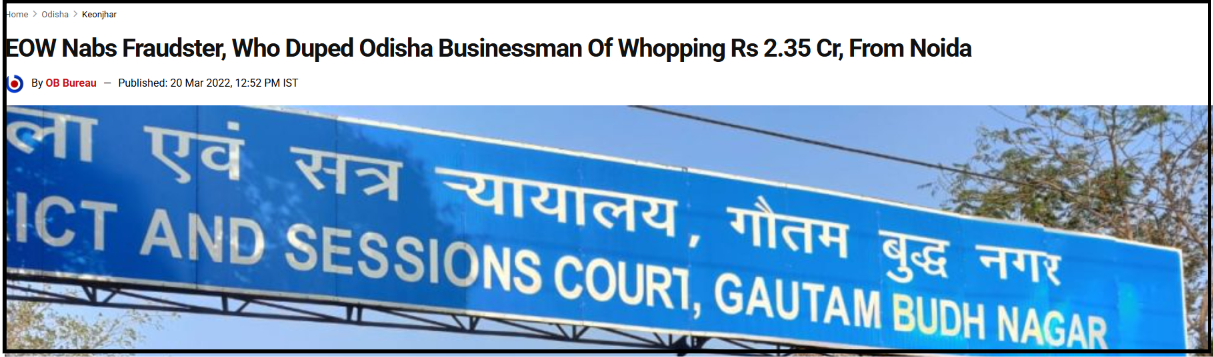
According to Odisha Bytes (20 March 2022), a businessman from Keonjhar made payments between 19 November 2019 and 2 February 2021 to a man who posed as a Finance Ministry official handling fund releases.
The letters he received carried the names of the Finance Ministry, IRDA, RBI and Income Tax.
He was told an insurance policy had been selected under a relief scheme, with ₹3 crore to be released.
The Economic Offences Wing reportedly arrested one person in Noida on 15 March 2022.
2. ₹1.8 Crore: Hyderabad Woman and a Fake Lottery
This case moved fast and used WhatsApp. The victim was in her seventies.
NewsBytes (26 December 2025) reported that a 77-year-old woman was promised a ₹2 crore lottery.
The callers allegedly posed as a business tycoon and as RBI officials, and sent a fake RBI document on WhatsApp.
They then took remote access to her phone.
Her fixed deposits were reportedly broken because “RBI rules” supposedly required her balances to match.
The report counts 123 small transactions. Police were reportedly investigating.

3. ₹95 Lakh: Kanpur Retiree and a Fake RBI Style Website
This one started with a real problem, not a prize. That is why it worked.
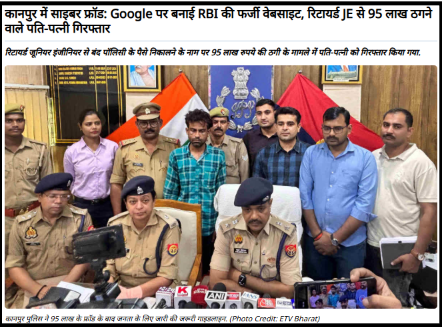
ETV Bharat (26 May 2026) reported that a retired junior engineer searched Google to recover money from a closed insurance policy.
A website that looked like an RBI page ranked high, and a caller allegedly posed as a senior RBI officer.
A husband and wife were reportedly arrested by Nazirabad police, and goods and bank accounts were seized.
The report does not state how much money was recovered.
4. ₹40 Lakh: Bengaluru Businessman and a Fake RBI Seal
The numbers in this story were so large that they should have raised alarms. They did the opposite.
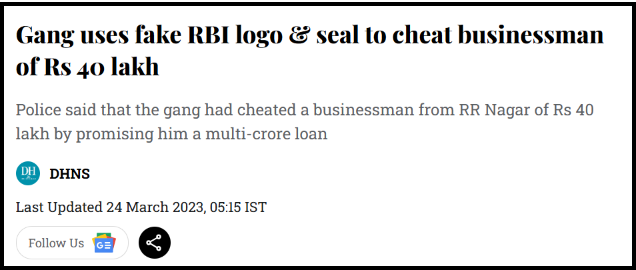
Deccan Herald (24 March 2023) reported that a gang used a fake RBI logo and seal.
They allegedly claimed ₹75,000 crore was held at RBI for atomic energy investments and that ₹150 crore was needed to release it.
The businessman was reportedly promised a ₹7.5 crore loan for a ₹20 lakh investment.
The Central Crime Branch reportedly arrested nine people, with two suspects still at large.
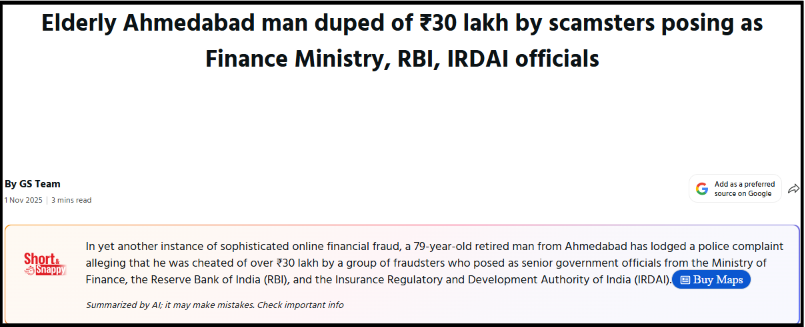
5. About ₹30 Lakh: Ahmedabad Retiree and Forged Letterheads
Here, RBI was one of many names, which is common in these cases.
Gujarat Samachar (1 November 2025) reported that calls to a 79-year-old retired man began on 16 July 2024.
A caller allegedly posed as a senior SBI officer, and others posed as IRDAI and Finance Ministry officials.
Forged letters on RBI, IRDAI, NPCI, and DFS letterheads reportedly demanded “processing charges” for insurance funds.
Money went by RTGS to more than 30 accounts.
An FIR was registered, and FIU-IND was alerted. No arrests were reported.
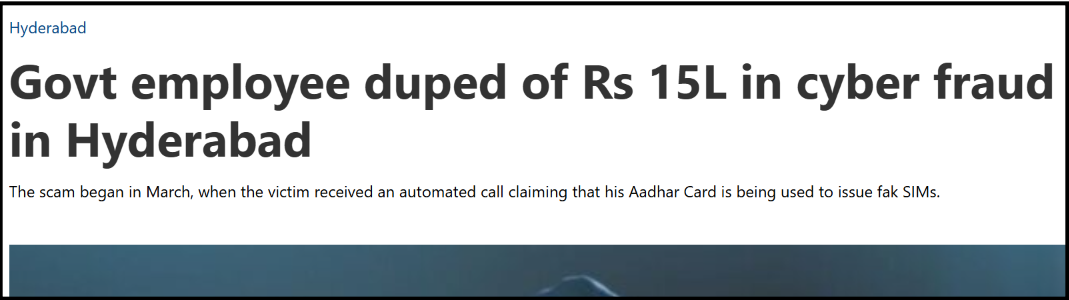
6. ₹15 Lakh: Hyderabad Employee and a Digital Arrest
Not every RBI case is about a prize. Some use fear instead, and RBI is used to make the threat sound official.
Siasat (12 May 2026) reported that a 56-year-old BHEL employee was targeted by people posing as CBI, TRAI, police, and RBI officials, who allegedly sent forged ED and RBI notices. No arrests were reported.
Did a caller or letter in RBI’s name already take your money?
You do not have to work through it alone. We review cyber fraud cases where the loss is above ₹30,000 and explain the options open to you. Register with us and share what happened.
Four Ways Scammers Use the RBI Name
The six cases look different, but they fall into four patterns. Once you can name the pattern, the call loses its power.
1. The Fund Release Fee
A large sum is said to be stuck at RBI or a ministry. You are asked to pay a processing charge, a security deposit, or a clearance fee to release it.
The Odisha, Bengaluru, and Ahmedabad cases followed this path.
Each payment is described as the last one, and then another fee appears.
2. The Fake Lottery or Tycoon Offer
A prize or inheritance arrives on WhatsApp with a document carrying RBI’s name.
Then comes the fee, or a request for remote access to your phone.
Before you reply to an unknown caller, there is a quick way to check if a phone number is scam, and it takes a minute.
3. The Fake RBI Website
You search for a way to recover your own money, and a look-alike page ranks near the top.
The Kanpur case began exactly this way.
The real RBI site is rbi.org.in. Any page asking you to pay to claim money is not it.
4. The Digital Arrest Threat
Here fear does the work. Callers claim a money laundering probe and say RBI must “verify” your money.
The next step is a transfer to a “safe account”.
RBI is a supporting name in these cases, not the lead.
Fake RBI Messages on WhatsApp and Voicemail
Government fact-checkers have flagged this channel twice in the past year. Both warnings are worth knowing.
PIB Fact Check (19 November 2025) called a viral voicemail in RBI’s name false.
It claimed an account would be blocked over card fraud.
PIB Fact Check (12 June 2026), as reported by Deccan Chronicle, flagged a fake RBI WhatsApp message with an APK file.
It claimed suspicious transactions and demanded information within three working days.
PIB said RBI contacts people on WhatsApp only through its verified blue-tick numbers.
Do not download any APK sent in RBI’s name.
How to Check If an RBI Contact Is Genuine?
A few checks take less than five minutes. Run them before you pay or share anything.
- Fees: RBI never asks you to pay to receive money.
- OTPs and apps: RBI never asks for OTPs or an app install.
- Urgency: a deadline of hours or days is a pressure tactic.
- Secrecy: “do not tell your family or bank” is a warning sign, not a rule.
- Documents: a logo or seal proves nothing, since fake RBI letterheads have been reported since 2018.
- Source: check the matter on rbi.org.in directly, never through the caller’s link.
If even one of these fits, end the call and speak to someone you trust.
What to Do If You Already Paid an RBI Impersonation Scammer?
The first hours matter most.
If money has already left your account, work through these steps in order and do not feel embarrassed, since the people behind these calls are practised.
If you are unsure where to begin, this is what to do if online fraud happens to you.
- Stop paying. Do not send another rupee, even if the caller says it is the final fee.
- Save your proof. Keep screenshots, phone numbers, letters, payment receipts, and bank references.
- Report it formally. Call the cyber fraud helpline and tell your bank at once. Learn how to file a cyber crime complaint and keep your proof ready when you do.
- Cut contact. Block the numbers, but keep the chat history.
- Be careful with “recovery” offers. Anyone asking for an upfront fee to get your money back may be the next scammer.
After you file, you can follow your cyber crime complaint status online.
Conclusion
An RBI impersonation scam works because the name feels safe.
The reported cases, from ₹15 lakh to ₹2.35 crore, all relied on the same ideas: a large sum, a fee, a fake document, and pressure to stay quiet.
Remember one line from RBI itself: it never holds funds for individuals and never asks for deposits.
If a call breaks that rule, hang up and check on rbi.org.in.
Report. Recover. Stay Fraud Free.
Frequently Asked Questions
RBI says it never asks people to deposit money and never sends messages about lotteries or foreign funds.
PIB Fact Check said RBI contacts people on WhatsApp only through its verified blue tick numbers. A message with an APK file is a warning sign.
Fraudsters claim you have won a prize or a fund, then ask for processing charges or remote access to your phone. The prize does not exist.
Call helpline, tell your bank, and file a complaint on the national cyber crime reporting portal with your proof.
RBI says it does not hold funds for individuals. A request to pay a fee to release money held at RBI is a red flag.





 Add us as a preferred source on Google »