
Quick Summary
A Tata Capital impersonation scam begins with a loan offer, a job offer or a support call that uses the company’s name. The sender says your loan is approved, then asks for fees such as insurance, NOC or activation charges, one payment after another. This blog explains how the trick works, shows cases reported online, covers the company’s own fraud advisory and lists the steps to take if you have already paid. It is written for Indian borrowers and job seekers.
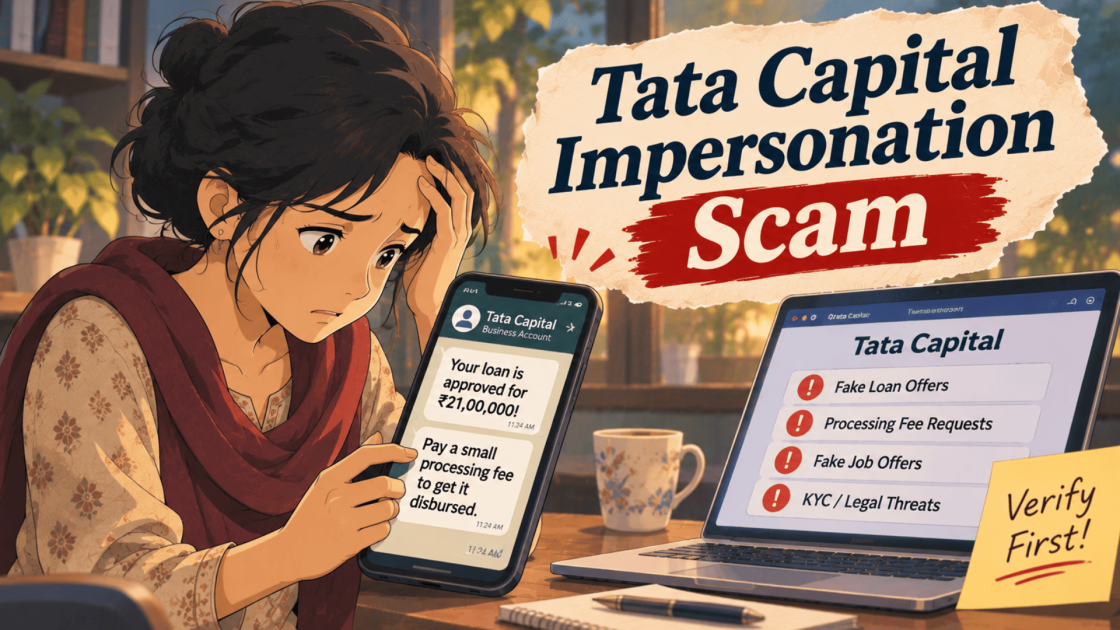
Got a message saying your Tata Capital loan is approved, but you must pay a small fee first? Stop right there.
That is how a Tata Capital impersonation scam usually begins: good news, then a tiny payment.
Fraudsters borrow the name on WhatsApp chats, fake support numbers, and even fake job offers.
This blog shows how the trick works, what the company itself warns about, and what to do if you have already paid.
Tata Capital Review
Tata Capital is a financial services company and a subsidiary of Tata Sons Private Limited.
It operates as a non-banking financial company, or NBFC.
It offers personal, home, business, vehicle, and education loans, loans against property, investment products, and insurance distribution.
Customers apply for and manage loans through its official website and digital services.
Those are the places a genuine loan process should happen.
Is the Loan Offer Really From Tata Capital?
This is the first question to settle before you pay or share anything. The checks below take a few minutes.
The company’s own advisory asks you to verify the authenticity of every call, email, SMS, website, and advertisement before making any payment or sharing documents.
Be careful if the offer arrives as a direct message, a WhatsApp chat, or a call from a personal number.
A loan offer that arrives this way deserves extra checking.
Also be careful if you are asked to pay fees to a personal account or through UPI to an individual.
Genuine charges appear in your loan documents and go through official channels.
When in doubt, stop replying and start again from the company’s official website.
Tata Capital Impersonation Fraud
This section defines the scam in plain words. It also shows what the fraudster is really after.
It happens when someone poses as a Tata Capital executive, loan agent, customer care representative, or recruiter.
Additionally, it is one form of the wider impersonation scam that borrows a trusted brand.
The promise is usually a quick, pre-approved loan or an easy job. Both are bait.
The real goal is money in advance, or your Aadhaar, PAN, OTPs, and other personal details.
Also Read: The real publisher has publicly said it has no association with any company collecting money through handwriting jobs, so who is actually asking for the fee? We looked into it in our Vishv books impersonation scam guide.
How Fraudsters Execute a Tata Capital Impersonation Scam?
The steps below follow the pattern in reported cases. The fee changes every time, but the trick stays the same.
- Contact. A person claiming to represent the company reaches out on WhatsApp, by call, SMS, or a fake support number.
- Approval. You are told your loan is sanctioned, often for a large amount, to make you feel safe.
- The first fee. You are asked to pay a small amount for insurance, GST, file processing, or a refundable charge.
- More fees. Every payment is followed by a new reason: a rejected payment, an NOC, account activation, app ID activation, or a new password.
Each reason sounds small. Together they add up fast.
- Silence. The app may show invalid credentials, the loan is never paid out, and the promised refund does not come.
Some versions skip the loan and use threats of legal action or KYC expiry to pull out OTPs and documents.
Others target job seekers with fake offers that demand deposits.
Tata Capital Impersonation Scam Types: Loan, Job and Support Calls
The same company name is used in several different stories.
This section sorts them so you can recognise the one in front of you.
The table lists the types named in the company’s advisories and in public posts.
|
Type |
What you are told | What it is after |
|
Fake loan offer |
A pre approved loan, pay processing fees, GST or insurance first | Money in advance |
| Fake customer care number | A helpline found online, or a link sent by SMS or WhatsApp |
Personal details and clicks |
| Impersonation or digital arrest | An executive or officer cites legal action or KYC expiry |
Aadhaar, PAN, OTPs, payments |
|
Fake job offer |
A job at a company with a Tata style name | Deposits and training fees |
| Social media offer | A direct message about a loan or guaranteed returns |
Trust, then money or codes |
The company says some of these use names that only sound similar to its own, such as fictitious entities with “Tata” in the name.
Loan offers are the most reported type. How to avoid loan scams covers the common warning signs in more detail.
Also Read: A friendly offer to help apply for a new credit card ended with ₹42,212 charged to the victim, as reported in our IDFC impersonation scam guide.
Real Tata Capital Impersonation Cases From Public Posts
These cases come from public posts and are given as the posters described them.
We could not confirm them independently, and no names or numbers are used here.
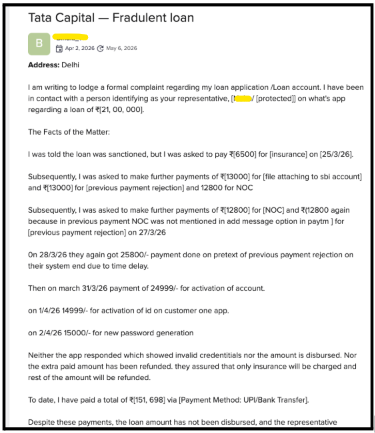
1. A ₹21 Lakh Loan Offer That Cost ₹1,51,698 in Fees
A Delhi resident filed a public complaint in April 2026.
She said a person claiming to be a Tata Capital representative contacted her on WhatsApp about a ₹21 lakh loan.
On 25 March, she was told the loan was sanctioned and asked to pay ₹6,500 for insurance.
More requests followed over the next week.
The reasons given were attaching the file to a bank account, a rejected payment, a No Objection Certificate, account activation, ID activation on an app, and a new password. Several amounts were repeated.
By 2 April, she says she had paid ₹1,51,698 through UPI and bank transfers.
The app showed an invalid credentials message; the loan was never disbursed, and the promised refund did not arrive.
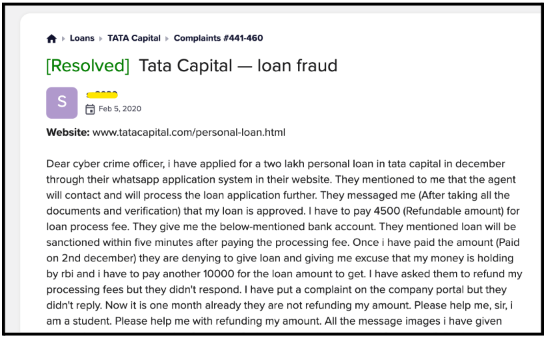
2. A Student Asked to Pay Again After a ₹4,500 Fee
An older complaint from February 2020 describes a student who applied for a ₹2 lakh personal loan through a WhatsApp application link.
After documents and verification, the student was told to pay ₹4,500 as a refundable processing fee, with a promise of approval within five minutes.
After paying, the student says the sender claimed the money was being held by the RBI and asked for another ₹10,000.
The refund was never made.
3. A Video Case of Lakhs In Loss
A YouTube awareness video, uploaded about four years ago, discusses a person who reportedly lost lakhs after a loan offer in the company’s name.
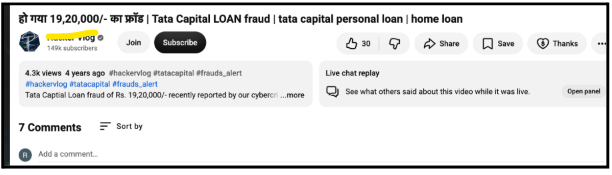
The creator stresses reporting to the police, using the proper complaint route and avoiding anyone who promises an unofficial fix.
Lost money to a loan offer like these?
Keep every payment record and register with us so our team can review your case.
What Tata Capital’s Own Fraud Advisory Says
The company publishes a fraud advisory with two parts. This section summarises both as they appear on its page.
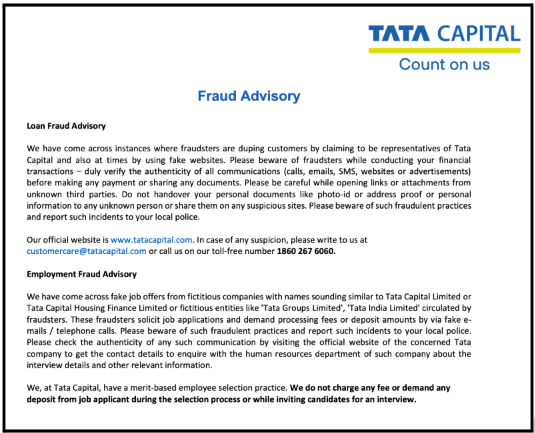
The loan fraud advisory says fraudsters dupe customers by claiming to be company representatives, sometimes using fake websites.
It asks you to verify every call, email, SMS, website, and advertisement before paying or sharing documents.
It also warns you to be careful with links and attachments, not to hand personal documents to unknown people, and to report such incidents to your local police.
The employment fraud advisory covers fake job offers from companies with names that sound like Tata Capital.
It says the company runs a merit-based selection process and does not charge any fee or deposit from applicants during selection or interviews.
The company has also posted a social media reminder about offers that promise guaranteed returns or pre-approved loans through direct messages.
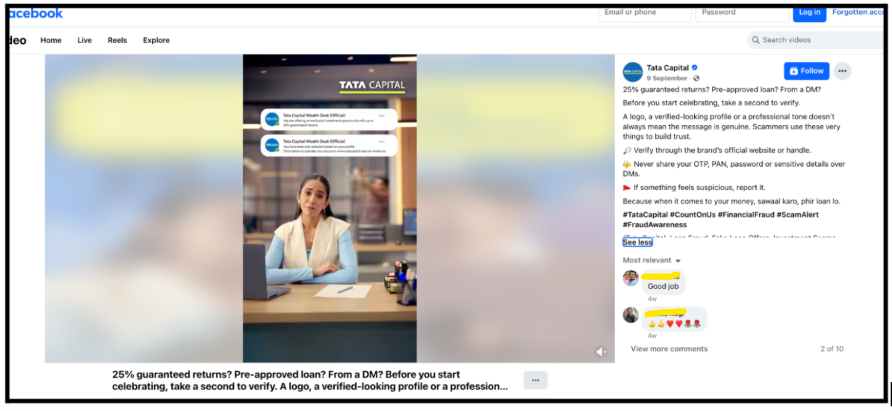
It says a logo, a verified-looking profile, or a professional tone does not make a message genuine.
It’s three simple checks: verify through the brand’s official website or handle, never share OTP, PAN, or passwords over direct messages, and report anything suspicious.
What the Online Posts Show
This section pulls out what the public posts have in common. It is a summary of patterns, not an official finding.
The fee keeps changing. The reason for the next payment is new each time: insurance, a rejected payment, an NOC, activation, a password.
The loan never arrives. In the reported cases, the money was never disbursed, and the app or chat went quiet.
A refund is always “coming”. Posters say they were told extra payments would be returned once the process finished.
A real lender does not need a new reason to ask for money every day. When the reasons keep changing, stop paying.
How to Stay Safe From a Tata Capital Impersonation Scam?
This section is about prevention, before any money moves. These habits work against nearly every version of the scam.
- Start from the official website. Apply for loans there, not through a chat link or a number someone sent you.
- Do not pay to receive a loan. Treat any demand for insurance, NOC, activation, or password charges before disbursal as a warning.
- Pay only through official channels. Be wary of any request to send money to a personal account or an individual’s UPI ID.
- Never share OTPs, PAN, Aadhaar, or passwords over chat, direct messages, or calls.
- Verify job offers. The company says it charges no fee or deposit during hiring, so any such demand is a red flag.
- Do not click links or open files from unknown senders claiming to be the company.
- Keep your documents safe. Share photo ID and address proof only with a lender you have verified.
- Talk to someone first. A few minutes with family or a friend often breaks the urgency.
If a loan agent starts pressuring or harassing you, the cases in fake loan app harassment complaints show how common that tactic is.
Ask the question first, then take the loan.
What to Do If You Lost Money to a Tata Capital Impersonation Scam?
This section is for the moment after payments have gone out. The first hours matter most, so the steps come in order.
- Stop paying. Do not send any further fees, even if it is described as refundable or the last one.
- Call the national cybercrime helpline. Report as soon as you can, because early reports help most when money has just moved.
- Tell your bank. Share the transaction details with your bank and ask what can be done about the payments.
- Save every record. Keep chats, call logs, payment screenshots, UPI and bank references, the numbers used, and any app or links sent.
- Report to the company. Use only the contact details printed on the official website to tell Tata Capital about the impersonation.
- File the online complaint. You can report on the national portal yourself, and knowing how to file a cybercrime complaint helps you include the right details.
- Avoid recovery offers. After a loss, strangers may promise to get your money back for an upfront fee. Do not pay anyone who guarantees results.
Conclusion
A Tata Capital impersonation scam depends on one thing: getting you to pay before you check.
The cases above show the pattern.
A loan is promised, the fees keep changing, and the money never arrives.
Verify through the official website, pay nothing to receive a loan, and report quickly if you already have.
Report. Recover. Stay Fraud Free.
Frequently Asked Questions
It is a fraud where someone poses as a Tata Capital representative, loan agent, recruiter or officer to collect fees, documents or OTPs.
Be careful with any request for insurance, NOC, activation or password charges before disbursal, or any payment to a personal account. Check the loan terms on the official website.
The company says it charges no fee or deposit during selection or interviews. A demand for one should be treated as fraud.
Stop replying and contact the company only through the contact details on its official website. Do not use numbers or links from the message.
Stop paying, call cybercrime helpline, tell your bank, save every record and file a complaint on the national cyber crime portal.





 Add us as a preferred source on Google »