
Quick Summary
An IDFC impersonation scam starts with a call, SMS or email that looks like it comes from IDFC FIRST Bank. The sender claims a card is blocked, KYC has lapsed or a loan is overdue, then pushes you to share OTPs, install an app or pay. This blog explains how the trick works, shows cases reported online, covers the bank’s own warnings and lists the steps to take if you shared details or lost money. It is written for Indian bank customers.
An IDFC impersonation scam works because the bank’s name feels trustworthy.
A call from your bank sounds urgent, official, and personal.
Fraudsters know this. They copy the bank’s name, its language, and sometimes even an ID card.
Reports shared online show the same tricks again and again: blocked card calls, fake loan recovery threats, and fake card offers.
This blog explains how each one works, what the bank itself warns about, and what to do if you have already shared details.
IDFC FIRST Bank
IDFC FIRST Bank is an Indian private sector bank.
It offers savings and current accounts, credit cards, personal loans, and digital banking.
Customers use it through branches, its website, its mobile app, and its customer support channels.
Those are the places where a real request will show up.
A call or message from anywhere else deserves a pause.
Is the Caller Really From IDFC FIRST Bank?
This is the first question to ask before you answer anything. A few simple checks usually settle it in minutes.
A bank will not ask for your OTP, PIN, CVV, or banking password on a call, SMS, or chat.
If someone does, treat it as a red flag.
Be careful with numbers too.
Fake customer care numbers can appear online, so use only the number printed on your card or shown in the bank’s own app and website.
A bank also generally deals with the borrower, co-borrower, or guarantor on a loan.
Calls to neighbours, relatives or random people about someone else’s loan do not fit that pattern.
A quick look at how to check if a phone number is scam can help when an unknown number claims to be the bank.
When in doubt, hang up and call the bank on a number you trust.
IDFC Impersonation Fraud
An IDFC impersonation scam happens when someone pretends to be an IDFC FIRST Bank official, customer care executive, or law enforcement officer.
The caller usually claims a problem with your account, credit card, loan, or KYC details.
That claim exists only to create urgency.
The goal is to steal OTPs, PINs, CVVs, and login details, take control of your device, or get you to send money yourself.
Also Read: A student who paid a ₹4,500 “refundable” processing fee was told the money was held by the RBI and asked for another ₹10,000, as described in our Tata Capital impersonation scam guide.
How Does an IDFC Impersonation Scam Work?
The steps below follow the pattern reported again and again. Each step is built to make you act before you think.
- Contact. Scammers reach out by phone call, SMS, WhatsApp, email, or a fake customer care number published online.
They present themselves as bank staff offering help. - Urgency. You are told your account or card will be blocked, KYC needs immediate verification, or your account is linked to suspicious transactions.
Sometimes the caller poses as a police or law enforcement officer instead, and accuses you of money laundering.
This is how digital arrest threats begin. - Stolen credentials. You are sent to a fake website or phishing link that looks like a banking portal.
It asks for account details, passwords, OTPs, PINs, or CVVs “for verification”. - Device access. Some victims are persuaded to install a malicious APK file or a remote access app.
The pretext is KYC, an e-challan payment, or account protection.
That gives the fraudster a view of your screen and possibly control of your phone. - Money leaves. With credentials or device access, the fraudster starts transactions from your account.
In digital arrest cases, you may be pressured into sending the money yourself.
Common Types of IDFC Impersonation Scams
The same bank name is used in very different stories.
This section sorts them so you can recognise the one in front of you.
The table below lists the types reported in public posts and in the bank’s own warnings.
|
Type |
What you are told | What it is after |
| Blocked card or KYC call | Your card or account will be blocked unless you verify |
OTP, PIN, CVV |
| Fake loan recovery call | You, or someone you know, owes an unpaid loan |
Fear and a payment |
|
Fake credit card offer |
Help with a new card, plus a link and an ID card | Card details and charges |
| Phishing email | Click to verify your email |
Personal data |
|
Fake customer care number |
A support number found online | Credentials, remote access |
| APK or remote access app | An app is needed for KYC or an e-challan |
Control of your phone |
|
Digital arrest |
A police officer says you are linked to a crime | A transfer made by you |
| Loan in your name | No call at all, a loan simply appears |
Your identity |
The last row is identity misuse, not a caller pretending to be the bank.
It is included because victims often search for it under the same words.
Malicious files sit behind several rows.
The RTO APK file scam shows how one innocent-looking file can hand over a phone.
Real IDFC Impersonation Cases From Public Posts
These cases come from public posts shared online and are given as the posters described them.
We could not independently confirm them, and no names or numbers are used here.
1. Loan Recovery Calls in a Mumbai Building
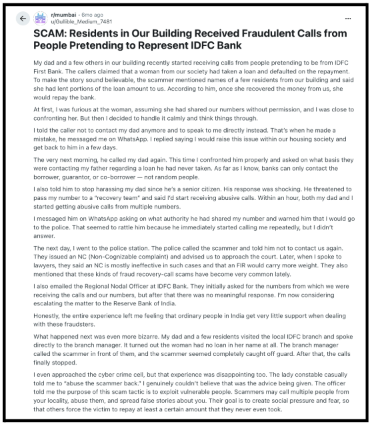
A resident posted that several people in their building received calls from someone claiming to be from IDFC First Bank.
The caller said a woman in the society had taken a loan and defaulted.
To sound believable, the caller named a few residents and said she had lent them parts of the money.
When the poster pushed back, the caller reportedly threatened to pass their number to a “recovery team”.
Abusive calls from several numbers followed within the hour.
The police called the caller and issued a non-cognizable report, but lawyers told the poster that an FIR carries more weight.
The case ended when residents visited the local branch.
The branch manager reportedly called the caller in front of them and confirmed the woman had no loan. The calls stopped.
2. A Fake Credit Card Offer That Cost ₹42,212
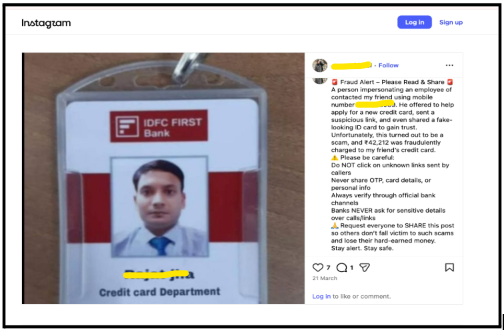
A fraud alert on Instagram describes a caller posing as a bank employee. He offered to help apply for a new credit card.
To look genuine, he shared a suspicious link and an ID card that looked fake.
₹42,212 was then charged to the victim’s credit card.
Cases like this are why credit card scams so often start with a friendly offer instead of a threat.
3. A Stranger Loan Taken in a Bengaluru Resident’s Name
A poster on Reddit described an email that looked like it came from the bank, asking them to click a link to verify their email.
Minutes later, a receipt arrived for an iPhone bought on loan in their name.
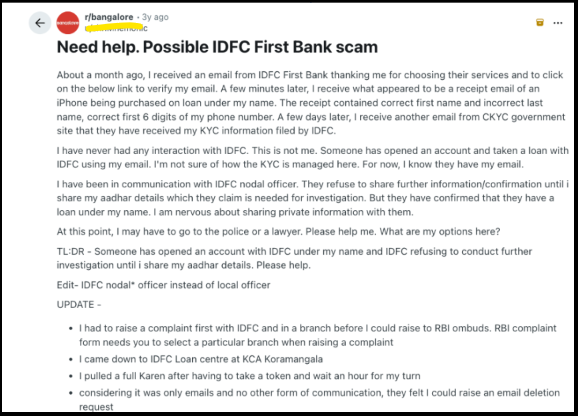
The poster says the bank later confirmed a loan tagged to a different person, with a different Aadhaar and PAN.
They raised complaints with the bank and branch and checked their credit report.
This is identity misuse, not a call impersonating the bank, but it shows how a single email link can be the start.
Did a call like these leave you out of pocket?
Keep every record and register with us so our team can look at your case.
What Victims Say Helped in IDFC Impersonation Cases?
This section pulls out the practical moves posters described. They are personal experiences, not official advice.
Ask on what basis they are calling. The Mumbai poster asked why a stranger was discussing a loan the family never took.
That question exposed the caller.
Check with the branch. In that case, a visit to the local branch settled it within minutes.
The manager confirmed there was no loan.
Keep a written trail. The Bengaluru poster raised complaints with the bank and its branch first, then pulled a credit report to see if any loan showed up.
None of this guarantees an outcome. It shows that calm questions and written records beat panic.
What IDFC FIRST Bank’s Own Advisory Warns About?
The bank’s safe banking page lists scam types it wants customers to know.
This section summarises that list as shown on the page.
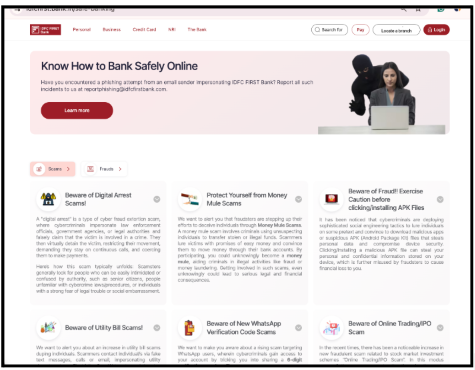
The page covers digital arrest scams, where cybercriminals pose as law enforcement or government officers and claim you are involved in a crime.
It also lists money mule scams, where fraudsters lure people into moving illegal funds, and APK file warnings about suspicious apps that steal personal data.
The remaining items are utility bill scams, new WhatsApp verification code scams, and online trading or IPO scams.
The page also invites customers to report phishing emails that impersonate the bank, using the address shown there.
Spam Calls or Scam Calls? The DND Question
Not every unwanted call from a bank is a scam. This section helps you tell a nuisance call from a fraud attempt.
A poster on a fraud prevention forum complained about 2 to 3 promotional or loan calls a day from IDFC First Bank despite years on the Do Not Disturb registry.
The calls came from ordinary 10-digit mobile numbers, which the poster suspected were third-party sales agents.
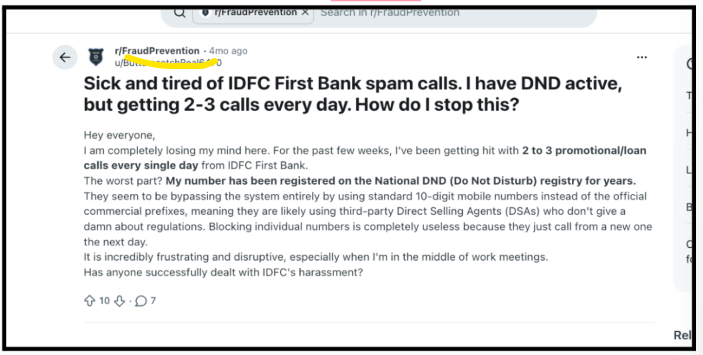
That is the poster’s guess, not a confirmed fact.
A promotional call is annoying. A scam call asks for an OTP, an app install, a link click, or a payment. That is the line to watch.
For nuisance calls, use your telecom operator’s DND complaint option.
For anything that asks for money or codes, treat it as fraud.
How to Stay Safe From an IDFC Impersonation Scam?
This section is about prevention, before anything goes wrong. These habits work against almost every version of the scam.
- Never share OTPs, PINs, CVVs, or passwords. No genuine bank staff member needs them from you.
- Do not click links or open files from unknown senders. This includes “verify your email” emails and shared APK files.
- Never install a remote access app because a caller or message asks you to.
- Verify before you trust. Hang up and call the number on your card or in the bank’s own app.
- Ignore threats of arrest over a call. No genuine officer needs you to stay on video or transfer money to clear your name.
- Protect your identity. Share Aadhaar and PAN copies only when you start the request, and note the purpose in writing.
- Check your credit report now and then. An unknown loan can show up there.
- Talk to family. Senior citizens are often targeted first, so share these rules with them.
One call you have verified is worth more than ten you answered in a hurry.
Also Read: A ₹499 registration fee reportedly grew to about ₹12,000 through withdrawal, postage and delivery charges, and another ₹7,000 was still demanded, as described in our Vishv books impersonation scam guide.
What to Do If You Lost Money to an IDFC Impersonation Scam?
This section is for the moment after something has gone wrong.
The first hours matter most, so the steps below come in order.
- Block your card or account. Call the bank on its official number and ask them to block the card, freeze the account, or stop the transaction.
- Call the national cybercrime helpline. Report as soon as you can, because early reports help most when money has just moved.
- Save every record. Keep call logs, SMS, WhatsApp chats, emails, screenshots, links, transaction IDs, and the numbers used.
- Secure your phone. Uninstall any app you were asked to install, change your banking passwords, and run a security scan.
- File the online complaint. You can report on the national cybercrime portal yourself, and knowing how to file a cybercrime complaint helps you include the right details.
- Avoid recovery offers. After a loss, strangers may promise to get your money back for an upfront fee. Do not pay anyone who guarantees results.
Conclusion
An IDFC impersonation scam depends on speed and fear. The caller wants you to act before you check.
The cases above show the pattern: a bank name, a threat or an offer, and a request for codes, links, or money.
Slow down, verify through official channels, and share nothing sensitive.
If money has already moved, report quickly and keep your records.
Report. Recover. Stay Fraud Free.
Frequently Asked Questions
It is a fraud where someone pretends to be an IDFC FIRST Bank official, customer care executive or police officer to steal OTPs, passwords or money.
Hang up and call the number printed on your card or shown in the bank's app and website. Do not rely on a number found through a search.
No genuine bank staff member needs your OTP, PIN, CVV or password. Anyone who asks for them should be treated as a fraud attempt.
Call your bank at once to block the card or account, then call and file a complaint on the national cyber crime portal.
Not always. Promotional calls can be sales calls, but any call that asks for codes, app installs, links or payments should be treated as fraud.




 Add us as a preferred source on Google »