

Quick Summary
Skyline Research is a SEBI registered research analyst, INH000021580, held by Humaira Irfan Shaikh since 7 July 2025. Its ten packages all say starting from ₹45,000 a month, which is ₹5,40,000 a year against SEBI’s ₹1,51,000 cap. The terms call the service general trading research, say fees are non refundable, and say clients cannot complain against the firm. The research shows no complaint data or reviews. We found no SEBI order against the firm as of 3 November 2026, which is not a clean certificate.
Picture this. You are scrolling late at night, and a website tells you one well researched call a day can change your trading.
The page says SEBI registered, so you relax a little.
This Skyline Research Review is for exactly that moment. The firm is real and the registration is real, but a licence number is where your homework starts, not where it ends.
We read the pricing, the terms and the policies so you do not have to. Then we turn every gap into a question you can ask before you pay.
Skyline Research Review
Let us begin with how the firm describes itself. These are its own words, and we have not tested any of them.
The website talks about research backed decisions, disciplined analysis and risk aware execution.
Here is what each claim says, and what the page does not show.
The tagline reads “Timely Ideas. Transparent Process. Tighter Risk”. That sounds reassuring, yet the page gives no evidence to back the claims.
The firm promises “clear, actionable ideas” from a disciplined process. It does not explain how an idea is created or checked.
It also stresses risk management, with position sizing, monitoring and downside protection.
The framework behind those words is not described.
You will see a focus on compounding and long term success too. No performance data sits beside it, so you cannot judge the basis.
Then comes the line most readers remember, “15 years of unbeaten trust from customers around the world”.
The page does not say how that is measured.
Finally, the firm promotes professional grade research and ongoing client support.
It does not spell out the scope, so you cannot tell what you would get.
None of this makes the firm unreliable by itself. It simply means the marketing asks for trust before it shows proof.
Is Skyline Research SEBI Registered?
Yes, the research shows the firm listed with SEBI. That is the first box to tick, and you should tick it yourself too.
Here is what the SEBI listing shows, point by point.
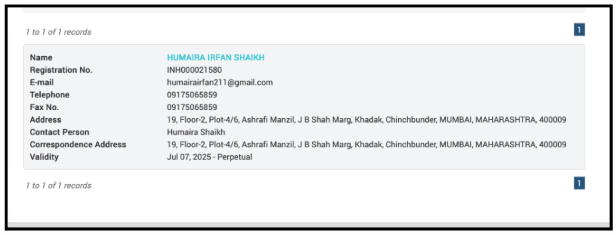
- Registration number is INH000021580. The INH prefix marks a research analyst, unlike INA for an investment adviser or INP for a portfolio manager.
- Registered name is Humaira Irfan Shaikh, and the footer of the website says the registration type is individual. The firm trades as Skyline Research.
- Validity is from 7 July 2025 and is listed as perpetual. So the registration is a little over a year old.
- Registered address is 19, Floor 2, Plot 4/6, Ashrafi Manzil, J B Shah Marg, Khadak, Chinchbunder, Mumbai 400009. The contact person is Humaira Shaikh.
You can check all of this in a few minutes. A SEBI RA registered site detector lets you enter INH000021580 and compare the name, category and validity.
A SEBI registration check online on the regulator’s own pages does the same job. Save a dated screenshot before you pay.
Registration says the person may publish research. It does not say anything about how good that research is.
Services Offered by Skyline Research
Now let us look at what you can actually buy. The services page lists ten research packages.
Each package is built around one product, such as stock futures or MCX options.
They differ mainly in the minimum investment asked.
The six standard packages ask for a minimum investment of ₹50,000. Here is how the research records them.
|
Service |
What it offers | Style |
| Stock Futures | One NSE futures alert daily, issued early, mixing technical setups with fundamental context |
NRML |
|
Stock Cash |
One NSE intraday alert daily, with technical and fundamental inputs | NRML |
| Stock Options | One options alert a day on NSE stocks and indices |
NRML |
|
Index Options |
One intraday alert daily on NIFTY and BANKNIFTY | NRML |
| MCX Futures | One MCX alert a day across bullion, base metals and energy |
NRML |
|
MCX Options |
One options alert a day across bullion, base metals and energy on MCX |
NRML |
Three premium packages ask for a minimum investment of ₹1,00,000. They are written in a more personal tone.
|
Premium service |
What it offers | Style |
|
Stock Cash Premium |
Tailored, high touch strategies from certified advisors across stocks, forex, commodities and global solutions | NRML |
| Stock Futures Premium | Bespoke guidance with global solutions across stocks, forex and commodities |
NRML or MIS |
| Stock Options Premium | Bespoke guidance with intraday ideas and selective overnight calls |
NRML or MIS |
There is also a tenth card called HNI Platinum, with a minimum investment of ₹5,00,000.
It appears in the website screenshots and promises a dedicated adviser, priority execution and exclusive research across equities, F&O, MCX and FX.
Every card is tagged High Risk, High Return and Volatility High. That honesty about risk is welcome.
Notice something about all ten. These are trading alerts in derivatives and commodities, not slow long term investing ideas.
That matters because most retail traders lose money in derivatives.
If you are new, ask yourself whether a daily alert fits your capital and your nerves.
Also Read: One month shows 26 complaints, 16 of them through SCORES, while the annual table shows only 8 for the whole of FY 2024 25, a gap we questioned in our Investowryght review.
Skyline Research Pricing Details
This is the section most readers jump to, and it deserves a slow read. The website shows one price for everything.
Let us see what that price means over a year, and what the page leaves out.
Every package says “Starting from ₹45,000 monthly”.
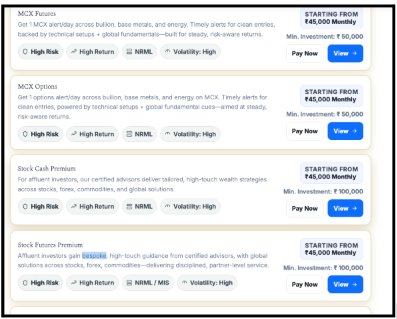
Stock futures, MCX options, premium and platinum all carry the same line.
Only the minimum investment and the scope change. The page does not explain what moves the final fee up or down.
Do the sum. ₹45,000 a month is ₹5,40,000 a year.
SEBI caps research analyst fees at ₹1,51,000 per client per family per year in the fixed fee mode.
The starting fee alone is about 3.6 times that.
The cap works out to about ₹12,583 a month. So even with GST on top, the website’s starting price sits far above it.
Here is a quick worked example. The cap plus 18 percent GST is ₹1,78,180 a year.
That figure still sits well below ₹5,40,000. And the site does not explain how its fee structure fits the cap.
There is a fair reading in the firm’s favour. “Starting from” may not be the final price, and a client may pay differently.
Even so, a visitor cannot tell. That is why we turn it into a plain question later in this blog.
|
Item |
What the website shows |
| Fee on every package |
Starting from ₹45,000 monthly |
|
Yearly equivalent |
₹5,40,000 |
| Standard minimum investment |
₹50,000 |
|
Premium minimum investment |
₹1,00,000 |
| HNI Platinum minimum |
₹5,00,000 |
|
Package specific pricing |
Not shown |
Before You Pay
Take these four steps first, since each costs nothing.
- Ask for the exact fee for your chosen package in rupees, with GST on a separate line.
- Ask how the fee fits the ₹1,51,000 cap for a client family in a year.
- Ask whether the minimum investment is a capital requirement or a condition to get the service.
- Ask for the agreement and the terms in writing before any payment.
Is Skyline Research Reliable?
Let us be fair first. The firm exists, the licence is visible and the website carries a risk disclosure.
It says it does not promise or assure returns. It says to trade with strict stop losses and to treat derivatives as high risk.
Additionally, it also lists a grievance page, a complaint board, an escalation matrix, a SMART ODR link and a SEBI SCORES link.
Those are good things to find.
But existence is not the same as trust.
A real firm can still have fees, wording and terms that deserve a hard look.
So here are the points that need a closer look, numbered.
Each one comes from the research and the firm’s own pages.
1. The ₹45,000 Monthly Start Sits Far Above the Fee Cap
Start with the money, because it is where most people get hurt. The advertised fee is the biggest single point.
A fee of ₹45,000 a month is ₹5,40,000 over twelve months. That is far above ₹1,51,000, the cap per client family per year.
The website does not say how this fits the cap.
It may be a starting price or a different structure, and the page does not tell you.
Ask for the full yearly cost in writing. If the answer is above the cap, treat that as a serious concern.
2. Every Package Shows the Same Fee
Look at the ten packages side by side. A single futures alert and a bespoke premium service carry the identical line.
A ₹50,000 minimum and a ₹5,00,000 minimum also share it. That makes the word “starting” hard to read.
Ask what decides the final price. Ask whether the fee grows with your capital or with the package.
A clear answer should name numbers. A vague answer about “customising” is your cue to slow down.
3. Premium Wording Sounds like Advisory, While the Licence Is For Research
The premium cards promise tailored, high touch wealth strategies, global solutions across stocks, forex and commodities, and “certified advisors”.
Those words sound broader than a research alert.
The licence is a research analyst licence, not an investment adviser one.
The firm should confirm that “wealth strategies”, forex and “advisors” fall within its registration.
You can ask directly. Which registration covers forex and global solutions, and what are the “certified” qualifications?
Do not guess on this one. Ask in writing and keep the reply.
4. Wording That Frames Returns As Something The Service Is Built To Deliver
The Stock Cash card says each pick is “built to target the returns you deserve”. That frames returns almost as an entitlement.
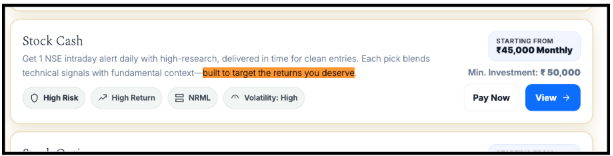
Other cards speak of “high accuracy execution”, “consistent” returns and “steady, risk aware returns”.
The research found no track record or audit figures beside any of this.
The hero banner adds a “Best Stocks • Live” badge. It promises “well researched calls” with “transparent risk controls”.

No analyst can promise returns, and SEBI does not allow it.
The firm’s own disclosure agrees, which makes the card wording sit oddly beside it.
Ask for audited performance, not adjectives. If the firm cannot show any, treat the claims as marketing.
5. “15 years of unbeaten trust” Against A Registration From July 2025
The website says it has earned 15 years of unbeaten trust from customers around the world. It does not say how that is measured.
The SEBI listing shows the registration valid from 7 July 2025. So the registration is about a year old.
That does not prove anything wrong.
The business may have existed in some form earlier, or the line may be a slogan.
Still, ask a simple question. What did the firm do for those fifteen years, and under which registration?
6. The Agreement Says The Service Is Not Investment Advice
The user agreement repeatedly describes the service as general trading research that is not investment advice.
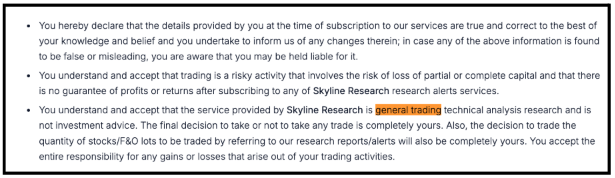
It says every decision to trade belongs to you.
For a registered research analyst, such wording is common.
But the premium cards speak of tailored strategies and advisors, and that creates some ambiguity.
You deserve to know which one you are buying.
Is it general research for everyone, or guidance fitted to your own situation?
Ask the firm to explain the difference in writing. The answer shapes what you can expect from the service.
7. A Clause Saying Clients Cannot Claim or Complain Against the Firm
This one stopped us. The agreement says that if you lose money, you cannot claim or complain against Skyline Research, its owner or its staff.
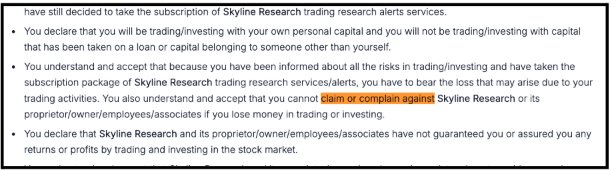
It goes further and says you cannot file a legal complaint or notice against the firm.
That could discourage someone from raising a genuine grievance.
We are not lawyers, so please take legal advice on what such a clause means.
But SEBI’s complaint channels exist for investors, and a clause in a service agreement should not leave you feeling shut out.
If you ever need to raise a case, the guide on a SEBI complaint against research analyst shows how such cases usually run.
It helps to know that before you sign.
Losses on their own are not a complaint. A complaint is about what the firm promised and what it did.
Signed up for alerts and now not sure the firm is being fair with you?
Our team reads your agreement and payment proof, drafts a written grievance to the research analyst, and takes it to the right SEBI channel if the reply falls short. Register with us for a free consultation.
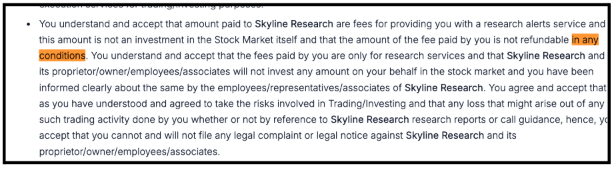
8. Fees Are Non Refundable “In Any Conditions”
The agreement states that subscription fees are not refundable “in any conditions”. It does not list exceptions.
So what if the service is not delivered? What if alerts stop for a week or arrive late?
The research found no explanation of how this fits a case where the firm itself falls short. That gap matters most when the fee is large.
Ask whether the refund rule changes if the firm fails to deliver. Get the answer by email.
9. The Firm’s Responsibility Is Thin, Yours Is Heavy
The agreement repeatedly says you take complete responsibility for every trade and every gain or loss. It also says the alerts are only for reference.
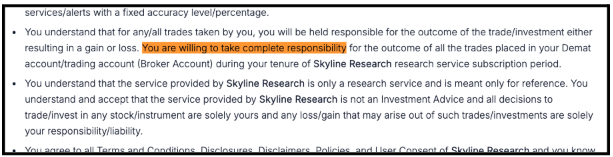
On the website terms, the content is provided “as is”, with no promise that information is complete, true or accurate.
The firm is not liable for indirect or consequential loss, or for lost profits and revenue.
Many websites carry such clauses, and their effect depends on law and facts. Still, it leaves the balance tilted heavily towards the firm.
Ask what the firm commits to, such as delivery time for alerts, support and corrections.
Look for promises, not only disclaimers.
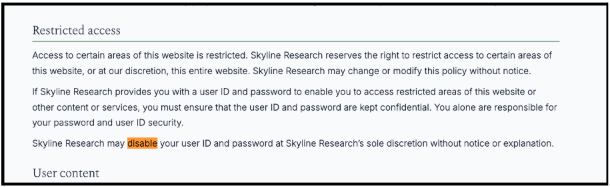
10. Access Can Be Switched Off Without Notice
The terms say the firm may disable your user ID and password at its sole discretion, without notice or explanation.
No process is given to challenge that.
Picture paying for a month and losing access in week two. You would have no clear way to ask why.
Ask whether access can end only for stated reasons. Ask what happens to your fee if it does.
11. A Wide Licence Over Anything You Submit
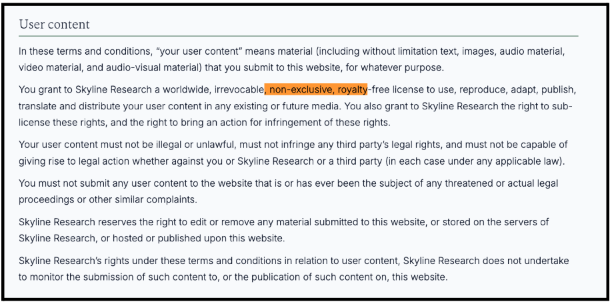
The terms grant the firm a worldwide, irrevocable, royalty free licence to use, adapt, publish and distribute content you submit.
The firm may also sublicense it.
That could matter if you send screenshots, trade records or personal documents. The scope is broad.
Ask what counts as user content here, and whether your trade details are covered. Share only what the firm really needs.
12. The Privacy Policy Leaves Key Details Open
The privacy policy lets the firm collect your income, investment goals, risk appetite and payment details. That is sensitive information.
It says the data is kept only as long as necessary, with no fixed period.
It also mentions only “reasonable” technical and organisational measures for protection.
The policy says offers and updates may be sent to you, without a clear way to opt out.
Ask how you can stop promotional messages.
It does say personal information will not be sold or traded for marketing. That is a good line to see.
13. Contact Details Do Not Match Across Pages
The SEBI listing shows an address in Chinchbunder, Mumbai, a Gmail address and a phone number ending 5859.
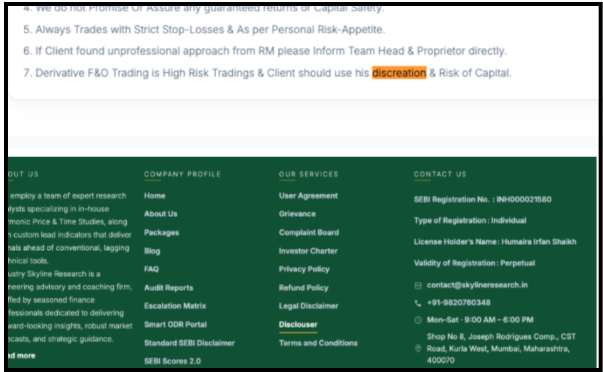
The website footer shows a shop in Kurla West and a different number.
Firms move and use several numbers, so this may be harmless.
But for a paying client it matters which address and number your agreement carries.
Ask which details are current. Make sure the payment account matches the registered name.
14. No Complaint Data And No Reviews In The Research
Here is a gap rather than a concern. The research doc contains no complaint status tables and no user reviews for the firm.
That could mean the pages were not available or the data was not shown. We cannot tell which.
So we cannot say whether complaints exist, or how they were handled.
Ask the firm for its latest monthly complaint data, which SEBI expects to be updated by the 7th of each month.
A search of SEBI’s public records found no SEBI order against Skyline Research or Humaira Irfan Shaikh as of 3 November 2026.
That is not a clean certificate. Orders can be published later, and our search was limited.
15. Small Spelling Slips On Legal Pages
The research also notes spelling slips such as “discreation” and a footer link written “Disclouser”. These are small.
We mention them only because legal and disclosure pages are where you expect care. They prove nothing on their own.
Read the pages closely before you rely on them.
Typos in a risk disclosure are worth a polite email.
Questions to Ask Skyline Research Before You Pay
You now have a long list. Let us turn it into a few questions to send by email, so you get replies in writing.
Wait for the answers before any money moves. A good firm will not mind.
1. What is the full yearly fee?
Ask for the fee per package, GST and any extra charge, and how it fits the ₹1,51,000 cap.
2. Which registration covers my package?
Ask whether forex, global solutions and “wealth strategies” fall under the research analyst registration.
3. Where is the proof behind the claims?
Ask for audited performance behind “high accuracy”, “consistent returns” and “15 years of trust”.
4. What happens if you fail to deliver?
Ask how the refund rule works when alerts are late, missing or wrong.
5. How are disputes settled?
Ask whether the agreement sends disputes to arbitration, and what that would mean for you if a dispute arose.
Skyline Research Complaint: How to Report Against the Company?
Nobody signs up expecting a dispute. But if alerts stop, a refund is refused or something feels unfair, you need to know where to go.
The good news is that the firm’s own website lists a grievance page, a complaint board, an escalation matrix, a SMART ODR link and a SEBI SCORES link. Those are the right doors.
The order matters, though. Start small and close to the firm, then move up only if the reply falls short.
Here are the steps in short. Each one builds on the one before.
- Collect your papers. Keep the agreement, payment proof, alerts, emails and screenshots in one folder.
- Write to the firm first. Email your name, payment reference, the issue and what you want, and copy the team head and proprietor named in its disclosures. A dated email beats a phone call.
- Move to SEBI’s online system if the reply falls short. The page on the SCORES SEBI complaint route covers what to attach and how a case moves after you file.
- Keep every reply. Save each message from the firm and from the regulator’s system, since they matter if the case goes further.
- Try the dispute resolution portal for a payment dispute. The SMART ODR portal brings in a neutral conciliator to go through your papers with you.
- Read the dispute clause in your agreement. Check whether it points to arbitration, and take legal advice before you rely on or challenge it.
- Know the arbitration route. If the matter stays open, reading about arbitration in share market cases shows how that route usually works.
Losses alone are not a complaint. A complaint is about what the firm promised and what it actually did.
Disclaimer
This blog is based on the firm’s published website pages and publicly available SEBI records as of 3 November 2026. It does not allege wrongdoing, and the firm is welcome to share its side. We could not independently confirm the final fee structure, how the fee fits the SEBI cap, the complaint position, any user reviews, the meaning or enforceability of any clause in the agreement, the operating history before the registration date, or whether the services described fall within the registration.
Conclusion
Skyline Research is a real, registered research analyst, and its website does carry risk warnings and a grievance trail. That deserves a fair mention.
But the starting fee of ₹45,000 a month, the premium wording, the refund rule and the clause on complaints deserve a slow read.
Do not pay on the strength of a licence number alone.
Check the registration yourself, ask the five questions above and keep every answer in writing.
If the replies are open and specific, you have a better basis to decide.
If a dispute comes later, write to the firm first and use the escalation routes in order.
Keep receipts, emails and screenshots in one folder.
Report. Recover. Stay Fraud Free.
Frequently Asked Questions
Skyline Research is listed under the research analyst registration INH000021580, held by Humaira Irfan Shaikh and valid from 7 July 2025 as perpetual. Confirm the details on SEBI's website before you pay.
All ten packages show "Starting from ₹45,000 monthly", about ₹5,40,000 a year. SEBI's cap is ₹1,51,000 per client family per year, so ask for the full fee and how it fits.
The user agreement says fees are non refundable "in any conditions". It lists no exceptions, so ask in writing what happens if alerts are late, missing or not delivered before you pay.
Its risk disclosure says it does not promise or assure returns. Yet some cards use wording such as "built to target the returns you deserve". Ask for audited performance behind any claim.
Write to the firm first and keep the reply. If it falls short, a complaint can go through SEBI's online system or the dispute resolution portal, and our guides cover those routes.





 Add us as a preferred source on Google »