

If you have ever looked at your Kotak Securities account and felt confused by trades you don’t fully recall approving, margin exposure that appeared without warning, or losses that grew faster than you expected, you are not the only one.
Kotak Securities account handling disputes have surfaced across investor forums, regulatory complaints, and formal arbitration proceedings, involving concerns ranging from dealer-controlled trading to the accumulation of margin debits and forced share liquidations.
This blog walks you through real arbitration outcomes, the complaint mechanisms available to you, and the patterns that have preceded significant investor losses in broker-related disputes.
If something in your account has felt unclear or unexplained, understanding how these disputes actually unfold could be the most important thing you read today.
Why Some Investors Raise Concerns About Kotak Securities Account Handling?
Most investors do not begin researching account-handling issues after a normal trading day.
They usually start searching when something in their account no longer makes sense.
It may be unexpected margin exposure, frequent dealer-assisted trades, sudden losses, unexplained charges, or account activity they do not fully remember authorising.
Kotak Securities (now operating as Kotak Neo) is one of India’s established full-service brokers serving a large retail investor base.
Like any brokerage handling a high volume of accounts, it also receives periodic complaints and grievances from investors.
When analyzing the patterns behind Kotak Securities complaints, arbitration records, and investor discussions frequently highlight recurring issues relating to:
- Dealer-assisted trading activity.
- Excessive leverage or margin exposure.
- Frequent high-volume transactions.
- Interest and debit balance disputes.
- Forced liquidation of securities.
- Communication and transparency concerns.
- Difficulty understanding account statements and charges.
This does not automatically mean misconduct occurred.
Stock market trading, especially in derivatives and leveraged products, carries significant risk.
However, many disputes arise because investors later question whether they fully understood the trades being taken, the risks involved, or how their accounts were being operated.
In many account handling disputes, the biggest issue is not the loss itself.
It is the confusion that comes afterwards.
And that is exactly why arbitration cases are important: they reveal how investor-broker disputes involving authorisation, communication, dealer involvement, and account control are actually examined.
Kotak Securities Account Handling Loss Recovery Cases
Most investors do not wake up one morning and decide to challenge their broker.
Something happens first. A trade appears that they do not fully understand. The losses become larger than expected.
The margin exposure suddenly looks much higher than they realised.
Or they begin asking themselves a simple question:
“Did I actually know everything that was happening inside my account?”
The following cases are often discussed because they reflect the types of concerns investors sometimes raise when disputes involving account handling, margin exposure, and dealer-assisted activity arise.
Case 1: The ₹1.75 Crore Profit Dispute After “Excess Margin” Exposure
One investor experienced what many traders would consider a dream day.
This arbitration matter involved a long-standing investor who executed high-value intraday derivative trades after excess trading margin allegedly became available in his account.
His account showed profits of approximately ₹1.75 crore after a series of intraday derivative trades.
But the situation quickly became complicated.
The investor later found himself questioning how the available trading exposure had appeared in the account in the first place and what responsibilities existed when such exposure was used.
What started as a profitable trading day gradually turned into a dispute involving margin availability, account operation, and investor understanding of risk.
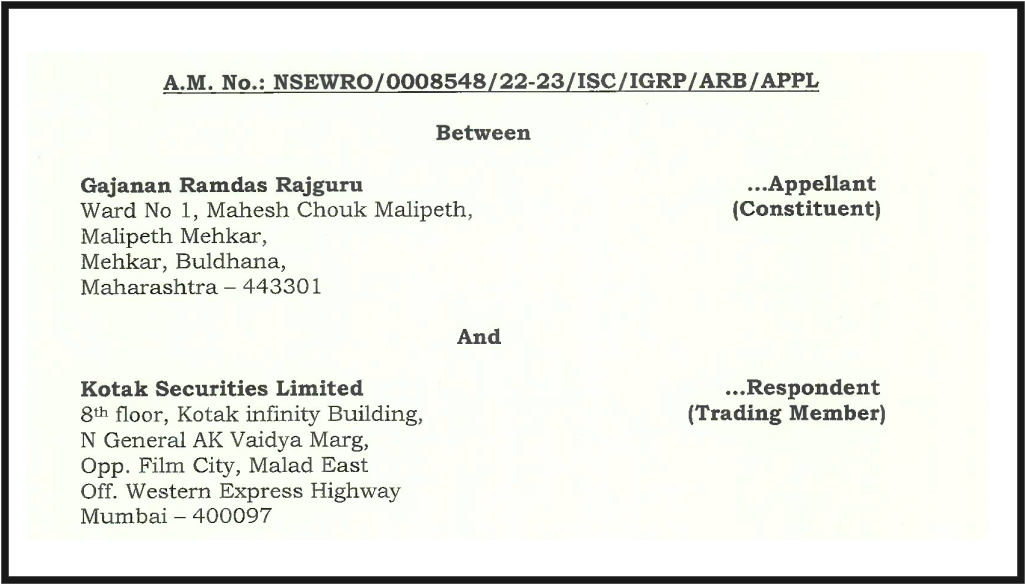
On that date, Kotak Securities, the respondent and a registered Trading Member of NSE, provided him with excess margin exposure for intraday trading.
Using the available margin shown in his account, Mr Rajguru executed intraday derivative trades. After deducting taxes and charges of Rs 8,49,710.37, the net profit in his account amounted to approximately Rs 1,75,01,673.
However, the same day, Kotak Securities debited the full profit amount from his account, citing that the margin had been provided in error.
What did the investor argue before the Tribunal?
Mr Rajguru argued that trades executed on the exchange floor cannot be cancelled unilaterally.
Kotak Securities submitted that the appellant was fully aware he had only Rs 3,175.69 in actual margin available, yet executed trades involving a risk volume of Rs 98.81 crore using funds that belonged to the respondent.
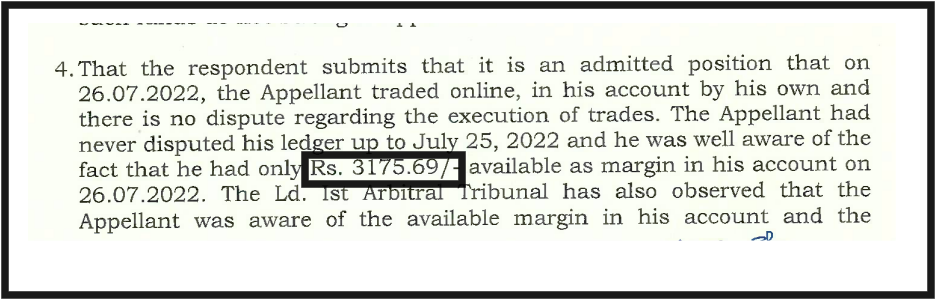
The broker argued that allowing Mr Rajguru to retain the profit would amount to unjust enrichment, a legal principle that prevents someone from benefiting from another’s money or mistake without legal justification.
The tribunal noted that stock brokers also carry responsibilities regarding risk management and client exposure monitoring.
The order discussed issues such as:
- Excess margin utilisation.
- Intraday exposure.
- Debit balances.
- Risk controls.
- Communication of obligations.
- Client understanding of leveraged trading.
The tribunal also discussed whether contractual clauses alone automatically settled all concerns in a dispute involving practical account handling and risk management.
Final Award
In this arbitration appeal, the investor requested the tribunal to review and overturn an earlier arbitration decision.
The investor mainly asked for four things:
- A previous arbitral award passed in June 2023 to be set aside.
- Compensation of around ₹1.75 crore along with 18% yearly interest.
- Additional compensation of ₹5 lakh for alleged mental stress and hardship.
- Reimbursement of arbitration-related costs and any other relief the tribunal considered appropriate.
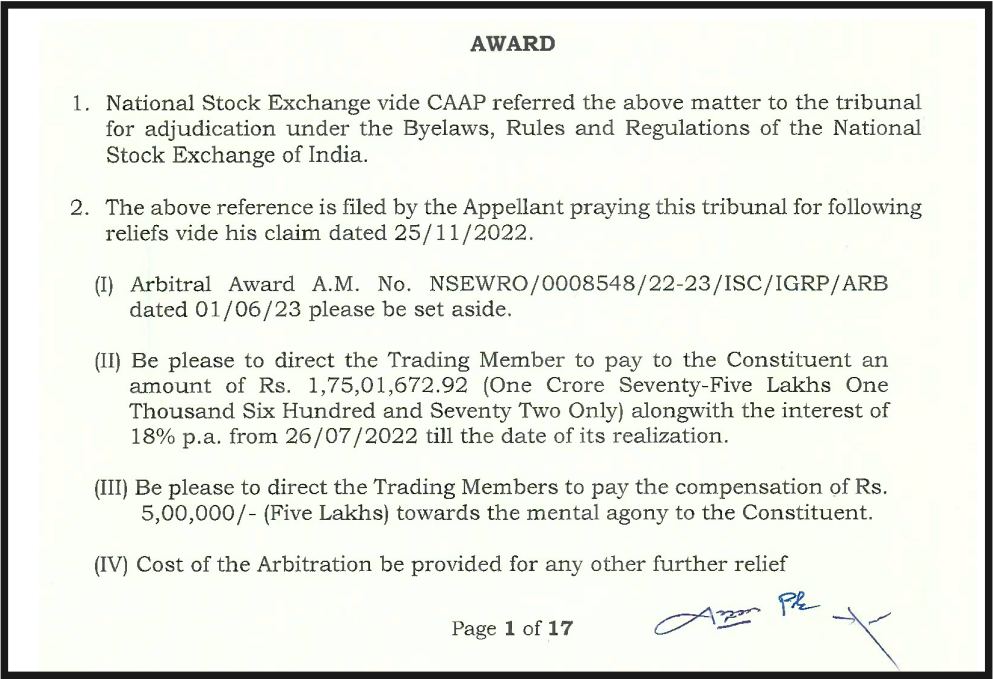
In simple terms, the investor argued that financial losses had occurred because of the way the trading account and margin exposure were handled, and therefore sought monetary compensation through the arbitration process.
If you are dealing with unexplained trades, dealer-controlled activity, margin disputes, or account losses you do not fully understand, reviewing your records early may help clarify whether formal complaint options are available.
Case 2: Allegations of Dealer-Controlled Trading and Heavy Losses
The second matter involved concerns that will sound familiar to many retail investors.
One major arbitration matter centred around explicit allegations of Kotak Securities unauthorised trading, where an investor claimed that high-volume trades were conducted in his account without proper consent.t.
The investor claimed he was persuaded to transfer shares and open an account after assurances regarding trading assistance and margin facilities.
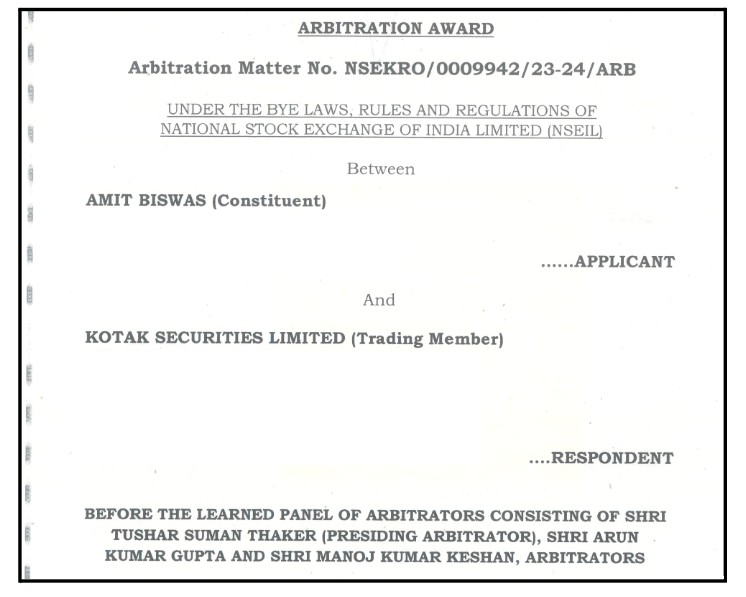
The investor further alleged:
- He did not personally execute many trades.
- Trades were conducted by representatives of the broker.
- Huge losses occurred in the account.
- Margin interest was charged.
- Certain shares were liquidated.
- His objections through emails were ignored.
- Transactions continued despite his concerns.
Main Arguments Raised
The central issue before the tribunal was whether transactions were genuinely authorised by the investor or whether the dealer effectively controlled trading activity.
The tribunal examined:
- Email correspondence
- Voice recordings
- Trade transcripts
- Margin arrangements
- Ledger entries
- Contract notes
- SMS records
One particularly important observation in the award related to the role allegedly played by the dealer representative.
The tribunal discussed whether the representative was merely executing instructions or effectively acting in an advisory capacity.
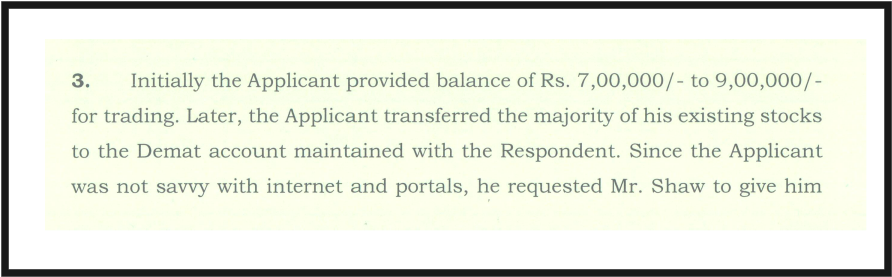
Initially, the investor deposited around Rs. 7 lakh to Rs. 9 lakh for trading and later transferred most of his existing shares into a Demat account maintained with the trading member.
According to the case records, he relied on assurances that trades would happen only with his approval and that any losses would remain limited.
However, the volume of trading allegedly increased significantly over time without clear documented authorisation for several transactions.
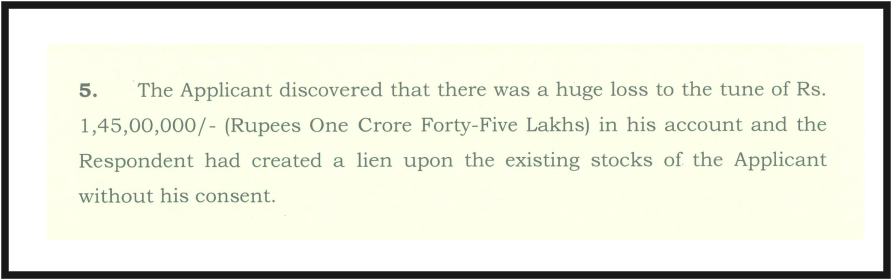
The investor later claimed that the account had suffered losses of nearly Rs. 1.45 crore.
Final Award
After reviewing the documents, trade records, submissions, and evidence presented by both sides, the tribunal passed multiple directions in favour of the applicant.
In simple terms, the tribunal ordered the respondent to:
- Return several shares to the investor’s Demat account within 30 days.
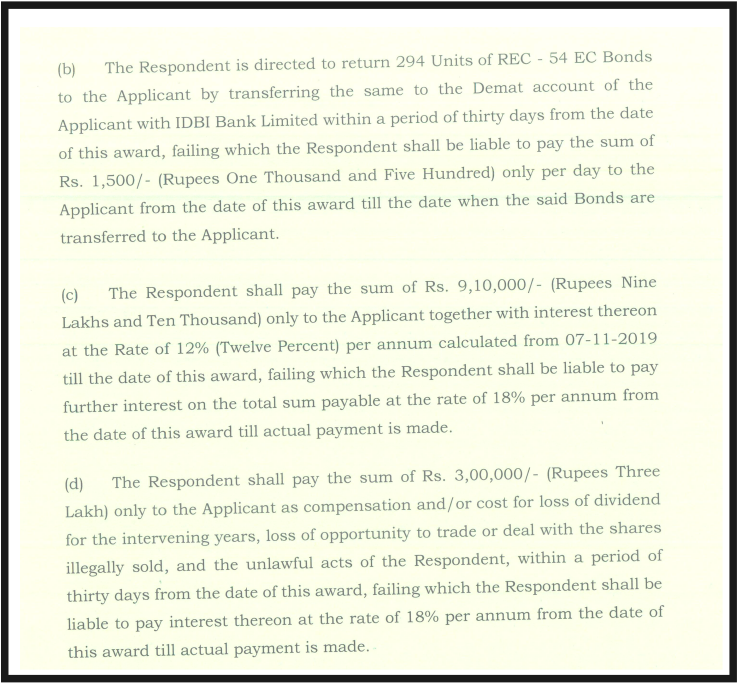
- Transfer 294 REC Bonds back to the investor.
- Pay Rs. 9.10 lakh along with interest.
- Pay an additional Rs. 3 lakh as compensation for the financial impact and loss of opportunity caused during the dispute period.
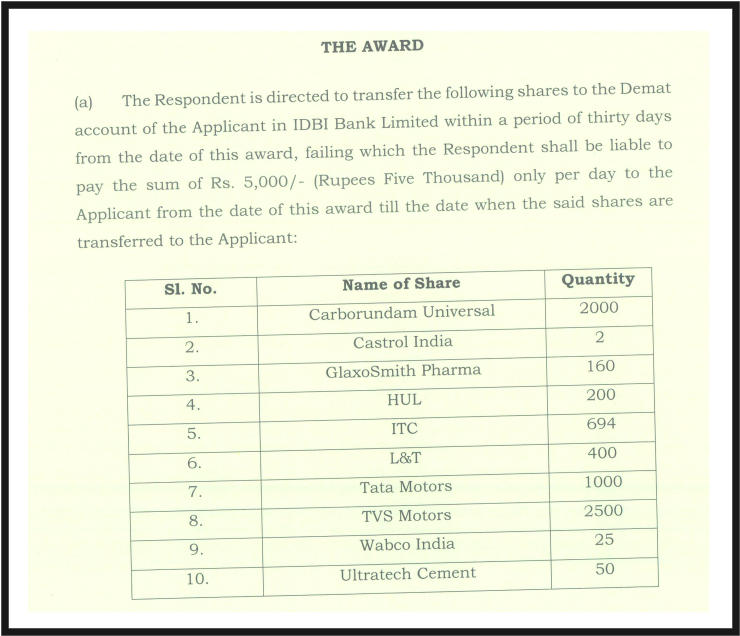
The award also stated that if the shares and bonds were not transferred within the specified timeline, daily penalties would apply until compliance was completed.


 Add us as a preferred source on Google »

