

Quick Summary
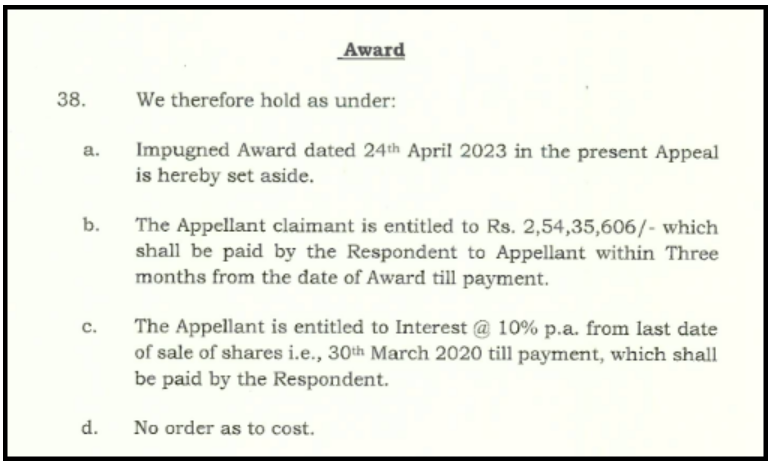
An NSE appellate tribunal directed Motilal Oswal to pay a client ₹2,54,35,606 plus 10% interest after the broker liquidated his shares claiming he was on a Margin Trading Facility, then could not produce the agreement proving he had ever signed up for one. The case was rejected twice, went to the Bombay High Court, and was sent back for fresh adjudication. On that fresh hearing, the client won the largest award in the reviewed set. He won because a mandatory agreement simply did not exist. This page explains when a forced liquidation crosses the line, and how the client recovered.
Brokers are allowed to sell your shares if you fall short on margin. That’s normal; it’s in the rules, and it protects everyone.
What’s not normal is doing it under a facility you never agreed to, or before you’ve had any fair chance to respond.
There’s a line between a lawful square-off and a wrongful one, and when a broker crosses it, the recovery can be enormous.
An NSE tribunal ordered Motilal Oswal to pay ₹2.54 crore for crossing exactly that line. Here’s where it sits.
Inside the ₹93 Crore Dispute: The Motilal Oswal Wrongful Liquidation Case
The client had a funding arrangement with the broker going back years: the broker funded 70% of his purchases at 14% interest, he put in 30%, and the shares were held as security.
Over about two and a half years, he had traded roughly ₹93 crore through it and paid around ₹1.17 crore in interest.
When the pandemic crashed the market in March 2020, the value of his pledged shares fell steeply. He met every margin call from 18 to 23 March.
Then the broker abruptly raised his margin requirement, first to 50% and then to 100% overnight, and liquidated four scrips worth crores, giving him roughly nineteen hours to meet the demand.
The broker’s justification was that he was on a Margin Trading Facility, which carried these liquidation rights. The client said he had never availed any such facility, only the old funding arrangement.
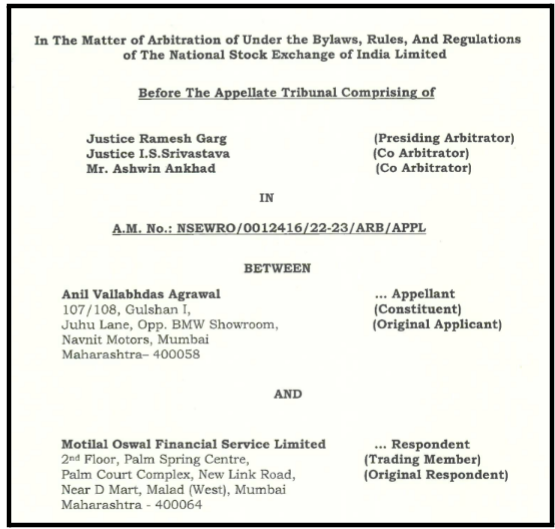
What Cost the Broker An Entire Case
The tribunal put the whole case on one question: was this a funding arrangement or a Margin Trading Facility? Because only the latter carried the liquidation rights the broker relied on.
And here the broker had nothing. SEBI’s rules make a signed Margin Trading Facility agreement mandatory.
The broker’s own document said the client had to agree in writing, in his own hand or by an irrefutable electronic method.
When the tribunal asked for that agreement, the broker first said it was inaccessible due to pandemic restrictions, then said it was an online acceptance that couldn’t be produced physically, and ultimately admitted it didn’t exist.
The tribunal’s conclusion was blunt. Without the agreement, there was no Margin Trading Facility.
Without it, the broker had no right to raise the margin or liquidate the shares, and the whole margin-shortfall demand from 17 to 31 March 2020 was illegal. The broker had been trading and selling in the client’s account without authority.
This lack of explicit client consent places the case squarely into the broader pattern of Motilal Oswal unauthorised trading.
There was a second finding that helps any client hit with a sudden margin call. Citing an earlier tribunal ruling, the panel held that a client must be given a clear day to meet a margin call. Nineteen hours, during a pandemic, did not come close.
The award computed the loss as the difference between the price at which the shares were dumped and their price on the date of payment: ₹2,54,35,606, plus 10% interest.
Motilal Oswal Wrongful Liquidation: Same Pattern, Different Sizes
That crore-scale award turned on a missing document and improper notice, and the same reasoning won other liquidation and square-off cases at more everyday amounts.
One client had his position squared off before the end of the day he was entitled to meet the margin call. The appellate tribunal held the broker had no right to close him out early and awarded ₹40,150.
In another case, the broker sold shares despite the client’s explicit written objection and his request for more time to arrange funds. The tribunal held that selling despite a valid objection breached the principles of natural justice, and awarded ₹6,44,200 on appeal.
The thread is consistent. A broker’s right to liquidate is not unlimited. It depends on a valid agreement, proper notice, and a fair chance for the client to respond. Remove any one of those and the liquidation becomes challengeable.
What to Do If Your Shares Were Liquidated?
A forced liquidation is challengeable when the broker acted without a valid agreement, without proper notice, or without giving you reasonable time. The case turns on documents and timing, so protect both.
Pull these together now:
- Every SMS and email about the margin shortfall, with exact timestamps
- The timestamp of the liquidation itself, from your contract note
- The agreement the broker relies on, if any, and your written request for a copy of it
- Proof of every margin call you did meet, with dates
- Any written objection you raised, or request for more time
- Your ledger and holding statements around the disputed period
The question that can win it outright: ask the broker, in writing, to produce the signed agreement authorising the facility it used to liquidate you. In the ₹2.54 crore case, the absence of that agreement is what decided everything. If it doesn’t exist, the broker’s authority to sell may not exist either.
Line up the notice against the sale. Compare the moment the demand was sent with the moment your shares were sold. A client is entitled to reasonable time, and a demand met with a same-day or next-morning liquidation is exactly the pattern tribunals have struck down.
The full escalation route, from your first complaint through to arbitration, is set out on our page covering Motilal Oswal complaints.
This kind of dispute usually needs arbitration to resolve, because a broker rarely concedes a liquidation on its own.
Did Motilal Oswal sell your shares without a fair chance to respond?
We map the notice trail against the liquidation timestamp, test whether the agreement the broker relied on actually exists, and build the claim on the gap tribunals treat as decisive. Register with us to give your complaint an edge.
The Reality Check: Knowing If You Have a Winnable Case
Here’s the straight version, because not every square-off is wrongful.
If the broker had a valid agreement, gave you clear and timely notice, and a fair chance to add funds, the liquidation will probably stand even if it hurts badly.
Where you have room is the opposite: no valid agreement, an overnight change in the rules, or a sale rushed through before you could reasonably respond.
The amounts vary enormously here, from ₹40,000 to over ₹2.5 crore, because they track the value of what was sold. But the principle is constant, and when the broker can’t show the authority it acted on, the claim is strong.
Conclusion
The ₹2.54 crore award drew the boundary in the clearest possible terms. A broker can liquidate for a genuine shortfall, but only under an agreement the client actually signed, with proper notice and a fair chance to respond.
When Motilal Oswal couldn’t produce the margin agreement it relied on, and gave nineteen hours during a pandemic to meet a demand, the tribunal held the entire liquidation illegal.
If your shares were sold under a facility you don’t remember agreeing to, or before you had a fair chance to react, that liquidation may be worth challenging.
Report. Recover. Stay Fraud Free.
Frequently Asked Questions
A broker can liquidate for a genuine margin shortfall, but only under a valid agreement and with proper notice and a reasonable chance to add funds. In the reviewed cases, tribunals struck down liquidations done without a valid agreement or without fair notice.
The broker liquidated shares claiming the client was on a Margin Trading Facility but could not produce the mandatory signed agreement for it. Without that agreement the tribunal held the broker had no authority to raise the margin or sell the shares, making the entire demand illegal.
The largest reviewed award was ₹2,54,35,606 plus 10% interest. A separate square-off case awarded ₹40,150, and a case of shares sold despite the client's objection awarded ₹6,44,200 on appeal. Amounts track the value of what was sold.
The tribunal held that a client must be given a clear day to meet a margin call. In the reviewed case the broker allowed only about nineteen hours during the pandemic, which the tribunal found unreasonable.




 Add us as a preferred source on Google »

