

Quick Summary
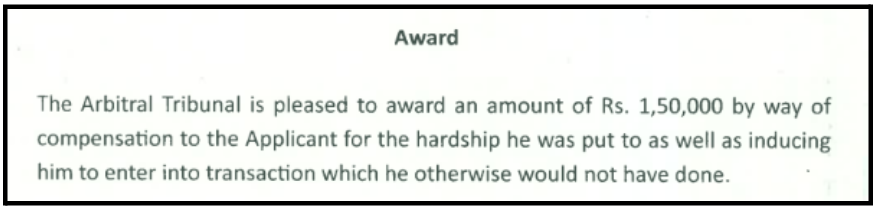
In two separate awards, NSE and BSE tribunals held Motilal Oswal liable for losses caused by its own technology. One awarded ₹1,44,809 after 44 trades fired in a single second, which the tribunal found was almost certainly a software glitch. The other awarded ₹1,50,000 after the app displayed a wildly wrong fund value and induced a bad redemption. Both rest on a principle brokers can’t wriggle out of: maintaining a reliable platform is their responsibility, and when it fails, they answer for the loss.This page explains when a glitch is challengeable and how these clients recovered.
Most broker disputes are about a decision: someone traded, someone sold, someone pushed.
Technical glitch cases are different. Here the culprit is the platform itself: an app that shows the wrong number, a system that fires trades no human could have placed.
These feel hopeless, because the broker controls the technology and can call any glitch a one-off. But the responsibility for that technology is the broker’s, and tribunals have made it pay when the technology failed.
In two separate cases, tribunals held Motilal Oswal liable for its own systems. Here’s how.
The Case of 44 Trades in One Second
The first client had traded with the broker since 2014 with a settled, recognisable pattern.
Then, on a single day, her account showed 44 trades executed in extraordinarily close succession, all within essentially the same instant, causing a loss she disputed as unauthorised.
Her argument was elegant and hard to answer. 44 trades cannot be placed by a human in one second. That kind of rapid-fire execution only happens through automated or systematic intervention. Something in the broker’s system, not her hand, had generated them.
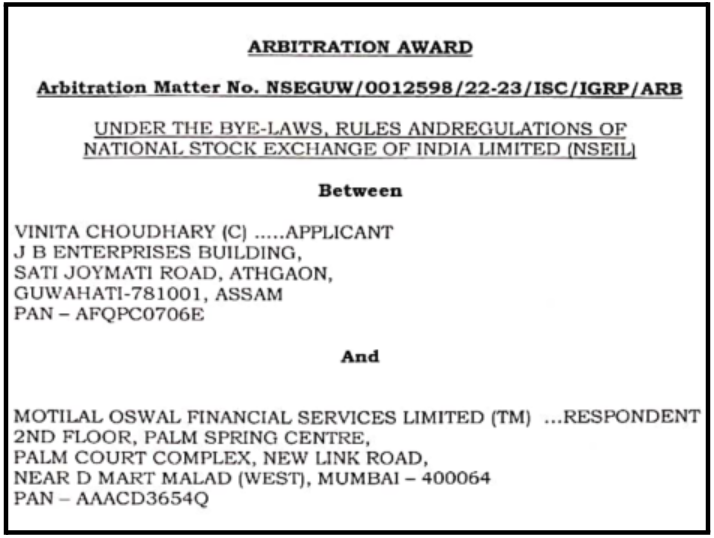
The tribunal agreed. It found that 44 trades executing within a single second was virtually impossible without a software or technical irregularity in the broker’s own systems, and that the loss stemmed from that abnormality rather than from any decision she made.
Why Did Motilal Oswal Lose?
The reasoning is the useful part, because it applies to any platform failure.
The tribunal held that trading members bear a significant responsibility for the integrity and stability of their trading platforms. That’s an established industry expectation, not a favour.
When an abnormality clearly connects to the broker’s own system, the broker is liable for the losses that flow from it.
Crucially, the tribunal didn’t require the client to prove exactly what went wrong in the code.
The sheer impossibility of the trade pattern was enough to shift responsibility onto the broker. It set aside the earlier grievance-committee order and awarded ₹1,44,809 plus interest.
The same logic decided a second case with completely different facts.
The Case of Impossible Gain
The second client, an IT professional, was browsing the broker’s app when it showed one of his mutual fund holdings had rocketed in value, an apparent gain of around 2,200%.
Acting on what the app displayed, he redeemed it, expecting roughly ₹35 lakh. He received about ₹1 lakh.
The broker admitted the app had shown a NAV of ₹2,323 against the real figure of about ₹94, and called it a technical glitch. It argued he’d suffered only a notional loss and shouldn’t be compensated.
The tribunal took a middle path that’s instructive. It agreed he wasn’t entitled to the fantasy ₹35 lakh, since that price was never real.
But it held the broker had failed its obligation to provide reliable infrastructure, and that the wrong display had induced him into a transaction he’d never otherwise have made. For that hardship and inducement, it was awarded ₹1,50,000.
The Common Thread
Two very different failures, one principle. A broker is responsible for the accuracy and reliability of its platform, and when the platform misleads or misfires, the broker answers for it.
Whether an account experiences rapid-fire automated trades or an investor simply finds Motilal Oswal not working during critical market hours, the broker cannot escape liability by writing off system failures as routine glitches.
Neither client had to reverse-engineer the broker’s code. In one case, the trade pattern was physically impossible; in the other, the displayed number was admittedly false.
In both, that was enough to move responsibility onto the broker. What the client had to do was document the failure clearly and refuse to accept “it was just a glitch” at the end of the conversation.
Motilal Oswal Technical Glitch: What to Do If It Costs You?
A technical glitch claim depends on capturing the failure before it’s quietly corrected, so speed and screenshots matter more than anything.
Pull these together now:
- Screenshots of the error itself, the wrong price, the impossible trade list, timestamped if at all possible
- Your contract notes and ledger showing what actually executed
- The exact time of the disputed event, down to the second if the record allows
- Any acknowledgement from the broker that a glitch or error occurred, in email or chat
- Your own trading history, to show the disputed activity breaks your normal pattern
The move that wins it: capture the impossibility. In the first case it was 44 trades in one second; in the second it was a 2,200% overnight gain. You don’t need to explain the technical cause. You need to show, plainly, that what happened could not have happened normally.
Get the broker’s admission in writing. In both wins, the broker effectively conceded the display or execution was wrong. An email where support says the price was incorrect or the system had an issue is powerful evidence, so pin it down before the thread goes cold.
If the glitch coincided with trades you also dispute as unauthorised, the two claims can reinforce each other, and our page on Motilal Oswal unauthorised trading arbitration covers how that side of the case is built.
Did a platform error at Motilal Oswal cost you money?
We capture and preserve the evidence of the failure, line it up against your normal trading pattern, and build the claim on the broker’s duty to run a reliable platform. Register with us for assistance.
An Honest View of the Odds
Here’s the honest position. Glitch claims are winnable, but they hinge on proof of the failure, and that proof is perishable.
If you captured the error, screenshots, timestamps, and a broker admission, you’re in strong territory, because tribunals have accepted impossibility and admitted display errors as enough.
If the only record is your memory and the broker quietly fixes the system, it’s much harder.
There’s also a ceiling worth being honest about. In the NAV case, the client didn’t get the ₹35 lakh the screen falsely showed, because that value was never real.
Glitch awards tend to compensate for the genuine loss or the hardship, not the imaginary windfall.
Conclusion
The two awards rest on the same foundation: a broker owns the reliability of its platform, and when the platform fails, it owns the consequences.
One client proved 44 trades in a second couldn’t be real. Another showed an app displaying a value that was admittedly false. Neither had to decode the technology, only document the failure.
If a glitch costs you money, that loss isn’t yours to simply absorb. Captured properly, it’s a claim.
Report. Recover. Stay Fraud Free.
Frequently Asked Questions
Yes. In the reviewed cases, tribunals held Motilal Oswal liable for losses caused by its own systems, on the principle that a broker is responsible for the reliability of its trading platform. You must be able to show the failure occurred, which is why capturing evidence quickly matters.
In one case, 44 trades executed in a single second, which the tribunal found impossible without a software fault. In the other, the app displayed a NAV of ₹2,323 against a real ₹94, which the broker admitted. In both, the evidence of the failure shifted responsibility onto the broker.
The two reviewed awards were ₹1,44,809 for the impossible trade pattern and ₹1,50,000 for the false NAV display. Glitch awards tend to compensate for the genuine loss or hardship rather than any imaginary gain the error displayed.
Timestamped screenshots of the error, your contract notes and ledger, the exact time of the event, any written admission from the broker that a glitch occurred, and your normal trading history to show the disputed activity was abnormal. This evidence is perishable, so capture it immediately.



 Add us as a preferred source on Google »

