
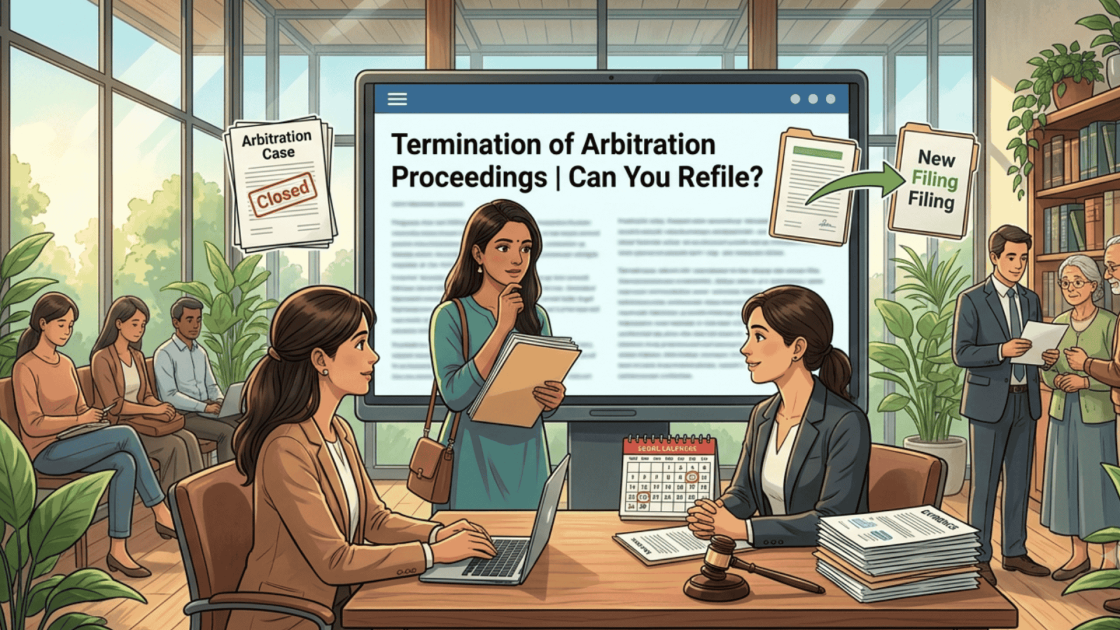
Quick Summary
Termination of arbitration proceedings means your case ended without a final award. It happens for five reasons: settlement, withdrawal, non appearance, ineligibility, or in rare cases the death of a party. The law behind it is Section 32 of the Arbitration and Conciliation Act, 1996, under which the arbitrator’s authority over the case ends the moment termination takes effect. What matters most is what survives: an administratively closed case can usually be refiled within the 3 year limitation period, while a withdrawn claim may be gone for good. This page covers every scenario and what to do in each.
You checked your case status expecting a hearing date, and instead you found one word: terminated.
Nobody called you, nobody explained, and now you are wondering if months of effort just vanished.
Take a breath first: terminated does not always mean over, and in many situations your claim can come back.
This page explains why cases get terminated, who has the power to do it, and exactly where your money stands in each situation.
What Does Termination of Arbitration Proceedings Mean?
In plain words, termination means your arbitration ended without the arbitrator deciding who was right.
No award was passed, so there is no binding decision directing anyone to pay anything.
The moment termination takes effect, the arbitrator’s role in your case is over, and the dispute goes back to being just a dispute, exactly where it stood before you filed.
Whether that is a setback or a disaster depends entirely on why the termination happened, and that is what the five scenarios below decide.
Why Do Arbitration Proceedings Get Terminated?
Five situations end a case before the award, and they are not equal: some protect you, some punish the other side, and one can quietly cost you everything.
In simple terms, they are: both sides settling, you pulling the claim back, someone not showing up, the case not qualifying in the first place, and rarely, a party passing away.
Find the one that matches your notice, because your next step depends on which it is:
1. You and the Other Side Settled
The whole purpose of arbitration is a fair resolution, and sometimes both sides reach one on their own before the award.
When that happens, the arbitration closes, and the arbitrator records the settlement, either as a consent award or through a formal termination order.
A settlement ending your case is a win, but only when the paperwork is done right, as you will see further below.
2. You Withdrew the Claim
If you pull your claim back voluntarily and the other side does not object, the arbitrator terminates the case.
This is the scenario that deserves the most caution, because a withdrawn claim may not be allowed back, and brokers know it.
A payment promise that arrives right before your hearing date is often designed to make you withdraw.
3. Someone Stopped Showing Up
When a party repeatedly skips hearings or never submits documents despite notices, the exchange or the arbitrator can close the case. This is called administrative closure.
If the absent party was you, your recovery chance closed with it.
If it was the broker, remember the proceedings can also continue without them, so a case closing this way is worth questioning.
4. The Case Did Not Qualify
If the dispute turns out to be outside what arbitration covers, it gets dismissed at whatever stage the problem surfaces.
This one is fully preventable, because what matters can be referred to arbitration is a defined list you can check before filing a single page.
5. A Party Passed Away
In rare cases, when one party dies and no legal representative steps forward, the matter may close depending on the nature of the claim.
Found your case terminated without your consent, or feeling pushed to withdraw before your hearing?
We will find out exactly why your case closed, whether it can be revived, and file the revival or fresh claim before the window shuts.
Who Has the Power to Terminate Your Case?
The name on your closure document matters more than most investors realise.
Only two authorities can end your case; each closes it for different reasons, and each sends you a different kind of paper.
Knowing which one acted tells you instantly how serious your situation is and who to question.
When the arbitrator ends it, you receive a reasoned order.
This is the route for cases that settled, claims taken back, or matters that turned out not to belong in arbitration at all. An order like this usually means a decision was involved, yours or both parties’ together.
When the exchange ends it, no arbitrator was involved in the closing.
This happens on process grounds: hearings nobody attended, papers that never arrived despite reminders. Both sides then get an intimation confirming the file is closed.
The first kind rarely surprises anyone. The second kind is the dangerous one, because it can build up quietly while you assume your case is simply moving slowly.
Which is exactly why you should never wait for closure papers to learn where things stand.
Our guide on how to check arbitration case status shows you where your case is at any moment, and a two-minute check every few weeks makes a silent closure impossible.
Section 32 of Arbitration and Conciliation Act: Termination Rules
Search this topic anywhere, and you will run into one section of law again and again, so let us settle what it means for you in one minute.
Section 32 is the rule that decides when an arbitration is officially over, and it recognises only two endings.
Either the arbitrator gives the final decision, or the case closes through a termination order before any decision comes.
For the order route, the law accepts just three reasons. You took your claim back, and the other side had no real ground to insist on continuing.
Or both of you agreed to stop. Or the arbitrator concluded that carrying on made no sense, maybe because the dispute resolved itself, or because continuing had genuinely become impossible.
Now the line every investor should underline: the moment your case terminates, the arbitrator’s authority over it dies with it.
Nobody can reopen that file, not even the arbitrator who ran it.
If your claim deserves another chance, it needs a fresh filing, which is why the refiling rules in the next section matter so much.
Is Your Money Gone? What Each Termination Means
Here is the question you actually came for.
The honest answer is that termination does not treat everyone equally.
Four different endings exist, and they range from a full win to a permanent goodbye: a recorded settlement, a withdrawal, a closure caused by your own absence, and a closure on process grounds.
One of these four is written on your termination order right now.
So find yours below, because the reason on that paper decides whether your money is settled, gone, or simply waiting for a fresh filing:
- Settled with a recorded agreement: your matter is resolved on the terms you signed, and those terms are what you can enforce.
- Withdrawn: the claim may not be raised again unless the withdrawal specifically allowed it. This is the most final of all endings.
- Closed because you did not participate: the recovery opportunity is usually lost, which is why silence is the most expensive mistake in arbitration.
- Closed administratively or on technical grounds: your claim survives, and you can refile within the 3 year limitation period counted from the dispute.
Landed in that last group? Then here is your good news twice over.
Your claim is alive, and the record you built the first time never expired: the complaint stages you completed and the evidence you filed all still stand, so the refiled case starts on a foundation, not from zero.
And if the filing route itself feels foggy the second time around, you do not need to reconstruct it from memory.
Our full guide on how to file complaint in NSE walks the entire route stage by stage, with the steps and contacts for each, ready whenever you restart.
How to Avoid Termination of Arbitration Proceedings?
Nearly every case lost to termination is lost the same way: through a small decision made in a hurry during the final days.
Someone signs nothing and withdraws on a phone promise. Someone misses one hearing and stays quiet about it.
The case closes, and no rule was broken except the investor’s own guard.
Four habits block every one of those endings, and they map to the two risky moments you may face: two protect you when settling, and two protect you when life gets in the way of a hearing.
Take the pair that fits your situation, and treat them as non-negotiable:
- Get every settlement in writing before withdrawing anything, signed by both sides, and ask the arbitrator to record it as a consent award so it carries the same binding force as any NSE arbitration award.
- Never withdraw on a promise. Money in your account first, withdrawal after. A promise is not a settlement.
- If you cannot attend a hearing or submit documents in time, tell the exchange in writing before the date, not after the closure.
- Ask for an extension or send a representative rather than letting an absence become an administrative closure.
Conclusion
A terminated case is a fork in the road, not always the end of it.
Settled well, it is your victory recorded. Closed administratively, it is a claim waiting to be refiled inside 3 years. Withdrawn carelessly, it may be the one ending nobody can undo.
Know which termination yours is before you accept it, and never let a case close through silence.
The investors who lose at this stage are rarely the ones with weak cases.
They are the ones who stopped watching.
Report. Recover. Stay Fraud Free.
Frequently Asked Questions
It depends on how it ended. Administrative and technical closures can usually be refiled within the 3 year limitation period. A voluntarily withdrawn claim generally cannot come back unless the withdrawal specifically preserved that right.
No. Losing means an award was passed against you on merits. Termination means no decision was made at all, so nobody won or lost, and depending on the scenario, your claim may still be alive.
When you settle during arbitration, the arbitrator can record the settlement as a consent award. It carries the same binding force as a decided award, which means the broker cannot later walk away from the agreed terms.
No. Non appearance by the respondent lets the case proceed ex parte and still end in a binding award. Administrative closure for non appearance is a risk for the absent party, not a weapon against the present one.
Get the termination order or closure intimation and read the stated reason. That single line decides everything: whether to enforce a settlement, refile within limitation, or challenge a closure that happened without proper notice to you.




 Add us as a preferred source on Google »

