

Quick Summary
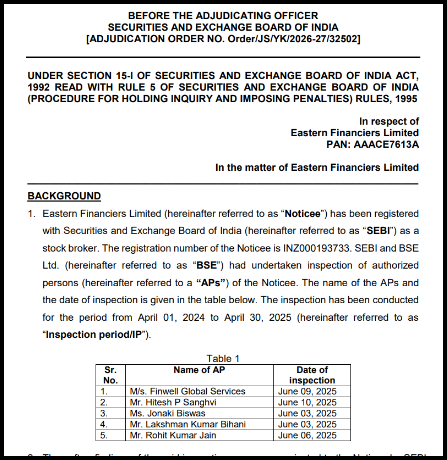
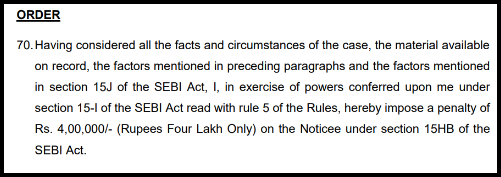
SEBI passed an adjudication order against Eastern Financiers Limited on July 22, 2026, imposing a penalty of ₹4,00,000. The broker holds registration number INZ000193733 and remains registered. SEBI and BSE inspected five of the firm’s authorised persons and established six violations: three APs could not produce a single call recording for phone orders, two lacked the mandatory NISM certification, terminals were run by unapproved users, and one terminal operated from an unreported address. No investor complained and no client lost money. This was also the firm’s second penalty in under two years, after ₹3,50,000 in February 2024.
Eastern Financiers took client orders by phone. When SEBI asked for the recordings, there were none.
That is the finding at the centre of the Eastern Financiers SEBI order of July 22, 2026, which ended in a ₹4 lakh penalty against a broker no investor had complained about.
Not one client lost money, and SEBI penalised the firm anyway.
If you place orders with your broker over the phone, the reasoning behind that penalty is written for you.
Here is everything the order found, and what it means for how your own account is protected.
What SEBI’s Order Against Eastern Financiers Actually Is?
Let us be clear at the outset, because it matters for how you read the rest.
Nobody lost money here. SEBI records that no investor complaint was received and no financial loss was caused to any client.
There is no allegation of unauthorised trading, no siphoning, no fraud. This is not that kind of order.
What actual broker misconduct looks like, from unauthorised trades to fund misuse, is a separate subject we cover across the real cases of stock broker scams in India.
What it is, is a regulator finding that the safety net was not in place.
And the reasoning SEBI gave for penalising anyway is the most useful thing in all thirty-nine pages.
So the question worth asking is not what Eastern Financiers did to anyone.
It is what would have happened if something had gone wrong.
Also Read: SEBI order on Nuvama Wealth, 63 clients never received a single contract note.
Eastern Financiers SEBI Order: What the Inspection Found?
SEBI and BSE inspected five authorised persons of the firm between June 3 and June 10, 2025, covering the period from April 2024 to April 2025.
Several violations were established:
1. Nobody Could Produce a Call Recording
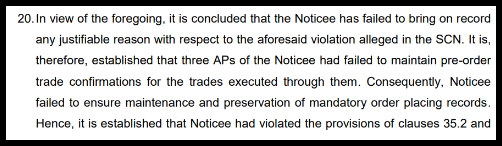
Three of the APs told the inspection team that client orders came in either by telephone or through the trading app.
So the inspectors asked for sample pre-order confirmations, including the call recordings.
None were produced.
The firm’s explanation shifted as the inspection progressed.
First, that clients came to the office in person and signed physical deal sheets. But no deal sheets were produced during the on-site inspection.
Then the firm accepted that the visitor registers did not contain entries matching those supposed visits.
The inspection team asked for CCTV footage showing clients arriving to place orders. None was furnished.
Client confirmation letters were produced later, saying they had visited and signed order slips.
SEBI held that letters obtained after the fact cannot substitute for records that were supposed to exist at the time.
2. Two APs Had No NISM Certification
Ms. Jonaki Biswas and Mr. Lakshman Kumar Bihani did not hold the NISM Series VII certification that has been mandatory since a 2010 notification.
The firm’s defence was an interesting one.
Because the certification is titled “Securities Operations and Risk Management,” it had understood the requirement applied to head-office risk staff, not to APs dealing with clients day to day.
SEBI rejected that, holding that a regulated intermediary is expected to read the rules correctly and an erroneous interpretation cannot override a statutory mandate.
There is a sharper detail.
SEBI communicated this finding in July 2025.
By the time the order was passed a year later, Mr. Bihani still had not obtained the certification, so SEBI recorded the violation as ongoing.
3. Terminals Were Operated by Unapproved Users
At one AP’s office, a Mr. Anil Shukla was executing orders on the trading terminal. Exchange records showed he was not an approved user.
At another, all client orders were being received and executed by a Mr. Madhusudan Mondal, who was also not approved.
The firm said this happened only on the day of inspection, because the approved user was absent.
SEBI checked the sample trades and found Mr. Mondal had executed orders on four separate dates spread across 2023, 2024 and 2025.
Not an exception. A practice.
The next finding is where the arrangement gets genuinely uncomfortable.
Two Brokers, One Room, One Family
During the inspection of the AP called M/s. Finwell Global Services, the team found a second trading terminal in the same office, belonging to an entirely different stock broker.
That second terminal belonged to a firm called M/s. Folioport, an authorised person of Master Capital Services Limited.
It sat immediately next to the Eastern Financiers terminal, and the same unapproved employee was operating it too.
Then SEBI looked at who owned what.
The partners of Folioport were Mr. Rhiju Sengupta and Mr. Biswadeep Chatterjee.
The partners of Finwell Global Services were Ms. Nilima Sengupta and Ms. Daliya Chatterjee, who are their mothers.
And the exchange-approved user for the Eastern Financiers terminal was Mr. Rhiju Sengupta himself, who was simultaneously a partner in the competing broker’s AP.
So two authorised persons of two different brokers were being run, in practice, by the same two men from the same room, with terminals side by side.
The firm answered that the entities were legally distinct and no client information was misused.
SEBI’s response is worth understanding, because it explains the entire logic of these rules:
The requirement to keep terminals segregated does not depend on proving that anything actually went wrong. It is preventive.
It exists to remove the possibility of operational overlap, unauthorised access and conflicts of interest before they arise.
That single sentence is why the rest of this order matters to you.
How Did an Unregistered Trading Office Location Trigger SEBI’s Penalty?
One more finding, and it is the one that would matter most if you were a client of that particular AP.
A terminal allotted to Ms. Jonaki Biswas was registered at an address in Bally, Howrah.
On the day of inspection, it was not there. It was operating from a completely different address in Kolkata.
The chronology SEBI reconstructed is telling.
The AP told the firm about the address change on February 7, 2025. The firm applied to NSE on February 21.
NSE rejected it three days later for want of a notarised rent agreement. Nothing further happened for three months.
A fresh application went in on May 29 and was approved on May 30.
On BSE, the request was not filed until July 21, 2025, which was after the inspection had already happened.
Clients mapped to that AP were required to be told at least thirty days before the office moved.
They were not.
Also Read: Choice Broking Unauthorised Trading, a 30-day payment order, with 12% interest waiting behind it.
Why SEBI Penalised a Broker Nobody Complained About?
Here is the heart of the order, and the reason it belongs on your reading list even though no money went missing.
Eastern Financiers argued repeatedly that no investor complained, no client lost money, and every trade was executed on genuine client instructions.
Surely, it suggested, that proves the trades were fine.
SEBI dismantled the logic:
The allegation was never that unauthorised trading occurred. The allegation was failure to maintain the mandatory order-placing evidence. And that obligation exists independent of whether any investor complaint is subsequently received.
Read that again, because it is the whole point.
Those call recordings are not paperwork for the regulator’s benefit.
They are the evidence that decides who wins when a client says “I never placed that trade.”
Every arbitration award where an investor recovered money against a broker turned on precisely this: the broker could not produce the record proving the client placed the order, so the trades were held unauthorised.
A firm with no recordings is not a firm where nothing goes wrong. It is a firm where, if something does go wrong, there is nothing to check.
Our breakdown of the Motilal Oswal complaints shows what that looks like in practice, where an elderly investor recovered over a crore because her broker could not produce a single pre-trade confirmation.
Why Did SEBI Increase the Penalty for Eastern Financiers as a Repeat Offender?
There is one more thing in this order that changes how you should read the penalty.
SEBI’s own table records that Eastern Financiers was penalised ₹3,50,000 on February 26, 2024, for violations of the broker regulations and circulars issued by SEBI and NSE.
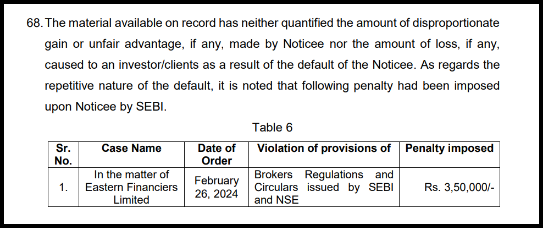
This order, seventeen months later, is the second penalty.
SEBI expressly considered the repetitive nature of the default when fixing the amount, which is how a firm with no investor complaints and no quantified gain still ended up at ₹4 lakh.
There was also a finding about the firm’s own oversight that deserves attention.
Eastern Financiers had inspected four of the five APs itself and recorded no adverse observations in any of them.
SEBI and BSE then walked into the same offices and found six categories of violation.
The fifth AP, Mr. Hitesh P. Sanghvi, had never been inspected at all since his registration in July 2023.
SEBI’s conclusion: a supervisory framework on paper does not satisfy the obligation. What matters is whether it actually catches anything, and this one did not.
What This Means If You Trade Through Any Broker’s Authorised Person?
Most retail investors deal with a local representative rather than the head office.
That is exactly the relationship this order is about.
And Eastern Financiers is not an outlier: the violation cases against SEBI registered brokers include names as large as IIFL and Motilal Oswal, with lakhs recovered by investors in each.
So the protection has to come from your side, and it comes down to four habits: confirming your calls are recorded, verifying who runs the terminal, keeping orders in writing, and holding your own records.
Each one closes a gap this order exposed, so check yourself against all four:
- Ask whether your calls are being recorded: If you place orders by phone, that recording is your protection, not the broker’s inconvenience. SEBI’s circular requires brokers to use a telephone recording system wherever order instructions come in by phone, and a firm that does not record is a firm where your word will stand against theirs with nothing in between.
- Check who is actually operating the terminal: The person placing your orders should be an exchange-approved user. NSE runs a facility on its website where you can verify a broker and its authorised persons. It takes a minute, and this order shows why it is not a formality.
- Place orders in writing wherever you can: Email, or the app leaves a log. A phone call at an office with no recording system leaves nothing. If you must call, follow up with a message confirming what you asked for, so a record exists on your side.
- Keep your own trail: Contract notes, ledger statements, every SMS. If a dispute ever arises, the strength of your position depends on what you can produce, and you cannot rely on the branch having kept anything.
If you are already in a dispute with a broker or its representative, our guide to filing a complaint against a broker walks through the escalation route from the first email onward.
Has a broker’s representative traded your account without a clear record of your instruction?
We will reconstruct your ledger against whatever order evidence the broker can actually produce, and build the claim around the gap where the records should be.
Eastern Financiers SEBI Order: Timeline
The dates in this case tell their own story, because the gaps between them are where the violations lived.
The trouble starts well before the inspection.
One authorised person registered on July 20, 2023, was never inspected by the firm at all, and SEBI had already penalised Eastern Financiers ₹3,50,000 on February 26, 2024.
The inspection period itself ran from April 1, 2024 to April 30, 2025.
Inside that window sits the address change failure.
An AP reported her office move on February 7, 2025, NSE rejected the application on February 24, and the firm then did nothing for three months.
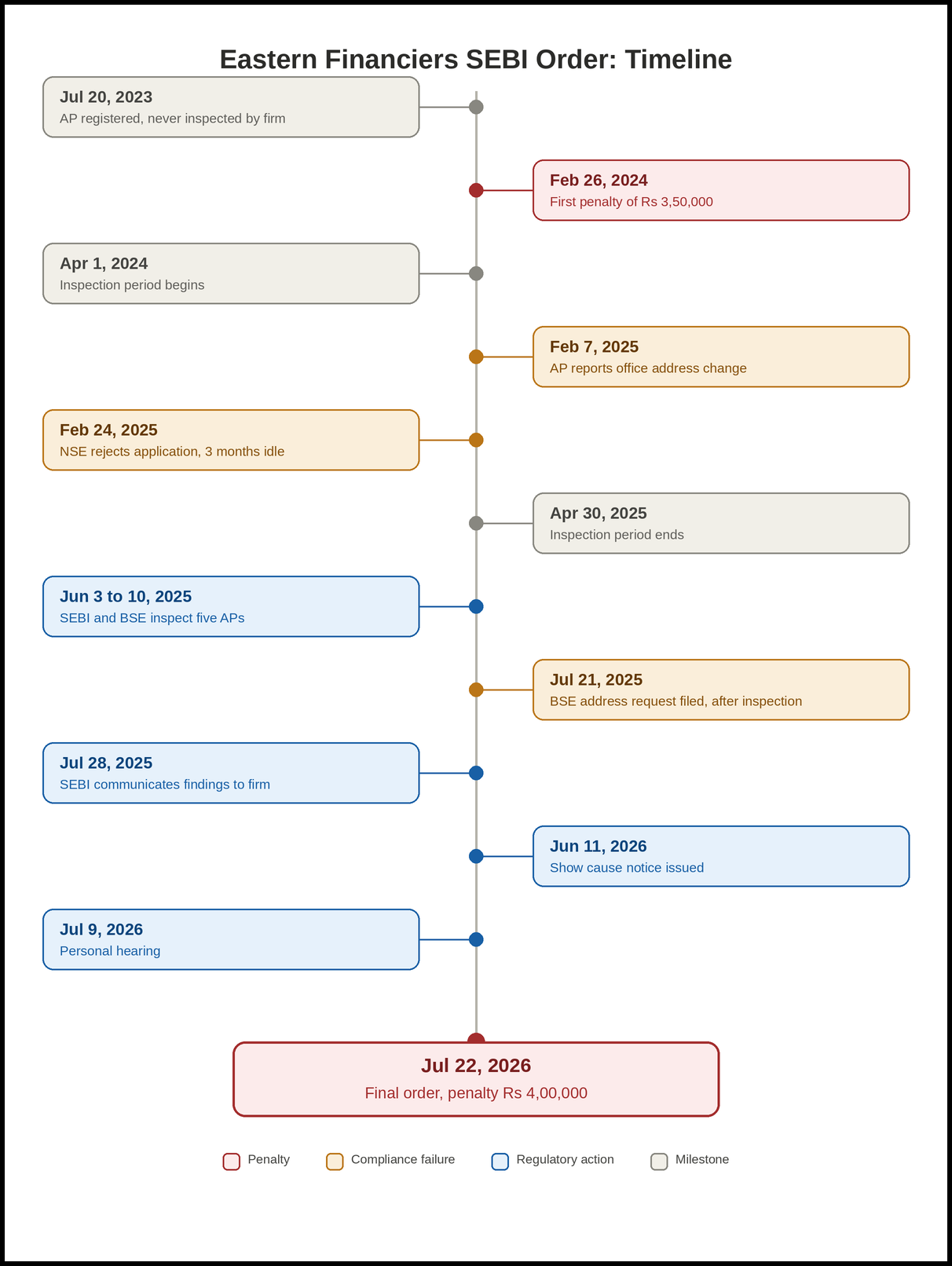
SEBI and BSE inspected the five APs from June 3 to 10, 2025, and communicated their findings on July 28.
The BSE address request went in on July 21, 2025, after the inspection had already happened.
The final year moved fast: a show cause notice on June 11, 2026, a personal hearing on July 9, and the final order with the ₹4,00,000 penalty on July 22, 2026.
Conclusion
SEBI’s July 22, 2026 order against Eastern Financiers Limited establishes six compliance failures across five authorised persons and imposes a ₹4 lakh penalty, the firm’s second in under two years.
Not a rupee of investor money was lost. That is precisely what makes the order instructive.
SEBI penalised the absence of records that exist for one purpose: to answer the question “did the client actually place this trade?” when somebody finally asks it.
The firm’s own inspections had found nothing wrong at four of these offices. The regulator found six violations at the same four.
When the safety net is checked by the people who benefit from it being intact, it tends to look fine.
If you trade through a representative, ask about the recordings before you need them. Afterwards is too late.
Report. Recover. Stay Fraud Free.
Frequently Asked Questions
SEBI imposed a monetary penalty of ₹4,00,000 under section 15HB of the SEBI Act, by order dated July 22, 2026. The firm has 45 days to pay, after which recovery proceedings can begin under section 28A, including attachment of property.
No. SEBI records that no investor complaint was received and no financial loss was caused to any client. The violations concerned failures to maintain mandatory records, certifications and supervision, not unauthorised trading or misappropriation.
SEBI held that the obligation to maintain order-placing evidence exists independent of whether any investor complaint is later received. The records are preventive, and the absence of a complaint does not cure the failure to keep them.
It is the evidence that you placed an order before it was executed, such as a signed physical record, a telephone recording, an email, or an internet transaction log. If a trade is ever disputed, the broker must produce it. Where a broker cannot, tribunals have consistently held the disputed trades unauthorised.
Yes. The order imposes a monetary penalty only. Registration number INZ000193733 was not suspended or cancelled, and no restriction was placed on the firm taking on clients or continuing business.




 Add us as a preferred source on Google »

