

Quick Summary
NSE arbitration is the final stage of the exchange dispute process, where an independent arbitrator hears both sides and passes a legally binding award. You reach it only after your complaint, SCORES, and conciliation fail to resolve the dispute. Claims above ₹30 lakh go before a panel of three arbitrators; everything below gets a sole arbitrator. The award binds the broker, and non compliance carries regulatory consequences. Investors we represented recovered ₹18,56,140 from a broker, ₹14,37,200 from IIFL Securities, and more, each case decided on evidence. This page covers the rules, every step, and the real cases.
You have tried everything to resolve your investment dispute, and you are still waiting for a fair outcome.
NSE arbitration may be your last formal opportunity to have the case decided, and unlike every stage before it, the decision that comes out is binding.
Most investors who reach this stage have never seen how the process actually runs.
This guide covers the rules, the steps before and after filing, and the real recoveries that show what evidence wins.
What Is NSE Arbitration?
NSE arbitration is a legal dispute resolution process conducted under the framework of the National Stock Exchange.
Instead of filing a civil lawsuit, eligible disputes between investors and market intermediaries are decided by an independent arbitrator appointed through the process.
Both parties submit documents, present arguments, and respond to each other’s claims before an award is passed.
The decision rests on the evidence and the applicable rules and SEBI regulations, which makes arbitration a structured and legally recognised way to resolve investment disputes.
But before you start preparing your claim, some rules decide whether your dispute can even enter arbitration.
NSE Arbitration Rules
A genuine grievance alone does not get you into arbitration.
The rules decide when you can file, who can file, and what must happen first, and knowing them saves you from a rejection on procedural grounds.
The rules that matter most for you:
- Arbitration opens only after you complete the prescribed grievance process.
- Your claim must be filed within the applicable time limits.
- Documents and evidence must support every allegation.
- Claims above ₹30 lakh go before a tribunal of three arbitrators; claims up to ₹30 lakh get a sole arbitrator.
- The award binds both parties unless challenged under the Arbitration and Conciliation Act, 1996.
What Does NSE Arbitration Cost?
The fear of spending more money after already losing some is what stops most investors from filing, so the cost question deserves a straight answer.
The fee works on a slab system: the amount you pay depends on the value of your claim, starting small for retail-sized disputes and rising only as the claim crosses each threshold.
Timing changes the bill too.
Filing promptly after conciliation fails keeps you at the base fee, while delay can double what you pay for the very same claim, and late fees do not come back even if you win.
There is one more part of the structure most investors never hear about, and it changes the maths completely.
If the award goes in your favour, the fee you deposited comes back to you. A strong case, filed on time, effectively costs you nothing at the end.
For a sense of scale, a claim up to ₹1 lakh costs ₹5,400 and a claim up to ₹10 lakh costs ₹9,000, with GST and stamp duty extra, rising by slab beyond that.
The exact slab for every claim amount, the late fee calculations month by month, and the refund conditions are covered in full on our page on NSE arbitration fees, which is worth reading before you decide when to file.
When Should You File For NSE Arbitration?
Many investors think arbitration is the first step after a dispute.
It is actually the last.
You file only after the earlier mechanisms have failed, and your case is strongest when the record shows you completed each one.
Consider filing when:
- Your complaint to the broker or intermediary went unresolved.
- SCORES did not produce a satisfactory outcome.
- Conciliation could not settle the dispute.
- You hold evidence such as contract notes, statements, chats, or recordings.
- You want a binding decision instead of indefinite waiting.
If you have reached this stage, delay only weakens you.
Arbitration is often the last formal chance to recover your losses.
And if your trades ran on both exchanges and you are unsure where this case even belongs, our guide on BSE vs NSE arbitration settles the jurisdiction question in five minutes.
How Does the NSE Arbitration Process Work?
You cannot jump straight to an arbitrator.
The NSE arbitration process runs through a defined escalation path, and each completed stage becomes part of the record your case stands on.
Six stages lead to the arbitrator’s door, and the first three happen before any dispute platform is involved:
- Step 1: Gather your evidence: Contract notes, statements, bank records, chats, emails, and recordings, all in one place before anything else.
- Step 2: Draft the complaint: What happened, in order, with the loss and the relief you seek clearly named.
- Step 3: Raise it with the entity: The broker or intermediary gets the first complaint, and every reply goes into your record.
- Step 4: Escalate to SEBI SCORES: This creates the regulator’s own record of the dispute, which the later stages rely on.
- Step 5: Attempt conciliation: A neutral conciliator brings both sides together, and a settlement here ends the matter with a recorded agreement.
- Step 6: File share market arbitration: Once conciliation fails, the application goes in, and from this point the process is formal and enforceable in law.
If you want the full process with the portal steps, contact details, and documents for each stage, check our guide: file complaint in NSE.
What Happens After You File the Arbitration?
Filing is where most guides stop, but the part after filing is where your case is actually decided.
The proceedings move through five stages, from scrutiny of your application to the final award, and each has its own timeline:
- Your application is checked first. Complete documents get it registered with a reference number. Incomplete filings can be rejected.
- An arbitrator is appointed. A sole arbitrator for claims up to ₹30 lakh, a panel of three above that.
- The respondent is notified and must file a written reply with supporting evidence.
- Hearings are scheduled, usually within 30 to 45 days, where both sides present evidence and the arbitrator may question either party. Non-appearance can still lead to a decision.
- The final award is issued, typically within 30 days of the hearings, and it binds both parties under the Arbitration and Conciliation Act, 1996.
Reaching this stage means conciliation did not settle your case, and if you are wondering what this stage wins you over the settlement you did not get, our guide on SMART ODR vs NSE arbitration puts the two side by side.
Most matters conclude within four to six months of filing.
Want the stage-by-stage timeline with what happens at each milestone?
Check our guide: how long does arbitration decision take.
Ready to file but not sure your documents will survive scrutiny?
We will map your evidence to the specific violations, structure the claim the arbitrator actually reads, and represent you through every hearing.
NSE Arbitration Award: Does Filing Guarantee Recovery?
Not necessarily.
Arbitration is evidence-driven. Two investors with similar losses can get opposite outcomes because their documentation differs.
An award depends on: whether a regulatory violation exists, the documentary evidence available, whether the intermediary failed its compliance obligations, and how well the facts are presented.
What a binding NSE arbitration award means for enforcement, and what happens when the broker does not pay, is a subject with its own full page.
The cases below show what decides real outcomes:
Case 1: NSE Arbitration Against a Broker
It all started when Sudhir trusted his broker with his trading account.
He had no reason to doubt SMIFS Limited. Until one day, contract notes landed in his inbox for trades he had never placed, never discussed, and never approved.
When he raised the alarm, the broker’s response was casual: these are your trades only.
But the broker had no proof that could validate the answer. There were no call recordings, no chats, no emails.
Violations our team identified:
- Trades executed without verified client instructions.
- Missing or incomplete call recordings for the disputed dates.
- Trading patterns inconsistent with the investor’s profile.
Our team arranged every contract note, account statement, and communication gap into a case that was impossible to dismiss.
At arbitration, the absence of pre-trade records said more than SMIFS’s defence ever could.
Award: ₹18,56,140 recovered.

Case 2: NSE Arbitration Against a Research Analyst
Have you ever subscribed to a service because the initial “demo profits” looked impressive?
That is what happened with Yogesh Gupta and Insight Research. After seeing profitable demo trades, trust was built quickly.
He paid ₹56,000 for the service.
But soon after, losses of ₹2,30,000 followed, and everything was being handled over WhatsApp without proper structure.
Key issues:
- Demo trades used to build trust.
- No structured stop-loss or target system.
- Advisory shared informally over WhatsApp.
- No verifiable proof of performance claims.
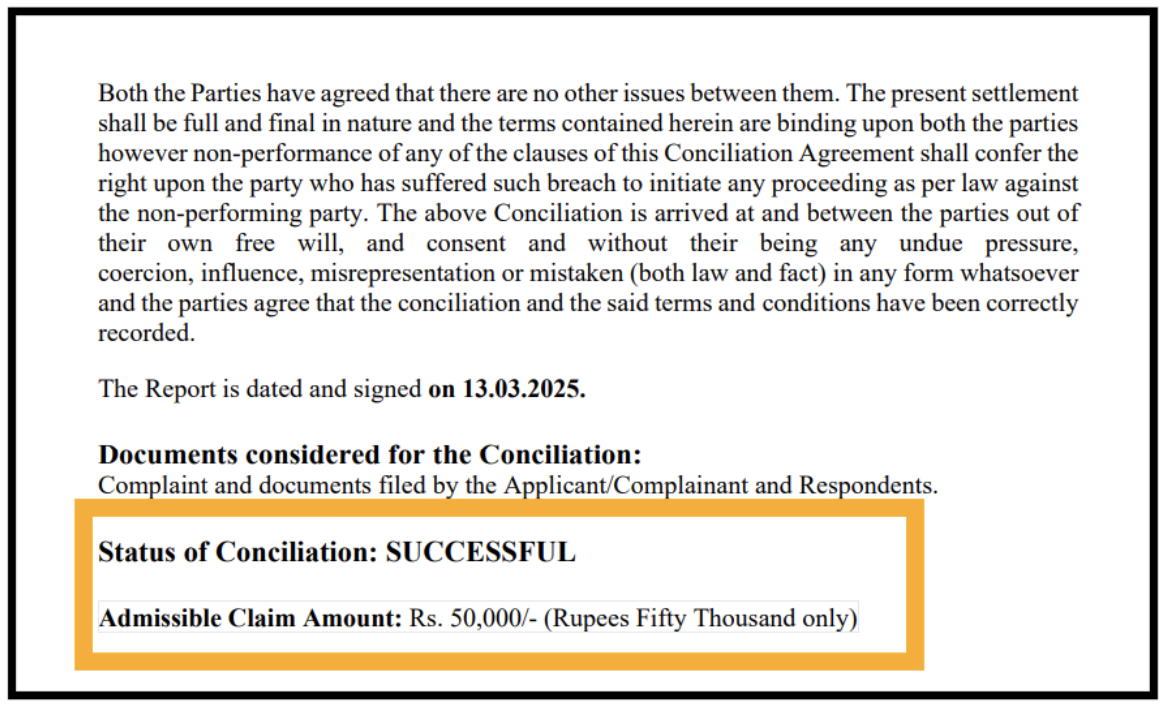
In arbitration, the focus was not on market loss but on missing compliance and documentation.
Award: ₹50,000 recovered.
Case 3: NSE Arbitration Against an Investment Advisor
Sometimes it doesn’t feel wrong at the beginning because you believe professional help means better control and better returns.
That belief led Naman Sharma to share his trading credentials. Trades were later executed in his account without clear authorisation.
When questioned, the justification was that credentials were shared voluntarily.
But the evidence showed otherwise:
- Execution of trades without valid client authorisation.
- Credentials obtained under the representation of advisory support.
- Violation of SEBI Investment Adviser regulations related to execution practices.
- Internal email acknowledgement indicating execution-led losses.
A key internal email became the turning point in the dispute. The case was structured strictly on regulatory breaches and documented evidence rather than assumptions or interpretations.
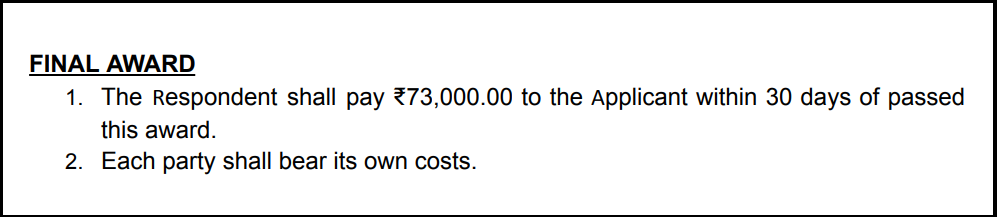
On 12th September 2025, the arbitral tribunal ruled in favour of the investor.
Award: ₹73,000 recovered.
If these cases demonstrate anything, it is this: recovery is rarely determined by the amount of money lost or how strongly an investor feels about the situation.
It depends on the merits of the case and the evidence supporting it.
In each of the cases above, the difference was made by:
- Clear documents and records.
- Evidence of regulatory violations.
- A well-organised presentation of facts.
In arbitration, it is rarely about who speaks louder. It is about who proves their case better.
NSE Arbitration Status: When and Why to Check It?
Filing the arbitration does not mean you can sit back and wait for a call.
Hearings get scheduled, reply deadlines pass, and document requests arrive, and missing any of them can cost you the right to respond.
The exchange will not chase you. Staying informed is your job, and it takes two minutes once you know where to look.
Keep your arbitration reference number saved somewhere you will not lose it, because every status check starts with it.
Check the status after each expected milestone: once after registration, again around the arbitrator appointment window, and before the 30 to 45 day hearing mark.
If your case suddenly shows no movement for weeks, that silence is information too, and an email to the exchange’s arbitration desk with your reference number usually gets an answer.
The full walkthrough for both NSE and BSE, including what to do when your case does not appear online at all, sits in our guide on how to check arbitration case status.
Conclusion
Losing money hurts. Losing it to someone else’s misconduct and then waiting in silence is worse.
NSE arbitration exists precisely for that situation: a structured, binding path that ends in a decision instead of another ignored email.
A strong case is built on facts, evidence, and sequence, not on emotion.
Complete each stage, keep every record, and file before the timelines close on you.
The investors in the cases above did exactly that, and the awards followed.
Report. Recover. Stay Fraud Free.
It is the final stage of the exchange dispute process. You first raise the complaint with the entity, escalate through SCORES and conciliation, and only then can an independent arbitrator hear the case and pass a binding award. Yes. If the award is passed in your favour, the fees you deposited are refunded as per the applicable rules, which makes a genuine claim far less costly than most investors fear. No. The grievance process must be completed first. Skipping stages gets applications rejected, which is why following the sequence matters as much as the evidence. Do not decide that alone. Emails, WhatsApp chats, statements, and call recordings often become strong evidence once mapped to specific violations, and many investors discover their case only after a proper review. The party against whom the award is passed must submit its intent to challenge under Section 34 of the Arbitration and Conciliation Act within 7 days, and unless a stay is granted within 3 months, the award must be complied with in full.Frequently Asked Questions





 Add us as a preferred source on Google »

