Most people don’t think about complaints when they open a trading account. Everything feels simple at first. You place a few trades, check your portfolio, and slowly start trusting the platform.
Then something goes wrong. A trade doesn’t execute the way you expected. You notice charges that don’t make sense.
You raise a complaint, but the response either takes too long or doesn’t really solve anything.
That’s when the frustration kicks in. And more importantly, that’s when you realise, you don’t actually know what to do next.
If you’re using Nuvama or even thinking about it, don’t wait for that moment to figure things out.
In this blog, we’ll look at Nuvama complaints in a simple, practical way. Not to prove that the broker is good or bad. But to help you understand what kind of issues can come up, and what you should do if they do.
Nuvama Complaints Overview
Nuvama is not a small or unknown broker. It positions itself as a wealth management + full-service broker, which means it doesn’t just offer trading. It also provides advisory, portfolio management, and relationship-based services.
Because of this, expectations are naturally higher. When someone uses a platform like Nuvama, they don’t just expect execution. They expect clarity, support, and proper guidance.
And that’s where complaints usually start. To be clear, the complaints are not unusual.
Every broker in India, whether it’s Zerodha, ICICI, or IIFL, deals with user complaints. As the number of clients increases, complaints also increase.
So the real question is not: “Does Nuvama have complaints?”
The real question is: “What kind of complaints come up, how often, and how does the company handle them?”
In Nuvama’s case, most issues reported by users typically revolve around:
- Delays in response or support.
- Confusion around charges or fees, leading to claims of Nuvama Wealth excess charges.
- Platform or execution-related issues, such as the Nuvama app not working during critical market hours.
- Gaps between advisory expectations and experience.
- Instances of unauthorised trading where trades appear in the ledger without client consent.
Apart from user-level complaints, there have also been regulatory observations in the past, including references to a SEBI order on Nuvama Wealth, mainly around compliance processes.
These were not fraud-related issues, but they do indicate that the company has faced scrutiny.
That doesn’t automatically make the broker unreliable. But it does mean you should stay aware and not assume everything will always run smoothly.
In the next section, we’ll look at the actual complaint data from NSE, because that’s where things become more objective.
Exchange Complaint Data
Instead of relying only on opinions or reviews, it makes more sense to look at actual exchange data.
NSE publishes complaint-related data for brokers every year. This helps you understand one simple thing: how often users face problems and how the broker handles them.
Here’s the complaint data for Nuvama:
| Financial Year | Total Clients | No. of Complaints | % of Complaints | Resolved Complaints | % Resolved | Arbitration |
|---|---|---|---|---|---|---|
| 2023–24 | 3,12,448 | 142 | 0.045% | 138 | 97.18% | 2 |
| 2024–25 | 3,89,772 | 268 | 0.069% | 268 | 100% | 1 |
| 2025–26 | 3,65,981 | 241 | 0.066% | 220 | 91.29% | 0 |
At first glance, the numbers look under control. The percentage of complaints stays below 0.07% across all years. On paper, that looks strong. It tells you that most users don’t raise complaints.
But here’s how you should actually look at this data. First, don’t get too comfortable with low percentages.
Even a small percentage can hide real issues when the user base is large. If you look at absolute numbers, complaints almost doubled from 142 to 268 before slightly coming down.
That clearly shows that users do face problems, especially as the platform grows.
Second, look closely at resolution. A 100% resolution rate in 2024–25 looks impressive. But the next year drops to around 91%. That shift matters.
Because as an investor, you don’t care about “average performance”. You care about what happens when your complaint is one of the unresolved ones.
Third, arbitration numbers. They remain very low across all years, which is a good sign. It shows that most issues don’t escalate to serious legal disputes.
At the same time, keep this in mind: arbitration cases are not always publicly detailed, so you won’t find complete information easily.
Now step back and look at the overall picture.
- Complaints are low, but not zero
- Issues increase as the user base grows
- Resolution is generally strong, but not consistent
- No clear pattern of major disputes
So what should you take from this?
Don’t assume that you’ll face problems. But also don’t assume that everything will always work perfectly.
Because when something does go wrong, this data tells you one thing clearly: you need to know how to act.
In the next section, we’ll look at real user reviews, where these numbers turn into actual experiences.
Nuvama User Reviews
Before you make any decision, it helps to look at what actual users are experiencing.
Reviews should not be taken at face value, but they do give you a sense of where things go wrong in real situations.
The key is to understand the pattern behind the complaint, not just the emotion.
1. Poor Customer Support Experience
One common theme that shows up in user feedback is around customer support.
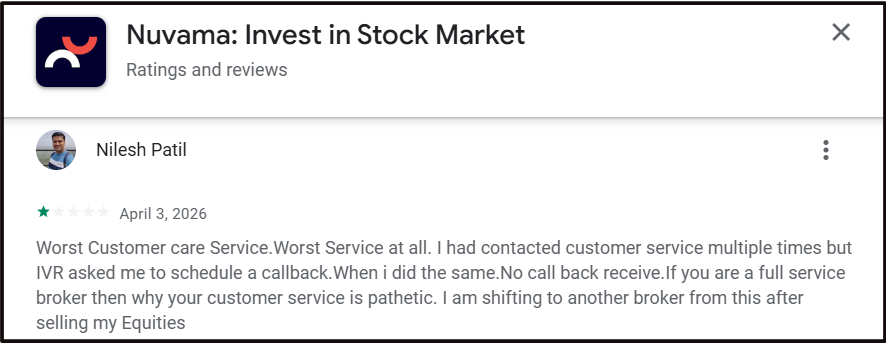
In this case, the user mentions repeated attempts to contact support but ends up dealing with IVR systems and missed callbacks. The frustration is not just about the issue itself, but about the lack of a timely response.
From an investor’s point of view, this matters.
Because when your money is involved, delayed support increases uncertainty. Even if the issue is small, slow or ineffective communication can make it feel much bigger.
This kind of feedback usually points to response delays or support inefficiencies, especially during peak times.
2. Issues Related to Brokerage Plans and Charges
Some users have raised concerns about brokerage plans and how charges are applied.
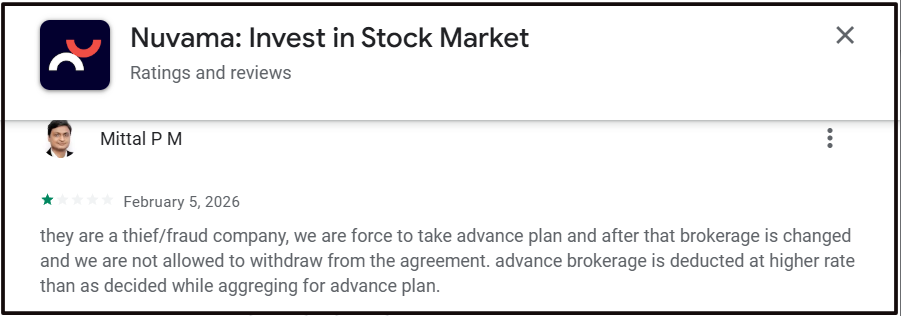
The review reflects dissatisfaction with an advanced brokerage plan, where the user feels that terms were not clearly communicated or did not match expectations.
Now, this is important to understand carefully.
In many cases, such issues arise from a misunderstanding of plan terms, but that does not remove the broker’s responsibility to communicate clearly.
As a user, you should always:
- Read plan details properly
- Confirm charges in writing
- Avoid committing to anything unclear
Because once you agree, reversing it becomes difficult.
3. Serious Allegations of Fraud
Some reviews go beyond service complaints and make strong allegations.
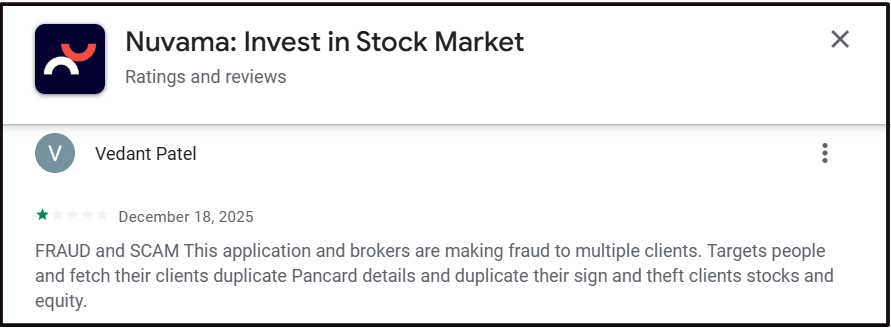
This particular review uses words like “fraud” and “scam”, which are serious claims. You should approach such reviews with caution.
These statements reflect the user’s experience or perception, but they are not verified findings. There is no publicly established pattern of large-scale fraud in the data we discussed earlier.
At the same time, you should not ignore the concern completely.
If you ever notice:
- Unauthorised transactions or cases resembling Nuvama Wealth unauthorised trading.
- Account activity you don’t recognise.
You should act immediately and escalate the matter without delay.
4. Trading App and Feature Limitation
Another set of complaints focuses on the trading experience, especially for active traders.
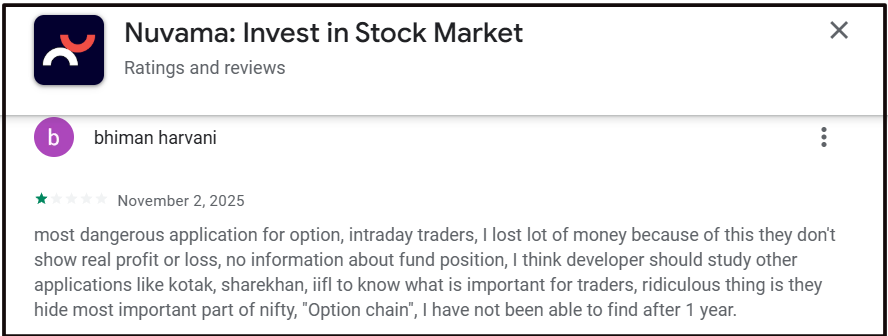
The user points out issues like:
- Incorrect profit/loss display
- Lack of fund visibility
- Missing or hard-to-find features, like an option chain
This kind of feedback usually comes from traders who rely heavily on real-time data.
From your perspective, this highlights one thing: Nuvama positions itself more as a wealth-focused platform, not a trader-first platform.
So if you are:
- An intraday trader
- An options trader
You should test the platform properly before depending on it.
Don’t treat every review as the absolute truth. But don’t ignore them either.
Look for patterns:
- Support delays
- Communication gaps
- Platform experience issues
These are practical concerns, not just emotional reactions. At the same time, extreme allegations should always be verified before forming any conclusion.
As an investor, your goal is not to find a “perfect broker”. Your goal is to understand where things can go wrong and stay prepared.
When To Take Action Against Brokers?
Not every issue needs escalation. Sometimes, delays happen. Sometimes, you misunderstand a charge. And in many cases, a simple follow-up with the broker solves the problem.
But there are situations where you should not wait or ignore things. You need to take action when the issue starts affecting your money, your trades, or your trust in the platform.
Here are some situations where you should act:
1. When the broker delays your complaint without a reason: If you’ve already raised a complaint and days pass without a clear response, don’t keep waiting. A genuine issue should not take endless follow-ups.
2. When you don’t get a proper explanation: If charges don’t make sense or transactions look unclear, you have the right to a clear answer. Vague replies or generic responses are not enough.
3. When there are unauthorised trades or transactions: This is serious. If you notice trades you didn’t place or funds moving without your knowledge, you should act immediately.
4. When your funds or securities don’t match: If your account balance or holdings don’t reflect correctly, don’t assume it’s a temporary glitch. Verify and escalate if needed.
5. When the issue repeats again and again: One-time problems can happen. But if the same issue keeps coming back, it shows a deeper problem. That’s when you stop relying only on support.
6. When the broker stops responding: No response is a response in itself. If communication breaks down completely, you should move beyond the broker and escalate the matter.
Don’t panic over small issues. But don’t stay passive when something feels wrong. Because once money is involved, delays and ignorance can cost you more than you expect.
In the next section, we’ll look at how you can actually report a stock broker step by step, so you don’t feel stuck if things don’t get resolved.
Where To Complaint About Stock Broker in India?
If your issue does not get resolved at the broker level, you should not stop there. Many investors either give up too early or jump directly to extreme steps without following the proper process.
That usually weakens their case instead of strengthening it.
There is a clear system in place to handle such situations. If you follow it step by step and maintain proper records, your chances of resolution improve significantly.
Here’s how you can register a complaint against your broker:
Step 1: Contact the Broker’s Support Team
You should always begin by raising the issue directly with the broker. Use official channels such as customer care, email support, or the in-app help section.
While raising the complaint, make sure you clearly explain the issue. Include relevant details such as trade IDs, dates, amounts, and screenshots wherever possible.
A vague complaint often leads to vague responses.
Give the broker a reasonable time to respond. In many cases, issues do get resolved at this stage itself.
Step 2: Lodge a Complaint with SCORES
If the issue remains unresolved, take it up with SEBI through the SCORES platform.
This step brings the regulator into the process, which increases accountability on the broker’s side.
Step 3: File a Complaint on SMART ODR
If your complaint still does not reach a satisfactory outcome, you can move to the Online Dispute Resolution (ODR) mechanism introduced by SEBI.
ODR provides a structured platform where both you and the broker can present your case digitally. A neutral system facilitates the process, making it more formal than regular complaint handling but still accessible.
This step is especially useful when there is a clear disagreement between you and the broker regarding responsibility or resolution.
Step 4: Arbitration in Share Market
If the dispute continues even after ODR, the final step is arbitration through the stock exchange.
In this process, an arbitrator reviews the case, examines the evidence from both sides, and passes a decision. This is a formal and legally binding stage, so you should ensure that all your documents, communication records, and proofs are properly maintained.
You should not skip steps or escalate randomly. Each level exists for a reason, and following the sequence strengthens your case.
Start with the broker, move to higher authorities only when required, and keep proper documentation throughout the process.
When you approach the system in a structured way, you don’t just increase your chances of resolution; you also avoid unnecessary delays and confusion.
Need Help?
Sometimes, even after raising complaints and following up, things don’t move the way they should.
If you feel stuck or unsure about the next step, getting the right guidance can make a big difference.
You can register with us, and we will help you:
- Understand your issue and how strong your case is.
- Guide you through the complaint and escalation process.
- Assist with exchange, SCORES, and ODR if needed.
Conclusion
Nuvama, like any other broker, does receive complaints. The data shows that the overall percentage of complaints remains low, which is a positive sign.
At the same time, the number of complaints has increased over time, and the resolution rate has not stayed consistent.
That does not make the broker good or bad by itself. What it tells you is simple: issues can happen, and you should be prepared for them.
As an investor, your focus should not be on finding a broker with zero complaints. That doesn’t exist. Your focus should be on understanding how problems are handled and what you can do if something goes wrong.
If you stay aware, keep proper records, and follow the right escalation process, most issues can be resolved.
Because in the end, it’s not just about the platform you choose; it’s about how you handle the situation when things don’t go as expected.