

Quick Summary
Pheonix Capital Research is the trade name of Raksha Sharma, a SEBI registered research analyst (INH000022446) with an address in Udaipur, Rajasthan. The firm sells quarterly “Stock Option” call packages, with one invoice showing ₹80,000 for a single quarter, marked non refundable. Calls and updates go out over WhatsApp. Before you pay, it’s worth knowing exactly what an RA registration covers, and what it doesn’t. Here’s the full profile.
You’ve probably come across Pheonix Capital Research through a call, an ad, or a WhatsApp message offering option trading calls, and now you’re checking who’s behind it.
That’s exactly the right instinct, especially before handing over a five-figure fee for a single quarter.
On this page, we look at who owns the firm, what its SEBI registration means, what it sells, and the checks worth running before you subscribe.
If you’ve already had a bad experience and want to report financial fraud India, our team can point you to the right forum.
What Is Pheonix Capital Research?
Let’s start with the basics, because the business structure decides who is responsible for what.
Pheonix Capital Research operates as a proprietorship, not a company.
That means the registered person behind it, Raksha Sharma, is the one SEBI holds accountable for the firm’s research and conduct.
Its invoices give an address on Savina Main Road, Udaipur, Rajasthan 313002, along with the website name pheonixcapitalresearch and email addresses on the same domain.
Some of the firm’s emails spell the name “Phoenix Capital Research,” while its invoices and registration use “Pheonix.”
If you’ve searched either spelling, you’re looking at the same Udaipur-based firm in the documents we reviewed.
Who Owns Pheonix Capital Research?
People often search for the person behind a research firm, and here the answer is on public record.
SEBI’s records list Raksha Sharma as the proprietor of Pheonix Capital Research, registered as a research analyst.
In a proprietorship, the proprietor is the registered intermediary, so complaints about the firm’s service ultimately sit against that registration.
The firm also works through representatives who call and message clients.
Any representative dealing with you should be able to tell you their role, and research analysts’ staff are generally expected to hold the relevant NISM certification. It’s fair to ask.
Is Pheonix Capital Research SEBI Registered?
Yes, and it helps to understand what that registration actually allows. “SEBI registered” means “accountable under specific rules,” not “risk free.”
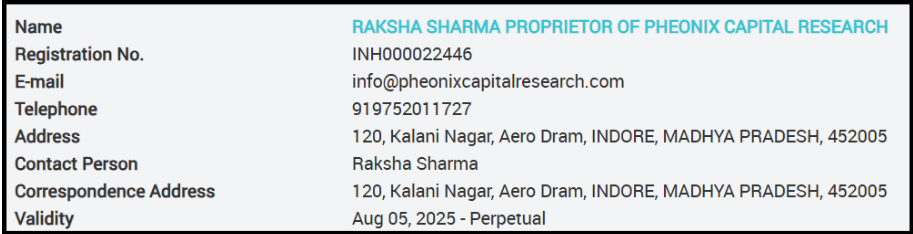
The firm is registered as a research analyst with registration number INH000022446. You can confirm this yourself on SEBI’s list of registered intermediaries.
A research analyst publishes research and recommendations that should be backed by research reports.
Personalised advice, built around one client’s money, goals, and risk, needs a separate investment adviser registration.
Knowing this difference helps you judge the kind of service you’re getting.
What Do the SEBI Register Details for Pheonix Capital Research Show?
A registration is only a claim until you match it against the register. So here is what the register listing shows, and where it differs from the invoices we reviewed.
These details come from SEBI’s list of research analysts as reproduced by a public directory.
Check each line against the official SEBI website yourself before you rely on it.
- Registered name: Raksha Sharma, proprietor of Pheonix Capital Research.
- Registration number: INH000022446, where the INH prefix marks a research analyst.
- Validity: listed from 5 August 2025 and marked perpetual, so there is no expiry date to track.
- Registered address: 120 Kalani Nagar, Indore, Madhya Pradesh 452005.
- Registered email: an info address on the firm’s own pheonixcapitalresearch domain.
Now look at the address. The invoices carry a Savina Main Road address in Udaipur, while the register listing shows Indore.
That is not a finding against anyone. A firm can register at one address and work from another, so ask which one is current.
Notice the date too. A registration from August 2025 is a little over a year old, which leaves a short public record to check.
With a short record, the paperwork checks carry more weight. The next section shows how to run them in a few minutes.
Also Read: Mahadev Research, a Pune based SEBI registered research analyst, shows where its licence ends and where two clients say their payments and consent records stopped lining up.
How Do You Verify Pheonix Capital Research on SEBI’s Register?
A name search can mislead you here, because the firm’s name appears with two spellings across its documents and emails. The registration number removes that doubt.
Run these five checks in order, and keep the result with your payment records.
- Search by the number INH000022446, not by the firm’s name.
- Open the research analyst list, not the investment adviser or portfolio manager lists.
- Confirm the name, status and validity match what the firm told you.
- Compare the address and email with your invoice, and ask about any gap.
- Save a dated screenshot, because register entries can change.
If the entry does not match what you were told, stop and ask in writing before you pay.
A genuine registration is the minimum you should expect, not a promise about service quality.
The next question is what that licence lets the firm do.
What Can a SEBI Registered Research Analyst Legally Do?
A research analyst licence is narrow, and most disputes start where a service drifts outside it. Here is the line, so you can hold any research analyst to it, this one included.
SEBI’s Research Analyst Regulations and its Master Circular dated 6 February 2026 set what sits inside the licence. Start with what a registered analyst may do.
- Publish research reports, and recommendations backed by them.
- Disclose any financial interest in the securities it covers.
- Charge a fixed fee within SEBI’s annual ceiling.
Now the other side. These are the things the licence does not allow, whatever the package is called.
- Managing your money or placing trades for you.
- Guaranteeing returns or promising to recover losses.
- Taking a share of profits instead of a fee.
- Collecting a fee before you give written consent to the terms.
If any of these come up in your conversations, you have stepped outside what a research analyst can offer.
When a firm crosses that line, our guide on SEBI complaint against research analyst shows where to take it.
Keep every message from that point on.
That is the boundary. Now look at what the firm sells inside it.
Pheonix Capital Research Services and Packages
Here’s what the firm actually sells, based on its own invoices. This tells you what you’d be paying for and on what terms.
The invoices we reviewed are for “Stock Option” service on a quarterly basis.
One of them shows ₹80,000 for the quarter from 2 July to 2 October 2026, inclusive of GST.
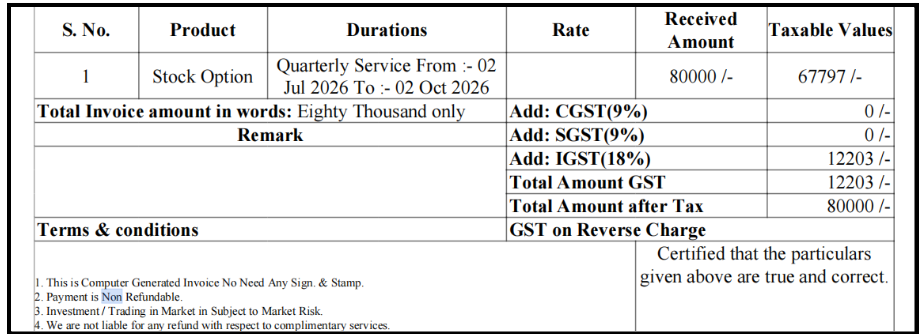
Each invoice lists terms that include “Payment is Non Refundable” and a note that subscription charges, once paid, aren’t refundable.
Disputes are placed under the jurisdiction of courts in Udaipur.
That non-refundable line doesn’t override SEBI’s own rules on research analyst fees.
If you’re already in a disagreement over fees or service, our page on the complaint against Pheonix Capital Research explains the refund rules and the exact route to SEBI.
According to the firm’s own email, service during an extension period is delivered through WhatsApp, with trade updates carrying a target and stop loss, and clients asked to trade only the number of lots given.
How Does the Pheonix Capital Research Price Compare With the SEBI Fee Limit?
The ₹80,000 invoice raises a fair question for any buyer. How many quarters can you pay before you cross SEBI’s ceiling? The sums are short, and you can run them on your own invoice.
The ceiling SEBI sets is ₹1,51,000 per client family per year.
As we read the Master Circular, it applies to the fee itself, so GST sits on top.
If the ₹80,000 includes GST at the standard 18 percent, the fee before tax is about ₹67,800 a quarter.
Two quarters come to about ₹1,35,600, which fits under the ceiling. A third quarter takes the total to about ₹2,03,400, which does not.
That is arithmetic on one invoice, not a finding about this firm.
Other packages may be priced differently, and the ceiling counts everything one family pays in a year.
Check the tax line on your own invoice first, because the GST rate and what it includes change the result.
Price is one half of the question. The other half is what the package actually delivers.
What Does a Stock Option Call Package Include?
A price tells you what you pay, not what you get.
Put these questions to the firm in writing before you pay, because a vague package is hard to enforce later.
Each one should have a clear answer, and the answers should match your invoice.
- How many calls you get each day or week, and in which instruments.
- Whether each call comes with a written research report, since SEBI’s Master Circular expects the service to be backed by reports.
- Who sends the calls, the named registered analyst or a representative, and in what role.
- What happens when a call is missed, and whether the quarter extends.
- Whether you get exit or review updates, or only entry calls.
- The start and end dates of the quarter on your invoice.
Get the answers in writing. A reply on WhatsApp counts, so save it with the date.
Once the terms are clear, you can judge the product itself, starting with how often the people who buy such calls win.
How Many Option Traders Lose Money, According to SEBI?
Before you pay for calls, you should know the baseline you are trying to beat. SEBI’s own studies of individual traders give it, and the numbers are blunt.
SEBI’s study for FY25 found that over 91 percent of individual F&O traders lost money, with net losses of ₹1,05,603 crore, as Business Standard reported.
Its FY26 study, published on 21 August 2026, found that 87.7 percent lost money, with aggregate losses of ₹91,685 crore, as Business Today reported.
The average loss per trader in FY26 was about ₹1.17 lakh. Options accounted for 92 percent of the total loss.
Those figures cover all individual F&O traders. They say nothing about Pheonix Capital Research or its clients.
What they do show is that a call package starts from a losing baseline.
A subscription fee adds a certain cost to an outcome most traders do not win.
So judge a package by its written terms and its record, not by the pitch that sold it.
A Client Complaint Against Pheonix Capital Research
One client has formally complained about his experience with the firm. We’ve kept the full details on separate pages so each one stays focused.
In short, he paid ₹1,35,000 in fees in mid 2026 and recorded a ₹5.3 lakh options loss in his P&L for the same period.
The firm’s written reply offered a one-month extension and said no loss recovery is guaranteed. The dispute’s outcome isn’t known yet.
If you want to see what happened on the calls and chats, the Pheonix Capital Research reviews page lays out his experience along with the firm’s side.
Does Pheonix Capital Research Publish Its Monthly Complaint Data?
Every research analyst has to publish its complaint record on its own website. A profile page on a firm should say what that record shows, so here is what we could and could not confirm.
Under SEBI’s Investor Charter, an analyst must disclose all complaints it receives every month, by the 7th of the following month. That includes anything filed as a SCORES SEBI complaint.
The monthly disclosure should show pending complaints, resolved complaints, and the average time taken to resolve them.
We tried the firm’s website on 7 October 2026, using the domain in its email addresses.
The page loaded only its header code, so we could not read a complaint table.
That means we cannot say whether the data is present, missing, or out of date. It does not mean the data is absent.
Open the site yourself and look for the monthly table. Check that the latest month shown is the previous month, not an old one.
If you cannot find the table, ask the firm for it in writing and keep the reply.
What Rights Does a Pheonix Capital Research Client Have?
SEBI publishes an Investor Charter for research analysts, and it applies to this firm like any other. It lists what you can expect and what the analyst must do.
Read it as a checklist for any invoice and any call. These are the points that matter most to a paying client.
- Unbiased recommendations, with any financial interest disclosed.
- Research reports that come from the analyst’s own research.
- Reports and recommendations sent to all clients without discrimination.
- An annual audit of the analyst’s activities.
- A grievance raised with the analyst first, with 30 days to resolve it.
If those 30 days pass without an answer, the grievance moves to SEBI’s own portal.
Where that portal does not settle it, the SMART ODR portal is the next stage, with conciliation first and arbitration if needed.
Knowing these rights before you pay changes how you read a pitch. It also tells you what to ask for if the service falls short.
Before You Subscribe to Pheonix Capital Research
If you haven’t paid yet, you’re in the strongest position you’ll ever be in. Run these checks first.
- Verify the registration on SEBI’s website and note the exact name and number.
- Ask for the full terms in writing before paying, especially the refund and fee sections.
- Ask the representative their role and whether they hold NISM certification.
- Record calls and keep chats, because spoken promises are hard to prove later.
- Slow down on any loss recovery pitch. It’s the moment people pay the most and think the least.
- Decide your own lot size. Never let anyone push you into quantity your capital can’t carry.
Thinking of paying Pheonix Capital Research, or already paid and unsure what you signed up for?
Send us the invoice and terms you received. We’ll tell you what to check before you go any further. Register with us for a free consultation.
Disclaimer: This page is based on the firm’s invoices and emails, SEBI’s public records, and one client’s documents shared with us with his identity removed. It makes no finding against Pheonix Capital Research or Raksha Sharma, and any dispute mentioned had not been decided at the time of writing.
Conclusion
Pheonix Capital Research is a proprietorship run by Raksha Sharma and registered with SEBI as a research analyst, selling quarterly option call packages from Udaipur.
That registration gives you rights, from written terms before payment to a formal complaint route, but it doesn’t guarantee results.
Check the registration, read the terms, keep your calls and chats, and decide your own trade size before you commit any money.
Report. Recover. Stay Fraud Free.
Frequently Asked Questions
SEBI's records list Raksha Sharma as the proprietor of Pheonix Capital Research, registered as a research analyst with number INH000022446. As a proprietorship, she is the registered intermediary.
Yes, as a research analyst with registration number INH000022446. That registration covers research and recommendations; personalised investment advice needs a separate investment adviser registration.
The firm's invoices and registration use "Pheonix," while some of its emails use "Phoenix." In the documents we reviewed, both refer to the same Udaipur based research analyst firm.
One invoice we reviewed shows ₹80,000 for a quarterly stock option package, inclusive of GST, with terms stating payment is non refundable. Ask for the full terms in writing before paying.
Its invoices give an address on Savina Main Road, Udaipur, Rajasthan 313002. Confirm the registered address on SEBI's website before you deal with the firm.





 Add us as a preferred source on Google »