If you searched for a profit-sharing stock advisory company, chances are you saw an offer that sounded almost “too fair” to refuse: pay only when you profit. We win only if you win.
It feels like a friendly deal, especially when you’re tired of paying fixed fees and getting average calls.
But here’s what many people learn the hard way: profit-sharing in stock tips can quietly turn into a trap where the advisor controls the story, the screenshots, the “profits,” and sometimes even the pressure tactics.
This blog breaks down what the model is, how it’s misused, and what SEBI has said, provides real examples, and offers guidance on what to do if you’re already stuck.
What is a Profit Sharing in Stock Market?
A profit-sharing model typically means the advisor requests a percentage of your profits, rather than charging a fixed fee.
Many pitch it as “performance fees” or “pay after profit,” and they may also ask for an “activation charge” first, then a profit split later.
On paper, it sounds like alignment.
In real life, it can become messy because profits are easy to claim and hard to verify, and losses are often blamed on “market conditions” or “you didn’t follow properly.”
And above all, is it legal? Can an Investment Advisor Share in Profits?
How The Profit Sharing Trap Works?
A lot of traps in profit-sharing models follow a familiar pattern. And the scariest part is how relatable it feels when it’s happening. The trap starts as follows:
- They start small to build trust. They usually provide you 1–2 winning trades, quick confidence, and then the “bigger plan” pitch.
- They push you into urgent situations. They often pitch as “BankNifty moving fast,” “only for serious clients,” “today is recovery day,” and “don’t miss.”
- They keep the calculation fuzzy. The profit is counted in a way that benefits them, but losses are somehow not counted the same way.
- They create user dependency. You stop using your own judgment because their “team” sounds certain, technical, and fast.
- They often use recovery traps. After a loss, they promise to recover it by telling you that “if you pay again, increase capital, or join a higher package, you will receive the profit.”
And if you ever question them, the conversation often shifts from service to guilt. Then they might sound like “We gave you profit, now pay,” or “You broke discipline, so loss is on you,” or “If you don’t pay, we’ll stop support.”
That emotional pressure is not financial expertise; it’s a sales tactic.
SEBI’s Verdict On Profit-Sharing Stock Advisory Company
SEBI has clearly indicated that linking advisory fees to profit/loss (profit-sharing/variable fees) is not part of the investment adviser fee framework.
SEBI has also highlighted that investment advisory is not the same as portfolio management, and a performance-based fee model is “not desirable” for advisory services.
Real Case of Profit-Sharing Scam
A real-world example that often shocks readers is SEBI’s final order involving an entity called “The Profit Sharing” (a proprietorship of Shri Piyush Shambharkar).
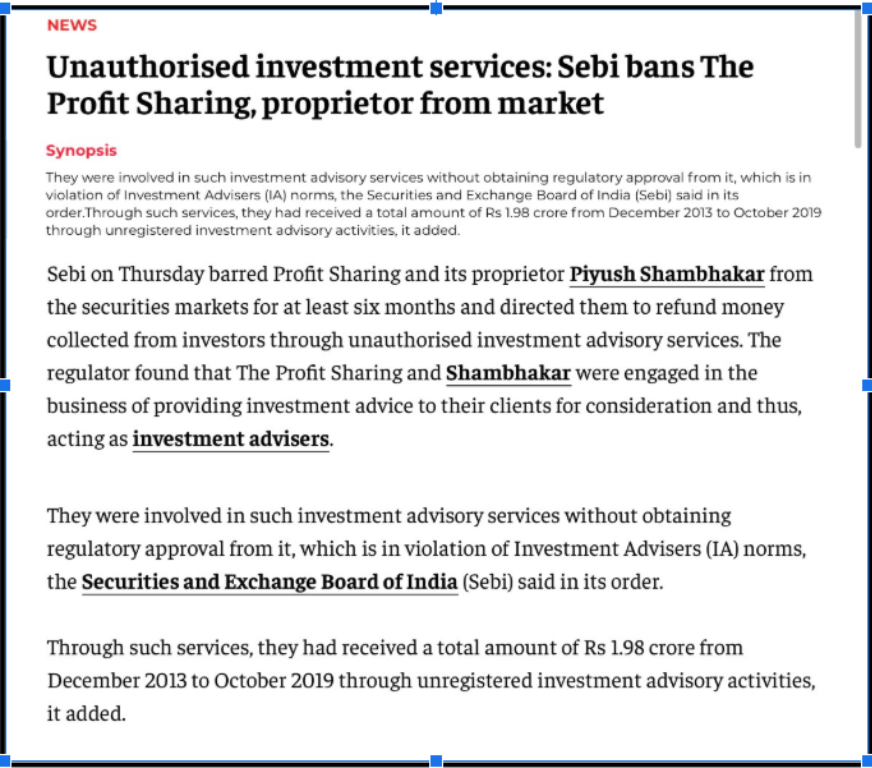
SEBI found unregistered investment advisory activity and noted the existence of “sharing” packages shown on the website, e.g., a stated sharing ratio between customer and company.
In that matter, the order records a complaint describing profit-sharing promises, subsequent pressure to trade bigger without stop loss, and a claimed loss.
SEBI ultimately issued directions, including a refund to investors and a market debarment period linked to refunds.
This doesn’t mean every service using the words “profit sharing” is automatically the same, but it does show why you must treat these models as high-risk until proven compliant and transparent.
How To File Stock Market Fraud Complaint?
If you feel trapped by a profit-sharing stock advisory company, don’t wait for “one more trade” to fix it. Report it step-by-step, like a clean case file.
1. Stop payment, stop access
Pause further payments immediately, and do not share the following:
- OTPs
- remote-access app permissions
- UPI PINs
- screen-sharing during trading.
If they are “handling your trades,” take control back because the longer it continues, the harder it becomes to separate advice from execution and responsibility.
2. Collect Proof
Save every proof for the profit money advisor, such as:
- WhatsApp and Telegram messages
- call recordings (if available)
- payment proofs
- bank statements
- UPI screenshots
- invoices
- any “profit calculation” they sent
Also, write a simple timeline: date, what they promised, what you paid, and what happened after.
3. Demand a written resolution first.
Send a clear message/email:
“I want a refund/closure. Here are the payment details. Here is the problem.”
Keep it short and factual. If they threaten you, save that too because threats become evidence.
4. Lodge a complaint with SEBI SCORES
SCORES is SEBI’s online platform to lodge complaints related to the securities market.
Upload your proof, write the timeline, and clearly mention the exact issue: unregistered advisory, misleading profit-sharing promise, pressure trading, non-refund, or harassment.
5. File a complaint in Smart ODR
For disputes that go beyond normal complaint handling, SEBI’s Smart ODR framework is meant to help resolve eligible disputes through an online dispute resolution process instead of going to court.
Use it when the complaint is stuck, and you need a structured dispute route with documentation.
6. Use SEBI’s investor grievance guidance mindset
SEBI’s investor grievance information emphasizes that entities are expected to respond with an Action Taken Report within a defined timeline, and escalation routes exist when complaints are not resolved.
So don’t just “informally follow up” but track complaint numbers, keep closure emails, and escalate with proofs.
Need Help?
If you need help, you can reach out to us. We have a team that specialises in money lost to such profit sharing fraud.
We will guide you throughout the journey on how to complaint in SEBI and support you in the arbitration in the stock market and the counselling process.
We make sure that your journey is smooth and satisfactory.
Conclusion
A profit-sharing model sounds like a “win-win,” but in the wrong hands, it becomes a “pay-pay” model as you pay to join, pay to upgrade, pay to recover, and still feel unsure what’s real.
SEBI’s stance on profit-linked fees for investment advisers and SEBI’s actions in unregistered advisory cases are strong reminders to treat profit-sharing stock tip offers with extra caution.
If you’re already caught in it, the best move is not arguing on calls; it’s documenting, reporting, and escalating in the right order.
Once you shift from emotion to evidence, the power balance changes, and you give yourself the best chance of getting a proper response, a refund, and a clean closure.