

Quick Summary
A profit-sharing pitch, “we win only if you win”, sounds like the advisor’s interests are aligned with yours. SEBI disagrees. Investment advisers are required to charge a capped fee, not a cut of your gains, and a real SEBI order against an entity called “The Profit Sharing” shows exactly why: unregistered advisory activity, a stated sharing ratio, pressure to trade bigger without a stop loss, and an eventual refund and market debarment. If someone pitched you this model, whether they called it a subscription, a performance fee, or an activation charge, treat it as high-risk until proven otherwise.
If you searched for a profit-sharing stock advisory company, chances are you saw an offer that sounded almost too fair to refuse: pay only when you profit; we win only if you win. It feels like a friendly deal, especially after you’ve paid fixed fees for average calls before.
Here’s what many people learn the hard way: profit-sharing in stock tips can quietly turn into a trap where the advisor controls the story, the screenshots, the “profits,” and sometimes even the pressure tactics that follow a loss.
Is Profit Sharing Legal for an Investment Advisor in India?
No. SEBI’s Investment Adviser framework is not built for profit-sharing deals.
Under the IA rules, advisers are supposed to charge advisory fees, not a cut of profits and losses. SEBI has also clarified that RIAs cannot ask for profit-sharing fees, full stop.
If someone tells you “profit sharing is normal,” the direct question to ask is: show me where SEBI allows it.
Under Regulation 15(2)(b) of the SEBI (Investment Advisers) Regulations, 2013, an Investment Adviser is explicitly barred from using a profit-sharing or performance-linked fee model.
There is exactly one structure where a performance fee is permitted: a SEBI-registered Portfolio Manager operating under strict conditions: a high-water mark mechanism, mandatory disclosures, and a minimum investment threshold of ₹50 lakh per client.
An advisor offering profit sharing without holding that specific Portfolio Manager registration, with that minimum ticket size, is not offering a legal variant of the same idea; they’re offering something outside the law entirely.
Profit-sharing creates a dangerous incentive regardless of how it’s framed. The advisor gets rewarded for risk-taking; the client takes the real downside.
SEBI’s framework is built around the concept of “suitability”, advice matched to your actual risk profile and goals. Profit-sharing pushes the opposite behaviour: more churn, more leverage, more “recover fast” trades, because the advisor’s income depends on activity and outcome, not on giving you sound advice.
A typical pitch removes the fee objection entirely: “No fees, we’ll just take 20% of your profit.”
It sounds fair precisely because it removes the upfront cost, but it converts the advisor into someone with a direct financial stake in how aggressively your account trades.
How to Spot a Disguised Profit-Sharing Arrangement?
Not every advisor uses the phrase “profit sharing” outright; many disguise it specifically to avoid scrutiny.
“We only charge if you profit” is profit sharing by definition, whatever it’s called.
“50/50 split on gains” is a direct violation of both IA and RA regulations.
Demands for cash payments or transfers to a third-party account are a common way to collect profit-linked fees off the books, outside any traceable record.
“Average your position,” repeated after a loss, is typically motivated by extending the trade to eventually generate a profitable outcome the advisor can claim a cut from.
No stop-loss on recommendations keeps trades open longer, which increases potential profit for whoever is taking a share of it.
And requests for your broker login or demat credentials facilitate the account handling that lets an advisor execute trades and claim profit shares directly, itself a separate violation on top of the fee structure.
Each of these is independently reportable. Together, they form the standard pattern of an illegal profit-sharing operation, and recognising even one early is often what prevents the rest from happening.
How the Profit-Sharing Trap Actually Works
The trap follows a familiar shape, and the scariest part is how relatable it feels while it’s happening.
- They start small to build trust: One or two winning trades, quick confidence, then the “bigger plan” pitch.
- They push urgency: “Bank Nifty is moving fast,” “only for serious clients,” “today is recovery day.”
- They keep the calculation fuzzy: Profit is counted generously, losses are somehow not counted the same way.
- They create dependency: You stop using your own judgment because their “team” sounds certain and technical.
- They use a recovery trap after a loss: Pay again, add capital, join a higher package, and the profit will finally arrive.
If you ever question them, the conversation shifts from service to guilt: “We gave you profit, now pay,” or “You broke discipline, so the loss is on you.”
That emotional pressure is not financial expertise, it’s a sales tactic.
The Real SEBI Case: “The Profit Sharing”
A real-world example that shows exactly how this plays out is SEBI’s final order involving an entity called “The Profit Sharing,” a proprietorship of Piyush Shambharkar.
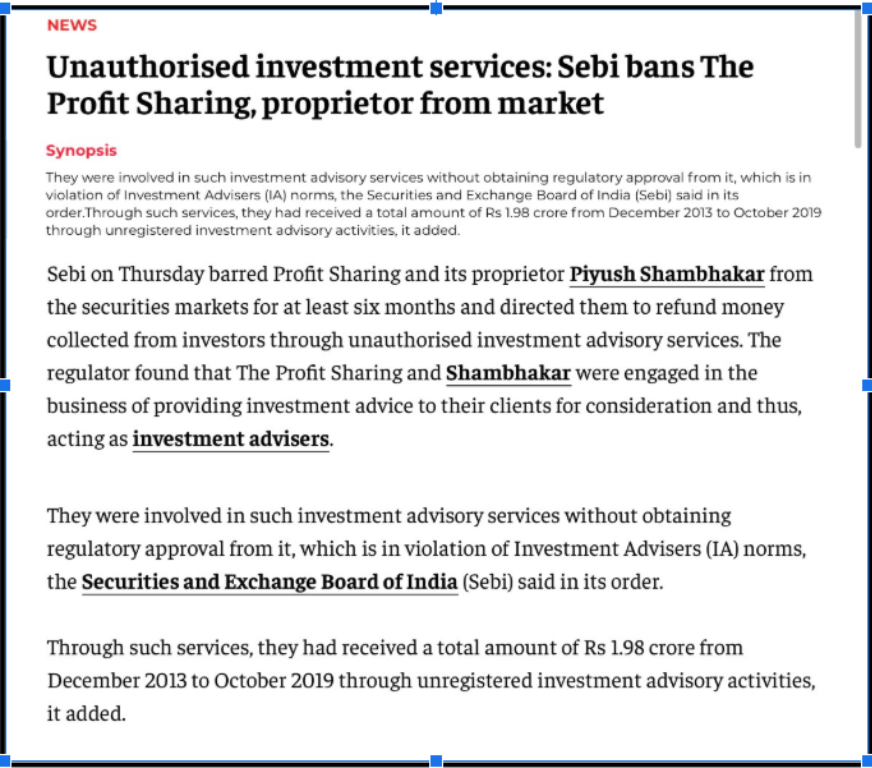
SEBI found unregistered investment advisory activity, and noted the existence of “sharing” packages displayed on the website, including a stated sharing ratio between customer and company.
The order records a complaint describing profit-sharing promises, followed by pressure to trade bigger without a stop loss, and a claimed loss.
SEBI ultimately issued directions including a refund to investors and a market debarment period linked to completing those refunds.
This doesn’t mean every service using the words “profit sharing” is automatically identical to this one, but it shows exactly why these models deserve to be treated as high-risk until proven transparent and compliant, regardless of how the pitch is dressed up, whether as a performance fee, an activation charge followed by a profit split, or a straightforward percentage cut.
A separate arbitration case against Aurostar Investment Advisory, involving reckless options positions taken without stop-loss protection and repeated pressure to “average” mounting losses, resulted in a tribunal awarding ₹14,10,000 in trading-loss compensation plus a ₹1,47,000 fee refund, both with 15% annual interest.
That case is covered in full detail, including every violation the arbitrator found, in our guide on profit sharing trading scam.
How to Report a Profit-Sharing Advisory?
Stop payment, stop access, immediately. Pause further payments and never share OTPs, remote-access app permissions, UPI PINs, or screen-sharing during trading. If they’re “handling your trades,” take control back; the longer it continues, the harder it becomes to separate advice from execution and responsibility.
Collect proof. Save WhatsApp and Telegram messages, call recordings if available, payment proofs, bank statements, UPI screenshots, invoices, and any “profit calculation” they sent you. Write a simple timeline: date, what they promised, what you paid, what happened after.
Demand a written resolution first. Send a clear, factual message or email requesting a refund and stating the payment details and the problem. If they threaten you, save that too; threats become evidence.
Lodge a complaint with SEBI SCORES, uploading your proof and timeline, and clearly stating the exact issue: unregistered advisory, misleading profit-sharing promise, pressure trading, or non-refund.
If the complaint stays unresolved, SMART ODR is the structured next step for disputes that need more than informal follow-up.
If your situation involves overcharged fees more than a profit-sharing arrangement specifically, the fee-cap violations covered in our guide on advisor charged more than SEBI limit may be the more precise complaint to file.
Trapped in a profit-sharing arrangement, or pressured to keep paying to “unlock” the promised returns?
We document the payment trail, the promises made, and the pressure tactics used, then build the complaint around the exact SEBI violation involved.
Register with us for a free consultation.
Conclusion
A profit-sharing model sounds like a “win-win,” but in the wrong hands, it becomes a “pay-pay” model as you pay to join, pay to upgrade, pay to recover, and still feel unsure what’s real.
SEBI’s stance on profit-linked fees for investment advisers and SEBI’s actions in unregistered advisory cases are strong reminders to treat profit-sharing stock tip offers with extra caution, and working out what share of your claim is fees versus trading loss, covered in stock advisory refund, shapes what you can realistically expect back.
If you’re already caught in it, the best move is not arguing on calls; it’s documenting, reporting, and escalating in the right order.
Report. Recover. Stay Fraud Free.
Frequently Asked Questions
No. SEBI's Investment Adviser Regulations require a capped fee, not a percentage of profits or losses. A profit-sharing arrangement, however it's framed, sits outside what a registered adviser is permitted to charge.
No. A single profitable demo trade, or even a short winning streak, is often the first step in building trust before the pitch for a bigger package or profit-sharing arrangement follows. It's evidence of a sales sequence, not of a compliant service.
No. Shifting blame onto the client after a loss is a common pressure tactic, not a legal defence. Whether the advisor was registered, whether profit-sharing was pitched, and whether a stop loss was refused are the facts that actually decide a complaint.





 Add us as a preferred source on Google »

