

Quick Summary
A ₹60,000 claim involved a firm registered as a Research Analyst that cited SEBI’s own annual fee ceiling as the reason to redirect payments away from its registered entity. Funds were sent instead to a personal UPI account and an unrelated sister company, with no invoice or documentation issued for any of it. After a formal legal notice failed to resolve the matter, we escalated through SEBI SCORES. A total settlement of ₹60,000 was agreed, with ₹30,000 already received and the second installment still pending.
Paritosh Mehra (name changed) is from Ujjain, Madhya Pradesh.
He asked a simple question: why he was being asked to pay into a personal account instead of the firm’s own.
The answer he got back was that SEBI’s rules required it.
That wasn’t true. And once we started pulling the thread, that single false explanation is exactly what unraveled everything else.
A Regulation Twisted to Justify the Wrong Thing
Paritosh was contacted by a representative of a firm registered with SEBI as a Research Analyst, offering F&O trading advisory services under the firm’s own registration number.
.When he moved to make his first payment, the representative told him plainly that SEBI’s rules meant the firm could not take payment above a certain point, and directed him instead to pay a separate company, described only as a sister concern.
SEBI’s fee ceiling exists to cap how much a single registered entity can charge a client per year.
It does not authorise, in any form, splitting that fee across multiple entities to get around the limit.
Invoking the regulator’s own rule to justify exactly the kind of structure that rule exists to prevent is a striking piece of misdirection.
Where the Payment Trail Actually Went?
Paritosh’s ₹60,000 in payments went to several different destinations.
One payment reached the firm’s own official UPI handle. Another, following a QR code sent directly over WhatsApp, went to the personal account of an individual with no stated connection to any advisory company.
Two further payments went to additional personal accounts, arranged through separate WhatsApp numbers used by the same representative.
When Paritosh questioned why a payment was going to a personal account, he was told it was fine, that the account belonged to the firm’s proprietor.
A fee for licensed advisory services paid into someone’s personal account is not a fee paid to a registered entity, regardless of whose name is attached to that account.
Anyone whose payments were redirected away from a firm’s own registered account can file a SEBI complaint against research analyst, since a documented payment trail leading to unrelated personal accounts is difficult for any firm to explain as routine practice.
A Cash Offer With Only One Real Purpose
At one point, while discussing a much larger advisory package, the representative offered to reduce the price and mentioned having a presence in a different city where payment could be collected in cash instead.
A SEBI regulated advisory firm operating within its own compliance framework has no reason to offer cash collection through a local presence in another city.
This kind of offer exists specifically to keep a transaction off any bank record.
Why They Wanted His Family’s KYC Documents?
When Paritosh initially hesitated to pay directly, he was asked whether his father’s or brother’s KYC documents could be used instead.
He declined.
A request like this, aimed at onboarding additional fee capacity under someone else’s identity, points toward a structure built around maximising collections rather than serving a single, properly documented client relationship.
Across the entire relationship, Paritosh received no invoice, no service agreement, no Most Important Terms and Conditions, and no risk disclosure document for any of the ₹60,000 he paid.
How We Followed the Money Back Through Every Diversion
With payments split across a company account, a personal account, and additional untracked transfers, this case needed a precise reconstruction of exactly where every rupee had actually gone.
Step One: We Mapped Each Payment to Its Exact Destination
Every transaction was matched to its specific UPI handle or account, distinguishing the one payment that reached the firm’s own registered handle from those diverted elsewhere.
Step Two: We Documented the SEBI Rule Misquote as Its Own Violation
The specific statement invoking SEBI’s fee ceiling to justify payment diversion was preserved directly from the WhatsApp record, treating this misrepresentation of regulatory language as a distinct issue in its own right.
Step Three: We Flagged the Personal Account Payment as Unauthorised Fee Collection
The payment directed to an individual’s personal account, rather than any registered entity, was documented as fee collection that never legitimately occurred under the firm’s own SEBI registration at all.
Step Four: We Recorded the Cash Collection Offer as Corroborating Evidence
The offer to collect payment in cash through a local presence in another city was preserved as independent evidence that the underlying financial structure was never designed for genuine regulatory compliance.
Step Five: We Sent a Legal Notice Demanding Full Traceability
Our notice demanded not just a refund, but a full accounting of why payments had been routed the way they were, treating documentation and restitution as connected demands.
Step Six: We Escalated Through SEBI SCORES to a Structured Settlement
When the notice did not produce a satisfactory response, we escalated formally through SEBI SCORES, using the mapped payment trail and the recorded statements as the core of the case.
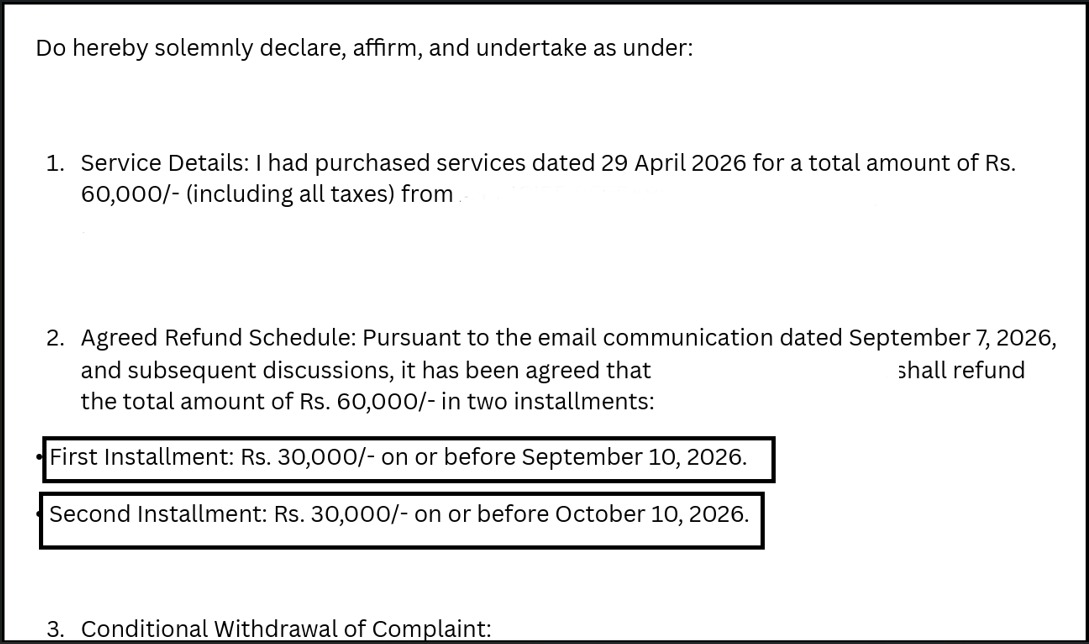
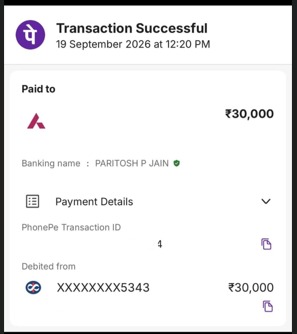
Through this process, a total settlement of ₹60,000 was agreed, with the first installment of ₹30,000 already received and a further ₹30,000 pending.
Asked to Pay Into a Personal Account Instead of a Firm’s Own? Our Team Can Help
Paritosh’s case worked because every single payment was mapped to exactly where it actually went, not just what he was told. If your payments have gone somewhere that doesn’t match the firm’s own name, gather every transaction ID today.
Register with us, and we will take it from there.
Conclusion
A firm that cites a regulation to justify exactly the conduct that regulation exists to prevent is telling on itself more clearly than almost any other single detail could.
Paritosh’s case shows why mapping every payment to its precise destination, rather than accepting a firm’s own explanation for where the money went, is often the fastest way to expose a structure built around evading accountability rather than delivering a service.
A cash collection offer or a request to use someone else’s identity for onboarding are not minor conveniences; they are signs of a financial design meant specifically to avoid the kind of traceable record that makes a complaint like this possible in the first place.
Report. Recover. Stay Fraud Free.
No. The annual fee ceiling applies to the total consideration paid for research services, regardless of how many entities or accounts are used to collect it. No. A fee for licensed advisory services should be paid to the registered entity itself, not to a personal account, even if you are told the account belongs to the firm's proprietor. It suggests a deliberate effort to avoid a traceable bank record, something a genuinely compliant, digitally documented advisory relationship has no reason to require. Decline, and treat the request itself as evidence. Onboarding fee capacity under someone else's identity points toward a structure focused on collections rather than compliance. Yes, once formally agreed. Tracking each installment against the agreed total ensures the case moves toward complete, documented closure.Frequently Asked Questions





 Add us as a preferred source on Google »

