
Quick Summary
A Power of Attorney lets your broker act on your demat account without a signature for every transaction.
SEBI introduced DDPI in 2022 as a safer, narrower alternative restricted to settlement and pledge purposes.
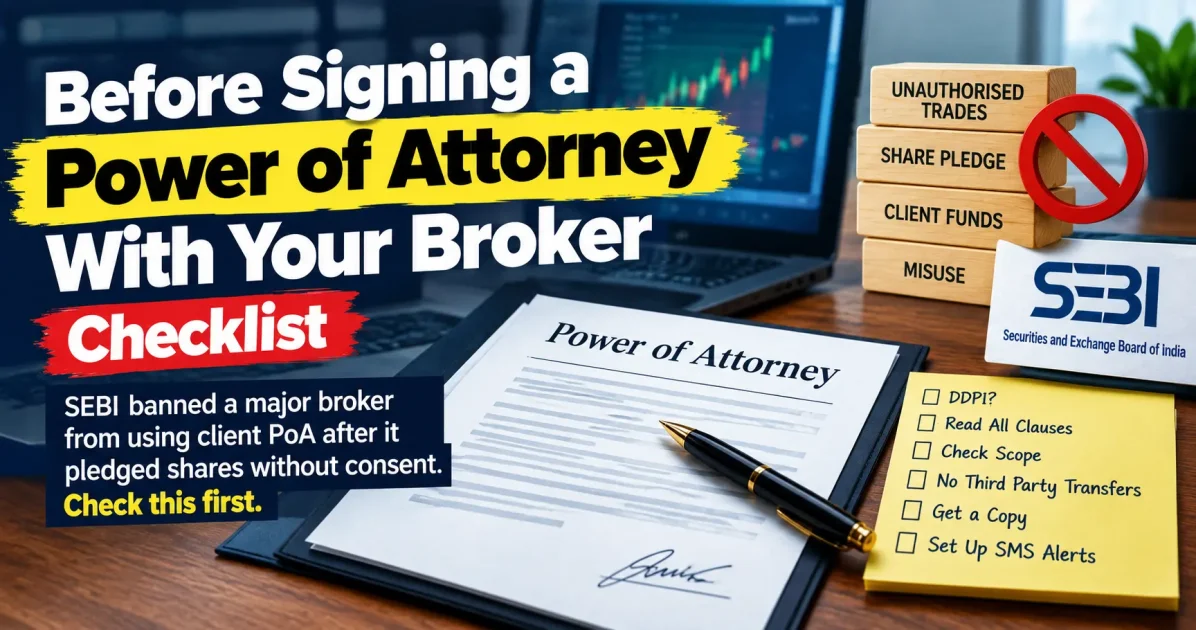
One major broker was barred by SEBI from using client PoA after pledging shares without consent.
This checklist covers exactly what to check before signing any PoA document.
A major brokerage pledged client shares with banks and NBFCs to raise money for itself.
SEBI’s response was to ban the broker from using client Power of Attorney to withdraw shares at all.
That PoA had been signed by thousands of ordinary investors who never expected this outcome.
Before you sign one yourself, run this checklist first.
PoA vs DDPI: What’s Actually Different
| Feature | General PoA | DDPI (SEBI, 2022) |
| Scope | Can be broad, sometimes vaguely worded | Restricted strictly to settlement and pledge |
| Optional status | Must be optional, often bundled by default | Purpose built as a narrower alternative |
| Misuse risk | Higher, due to broader authority granted | Lower, due to defined, limited scope |
| Third party transfers | Can potentially allow broader access | Not permitted under its defined scope |
The PoA Verification Checklist
Go through every point below before signing any Power of Attorney document.
- Ask about DDPI first: SEBI’s Demat Debit and Pledge Instruction is a narrower, safer alternative introduced since 2022.
- Read every clause: Understand exactly what authority you’re granting, not just where to sign.
- Confirm it’s standalone: SEBI requires PoA to be optional and provided as a separate document, not bundled silently into account opening forms.
- Check the scope limit: The PoA should cover only demat and trading related actions, nothing broader.
- No third party transfers: Your PoA should only permit transfers to the broker you have an account with, not any group entity.
- Get a copy: Brokers must provide you the original PoA document or a certified copy for your records.
- Set up SMS alerts: Confirm every transaction in your account triggers an SMS notification to you.
How to Actually Request DDPI Instead
1. Ask your broker directly: whether DDPI can fully replace the PoA they’re asking you to sign.
2. Compare the scopes: confirm DDPI covers your actual use case, mainly settlement and pledge transactions.
3. Sign only the narrower document: if DDPI meets your needs, there’s no reason to grant broader PoA authority.
4. Keep records of both: retain a copy of whichever document you sign, along with the date and broker acknowledgement.
What Misuse Actually Looks Like
Misuse includes unauthorised trades, unauthorised transfers, excessive fees, or pledging shares without your consent.
One documented arbitration case involved trades executed without permission and questionable PoA use, detailed in unauthorised trading in India, resulting in losses of Rs 1.45 crore.
Regularly checking your account statements is your fastest way to catch this early.
Bottom Line
A limited PoA, or DDPI where possible, protects you far better than a broadly worded general PoA.
For more broker safety checklists, you can report brokerage churning and explore other topics through Fraud Free.
If your broker misused your PoA, you can file a broker complaint over PoA misuse through the correct process.
Report. Recover. Stay Fraud Free.
Frequently Asked Questions
DDPI, or Demat Debit and Pledge Instruction, is a SEBI introduced alternative to PoA, restricted strictly to settlement and pledge purposes. It offers narrower, safer authority compared to a broadly worded general PoA.
No, this would be unauthorised misuse. SEBI has taken action against brokers found pledging client securities without consent, including barring PoA usage entirely in one major enforcement case.
No. SEBI requires PoA to be optional and provided as a standalone document, not bundled into account opening paperwork. You can request DDPI or manual delivery instruction slips instead.
Enable SMS and email alerts for every transaction, and review your account statements regularly. Report any trade, transfer, or pledge you didn't authorise to your broker and SEBI immediately.
Document the unauthorised transactions and raise a written complaint with your broker first. If unresolved, escalate through SEBI SCORES or exchange arbitration with your transaction evidence.
In most cases, yes. DDPI's narrower scope, limited to settlement and pledge purposes, reduces your exposure compared to a broadly worded PoA, unless your specific use case genuinely requires broader authority.



 Add us as a preferred source on Google »