
Quick Summary
Radheshyam Dandare operates Stockedge Research, a SEBI-registered Research Analyst carrying INH000019336, active since January 2025 and based in Indore, Madhya Pradesh. One plan, StockEdge Combo, is priced at ₹1,51,000 plus GST for a single quarter, the entire annual SEBI fee ceiling in three months before tax is even added. Four of the firm’s six other plan families also breach the ceiling on at least one billing cycle, while two stay compliant throughout. The firm’s own current-month complaint table shows a Grand Total row of all zeros directly beneath a row recording two complaints received and resolved through SEBI SCORES, an arithmetic error within a single table.
Radheshyam Dandare operates Stockedge Research, registered as INH000019336, active since 7 January 2025, and based in Indore, Madhya Pradesh.
The registration is genuine. The pricing page is where this firm’s most serious issue lies: one plan alone, StockEdge Combo, is priced at the full annual SEBI fee ceiling for a single quarter, before GST is even added.
This page works through the registration, the complete pricing grid against the ₹1,51,000 cap, an arithmetic error inside the firm’s own current complaint table, and a genuinely confused section of its Investor Charter.
Radheshyam Dandare Review
Stockedge Research describes itself as a financial market research provider built around a customer-centric approach, with its research grounded in market analysis and data and a stated focus on technical analysis and systematic trading strategies.
The firm offers seven branded products spanning cash, futures, options, and index segments: StockEdge Cash, StockEdge Future, StockEdge Option, StockEdge Index, StockEdge Option Plus, StockEdge Option BTST, and StockEdge Combo, the last combining several services.
All recommendations are delivered through SMS only, a narrower and more verifiable delivery channel than the WhatsApp or Telegram groups several other firms in this sector rely on.
One point is worth crediting directly. The firm’s own site states plainly that it does not open demat accounts, does not accept cash payments, and warns clients never to share demat login credentials with anyone, describing that specific risk as a path to serious financial loss.
That is a clear, correctly scoped disclosure, and it is worth naming as a point in the firm’s favour before getting into what needs closer attention.
None of what follows establishes wrongdoing, and nothing further on this page does either.
Where a registered analyst’s conduct does cross a line, the formal escalation route is covered in full further down this page.
Is Radheshyam Dandare SEBI Registered?
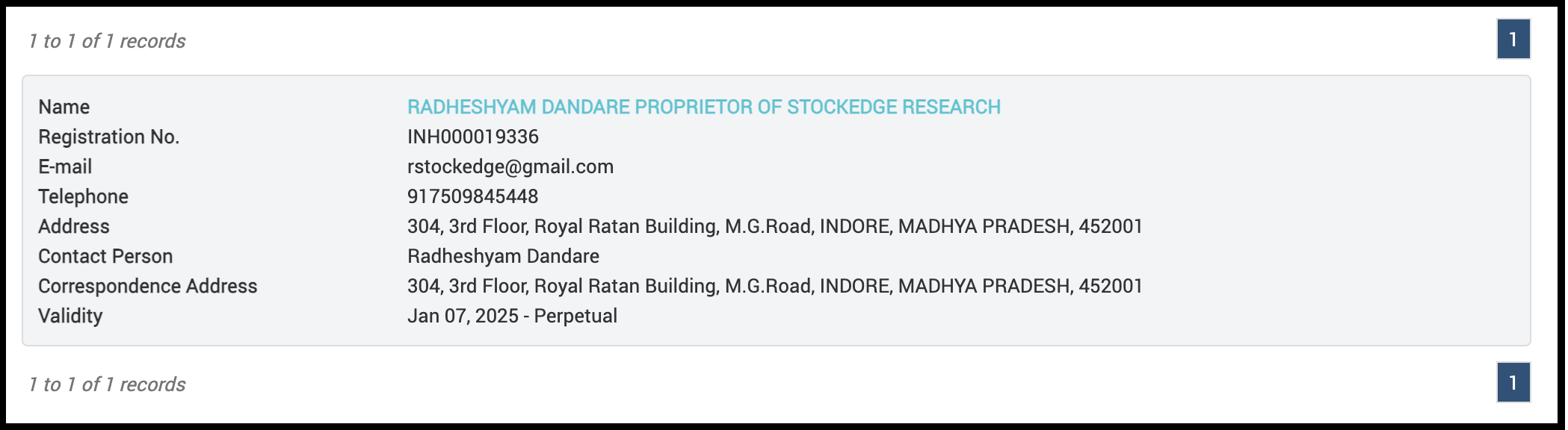
Yes, and INH000019336 is confirmed independently on SEBI’s own published Research Analyst list.
| Detail | Information |
| Name | Radheshyam Dandare, Proprietor of Stockedge Research |
| SEBI Registration Number | INH000019336 |
| Validity | 7 January 2025, Perpetual |
| Registered Address | 304, 3rd Floor, Royal Ratan Building, M.G. Road, Indore, Madhya Pradesh 452001 |
| Correspondence Address | Same as registered address |
| Contact Person | Radheshyam Dandare |
What the INH Prefix Permits
The INH prefix marks a Research Analyst. It permits publishing research and issuing recommendations to a subscriber base.
It does not permit personalised advice built around an individual client’s income, goals or holdings, trade execution, or portfolio management.
Also Read: Stocksence Research Private Limited, a real registration, and seven real accounts worth reading first.
Stockedge Research Pricing And The Risk Of SEBI Fee Cap Breach
This is the clearest and most serious finding on this page, and one plan in particular deserves to be shown before anything else.
A Research Analyst may charge a maximum of ₹1,51,000 per annum per family, excluding statutory charges, for individual and HUF clients who are not accredited investors.
Every price on this firm’s site is quoted with GST added separately, so the base figures below are what should be checked against the ceiling.
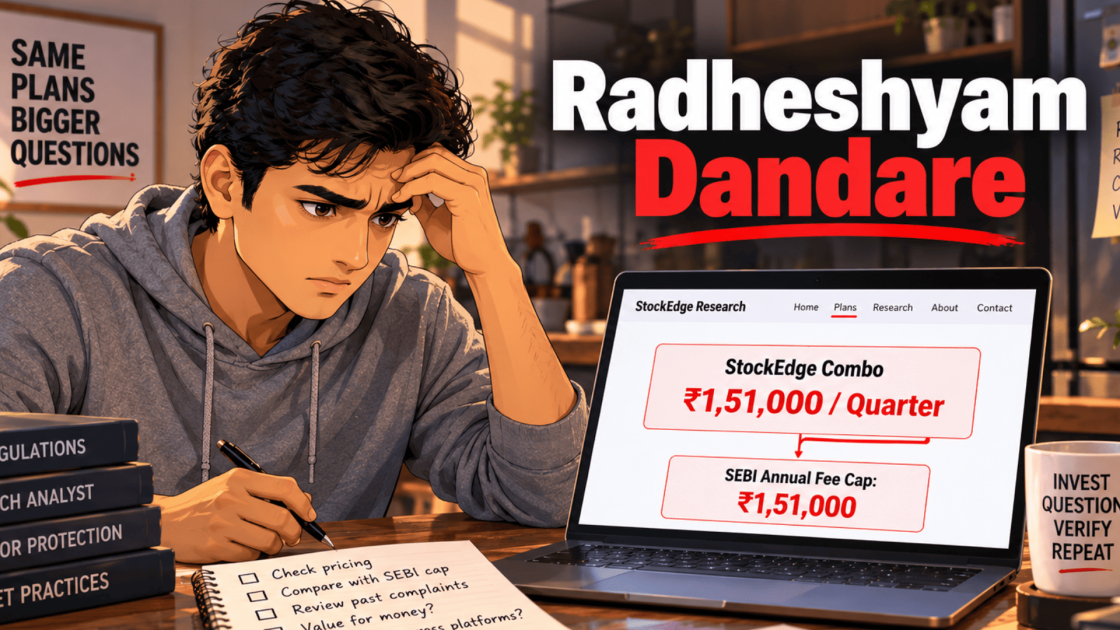
StockEdge Combo: One Quarter, The Entire Annual Limit
StockEdge Combo is priced at ₹1,51,000, plus GST, for a single quarter. That figure is not close to the annual ceiling.
It is the ceiling, quoted as a three-month price, before any tax is added on top.
Renewed every quarter for a full year, the base cost alone comes to ₹6,04,000, exactly four times the annual limit for an individual or HUF client.
There is no reading of this plan, taken for more than one quarter, that stays within what SEBI permits.
The site does not state whether Combo is intended as a single, one-time three-month service rather than an ongoing subscription.
If you are considering this plan, get written confirmation of whether it is a one-time purchase or a recurring subscription, since the answer changes whether the price is a serious compliance problem or a one-off transaction that happens to land exactly on the cap.
Full Pricing Grid, Annualised
| Plan | Cycle | Base Price | Annualised | Against the Cap |
|---|---|---|---|---|
| StockEdge Cash | 1 Month | ₹10,000 | ₹1,20,000 | Under by ₹31,000 |
| StockEdge Cash | 3 Months | ₹25,000 | ₹1,00,000 | Under by ₹51,000 |
| StockEdge Future | Monthly | ₹25,000 | ₹3,00,000 | Over by ₹1,49,000 |
| StockEdge Future | Quarterly | ₹60,000 | ₹2,40,000 | Over by ₹89,000 |
| StockEdge Option | Monthly | ₹12,000 | ₹1,44,000 | Under by ₹7,000 |
| StockEdge Option | Quarterly | ₹30,000 | ₹1,20,000 | Under by ₹31,000 |
| StockEdge Index | 15 Days | ₹7,000 | ₹1,68,000 | Over by ₹17,000 |
| StockEdge Index | 1 Month | ₹11,000 | ₹1,32,000 | Under by ₹19,000 |
| StockEdge Index | 3 Months | ₹21,000 | ₹84,000 | Under by ₹67,000 |
| StockEdge Option Plus | Monthly | ₹25,000 | ₹3,00,000 | Over by ₹1,49,000 |
| StockEdge Option Plus | Quarterly | ₹70,000 | ₹2,80,000 | Over by ₹1,29,000 |
| StockEdge Option BTST | Monthly | ₹25,000 | ₹3,00,000 | Over by ₹1,49,000 |
| StockEdge Option BTST | Quarterly | ₹60,000 | ₹2,40,000 | Over by ₹89,000 |
| StockEdge Combo | Quarterly | ₹1,51,000 | ₹6,04,000 | Over by ₹4,53,000 |
A Graduated Picture, Not a Uniform One
Two plan families, StockEdge Cash and StockEdge Option, stay compliant across every cycle they offer, and that is worth crediting plainly rather than being treated with suspicion it has not earned.
Four other plan families breach the ceiling on at least one cycle: StockEdge Future, StockEdge Option Plus, and StockEdge Option BTST breach on both their monthly and quarterly cycles, while StockEdge Index breaches only on its shortest 15-day cycle if renewed continuously, staying compliant on its monthly and quarterly options.
StockEdge Combo is the outlier among outliers. Every other breach on this page depends on renewing a plan repeatedly across a year.
Combo’s single quarterly price alone equals the full annual limit, with no renewal assumption required to make the point.
One protection applies regardless of which plan is chosen.
On early termination, a client is entitled to a proportionate refund for the unexpired period, and a Research Analyst may not retain a breakage fee.
Also Read: Ritesh Gupta, weekly and monthly billing cycles that cross the ₹1,51,000 annual SEBI fee ceiling.
Does Stockedge Research’s Own Complaint Table Add Up?
This is a different kind of problem from the annual-versus-monthly mismatches that show up on other firms’ disclosures.
Here, a single table’s own total row does not match the row directly above it.
Current Complaint Status
| Received From | Pending Last Month | Received | Resolved | Total Pending | Pending Over 3 Months | Avg. Resolution Time |
|---|---|---|---|---|---|---|
| Directly from Investors | 0 | 0 | 0 | 0 | 0 | 0 |
| SEBI (SCORES) | 0 | 2 | 2 | 0 | 0 | 0 |
| Other Sources | 0 | 0 | 0 | 0 | 0 | 0 |
| Grand Total | 0 | 0 | 0 | 0 | 0 | 0 |
The SCORES row states 2 complaints received and 2 resolved.
The Grand Total row directly beneath it, which should sum the three rows above, states 0 received and 0 resolved.
The total is wrong within its own table, not disagreeing with a separate table describing a different period.
Monthly Disposal Trend
| Month | Carried Forward | Received | Resolved | Pending |
|---|---|---|---|---|
| March 2026 | 0 | 2 | 2 | 0 |
| June 2026 | 0 | 0 | 0 | 0 |
| July 2026 | 0 | 0 | 0 | 0 |
| Grand Total | 0 | 2 | 2 | 0 |
Annual Disposal Trend
| Financial Year | Received | Resolved | Pending |
|---|---|---|---|
| 2025-26 | 2 | 2 | 0 |
| Grand Total | 2 | 2 | 0 |
The monthly and annual tables agree with each other cleanly, both correctly showing 2 complaints received and resolved in March 2026, all falling inside FY2025-26.
The error sits specifically in the current-month summary table’s own Grand Total row, which is a straightforward addition mistake on a single page rather than a deeper inconsistency across the firm’s disclosure as a whole.
Two Further Gaps about Radheshyam Dandare Complaint Disclosure Worth Knowing
The registration became active in January 2025, but the complaint disclosure shown on the site only begins in March 2026, over a year later, with no explanation for the gap in between.
The most recent monthly data published covers July 2026.
As of this writing in September 2026, that leaves August unaccounted for, past SEBI’s requirement that complaint data be refreshed by the 7th of the following month.
On the substance, two complaints, both received through SCORES rather than directly, both resolved.
That the complaints reached SEBI’s own platform rather than being raised with the firm first is worth noting, though the data alone cannot say why investors chose that route.
Also Read: Rupesh Raj has a privacy policy allowing information to be shared with organisations the firm “has an interest” in.
Does Stockedge Research’s Investor Charter Actually Make Sense?
This is worth flagging as a document quality problem rather than a conduct issue, but it is a genuinely confusing one.
A section of the site’s Investor Charter is titled “Investors Have Responsibility To,” and lists obligations underneath it, including publishing research reports, providing independent views, conducting audits, client onboarding, and distributing disclosures to clients.
Every one of those items describes something the Research Analyst is responsible for, not the investor.
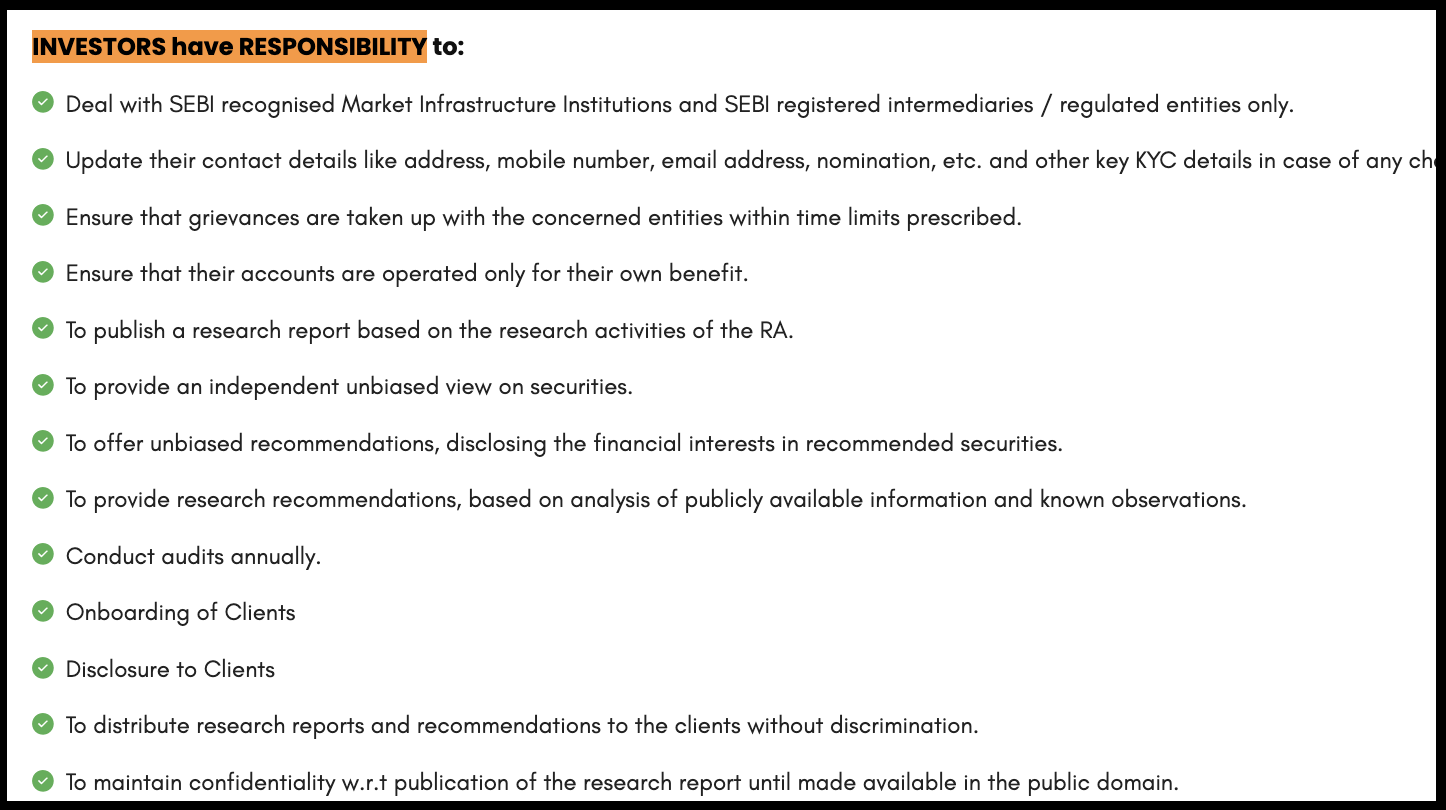
Publishing research reports and providing disclosures are things a firm does for its clients, not things a client does for the firm.
As published, the charter has the two roles reversed, which makes the document confusing rather than genuinely misleading about anyone’s actual obligations, since the substance of what the firm must do elsewhere on the site is not in dispute.
It is still worth reading the charter with that in mind, and asking the firm to correct the section if it has not been fixed by the time you check it yourself.
Also Read: Vineet Ashwinikumar Chawla, the full profile, name, registration, and every real inconsistency checked.
What Else on Radheshyam Dandare’s Website Is Worth Knowing?
Two smaller items are worth a mention before you engage with this firm.
The site refers to contacting investors “through one of our accomplices,” without identifying who these third parties are or what information might be shared with them.
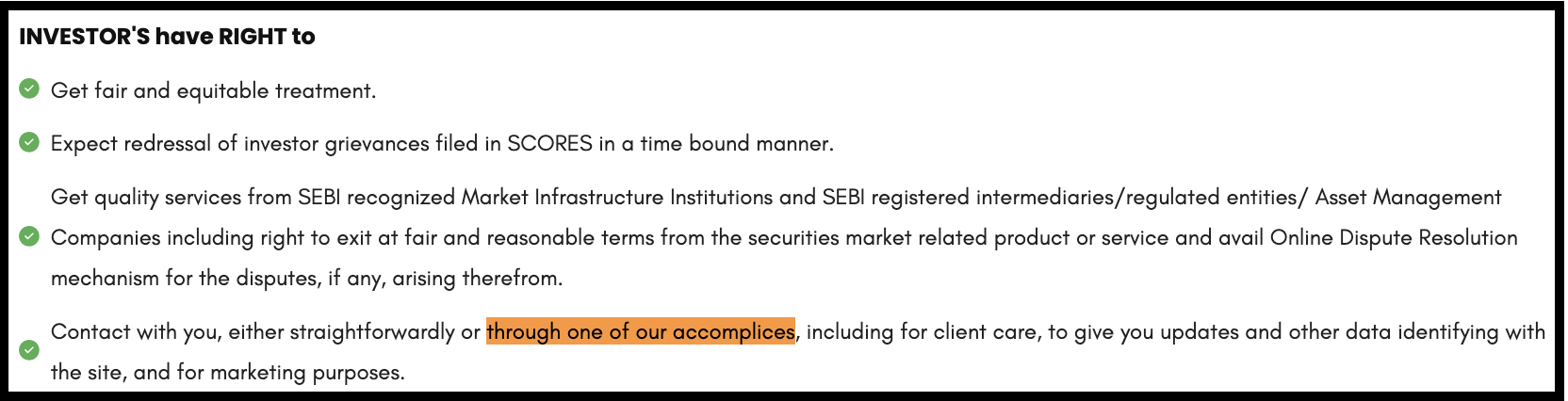
That is vague enough to be worth asking about directly if you are contacted by anyone claiming to represent the firm through a channel other than SMS from the registered number.
The payment section prominently displays the firm’s bank account and UPI details and encourages direct transfers, without setting out a clear invoicing or payment documentation process alongside it.
Keep your own transaction record and ask for a receipt or invoice for anything you pay, since the site does not describe how that documentation is handled on its end.
Also Read: Rohit Gholap of Beststockadvisor has Terms and Conditions that repeatedly name a completely different website.
How to File a Complaint Against Radheshyam Dandare?
Given the pricing findings above, particularly StockEdge Combo, a complaint here has firmer, more documentable ground than a dispute over research quality alone.
Start by working out your actual annual cost if you hold StockEdge Future, Option Plus, Option BTST, or the Combo plan.
Ask the firm directly, in writing, whether Combo is a one-time purchase or a recurring subscription, and request a receipt for any payment made to the published bank or UPI details.
Send your grievance to the RA’s email ID, describing what you were told, what you paid, and what you want resolved.
Keep the sent record regardless of what comes back.
If the response is not satisfactory, escalation runs through a specific set of channels, and each one exists for a different stage of the dispute rather than as alternatives to pick from.
1. SEBI SCORES
Begin by submitting your grievance through the SEBI SCORES complaint portal.
Clearly explain the issue and attach any relevant documents or records that support your complaint.
2. SMART ODR
If the matter is not resolved through SCORES, you can proceed with structured conciliation through the SMART ODR portal.
This provides another stage for attempting to resolve the dispute.
3. Arbitration
If conciliation does not result in a settlement, the matter can move to arbitration through the stock exchange.
The proceedings may conclude with a binding and enforceable award.
For a detailed explanation of the complete process and the steps involved at each stage, read our guide on filing a complaint against a SEBI-registered research analyst.
Paying ₹1.51 lakh or more in a single quarter?
We total your invoices against the SEBI ceiling, confirm whether your plan was billed as a one-time purchase or a recurring charge, and put the figure on record in a form the analyst has to respond to. Register with us for a free read on your situation.
Disclaimer
This page is based on Stockedge Research’s own published material and the SEBI intermediary register, current as of September 2026, and alleges no wrongdoing since no SEBI order stands against the firm.
Registration details, pricing, and website content can change, so verify everything at source before acting. Treat this page as research, not legal or investment advice.
Conclusion
Radheshyam Dandare’s Stockedge Research holds a genuine SEBI Research Analyst registration, INH000019336, with a correct and clearly stated warning against sharing demat credentials, and a complaint record limited to two SCORES complaints, both resolved.
The pricing page needs real caution. StockEdge Combo alone is priced at the entire annual SEBI fee ceiling for a single quarter, and four other plan families breach the same ceiling on at least one billing cycle, while StockEdge Cash and StockEdge Option stay compliant throughout.
The firm’s own current-month complaint table also contains a straightforward addition error: a Grand Total row that does not match the figures directly above it.
Before subscribing to Combo, Future, Option Plus, or Option BTST, work out your actual annual cost and get it confirmed in writing.
Report. Recover. Stay Fraud Free.
Frequently Asked Questions
Yes. It is registered to Radheshyam Dandare, operating as Stockedge Research, from 7 January 2025 and is perpetual. Confirm it directly on the SEBI register rather than relying on the website alone.
It is priced at ₹1,51,000 plus GST for a single quarter, equal to the entire annual ceiling before tax. Renewed for a full year, the base cost alone reaches ₹6,04,000, four times the permitted limit.
StockEdge Cash and StockEdge Option stay under ₹1,51,000 across every cycle they offer. StockEdge Index stays compliant on its monthly and quarterly cycles, breaching only if its 15 day cycle is renewed continuously across a year.
The table's Grand Total row does not correctly sum the figures in the row above it, an arithmetic error confined to that single table. The separate monthly and annual tables on the same site correctly show 2 complaints received and resolved.
No. The section mislabels the Research Analyst's own obligations as investor responsibilities, which is a document error rather than a change to what the firm is actually required to do, as described correctly elsewhere on the site.





 Add us as a preferred source on Google »

