

Quick Summary
Rupesh Raj operates NexEra Research, a SEBI registered Research Analyst carrying INH000020280, active since April 2025 and based in Indore, Madhya Pradesh. Nine of the firm’s eleven published pricing plans breach the ₹1,51,000 annual SEBI fee ceiling once annualised, a far wider breach than a partial reading of the pricing page suggests, with the two commodity plans running to roughly six and eight times the limit. The firm’s overall complaint total matches across its monthly and annual tables, 7 received and 7 resolved either way, but individual complaints appear attributed to the wrong financial year, with the annual table’s yearly split not matching what the calendar dates in the monthly table actually show.
Rupesh Raj operates NexEra Research, a SEBI-registered Research Analyst carrying registration INH000020280, based in Indore, Madhya Pradesh.
The registration is genuine. The pricing page is where the real problem sits, and it is considerably broader than a partial check of the site would suggest.
Working through all eleven published plans against the SEBI fee ceiling shows nine of them breach it, not a handful.
This page works through the registration, the full pricing grid against the ₹1,51,000 cap, the complaint disclosure and a specific misattribution inside it, and the compliance documents worth a second look.
Rupesh Raj Review
NexEra Research provides research and recommendations across securities, commodities, and currencies, describing its method as combining fundamental research, technical analysis, financial performance review, and market trend tracking.
Its stated services include in-depth fundamental research, real-time technical indicators, data-driven market tracking, and what the site calls strategic portfolio allocation, aimed at identifying what it describes as high-probability risk-reward opportunities for both retail and institutional investors.
Facebook, Instagram, X, GitHub, and YouTube icons appear on the site, but all five currently redirect back to the NexEra Research homepage rather than to the firm’s actual social media profiles, making its claimed social presence impossible to verify through the website itself.
None of this establishes wrongdoing, and nothing further on this page does either.
Where a registered analyst’s conduct does cross a line, the formal escalation route is covered in full further down this page.
Is Rupesh Raj SEBI Registered?
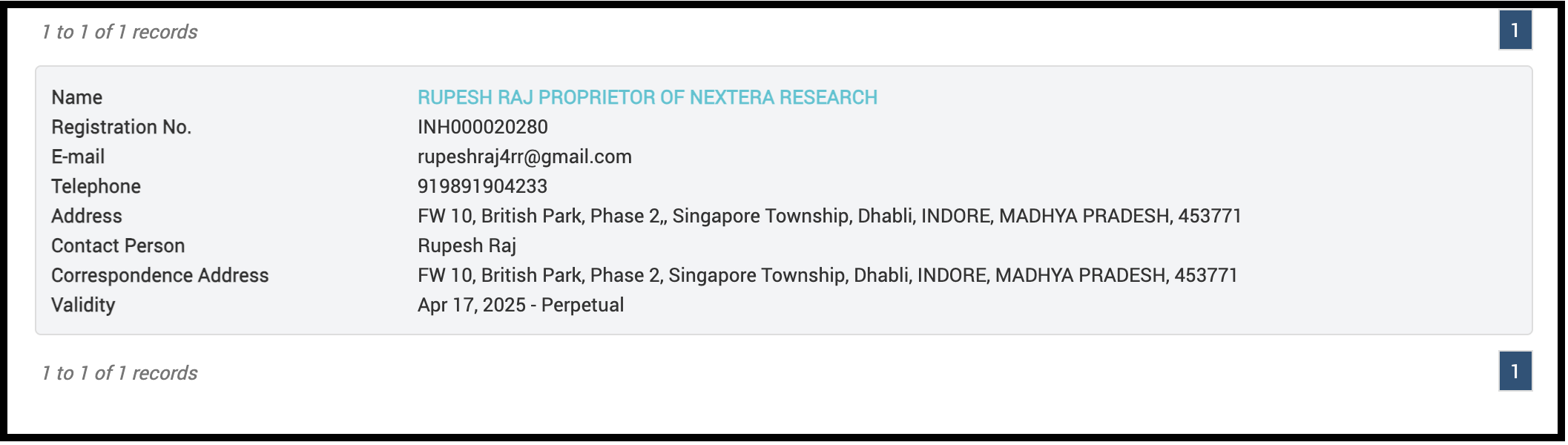
Yes, and INH000020280 is confirmed independently on SEBI’s own published Research Analyst list.
| Detail | Information |
| Name | Rupesh Raj, Proprietor of NexEra Research |
| SEBI Registration Number | INH000020280 |
| Validity | 17 April 2025, Perpetual |
| Address | FW 10, British Park, Phase 2, Singapore Township, Dhabli, Indore, Madhya Pradesh 453771 |
| Correspondence Address | Same as registered address |
| Contact Person | Rupesh Raj |
What the INH Prefix Permits
The INH prefix marks a Research Analyst. It permits publishing research and issuing recommendations to a subscriber base.
It does not permit personalised advice built around an individual client’s income, goals or holdings, trade execution, or portfolio management.
NexEra Research Pricing and the ₹1,51,000 SEBI Fee Cap
This is the most serious finding on this page, and it runs considerably wider than a partial check of the pricing table would suggest.
A Research Analyst may charge a maximum of ₹1,51,000 per annum per family for individual and HUF clients who are not accredited investors.
The Published Price Grid, Annualised
| Plan | Segment | Price | Annualised | Against the Cap |
|---|---|---|---|---|
| Wealth Wave Pack | Cash | ₹30,000/Quarter | ₹1,20,000 | Under by ₹31,000 |
| Trade Nexus Pack | Cash | ₹14,999/Month | ₹1,79,988 | Over by ₹28,988 |
| Cash MIS | Cash | ₹14,999/Month | ₹1,79,988 | Over by ₹28,988 |
| Stock Futures MIS | Futures | ₹14,999/Month | ₹1,79,988 | Over by ₹28,988 |
| Futures Combo | Futures | ₹22,000/Month | ₹2,64,000 | Over by ₹1,13,000 |
| Stock Options | Options | ₹6,000/Week | ₹3,12,000 | Over by ₹1,61,000 |
| Index Options | Options | ₹7,000/Week | ₹3,64,000 | Over by ₹2,13,000 |
| Combo, Stock & Index | Options | ₹35,500/Quarter | ₹1,42,000 | Under by ₹9,000 |
| Super Sensex | Options | ₹1,11,000/Half Year | ₹2,22,000 | Over by ₹71,000 |
| MCX Basic | Commodity | ₹12,000/Week | ₹6,24,000 | Over by ₹4,73,000 |
| MCX Premium | Commodity | ₹14,999/Week | ₹7,79,948 | Over by ₹6,28,948 |
Nine of Eleven Plans Breach the Ceiling, Not Five
Only two of the eleven published plans, Wealth Wave Pack and the Stock & Index Combo, both billed quarterly, stay under the ₹1,51,000 ceiling once annualised.
Every other plan on this page, spanning cash, futures, options and commodities, breaches it.
The two commodity plans are the sharpest figures on the entire page. MCX Basic annualises to ₹6,24,000, over four times the limit.
MCX Premium annualises to ₹7,79,948, more than five times the limit. Both are billed weekly, which means the breach is not a matter of an unusual renewal pattern; it is the direct result of continuing the most basic recommended use of the plan across a year.
Pricing Page Does Not Address What Happens When Clients Combine Services
Nothing on the pricing page explains how NexEra Research expects its fee structure to stay within the SEBI ceiling when a client subscribes to more than one plan, which the range of segments on offer- cash, futures, options, and commodities- actively invites.
Given how many individual plans already breach the ceiling on their own, combining any two of them makes compliance essentially impossible for an individual or HUF client under this pricing structure as published.
One protection applies regardless of which plan is chosen.
On early termination, a client is entitled to a proportionate refund for the unexpired period, and a Research Analyst may not retain a breakage fee.
Also Read: Ritesh Gupta has the yearly price stays under the cap, while weekly billing crosses ₹2.60 lakh annually.
What Does NexEra Research’s Complaint Data Show?
The firm’s overall complaint total is consistent between its two disclosure tables. The way that total is split by financial year is not.
Current Complaint Status, August 2026
| Received From | Pending Last Month | Received | Resolved | Total Pending | Pending Over 3 Months | Avg. Resolution Time |
|---|---|---|---|---|---|---|
| Directly from Investors | 0 | 0 | 0 | 0 | 0 | N/A |
| SEBI (SCORES) | 0 | 1 | 1 | 0 | 0 | N/A |
| Other Sources | 0 | 0 | 0 | 0 | 0 | N/A |
| Grand Total | 0 | 1 | 1 | 0 | 0 | N/A |
Monthly Disposal Trend, Months With Activity
| Month | Received | Resolved | Pending |
|---|---|---|---|
| January 2026 | 1 | 1 | 0 |
| February 2026 | 2 | 2 | 0 |
| June 2026 | 3 | 3 | 0 |
| August 2026 | 1 | 1 | 0 |
| Grand Total (all months) | 7 | 7 | 0 |
Annual Disposal Trend
| Year | Received | Resolved | Pending |
|---|---|---|---|
| 2025-26 | 1 | 1 | 0 |
| 2026-27 | 6 | 6 | 0 |
| Grand Total | 7 | 7 | 0 |
Overall Totals Match, but the Year-by-Year Split Does Not
Both tables agree on the same overall figure: 7 complaints received and 7 resolved.
Checking how that total is actually distributed across the two financial years shown reveals a mismatch.
Financial year 2025-26 runs April 2025 to March 2026. Within the monthly table’s window for that year, January 2026 and February 2026, the complaints sum to 3 received: 1 plus 2. The annual table’s 2025-26 row states only 1.
Financial year 2026-27 runs from April 2026 onward. Within the monthly table’s window, June 2026 and August 2026, the complaints sum to 4 received: 3 plus 1. The annual table’s 2026-27 row states 6.
The overall count is correct, but two complaints that the calendar dates in the monthly table place in FY2025-26 appear instead counted under FY2026-27 in the annual table.
This is worth raising directly with the firm, since a prospective client checking only the annual table would see a considerably smaller FY2025-26 figure and a larger FY2026-27 figure than the underlying monthly dates actually support.
The Volume Itself Is a Separate Point Worth Noting
Seven complaints since the registration became active in April 2025, all resolved, is a real number for a firm that has been operating for under a year and a half.
Complaints appeared in four separate months rather than a single cluster, June 2026 being the busiest with three.
What Do Rupesh Raj’s Compliance Documents Say?
A few clauses in the firm’s terms and privacy policy are worth reading closely.
1. A Broadly Worded Liability Disclaimer
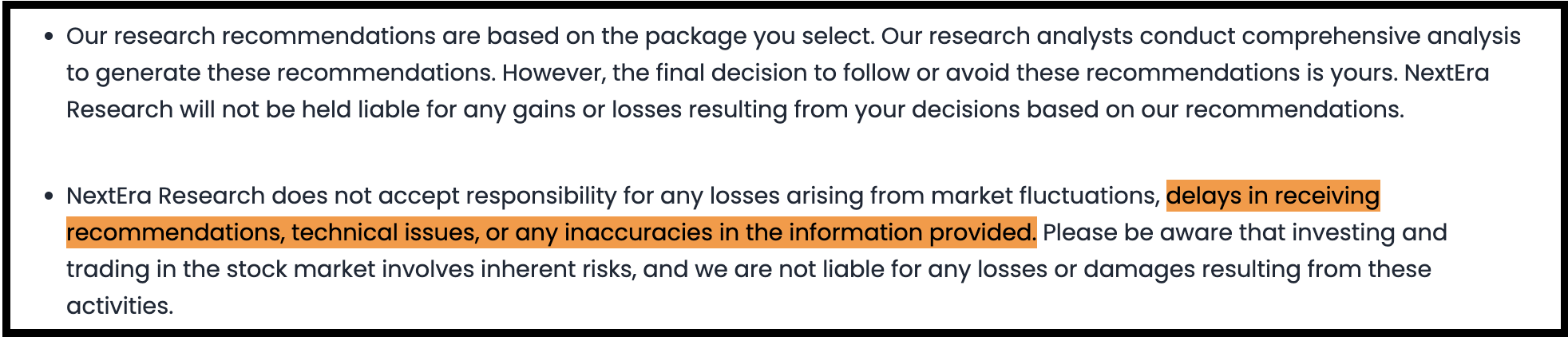
The Terms and Conditions state that NexEra Research will not be held liable for losses arising from market fluctuations, delays in receiving recommendations, technical issues, or inaccuracies in the information provided.
Disclaimers this broad are common across the sector, and they do not remove a Research Analyst’s underlying regulatory obligations regardless of how they are worded.
2. Personal Information May Be Shared Broadly Without Consent
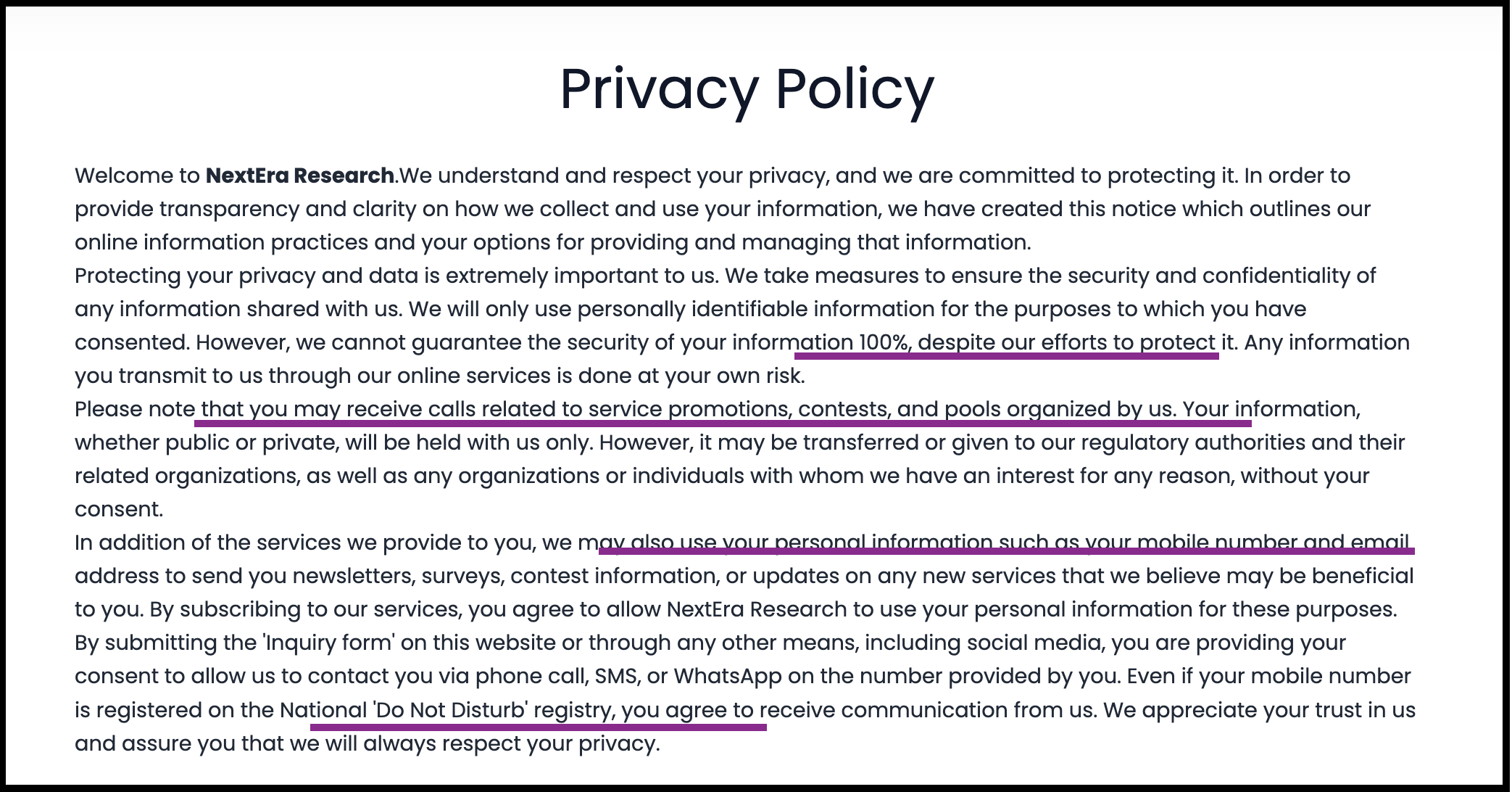
The Privacy Policy states that user information may be transferred to regulatory authorities, related organisations, and any organisation or individual with whom NexEra Research has an interest, for any reason, without the user’s consent.
This is a considerably wider sharing scope than most comparable firms publish.
3. Marketing Consent Extends Beyond the Research Service Itself
The policy permits using a client’s mobile number and email for newsletters, surveys, contests, and promotion of new services, beyond what is needed to deliver the subscribed research.
4. Consent to Contact Overrides DND Registration
Submitting an inquiry or contacting the firm through social media is treated as consent to calls, SMS and WhatsApp messages even where the number is registered under the National Do Not Disturb registry.
5. Security Is Explicitly Not Guaranteed
The policy states plainly that the firm cannot guarantee the security of user information, and that information transmitted through its online services is at the user’s own risk.
What Marketing Language on Rupesh Raj’s Website Needs a Closer Look?
The homepage uses several broad claims without the supporting detail needed to assess them, including “accurate and unbiased research,” “competitive edge,” “high-probability risk-reward entries,” and language around helping clients “grow wealth.”

The site also repeatedly highlights “real-time insights” and “real-time technical indicators” without explaining how that immediacy is actually delivered or which specific products it applies to.
None of this amounts to an explicit guarantee of returns in the way SEBI orders have treated direct profit promises.
It is the kind of language a compliance review would ordinarily flag for lacking the supporting detail that would let a prospective client actually evaluate the claim.
Also Read: Rohit Gholap has Terms and Conditions that still name a completely different website in itself.
How to File a Complaint Against Rupesh Raj?
Given the scale of the fee cap findings above, a complaint here has firmer, more documentable ground than a dispute over research quality alone.
Start by checking every plan you hold against the annualised figures above, particularly if you subscribed to more than one, since combining plans makes staying within the ceiling nearly impossible under this pricing structure.
Ask the firm directly to reconcile the annual complaint table’s year-by-year split against the dated entries in its own monthly table.
Send your grievance to the RA’s email ID, describing what you were told, what you paid, and what you want resolved. Keep the sent record regardless of what comes back.
If the response is not satisfactory, escalation runs through a specific set of channels, and each one exists for a different stage of the dispute rather than as alternatives to pick from.
1. SEBI SCORES
The first step is to register your complaint through the SEBI SCORES complaint portal.
Provide the relevant details, explain the issue clearly, and upload any supporting documents or payment records that may help establish your complaint.
2. SMART ODR
If the matter is not resolved through SCORES, you can move forward with structured conciliation through the SMART ODR portal.
This process provides an additional platform to communicate with the concerned party and work towards a possible settlement.
3. Arbitration
If conciliation does not resolve the dispute, the next available route may be arbitration through the stock exchange.
Arbitration proceedings can result in a binding and enforceable award, subject to the applicable rules and process.
If you want to understand each stage in greater detail, including the documents required and how to proceed, read our complete guide on filing a complaint against a SEBI-registered research analyst.
Paying several times the SEBI cap without realising it?
We total your invoices against the ₹1,51,000 ceiling, calculate the exact excess across every plan you hold, and put the figure on record in a form the analyst has to respond to. Register with us for a free read on your situation.
Disclaimer
This page is based on NexEra Research’s own published material and the SEBI intermediary register, current as of September 2026, and alleges no wrongdoing since no SEBI order stands against the firm.
Registration details, pricing, and website content can change, so verify everything at the source before acting. Treat this page as research, not legal or investment advice.
Conclusion
Rupesh Raj’s NexEra Research holds a genuine SEBI Research Analyst registration, INH000020280, active since April 2025.
The pricing page needs serious caution.
Nine of eleven published plans breach the SEBI fee ceiling once annualised, with the two commodity plans running to roughly five and eight times the limit on their most basic weekly billing.
The firm’s complaint disclosure carries a consistent overall total but an inconsistent year-by-year breakdown, with dated complaints in the monthly table not matching how the annual table attributes them.
Before subscribing to anything beyond Wealth Wave Pack or the Stock & Index Combo, work out your actual annual cost and compare it to ₹1,51,000 directly.
Report. Recover. Stay Fraud Free.
Frequently Asked Questions
Yes. It is registered to Rupesh Raj, operating as NexEra Research, from 17 April 2025 and is perpetual. Confirm it directly on the SEBI register rather than relying on the website alone.
Nine of the eleven published plans do, spanning cash, futures, options and commodities. Only Wealth Wave Pack and the Stock & Index Combo, both billed quarterly, stay under the ceiling.
MCX Premium, billed weekly at ₹14,999, annualises to ₹7,79,948, more than five times the ₹1,51,000 limit. MCX Basic follows closely at ₹6,24,000 annualised.
The overall totals match, 7 received and 7 resolved in both the monthly and annual disclosures. The year-by-year split in the annual table does not match what the dated entries in the monthly table would produce, with complaints appearing shifted between financial years.
The firm's privacy policy states that contacting them is treated as consent to calls, SMS and WhatsApp messages even if your number is registered under the National Do Not Disturb registry. Be aware of this before submitting an inquiry.





 Add us as a preferred source on Google »

