

Quick Summary
Stocksence Research Private Limited is a SEBI-registered Research Analyst (INH000017019) operating from Bengaluru and Surat. Seven publicly shared investor reviews describe losses ranging from ₹50,000 to ₹8.14 lakh, alongside high-pressure sales tactics and support that disappears after losses. The firm’s own complaint disclosures contain a mathematical contradiction, a yearly total of 10 complaints against a month-by-month breakdown that adds up to 27, with 32 listed as pending. This blog covers the full review record, the complaint data discrepancy, the firm’s pricing structure, and the exact process to file a complaint.
Can a 4.4-star rating really tell the full story when investors report losses running into lakhs?
Many people see the stars first. The real question is what happened after they took the subscription.
That’s where Stocksence Research Private Limited reviews become important, because the complaints reveal a pattern worth understanding before you pay anything.
This page covers the company profile, its SEBI registration status, the full complaint data, all seven reviews in detail, and exactly how to escalate a complaint if you’ve had a similar experience.
Stocksence Research Private Limited
Stocksence Research Private Limited is a Bengaluru-based investment research and advisory firm, also operating out of a Surat office, offering research-backed recommendations to individual investors, institutions, and corporate clients.
Its Google rating stands at 4.4 stars. At first glance, that looks impressive and might even make the company seem trustworthy on its own.
But a rating alone doesn’t tell the full story.
The firm offers subscription services across seven categories: Stock Cash, Stock and Index Futures, Stock and Index Options, Commodity (MCX and NCDEX), Bullions, Base Metals, and Energy.
On paper, this looks like a standard research advisory setup. It’s once you look past the service list and into the pricing that things start raising questions.
Stocksence Research Pricing
The Stock Cash Subscription is priced at ₹35,555 for a monthly plan, ₹85,555 for a quarterly plan, and ₹1,49,999 for a half-yearly plan.
The Stock/Index Futures Subscription runs similarly: ₹35,555 monthly, ₹89,555 quarterly, and ₹1,49,999 for the half-yearly plan, matching the cash service exactly.
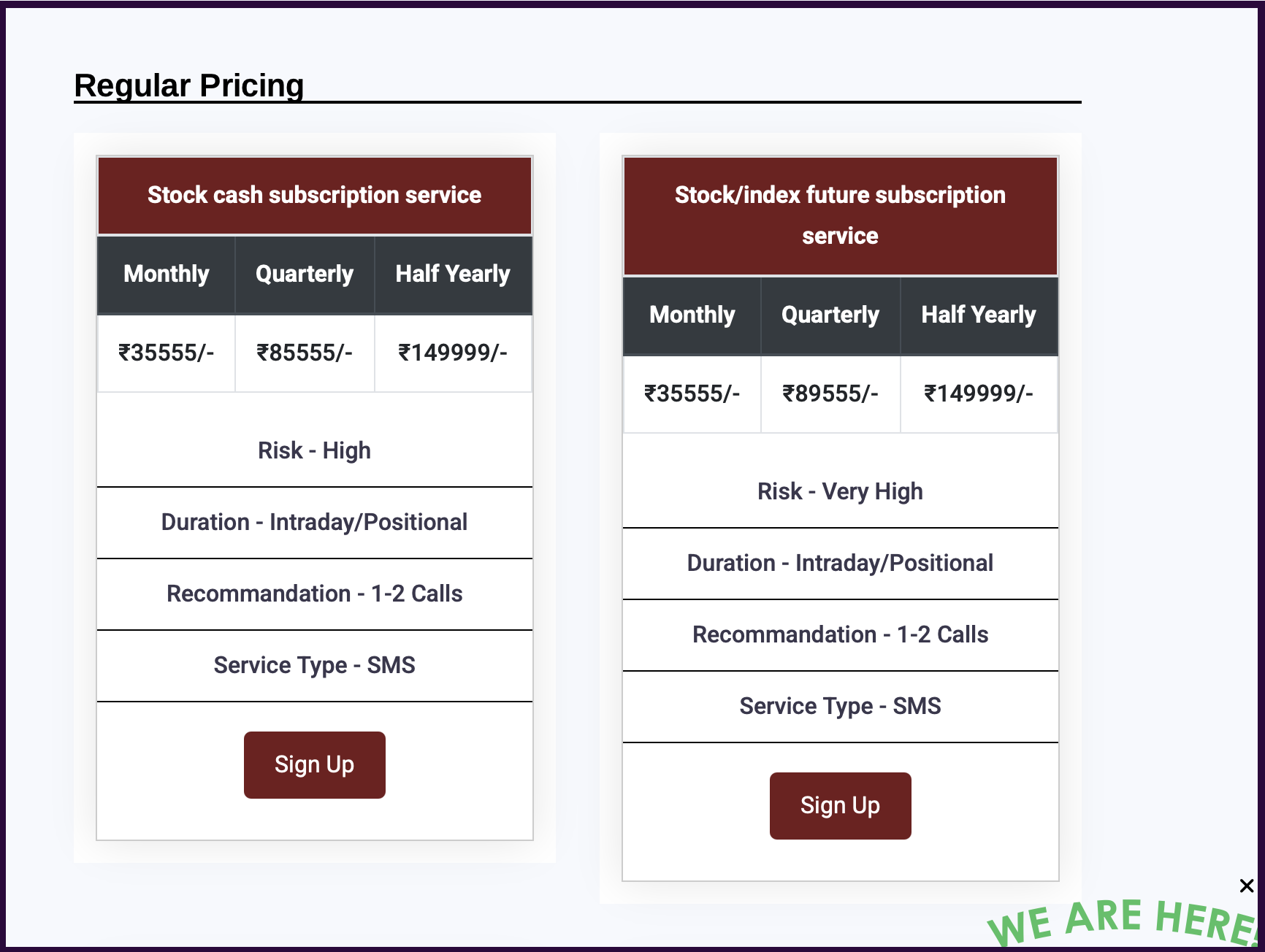
What stands out is that both half-yearly prices land at the same figure, ₹1,49,999, just under SEBI’s ₹1,51,000 annual fee cap for a Research Analyst.
On its own, this pricing stays within the legal limit. The problem starts if the firm asks the same client for any additional payment within that same financial year, whether a renewal, an upgrade, or a separate service.
Once that happens, the total collected crosses the SEBI-mandated limit, and that’s where compliant pricing turns into a violation.
Also Read: Kaushal Prafulla Somani, a firm that changed pricing conditions on its Telegram channel mid-subscription.
Is Stocksence Research SEBI Registered?
Yes. Stocksence Research Private Limited is registered with SEBI as a Research Analyst under Registration Number INH000017019.
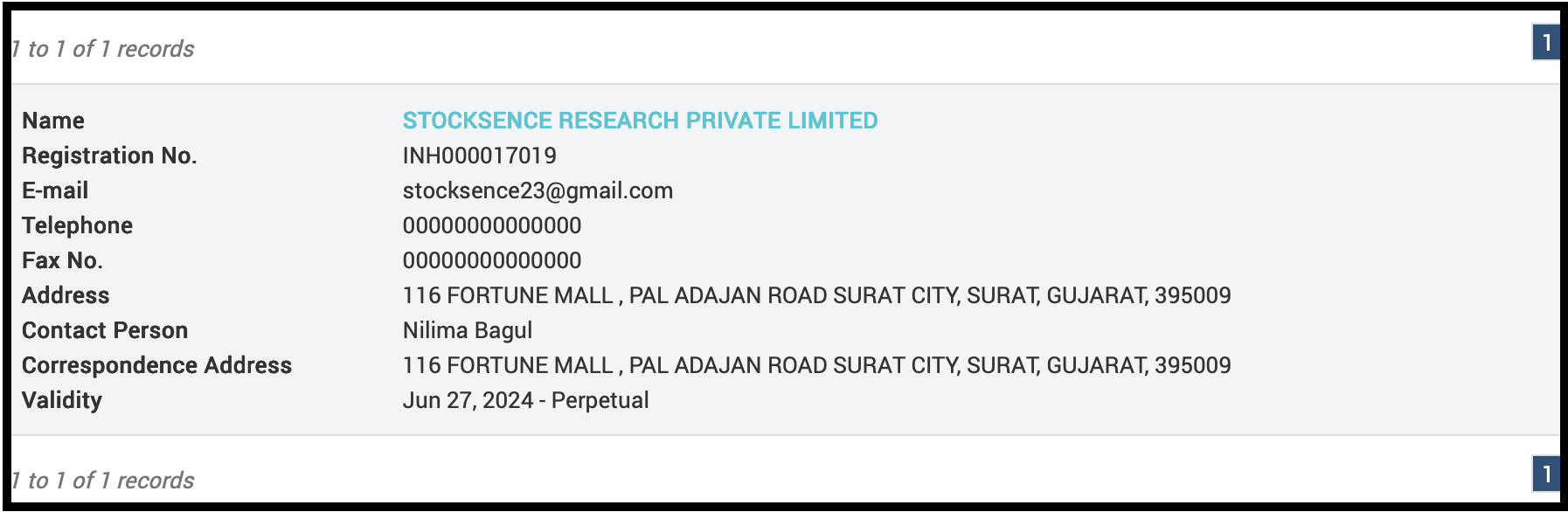
The registration was granted on June 27, 2024, and remains valid.
Here’s the practical distinction worth understanding: a registration certificate is not a guarantee of safety. Think of it like a driving licence.
It permits someone to drive, but it says nothing about how carefully or responsibly they’ll actually drive once they’re on the road. The same logic applies here.
While it means the firm can legally operate, it doesn’t guarantee compliance in practice. If you rely solely on that registration number to protect your capital, you’re stopping at the starting line rather than finishing the due diligence.
One specific gap is worth flagging directly. Since the company received its SEBI registration in 2024, complaint data covering 2024 onward should reasonably be expected on its disclosure page.
But only one year’s complaint data currently appears on the website. If a registered entity isn’t maintaining or displaying information as required, that’s a signal worth your attention on its own, separate from the numbers themselves.
Stocksence Research Private Limited Complaints
Reading individual reviews gives you a warning.
The official numbers give you the fuller picture, and here, the numbers genuinely don’t add up.
1. The Single-Month Spike
The complaint data published for one month, May, shows a sudden surge of 8 complaints received through SEBI’s SCORES platform.
| Sr. No. | Received From | Previous Pending | Received | Resolved |
|---|---|---|---|---|
| 1 | Directly from Investors | 0 | 0 | 0 |
| 2 | SEBI (SCORES) | 8 | 1 | 8 |
| 3 | Other Sources | 0 | 0 | 0 |
| Grand Total | 8 | 1 | 0 |
Investors typically only escalate to SCORES after a firm has already ignored them directly. A spike like this in a single month signals real service distress, not a routine grievance volume.
2. The Yearly vs. Monthly Contradiction
The firm’s yearly summary claims a total of just 10 complaints for the full year, with 7 resolved and 3 pending.
| Year | Complaints Registered | Resolved | Pending |
|---|---|---|---|
| 2025–2026 | 10 | 7 | 3 |
But add up the detailed month-by-month breakdown, and the real number of received complaints jumps to 27, not 10.
| Sr. No. | Month | Carried Forward | Received | Resolved | Total Pending |
|---|---|---|---|---|---|
| 10 | Jan 2025 | 0 | 0 | 0 | 0 |
| 11 | Feb 2025 | 0 | 3 | 3 | 0 |
| 12 | Mar 2025 | 0 | 3 | 3 | 0 |
| 13 | Apr 2025 | 0 | 0 | 0 | 0 |
| 14 | May 2025 | 0 | 0 | 0 | 0 |
| 15 | Jun 2025 | 0 | 1 | 1 | 0 |
| 16 | Jul 2025 | 0 | 0 | 0 | 0 |
| 17 | Aug 2025 | 0 | 1 | 0 | 1 |
| 18 | Sep 2025 | 1 | 0 | 0 | 1 |
| 19 | Oct 2025 | 1 | 2 | 0 | 3 |
| 20 | Nov 2025 | 3 | 0 | 0 | 3 |
| 21 | Dec 2025 | 3 | 0 | 0 | 3 |
| 22 | Jan 2026 | 3 | 2 | 1 | 4 |
| 23 | Feb 2026 | 0 | 0 | 0 | 4 |
| 24 | Mar 2026 | 4 | 0 | 0 | 4 |
| 25 | Apr 2026 | 4 | 4 | 0 | 8 |
| 26 | May 2026 | 8 | 1 | 8 | 1 |
| Total | 2025–2026 | 27 | 17 | 16 | 32 |
3. The Phantom Pending Complaints
It gets stranger still. While the yearly overview claims only 3 complaints remain unresolved, the total row at the bottom of the monthly tracking table shows 32 complaints currently pending.
How does a yearly total of 10 complaints turn into 27 monthly complaints? And how do pending cases climb all the way to 32?
These numbers don’t fit together; whether this is a reporting error or something more deliberate, messy compliance numbers are themselves a red flag worth taking seriously.
Before you hand over your capital, remember: if you can’t trust their data, you shouldn’t trust their advice.
Also Read: Moneyplant Research reviews, where ₹1.5 lakh was lost across a series of escalating payments.
Stocksence Research Private Limited Reviews
Beyond the regulatory data, a closer look at public reviews reveals accounts of wiped-out capital, aggressive upselling, and heavy financial distress.
We are reporting what these reviews describe. We have not independently verified these individual accounts.
1. ₹50,000 Lost Despite Following Their Calls
A good rating can make any advisory service look trustworthy, but reviews like this remind you why reading beyond the stars is important.
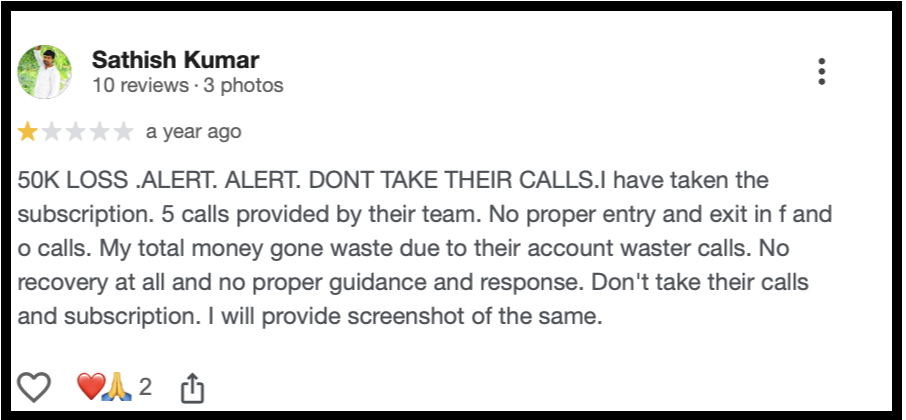
One investor claimed to have lost around ₹50,000 after purchasing Stocksence Research’s subscription. According to the review, only five Futures and Options calls were enough to wipe out that amount.
The investor alleged that there was no proper guidance on when to enter or exit trades, making every decision even more difficult. What seems to have disappointed the reviewer the most was the lack of support after the losses.
Instead of getting help, the investor claimed that responses were poor and recovery assistance was missing.
That is why the review ends with a clear warning for anyone thinking of taking the subscription.
2. Investor Claims ₹5 Lakh Loss After Multiple Stop Losses
The next review speaks about a much larger amount.
According to the investor, different representatives, including Kavya, Pradeep, and Varaprashath, kept sharing trading recommendations.
The expectation was that expert advice would help improve trading results.
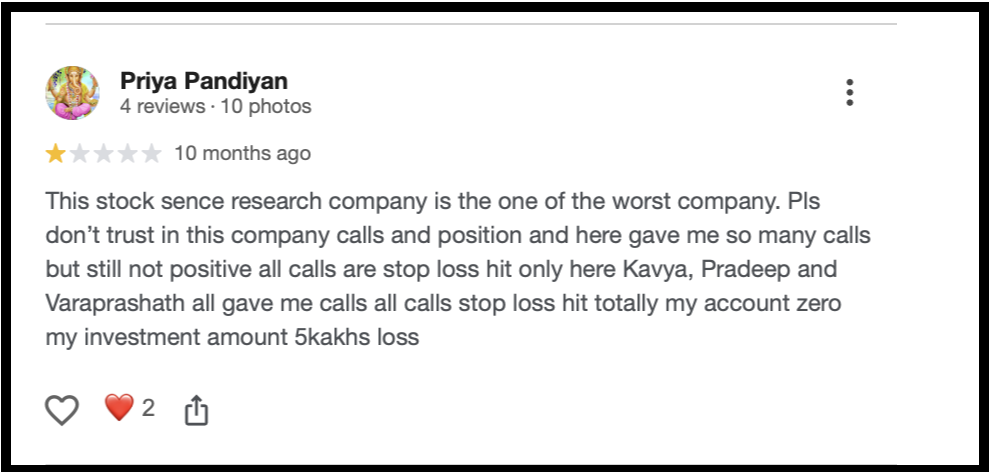
But the reviewer alleged that every single recommendation eventually hit the stop loss.
The review further claims that the losses kept increasing until the trading account became empty, resulting in an alleged loss of nearly ₹5 lakh.
Reading such experiences reminds you why no advisory service should ever be trusted only on promises or ratings.
3. Review Alleges ₹8.14 Lakh Loss in Just Five Days
Some reviews immediately make you stop and read them twice because of the amount involved. This is one of them.
An investor claimed to have lost around ₹8.14 lakh in only five days after dealing with a representative named Anil.
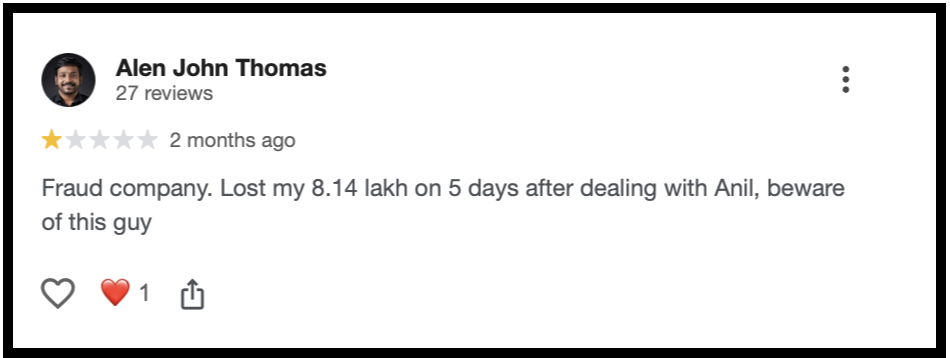
The review does not go into lengthy details, but the amount itself explains why the investor chose to warn others publicly.
4. Another Investor Reports ₹80,000 Loss
This review stands out because it echoes the same concerns raised in the earlier one.
The investor says nearly ₹80,000 was lost after following the company’s recommendations.
What made the experience worse, according to the review, was the lack of clear entry and exit guidance, which made the trades difficult to manage.
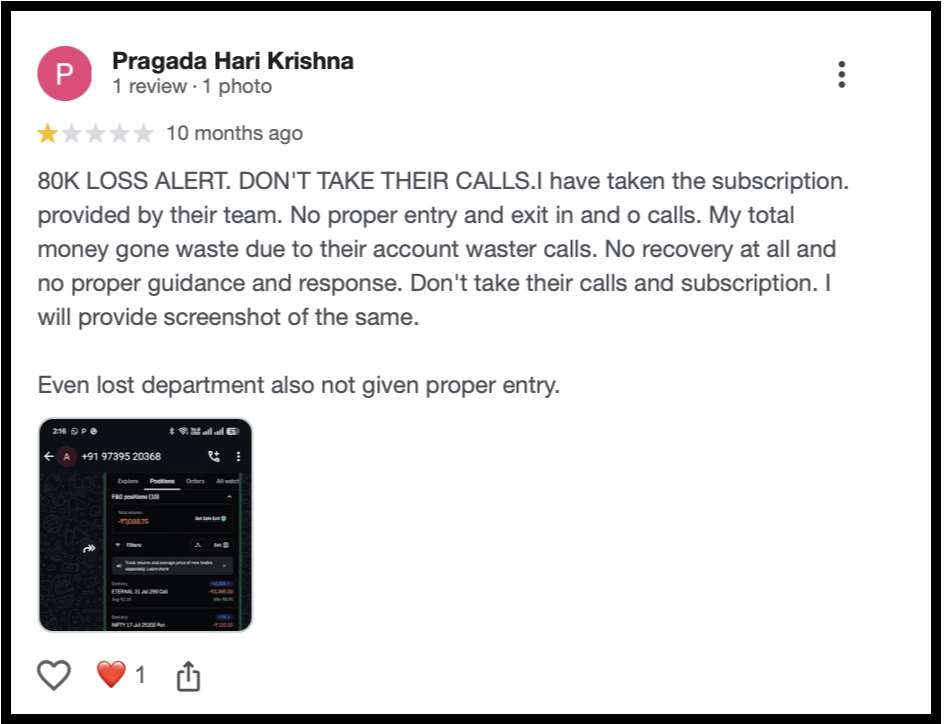
The reviewer also claimed that the team meant to handle loss-related issues did not offer much help.
When you see more than one review pointing to the same problems, it becomes harder to ignore them before signing up.
5. No Response After Heavy Losses
Making a loss is one thing, but not getting a response afterward can make the situation even more frustrating.
One investor alleged that a representative named Akram advised holding losing positions instead of closing them at the right time.
As the losses increased, the reviewer claimed that messages went unanswered and even requests to speak with another manager received no response.
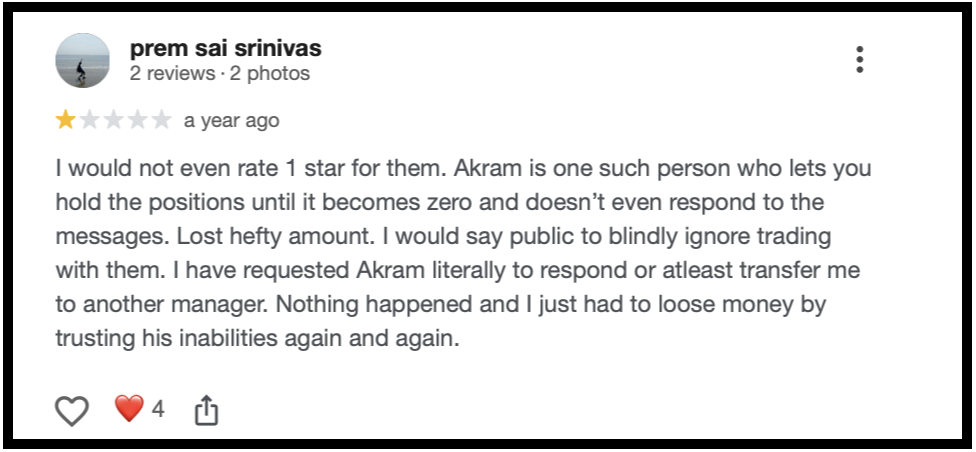
According to the review, the silence from the company became just as disappointing as the financial loss itself.
6. Good Calls Initially, Bigger Losses Later
This review describes an experience that many investors would probably not expect at the beginning.
According to the reviewer, the first few trading calls generated profits and helped build confidence in the advisory service.
Once that trust was created, the investor alleged that higher commissions and additional payments were requested.
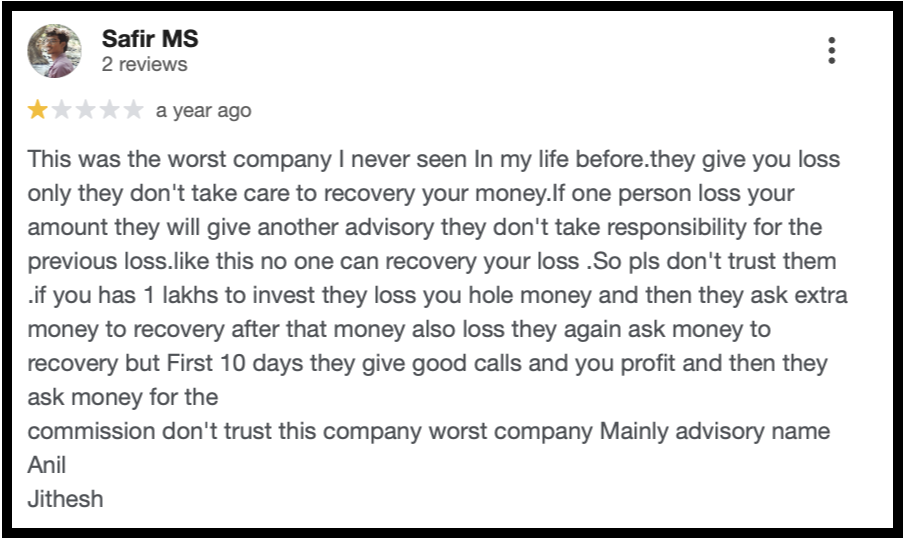
The review further claims that losses started increasing afterward, and instead of helping recover the earlier losses, new paid services were repeatedly suggested.
The investor specifically mentioned Anil and Jithesh, alleging that more payments were demanded in the name of recovery.
7. High Pressure Sales and Vanishing Support
The final review does not focus only on trading losses. It also talks about the way the service was sold.
According to the reviewer, repeated phone calls were made to convince investors to enter options trading.
Whenever a trade generated profits, it was allegedly described as a special “Galaxy Call”, encouraging customers to upgrade to more expensive plans.
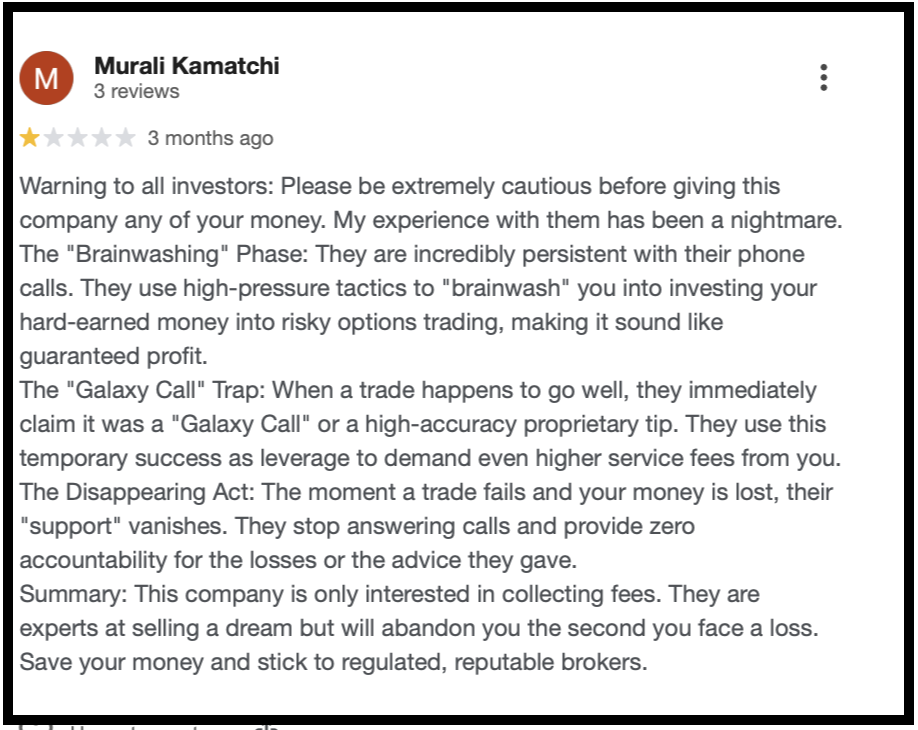
But the investor claimed that on-chat attractive sales conversations should never replace careful research before choosing any financial advisory service.
Also Read: Ajcon Global Services Limited reviews talk about a week full of connection failures and no support website to rely on.
Red Flags You Should Never Ignore
When you hire a SEBI-registered Research Analyst, you’re paying for research and market insight, not sales tactics.
If you notice these patterns with Stocksence Research or any similar firm, treat them as serious warnings.
- Guaranteed profits or loss recovery promises. No genuine analyst can guarantee returns or promise to recover past losses. If you’re asked to upgrade because it will “recover your money” or offered “sure-shot profits,” that’s a major red flag.
- Constant pressure to upgrade. If the focus stays on selling costlier plans rather than providing quality research, be careful. Some firms build trust with a few early recommendations, then aggressively push premium packages.
- Disappearing after losses. A professional advisor supports you through both profits and losses. If they stop responding after a losing trade, that’s a warning sign worth acting on.
- Poor risk management. Every recommendation should include clear entry, target, and stop-loss levels. If these are missing, or you’re simply told to “hold” a losing position without a proper strategy, your risk isn’t getting proper attention.
From Loss to ₹4,31,500: A Stocksence Research Case
One investor’s case shows exactly what happens when these red flags play out in practice, and what real recovery can look like.
An investor approached our team alleging Stocksence Research had persuaded him to subscribe with assurances of high returns.
As the relationship progressed, fees increased, personalised trading calls were provided, and substantial losses followed.
The arbitrator found the firm had collected ₹3,00,000 by splitting the payment into advisory fees and an unauthorised “mentorship fee” to circumvent SEBI’s prescribed fee limit, provided personalised trading recommendations beyond a Research Analyst’s permitted role, and induced the investor through guaranteed-return assurances.
The Sole Arbitrator directed Stocksence Research to pay ₹4,31,500 to the investor.
For the complete case, including the fee-split calculation, the conciliation-to-arbitration timeline, and the arbitrator’s full findings, that’s covered in full in our loss recovery from Stocksence Research case study.
Want someone to actually handle this complaint for you?
We will check your case against these exact regulations and help you build a complaint that holds up.
Stocksence Research Not Responding? Here’s What to Do
Reading these reviews might sound familiar to your own experience. If so, you’re not stuck relying on the company alone. Several official escalation channels exist for exactly this situation.
Here’s where you can take it, in order:
- File a SEBI SCORES portal complaint against the firm.
- Escalate through SMART ODR login if unresolved.
- Move to stock market arbitration as the final step.
If you want the full process in detail, check our guide: complaint against SEBI registered research analyst.
Conclusion
A star rating alone is never enough to judge a financial advisory service.
When multiple investors report the same problems, poor guidance, pressure tactics, delayed responses, and repeated losses, those complaints deserve serious attention.
Stocksence Research Private Limited reviews show exactly why every investor should look beyond an attractive rating.
The firm holds a genuine SEBI registration, but its complaint disclosures contain a mathematical contradiction; its pricing structure sits right at the edge of the annual fee cap, and seven separate reviews describe a consistent pattern of losses paired with vanishing support once things go wrong.
Before you pay for any advisory service, check SEBI registered company directly on the regulator’s own database, study real user feedback, and keep every payment and conversation documented from the start.
Report. Recover. Stay Fraud Free.
Yes. Stocksence Research is registered with the Securities and Exchange Board of India (SEBI) as a Research Analyst under Registration Number INH000017019. However, SEBI registration does not guarantee returns, so it is always wise to review the company's services carefully before subscribing. Yes. If you believe you faced misleading advice or unfair practice, first raise the grievance with the company directly. If unresolved, escalate through SEBI SCORES, SMART ODR where applicable, or arbitration. The firm's yearly disclosure claims 10 complaints, but its own month-by-month table adds up to 27 received and 32 pending. This inconsistency is unexplained and worth treating as a transparency concern on its own. If you believe the loss resulted from misleading advice or any unfair practice, keep all your payment receipts, chats, emails, and trading records safe. These documents can be useful if you decide to raise a formal complaint. Keep all payment receipts, chats, emails, and trading records safe. These documents become essential if you decide to raise a formal complaint or pursue arbitration. Yes, depending on your case's facts. In one arbitration, an investor recovered ₹4,31,500 after the arbitrator found the firm had split fees to bypass the SEBI cap and given personalised trading instructions beyond its permitted role. Yes. In a prior arbitration, the arbitrator specifically held that the "mentorship fee" is not recognised under SEBI's Research Analyst Regulations, and ordered a full refund of that amount.Frequently Asked Questions





 Add us as a preferred source on Google »

