

Quick Summary
Initial Claim: ₹1,40,800 Core Violation: A firm registered as a SEBI Investment Adviser used a manufactured, recurring excuse about an unactivated profile to extract repeated fees from the same client across multiple representatives, and separately directed him to invest in IPOs through the firm’s own internal account. Forum Used: Direct negotiation with the firm, with recovery paid in installments. Recovery Secured: ₹1,00,000, roughly 71 percent of the claim, with the first installment received. Sanjeev Tiwari (name changed) is from Varanasi, Uttar Pradesh. He paid for one package. Then he was told his profile wasn’t quite ready. He paid again. He was told the same thing, from a different person, a second time.
Sanjeev’s relationship with a firm registered as a SEBI Investment Adviser began with a straightforward pitch, subscribe to their advisory service and earn substantial profits.
He paid ₹6,000 for a basic package, trusting the firm’s registration.
That first package produced a loss of ₹10,000. Rather than pausing, Sanjeev was persuaded to upgrade to a second package priced at ₹12,600, framed as the path to better service and recovery.
A New Person, the Same Manufactured Barrier
Two further representatives then made contact, each introducing themselves as part of the same firm.
They informed Sanjeev that his profile had not actually been activated, and that additional fees were required before he could genuinely access the firm’s services.
He paid a further ₹41,600 based on this claim.
A profile activation barrier appearing repeatedly, raised by different people at different stages, is not a technical requirement.
It is a manufactured reason to demand payment that has nothing to do with any real service gap.
Directed Into IPOs Through the Firm’s Own Account
Later still, Sanjeev was asked to invest ₹16,200 to participate in IPO allocations, specifically using the firm’s own internal identification rather than his own independent access.
He was told this arrangement would guarantee returns.
An Investment Adviser directing a client to route investments through the firm’s own account or ID, rather than the client’s independent channels, points toward undisclosed benefit or conflict of interest, conduct that sits outside what a registered adviser is permitted to do without separate authorisation.
Anyone directed to invest through an adviser’s own internal account or ID can file a complaint against SEBI registered investment advisor, since this specific arrangement raises a documented conflict of interest regardless of the returns promised alongside it.
Daily Pressure Behind Every New Demand
Throughout this entire sequence, Sanjeev faced daily calls carrying emotional pressure and repeated promises that the next payment would finally be the one that turned things around.
No written agreement, invoice, or fee schedule accompanied any of the payments across the relationship.
By the end, his total fees paid combined with his trading losses reached ₹1,40,800.
How We Documented the Repeating Pattern Across Three Representatives?
The recurring, manufactured excuse used by multiple representatives became the central thread connecting every payment Sanjeev had made.
Step One: We Mapped Every Payment to the Specific Excuse Given for It
Each of the four payments was matched to the exact reason given at the time, showing how the profile activation claim reappeared across different representatives rather than being resolved once and for all.
Step Two: We Treated the Recurring Excuse as Evidence of Design
Rather than treating each payment as an isolated request, we documented the pattern as a whole, since the same manufactured barrier reappearing under different names points toward a deliberate structure, not coincidence.
Step Three: We Flagged the IPO Investment Through the Firm’s Own Account
The instruction to invest through the firm’s internal ID was documented as its own distinct conflict of interest violation, separate from the fee extraction pattern around it.
Step Four: We Confirmed the Absence of Any Written Documentation
The complete lack of agreements, invoices, or fee schedules across every payment was recorded as an independent transparency violation running through the entire relationship.
Step Five: We Sent a Legal Notice Covering the Full Pattern and Every Violation
Our notice presented the recurring excuse, the conflict of interest, and the missing documentation together, each tied to its specific SEBI regulation.
Step Six: We Pushed Through Direct Negotiation to a Structured Settlement
With the full pattern clearly documented across all three representatives, our team engaged the firm directly to secure a resolution.
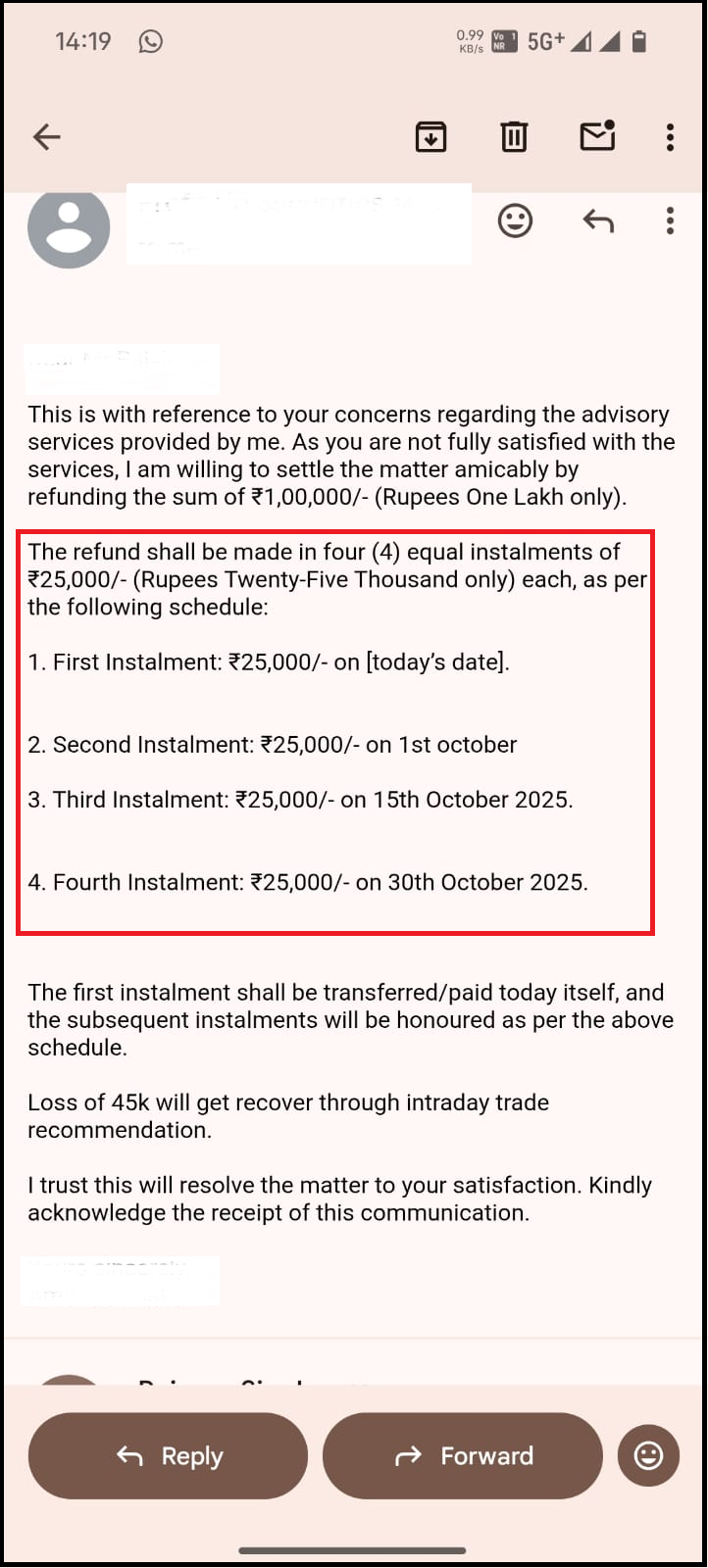
Through this direct negotiation, a total recovery of ₹1,00,000 was agreed, with the first installment already received.
Told Your Profile Wasn’t Activated By More Than One Person? Our Team Can Help
Sanjeev’s case worked because we showed the same excuse used repeatedly across different representatives, not treated it as one honest mistake. If you have heard something similar more than once, note down who said it and when.
Register with us and we will take it from there.
Conclusion
A single manufactured excuse for demanding more money is a red flag.
The same excuse repeated by a second, then a third, different representative is a pattern that deserves to be documented as exactly that: a structure designed to keep extracting payments rather than a genuine service issue.
Sanjeev’s case shows why treating each payment in isolation understates what actually happened, and why tracing the recurring justification across every representative involved builds a far stronger complaint than addressing the losses alone.
An investment routed through an adviser’s own internal account, rather than the client’s independent access, deserves the same scrutiny regardless of what returns were promised alongside it.
Report. Recover. Stay Fraud Free.
Frequently Asked Questions
No. This kind of claim reappearing at different stages, especially from different representatives, is a common tactic used to justify continued fee extraction rather than a genuine account requirement.
It raises a direct conflict of interest, since the adviser may benefit from the arrangement in ways that are not disclosed to you, and it falls outside what a registered adviser is permitted to do.
No. Documenting them together as a single pattern, connected across every representative involved, builds a far stronger and more accurate picture of what actually happened.
Ask for this in writing and request a clear explanation of what was missing from the original payment. Treat a vague or shifting answer as a warning sign.
Yes, once formally agreed and tracked against its schedule. Structured settlements are common, and following each installment through to completion ensures the case genuinely closes.





 Add us as a preferred source on Google »

