
Quick Summary
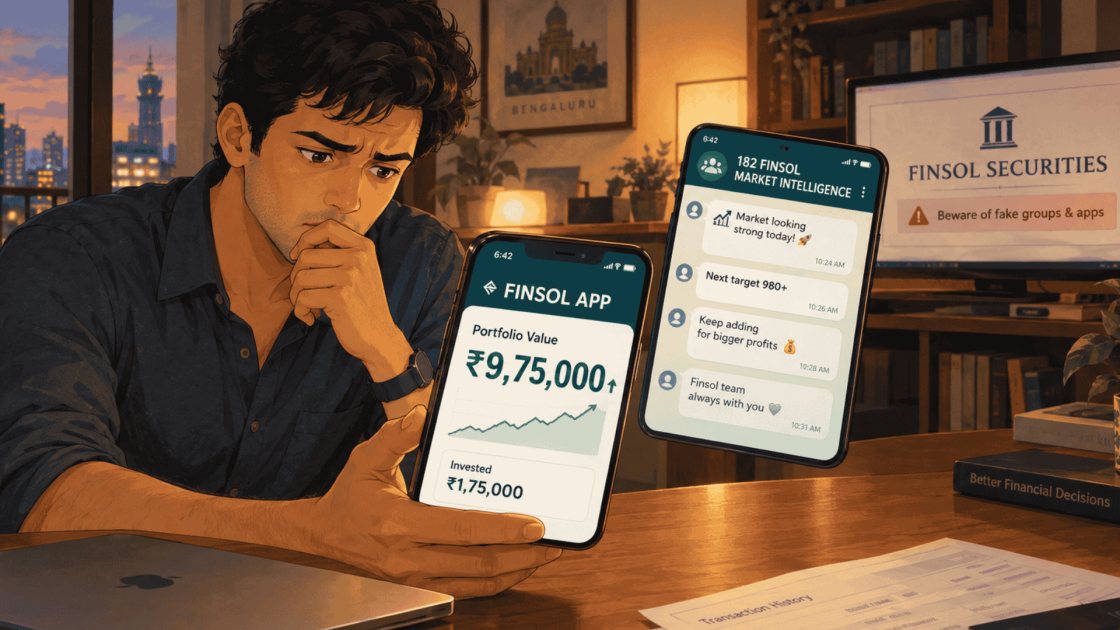
Finsol App searches are rising, and the reason is worth knowing before you pay anyone. In September 2026, a Bengaluru news report described an engineer who joined a WhatsApp group called “182 Finsol Market Intelligence” after a Facebook ad, and watched ₹1.75 lakh turn into ₹9.75 lakh on screen. A registered company, Finsol Securities Private Limited, exists, and its own website warns that WhatsApp groups claiming to represent it are unauthorised and fraudulent. Here’s how to tell the two apart.
The group chat is buzzing with profit screenshots, and then someone drops a link and says, “Download the Finsol App.”
A Bengaluru engineer got that exact push, and his ₹1.75 lakh showed up as ₹9.75 lakh on the app screen.
Here’s the twist. A real company called Finsol Securities exists, and it says WhatsApp groups using its name are not its own.
So whose app did you just get sent? Let’s find out, and if you’ve already paid, you can report financial fraud India to our team.
Finsol App Review
The name points to more than one thing online, which is exactly why people get confused.
Here’s what we could confirm from public sources.
Finsol Securities Private Limited is a private company registered in Ahmedabad, Gujarat. Company records show it was incorporated on 8 April 2024 and is listed as active.
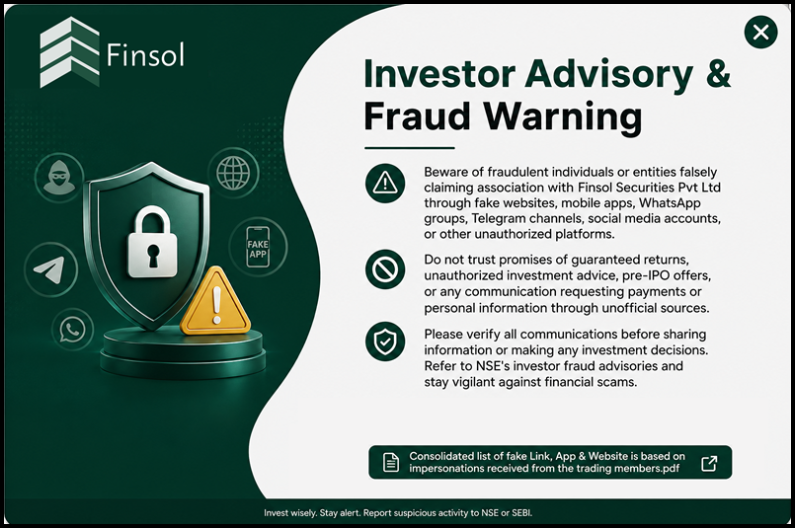
Several websites carry this company name. One of them, finsolcapital.com, shows a clear fraud alert.
It says any WhatsApp group or online community claiming to represent Finsol Securities is unauthorised and fraudulent, and it refers to an NSE advisory about fake links and impersonation.
Other websites with the same company name, such as fsplys.com and fsplyv.com, offer a “Download App” button, an “IPO Center,” and institutional trading, and display the SEBI registration number INZ000328134.
We couldn’t confirm whether these sites belong to the company, so treat any download link with care until you verify it, as explained below.
Finsol Securities SEBI Registration: What the Records Show
Many people stop at “it has a SEBI number.” SEBI’s own pages hold a few more details worth two minutes of your time before you trust any Finsol link.
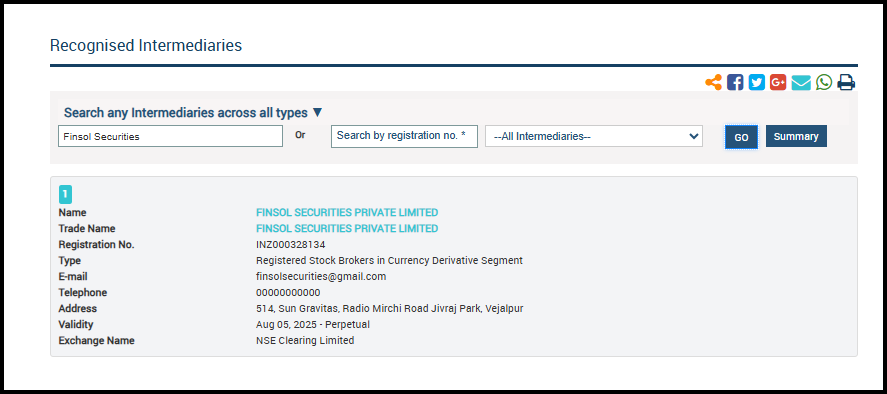
When we searched “Finsol Securities” in SEBI’s recognised intermediaries list, it showed Finsol Securities Private Limited with registration number INZ000328134.
The listing describes a registered stock broker in the currency derivative segment, linked to NSE Clearing Limited, valid from 5 August 2025 on a perpetual basis.
The address shown is Sun Gravitas, Jivraj Park, Ahmedabad.
SEBI’s separate list of stock brokers shows the same registration number under a different name, Athena Capital Private Limited.
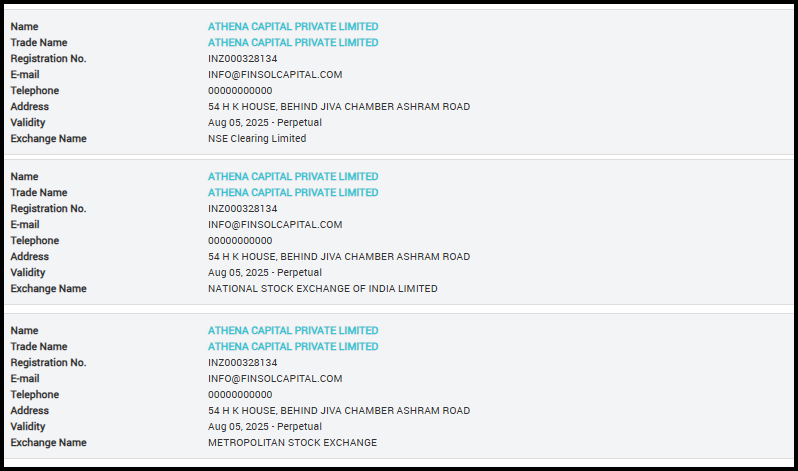
Those entries carry an email address on the finsolcapital.com domain, an address on Ashram Road in Ahmedabad, and links to NSE Clearing, the National Stock Exchange, and the Metropolitan Stock Exchange.
We don’t know whether a change of name explains this, and we make no claim about either company.
It does create the kind of confusion that people misusing a broker’s name can take advantage of.
Here’s how to use these records to protect yourself:
- Match the email domain. The only company domain in these SEBI records is finsolcapital.com, the same site that carries the warning about fake WhatsApp groups.
- Don’t rely on a phone number from a group or app. The telephone field in these listings shows only zeros, so take contact details from the exchange’s member directory instead.
- Check the segments. If an app offers IPOs or shares, confirm with the exchange that the broker is enabled for that segment before you trade through it.
- Search both names. If someone shows you a SEBI number, check it against Finsol Securities and Athena Capital, and make sure the address and email domain match what you were given.
Is Finsol App Real or Fake?
This is the question everyone types, and the honest answer depends on which “Finsol” you’re dealing with. Here’s how to think about it.
A company with this name exists and states a SEBI registration number. That alone doesn’t make every app, website, or WhatsApp group using the name genuine.
Scammers often copy a real broker’s name, logo, and registration number onto their own app.
So the real test is simple. Does the app you were given actually come from the registered company?
If a WhatsApp group sent you the link, the company’s own warning already tells you how it sees such groups.
We’ve seen the same pattern in cases we’ve handled, where groups used a well-known broker’s name on an app the broker had nothing to do with.
Also Read: Sam Pro app borrowed a real broker’s name and cost victims ₹30 lakh. Read the chats before you trust any app sent on WhatsApp.
Finsol WhatsApp Group Scam: The ₹1.75 Lakh Bengaluru Techie Case
A recent news report puts the Finsol name inside a real fake trading app case.
Here’s what was reported, in brief.
Deccan Herald reported in September 2026 that a Bengaluru engineer responded to a Facebook advertisement on 31 May and was then added to a WhatsApp group named “182 Finsol Market Intelligence.”
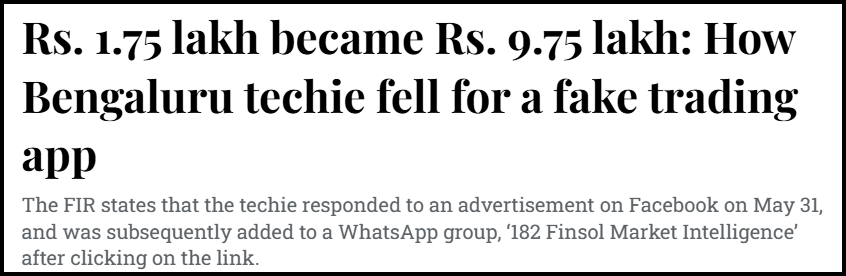
According to the report, his ₹1.75 lakh investment appeared to grow to ₹9.75 lakh on the trading app.
That kind of fast, large “profit” is a hallmark of fake trading apps, where the balance is only a number on the screen.
Nothing in the report suggests the registered company ran that group.
It shows that the Finsol name was used inside a WhatsApp group linked to a fake trading app, which matches the company’s own warning.
How Do Finsol WhatsApp Investment Scams Work?
WhatsApp investment scams rarely begin with a request for money. They begin with a friendly group, a market-sounding name, and a few members posting profits.
Police and news reports across India describe the same pattern again and again, whichever broker’s name is borrowed.
Here is how it usually unfolds:
- An ad or a stranger’s message on Facebook or Instagram offers stock tips or trading classes.
- You get added to a WhatsApp group with a market-sounding name and a long number in front, full of members praising a “professor” or “analyst.”
- You’re told to download an app or open a website that carries a real broker’s name, often with an “institutional account,” IPO quota, or discounted shares.
- Payments go to different bank accounts of unrelated firms, not to an account in the broker’s name.
- The app shows big profits quickly, sometimes with a small early withdrawal to build trust.
- Larger withdrawals get blocked, followed by demands for tax, fees, or “unlock” charges.
Promises of an IPO quota or guaranteed allotment are common in IPO scams, because no genuine IPO asks you to pay into a private account.
Police in Kerala, for example, warned about a scam using the name of a known trading brand where victims were added to WhatsApp or Telegram groups, told to download an app, and then blocked from selling while being asked for more money.
In Mysuru, a victim was told to deposit money into accounts of various local companies and was later asked for capital gains tax before any withdrawal.
If your Finsol group matches even three of these steps, stop paying.
Did a Finsol WhatsApp group ask you to download an app and deposit money into a company account you’d never heard of?
Talk to us before you send anything more. We’ll look at the group, the app, and the payments with you.
How Can You Check a Finsol App Before Investing?
These checks take a few minutes and work for any app that uses a broker’s name.
Run them before you pay a single rupee:
1. Verify the SEBI Registration Yourself
Search the registration number on SEBI’s list of registered intermediaries on sebi.gov.in.
The result should show the same company name and registered address as the app or website you were given.
2. Check the App’s Developer Name
On the Play Store or App Store, scroll to the developer name. It should match the registered company exactly.
An APK file sent on WhatsApp skips this check entirely, so never install one.
3. Check Who Receives Your Money
A registered broker collects money only into its own client bank account, in its own name, from your own bank account.
If you’re asked to pay a private firm, a “partner company,” or a person, stop.
4. Contact the Company Through Official Records
Get the company’s contact details from the stock exchange or SEBI records, not from the group or the app.
Ask them directly whether the app and the WhatsApp group are theirs. Their own fraud alert suggests they’ll tell you plainly.
Also Read: A ₹44,000 deposit showed minus ₹63 lakh and the money never came back; here is the Grow Capital app case.
How Can You Recover Money Paid to a Fake Finsol WhatsApp Group?
If money has already gone out, time matters more than anything.
Here’s where to start today:
- Stop all further payments, including any tax, fee, or margin demanded before a withdrawal.
- Call 1930 and file a cyber crime complaint on the National Cyber Crime Reporting Portal.
- Write to your bank with every UTR number and ask it to request a freeze on the receiving accounts.
- Keep the app installed and screenshot the group info, the app’s balance, and every payment instruction.
- Report the misuse of its name to Finsol Securities through contact details from official records.
If you’re unsure what to do first, our guide on what to do if online fraud happens in India walks you through each step in the right order.
Your complaint gets stronger when the chats, app screens, and bank records tell one clear story.
Keep each file dated and in one folder before you approach the police.
Disclaimer: This article relies on public company records, the company’s own website, and published news reports. It does not claim that Finsol Securities Private Limited, its directors, or any website mentioned runs or supports any fraud, and readers should verify all details independently with SEBI and the company.
Conclusion
The Finsol name now shows up in two very different places.
One is a registered company that warns investors about fake groups, and the other is a WhatsApp group linked to a fake trading app in a reported Bengaluru case.
Your safety lies in telling them apart before you pay.
Check the registration on SEBI, the developer name on the store, and the name on the bank account.
If a group pushed you into a Finsol App and money has already gone, stop paying, report it today, and save every screenshot.
Report. Recover. Stay Fraud Free.
A company called Finsol Securities Private Limited exists, but its own website calls WhatsApp groups claiming to represent it unauthorised and fraudulent. Verify that any Finsol app you were given comes from the registered company before paying. Websites using the company name display SEBI registration number INZ000328134. Check that number yourself on SEBI's intermediary list and confirm the company name and address match the app you were given. Finsol Securities' own website warns that WhatsApp groups claiming to represent it are unauthorised and fraudulent. A Finsol named group also appeared in a reported Bengaluru fake trading app case. Don't pay through such groups. Get the download link only through the company's contact details on official exchange or SEBI records, check the developer name in the app store, and never install an APK file sent on WhatsApp. Stop further payments, call 1930, and file on the National Cyber Crime Reporting Portal. Give your bank every UTR number and ask it to request a freeze on the receiving accounts.Frequently Asked Questions





 Add us as a preferred source on Google »

