

Quick Summary
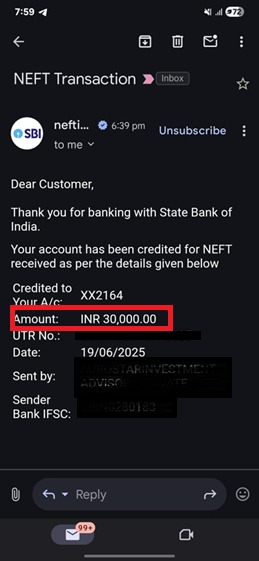
Initial Claim: ₹55,200 Core Violation: A firm registered as a SEBI Investment Adviser built trust through genuine early profits and personal rapport, then gave direct trade instructions without risk disclosure and stopped responding entirely once a position began collapsing. Forum Used: Direct negotiation with the firm, following a formal legal notice. Recovery Secured: ₹30,000. Irfan Qureshi (name changed) is from Allahabad, Uttar Pradesh. The representative who called him daily mentioned he was based nearby, a small detail that made the calls feel personal rather than like a sales pitch.
Unlike many cases built on fabricated screenshots, Irfan’s adviser actually delivered early wins.
A small initial investment returned a genuine profit of ₹2,500, and later trades brought in returns totalling close to ₹95,000, including a single trade worth ₹60,000.
Those real numbers did the persuading. Irfan paid a total of ₹55,200 across three separate charges, an initial premium tip fee, a payment for a weekend options call, and a further amount for what was pitched as a high return commitment.
Direct Instructions, Not Independent Advice
Throughout the relationship, Irfan received specific buy and sell instructions, exact lot sizes, and repeated guidance to average his position as trades moved against him.
This is execution guidance, not the independent advice a licensed Investment Adviser is meant to provide.
No risk profiling was ever conducted. No suitability assessment matched the recommendations to his actual risk appetite. The genuine early profits had replaced all of that groundwork entirely.
A Hedge Offered While He Was Already Down A Lakh
After his portfolio grew to three or four lakh rupees in equity, the pressure shifted toward larger positions. On May 5, 2025, a recommended options trade began losing heavily.
As the loss reached roughly one lakh rupees, the representative offered a hedging solution, priced at a further fifty thousand rupees. A losing position was treated as a fresh sales opportunity rather than a moment for caution.
Anyone offered a paid fix while already sitting on a loss can file a complaint against RIA conduct like this, since exploiting an existing loss for a further charge is a recognised warning sign.
Three Days Of Silence While The Position Fell To Ten Paise
Irfan exited the position himself on May 5, cutting his losses at around eighty to ninety rupees per unit. The firm’s representatives, who had called daily to place every prior trade, never once contacted him between May 6 and May 8.
During those three days, the option’s value collapsed to ten paise. No call came to suggest an exit. No guidance arrived to limit the damage. The same voice that had pushed every trade forward went completely quiet the moment things went wrong.
His total loss, combining the trading losses and the premiums already paid, came to more than a lakh rupees.
From Radio Silence to Recovery: How We Got ₹30,000 Back for a Trapped Trader?
Because real profits had been part of the pitch, this case needed to show the full arc, from legitimate early wins to unlicensed execution guidance to eventual abandonment.
Step One: We Timed The Profit Sequence Against The Fee Payments
Every profitable trade was placed on a timeline next to the fee charged around it, showing how each genuine win was used to justify the next, larger payment.
Step Two: We Catalogued The Direct Trade Instructions
Buy and sell orders, lot sizes, and averaging instructions were compiled as a distinct violation, separate from any general advisory relationship, since an Investment Adviser is not licensed to direct trades this way.
Step Three: We Documented The Hedging Upsell During An Active Loss
The specific offer to sell a hedge for fifty thousand rupees while Irfan was already down roughly a lakh was recorded as an independent act of exploitation tied to a client’s existing distress.
Step Four: We Established The Three Day Silence With A Precise Timeline
Call logs and message records from May 5 through May 8 were laid out to show the exact gap between daily contact and complete silence once the position turned against him.
Step Five: We Sent A Legal Notice With A Firm Deadline
Our notice detailed every violation with the exact SEBI Investment Adviser regulation it breached, giving the firm seven business days to respond before further escalation.
Step Six: We Pushed Through Direct Negotiation With The Firm
With the timeline and the fee pattern laid out clearly, our team engaged the firm directly to move the matter toward resolution.
Through direct negotiation, the matter was resolved with a recovery of ₹30,000.
Went Quiet On You The Moment A Trade Turned Bad? Our Team Can Help
Irfan’s case turned on one detail, a precise call log showing exactly when the silence began. If your adviser has gone quiet mid trade, start by pulling your own call and message history today.
Register with us and we will take it from there.
Conclusion
If an adviser calls daily to direct every trade but vanishes the moment a position collapses, that silence isn’t just poor service; it’s evidence. Call logs, WhatsApp timestamps, and sudden trade abandonment document a clear breach of duty.
You do not have to accept total losses when an adviser misleads you with early profits and abandons you during a drawdown.
With a structured legal notice and proper evidence, you can hold them accountable and recover your funds.
Report. Recover. Stay Fraud Free.
Frequently Asked Questions
Yes, but not in the adviser's favour. Genuine early profits can be used deliberately to build trust before larger, riskier recommendations follow.
No. Advisers are meant to provide independent advice, not direct execution guidance like exact lot sizes and entry or exit instructions on individual trades.
No. A hedging offer priced as a fresh fee while you are already in a loss deserves scrutiny rather than an immediate yes.
Document the exact dates and any attempts you made to reach them. A clear gap between routine contact and sudden silence is strong evidence on its own.
Call logs, WhatsApp instructions, payment receipts, and your trading statement around the specific dates in question are usually enough to build a clear timeline.





 Add us as a preferred source on Google »

