
Quick Summary
The SBI impersonation scam uses the bank’s name, its YONO app and its branch look to win trust. News reports from 2022 to 2025 describe a fake YONO app ring with a suspected loss above ₹20 crore, callers posing as SBI staff, and a fake branch that sold job offers. In 2026, PIB Fact Check flagged a fake YONO Aadhaar update APK. Here are six cases ranked by loss, how to check a message, and what to do first.
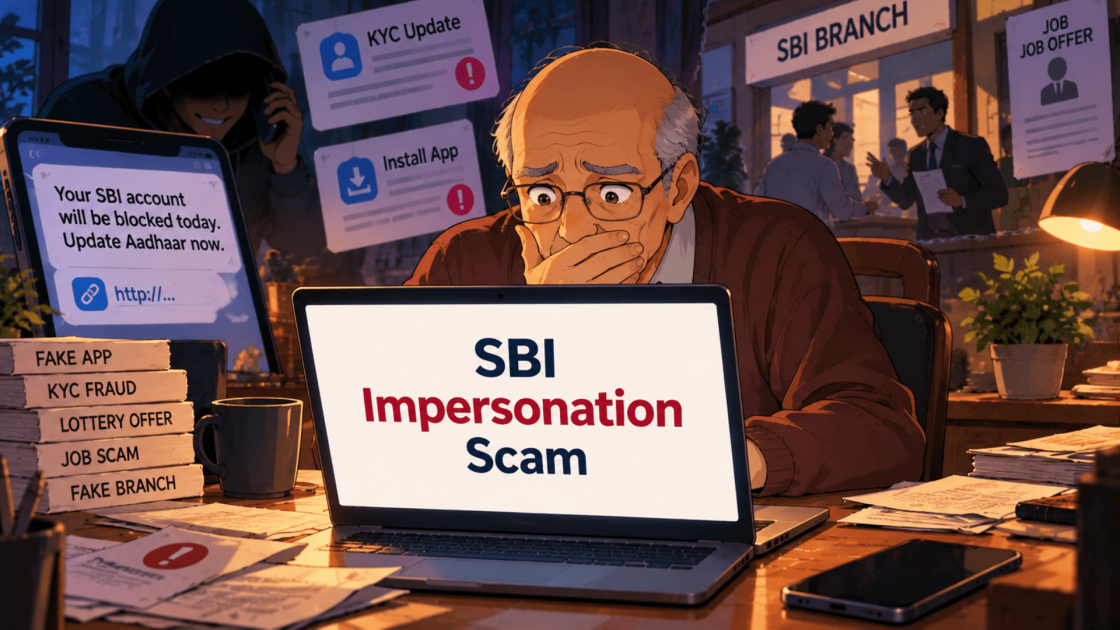
A text says your YONO account will be blocked today unless you update Aadhaar.
The message looks urgent, the logo looks right, and the link looks harmless.
That is how an SBI impersonation scam often begins, and the losses in reported cases run from about ₹50,000 to above ₹20 crore.
Police and news reports describe fake apps, callers posing as bank staff, and even a fake branch.
Read how these cases played out, and how to check a message before you tap.
What Is SBI?
State Bank of India, or SBI, is India’s largest public sector bank.
According to a Business Standard report in January 2026, SBI says it shares official updates only through its website, official mobile apps, branch notices and verified social media handles.
The same report says SBI does not ask customers to download third-party apps or APK files for an Aadhaar update.
YONO updates, it says, come only from official app stores.
In a warning reported around September 2020, SBI said it never calls or asks for personal or account details over WhatsApp or email.
It also said it has no lottery schemes or lucky customer gift offers.

Is a Message From SBI Real or Fake?
A message can look right and still be fake. This table puts what SBI says about its own channels next to what the reported scams did.
|
Question |
What SBI says | What the reported scams did |
|
Where do updates come from? |
Website, official apps, branch notices, verified social media handles |
Texts with links, WhatsApp messages and APK files |
| Is an app needed for an Aadhaar update? | No third party app or APK file is needed |
Messages asked users to install a fake YONO app (2022) or an APK (2026) |
|
Does SBI ask for details on WhatsApp? |
It does not ask for personal or account details on WhatsApp or email | Callers sent payment details over WhatsApp (2024) |
| Does SBI run gift or lottery offers? | It has no lottery schemes or lucky customer gift offers |
Calls and messages offered lotteries and gifts (SBI warning, 2020) |
|
Does SBI charge job applicants? |
Genuine employers do not charge applicants |
A fake branch took ₹2 to 6 lakh from each job seeker (2024) |
If a message matches the right-hand column, it does not follow how SBI says it contacts customers.
These statements come from news reports of SBI’s warnings, so check the bank’s own pages for the latest wording.
What Is an SBI Impersonation Scam?
The word impersonation simply means someone pretends to be the bank. What they want from you is where the cases differ.
An SBI impersonation scam happens when someone uses SBI’s name, app, branch, or staff identity to get your money, an OTP, or access to your phone.
It is one kind of impersonation scam, where the fraudster borrows a trusted name, and the victim does the rest.
The reports in this article show four ways it plays out:
- A message that asks for a KYC, Aadhaar, or PAN update.
- An APK file sent as an SBI update.
- A caller posing as SBI staff.
- A fake SBI branch.
Six SBI Impersonation Scam Cases, From Biggest Loss to Smallest
The cases below are ranked by the amount reported lost, not by date.
Each one comes from a news report, and anything police alleged stays an allegation until a court decides.
1. The Fake YONO App Ring in Delhi (2022)
This is the biggest SBI-linked case in the reports, and it started with an ordinary-looking text.
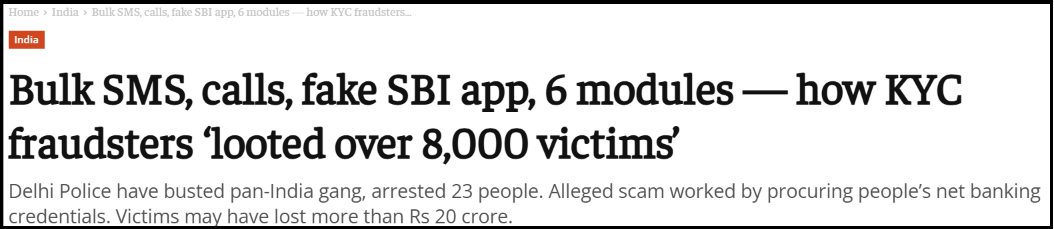
On 30 March 2022, ThePrint reported that Delhi Police’s IFSO unit had busted a KYC fraud ring.
Bulk texts and calls told people their KYC had expired and their number would be blocked.
The messages led to phishing pages and a fake app imitating SBI’s YONO app.
Police arrested 23 people.
The report’s headline mentions more than 8,000 victims, and the suspected loss was above ₹20 crore, with an average loss of about ₹25,000 per victim. Raids took place on 25 March.
The average loss was small, but the message reached thousands of people at once.
2. A Caller on WhatsApp in Vasai (2024)
The next case is a single victim and a much bigger single loss, which shows how a short call can grow.
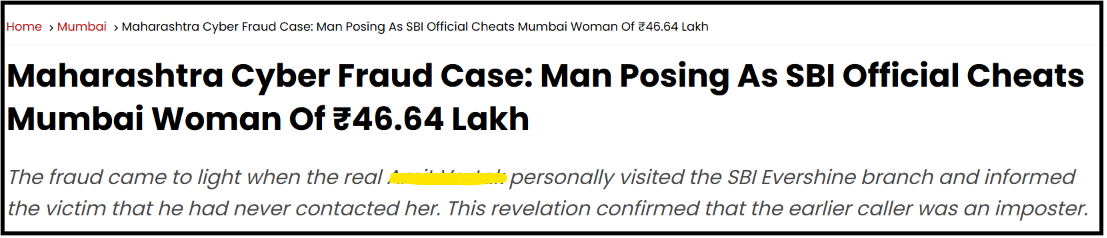
Free Press Journal reported on 9 May 2025 about an incident on 24 October 2024.
A caller posing as an SBI representative told a woman in Vasai that a payment had failed and sent payment details over WhatsApp.
A real SBI official later told her the bank had never contacted her.
The report gives ₹46,64,988 as the total defrauded from the victim and the SBI branch.
We repeat the amount as the report states. The report mentions no arrests.
3. From an SBI Caller to a Fake Police Video Call (2025)
This one starts like the others, then the story changes. The caller does not stay a bank employee for long.
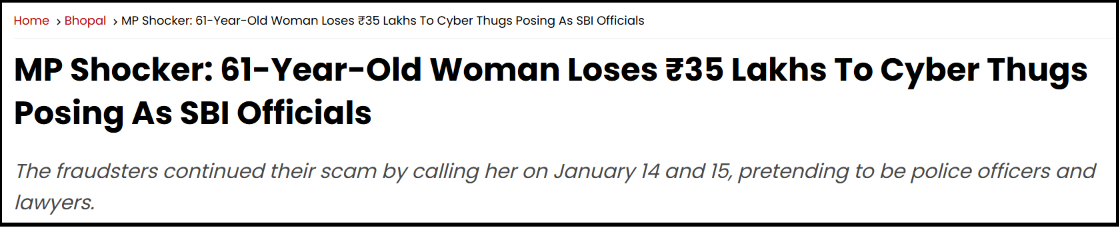
Free Press Journal reported that a 61-year-old woman in Madhya Pradesh lost ₹35 lakh between 14 and 20 January 2025.
A caller claimed to be an SBI official and said a credit card balance was due.
He then accused her of money laundering.
Later callers posed as police and lawyers and ran a video call from a fake police station set. The report mentions no arrests.
4. A Fake SBI Branch in Chhattisgarh (2024)
Here the fraudsters did not call anyone. They opened a branch and waited for job seekers to walk in.
A fake SBI branch opened on 18 September 2024 in Chhapora village, Sakti district, Chhattisgarh.
Police and SBI officials raided it on 27 September.
Reports say about ₹12 to 13 lakh was taken from people lured by job offers, with ₹2 to 6 lakh from each recruit.
The main accused was reported to be at large when the story was published.
A few weeks earlier, in August 2024, SBI had warned that fake job offers arrive by WhatsApp, SMS and email.
It said genuine employers do not charge applicants.

5. A Fake SBI Representative in Thane (2024)
Not every report explains how the fraud began. This one gives the loss and the legal sections, and little else.
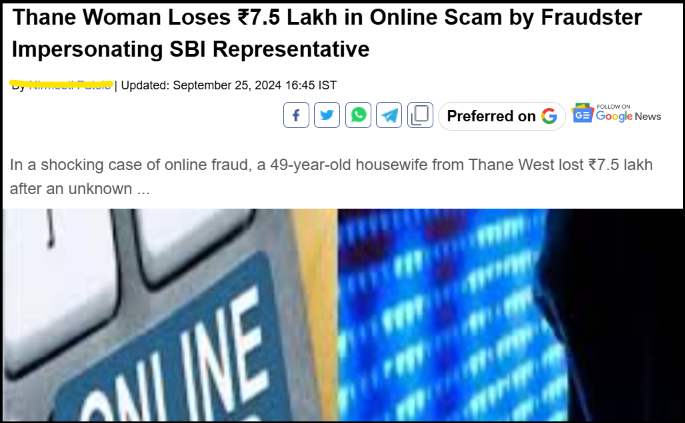
Lokmat Times reported on 25 September 2024 that a woman in Thane lost ₹7.5 lakh to a fraudster posing as an SBI representative.
The loss happened in August 2024.
A case was registered under sections 66C and 66D of the IT Act.
The report mentions no arrests and gives few details of how the fraudster approached her.
6. A Fake Aadhaar or PAN Update Text in Jalandhar (2022)
The smallest case is the one most readers will recognise, because the text looks just like a normal bank alert.
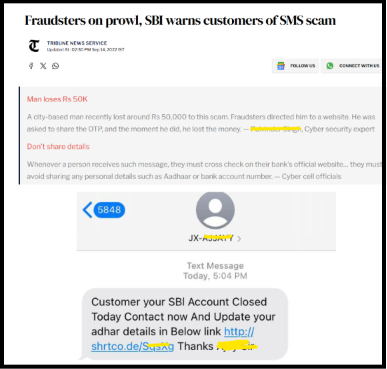
The Tribune reported on 14 September 2022 that SBI had warned of fake texts saying an SBI account or credit card was closed.
The texts asked customers to update Aadhaar or PAN through a link.
One man in Jalandhar reportedly lost about ₹50,000 after sharing an OTP on a fake site.
What the Six SBI Cases Have in Common?
Line the six cases up, and the story repeats. Only the size of the loss changes.
- A reason to hurry. An expired KYC, a number about to be blocked, a failed payment, or a card balance due.
- A move to the fraudster’s channel. A link, a fake app, or payment details sent over WhatsApp.
- A borrowed authority. An SBI representative, then police and lawyers, or a whole branch.
The Madhya Pradesh case shows the dangers of cyber crime do not stop at one call, because the story kept growing from a card balance to a money laundering accusation.
The Fake SBI YONO APK Message Reported in 2026
If a message about updating Aadhaar on YONO reached you this year, this is the one that the government’s fact-check unit and the bank have both called fake.
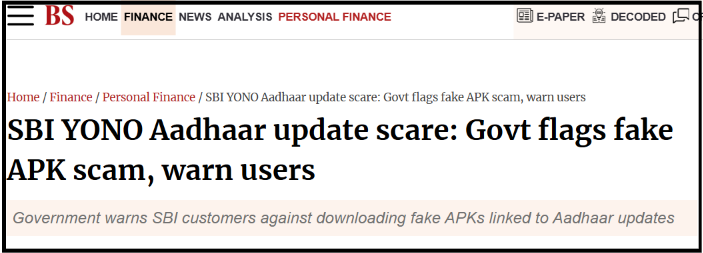
On 19 January 2026, Business Standard reported that PIB Fact Check called a viral message false.
The message said a YONO account would be blocked unless users updated Aadhaar by downloading an APK file.
SBI said it does not ask customers to download APKs for Aadhaar updates.
On 23 July 2026, Eastern Mirror reported that PIB Fact Check again flagged a message titled “SBI KYC AADHAR UPDATE” that asked users to download an APK.
SBI’s X handle confirmed that no APK download is needed for an Aadhaar update.
An APK is an Android app file. Installing one from a link skips the official app store, which is where SBI says YONO updates come from.
As reported, the advice is simple: do not download APK files, and do not share Aadhaar, OTP, or banking details.
Did you tap a link or share a code before you realised the message was not from SBI?
We can go through your messages, call details and transaction records with you and explain which complaint route fits your case. Register with us and we will get in touch.
How To Check an SBI Message Before You Tap?
A real message and a fake one can look the same on your screen. These checks rely only on what SBI itself has said in the reports above.
- Look at where it asks you to go. SBI says updates come through its website, official apps, branch notices, and verified social media handles. A random link or a WhatsApp number is a warning sign.
- Do not install an APK file. SBI says it does not ask for APK downloads for Aadhaar updates, and YONO updates come only from official app stores.
- Keep your OTP, Aadhaar, and banking details to yourself. In the Jalandhar report, the loss followed an OTP shared on a fake site.
- Treat gifts, lotteries and job fees as red flags. SBI says it has no lottery or gift offers, and genuine employers do not charge applicants.
- Check the caller’s number. If someone claims to be from the bank, you can check if a phone number is scam before you call back or share anything.
- Report what you receive. Business Standard and Eastern Mirror say suspicious messages can be sent to [email protected].
Shared an OTP or Installed a Fake SBI App? Do This First
If you already tapped, paid, or shared a code, the next hour matters more than the explanation.
Our page on what to do if online fraud happens covers the early steps, and the list below puts them in order.
- Stop replying. Do not answer further calls or messages from the same source, even if they say they are fixing the problem.
- Report it formally. Call the cyber fraud helpline, which a Business Standard report on SBI’s job scam warning in August 2024 lists for cyber fraud. Learn how to file a cyber crime complaint and keep your proof ready when you do.
- Keep your proof. Save screenshots of the messages, the phone number, the app name, and your transaction details.
- Email the message to the bank. Send it to [email protected], as the reports suggest.
Conclusion
The six cases run from about ₹50,000 to above ₹20 crore, yet the pattern stays the same: SBI’s name, a reason to hurry, and a link, app, or call that moves you away from the bank’s real channels.
SBI says its updates come only through official channels and that no APK is needed for an Aadhaar update.
If you lose money, keep your proof, report it quickly, and read how to follow your cyber crime complaint status once it is filed.
Report. Recover. Stay Fraud Free.
Frequently Asked Questions
PIB Fact Check called it fake in January and July 2026, and SBI says it does not ask customers to download APK files for Aadhaar updates.
In a warning reported around September 2020, SBI said it never calls or asks for personal or account details over WhatsApp or email. Do not share an OTP with anyone.
A fake SBI branch was reported in Chhapora village, Chhattisgarh, in September 2024. Police and SBI officials raided it, and SBI says genuine employers do not charge job applicants.
Stop entering details, keep screenshots and transaction records, and report it on the cyber fraud helpline. Then file a cyber crime complaint with your proof ready.





 Add us as a preferred source on Google »