
Quick Summary
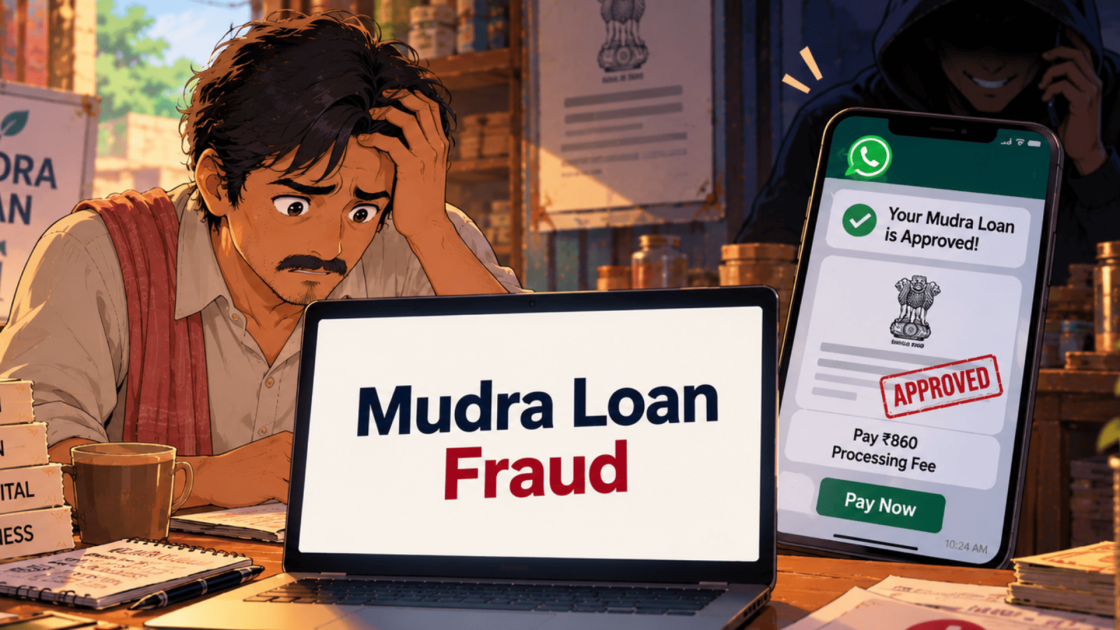
Mudra loan fraud works because the scheme is real. Fraudsters send fake PM Mudra Yojana approval letters on WhatsApp or run Instagram ads, then ask for a small fee such as ₹350, ₹860 or ₹7,699 before “releasing” the loan. PIB Fact Check has repeatedly said MUDRA does not lend directly, does not send approvals on social media and does not appoint agents. In February 2026, Hyderabad police arrested five men after a woman lost ₹1.08 lakh chasing a ₹3 lakh Mudra loan that never came.
You need money to grow your shop or start something small, and then a message arrives saying your Mudra loan is approved.
It even has a government emblem on it. All you need to do is pay a few hundred rupees.
That’s how most Mudra loan fraud begins, and it catches people precisely because the loan scheme behind it is genuine.
We’ve pulled together what the government has said, the fake letters it has flagged, and real cases reported by police.
If you’ve already paid and want to report financial fraud in India, the steps near the end tell you exactly what to do first.
What Is a Mudra Loan?
To spot a fake offer, you first need to know what the real scheme looks like.
Here’s the short version of how Pradhan Mantri Mudra Yojana actually works.
Pradhan Mantri Mudra Yojana (PMMY) gives collateral-free loans to small, non-farm businesses like shops, traders, vendors, and service units.
The loans come in four categories based on how much you need.
|
Category |
Loan amount |
| Shishu |
Up to ₹50,000 |
|
Kishore |
Above ₹50,000 and up to ₹5 lakh |
| Tarun |
Above ₹5 lakh and up to ₹10 lakh 
|
|
Tarun Plus |
Above ₹10 lakh and up to ₹20 lakh, for borrowers who have repaid an earlier Tarun loan |
The key point is who gives the money. MUDRA itself is a refinancing institution. It doesn’t lend to individuals.
The actual loan comes from a bank, an RBI-registered NBFC, or a microfinance institution.
Is Mudra Loan Real or Fake?
The Mudra loan is completely real. The fraud is in the messages, letters, and callers that borrow its name.
You can apply for a genuine Mudra loan by walking into a bank branch, NBFC, or MFI, or online through the Udyamimitra portal.
Nobody needs to call you first, and no one needs your money before the loan is sanctioned.
What Is a Mudra Loan Fraud?
A Mudra loan fraud is when someone pretends to be from MUDRA, the government, or a bank, promises a Mudra loan, and collects money upfront. The loan never arrives.
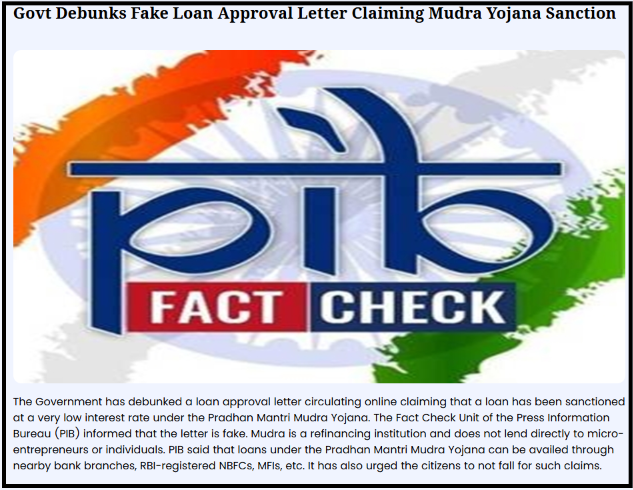
PIB Fact Check has spelled out the basic facts several times in 2026, and each one cuts straight through the scam.
- MUDRA does not lend directly to individuals or micro entrepreneurs.
- Loan approvals are not sent on social media or WhatsApp.
- MUDRA does not appoint any agent or middleman to arrange loans.
Fake Mudra Loan Approval Letters Flagged by PIB
The fake letters look official, with emblems, stamps, and loan numbers.
What gives them away is always the same thing: a fee you have to pay first.
Here are some that PIB has flagged this year.
|
Loan amount claimed |
Fee demanded | Reported |
|
₹7 lakh |
₹860 as “agreement charges” | Outlook Money, 26 January 2026 |
| ₹3 lakh | ₹7,699 as an “insurance charge refund” |
Angel One, 20 March 2026 |
| Not stated | ₹350 as a “processing fee” |
News On AIR, 12 July 2026 |
The amounts are kept small on purpose. ₹350 or ₹860 feels like nothing against a ₹7 lakh loan, so people pay without thinking twice.
Then the second and third demands follow.
How the Mudra Loan Scam Works Step by Step
Reported cases follow a very similar path. If you’re in the middle of one right now, you’ll probably recognise the stage you’re at.
- The hook. You see an Instagram or Facebook ad for a quick Mudra loan, search online for loan options, or get a WhatsApp message saying your loan is pre-approved.
- The “official.” Someone calls claiming to be from “Mudra Loan Services,” a bank, or a government office. They ask for your Aadhaar, PAN, photo, and bank details on WhatsApp.
- The approval. You get a sanction letter with government symbols. It looks real enough to remove any doubt.
- The first fee. A small amount for processing, agreement, insurance, or GST, paid by UPI to a personal account.
- Fee after fee. TDS, income tax, NOC, “cancellation charges,” or a refund that needs one more payment. Each new charge comes with a promise that it’s the last.
- Silence. Phones get switched off, and the loan never arrives.
Mudra Loan Fraud Cases Reported in 2026
These two cases were reported by news outlets and show how quickly small fees add up. Personal details have been left out.
1. Hyderabad Woman Loses ₹1.08 Lakh, Five Arrested
A 36-year-old woman in Hyderabad saw an Instagram ad for a loan and got a call from someone claiming to be from “Mudra Loan Services.”
She was told a ₹3 lakh loan was approved, with no processing fee.
Then came payments for insurance, TDS, income tax, and cancellation charges. She lost ₹1,08,274.
On 11 February 2026, Hyderabad Cybercrime police arrested five men from the erstwhile Warangal district.
Police said the gang ran fake loan websites and social media ads, worked from data sorted by state, and was trained in fake call centres in Kolkata and Delhi.
Each caller reportedly made 180 to 200 calls a day for about 30% commission on what they collected.
2. Bengaluru Government Employee Loses ₹1.23 Lakh
A 54-year-old government employee from Bengaluru was promised a ₹20 lakh loan under PM Mudra Yojana.
One man contacted him on WhatsApp, and a second person called later to back up the story.
He paid ₹1.23 lakh as instructed before realising he’d been cheated.
Police said the fraudsters likely found him after he searched online for loan options, and their phones were switched off by the time he complained.
Also Read: Karz Mukt Bharat Abhiyan, where borrowers paid membership fees believing their loans would be waived.
Warning Signs of a Fake Mudra Loan Offer
If you’re unsure about an offer in front of you right now, check it against this list. Even one of these is enough to stop.
- You didn’t apply at any bank, yet you’re told your loan is approved.
- The approval came on WhatsApp, SMS, or social media.
- Someone calls themselves a Mudra agent or “Mudra Loan Services” official.
- You’re asked to pay before disbursal for processing, insurance, agreement, GST, TDS, or NOC.
- The payment goes to a personal UPI ID or a random bank account.
- The letter promises a very low interest rate and a large amount with no paperwork.
How To Apply for a Genuine Mudra Loan?
If you need a Mudra loan, the real route is simple and doesn’t involve anyone calling you. Here’s what it looks like.
- Visit a bank branch, an RBI-registered NBFC, or an MFI and ask for a loan under PMMY.
- Or apply online on the Udyamimitra portal, which connects you to lenders.
- Deal only with the lender’s own staff at its branch or official website.
- Any charge will be the lender’s own, shown in your loan papers, never paid to a person’s UPI before sanction.
What To Do If You Lost Money in a Mudra Loan Fraud
If you’ve already paid, act today. The sooner you report, the better the chance that the receiving accounts get frozen before the money moves.
First, call the helpline and file a complaint on cybercrime portal with every UPI or bank reference number.
Our walkthrough on how to file a cyber crime complaint shows which details help police trace the accounts fastest.
Stop paying, no matter what the caller says about refunds. In the Hyderabad case, asking for a refund only led to more demands.
Protect your documents. You shared your Aadhaar, PAN, and bank details, so watch your bank account and credit report for loans or accounts you didn’t open.
Did you pay a “processing fee” for a Mudra loan that never reached your account?
Tell us what you paid and who you paid it to. We’ll help you put together a complaint that gives the money trail the best chance of being traced. Register with us for a free consultation.
Once your complaint is in, keep track of it and your bank’s response.
The checklist on what to do if online fraud happens covers the follow-up so you don’t miss a step while you wait.
Disclaimer: This article is based on PIB Fact Check advisories, news reports, and public information on the Pradhan Mantri Mudra Yojana. Names of victims and accused have been left out, and nothing here accuses any bank, NBFC or MFI of wrongdoing.
Conclusion
The Mudra loan is a genuine government-backed scheme, and that’s exactly why fraudsters use its name.
Their letters look official, and their fees look small, but the loan never comes.
Remember the three facts PIB keeps repeating.
MUDRA doesn’t lend directly, doesn’t send approvals on social media, and doesn’t use agents.
If someone asks you to pay before your Mudra loan is released, don’t pay, block the number, and report it.
A real Mudra loan starts at your bank, not on your phone.
Report. Recover. Stay Fraud Free.
Frequently Asked Questions
No. PIB Fact Check has said Mudra loan approvals are not communicated through social media. A letter on WhatsApp asking for a fee is fake, however official it looks.
Nobody should ask you to pay a person before your loan is sanctioned. Fake letters have asked for ₹350, ₹860 or ₹7,699. Any genuine charge comes from your bank as part of the loan papers.
No. PIB has said MUDRA does not appoint any agent or middleman to facilitate loans. Anyone calling themselves a Mudra agent is not authorised by MUDRA.
Visit a bank branch, an RBI registered NBFC or a microfinance institution, or apply online on the Udyamimitra portal. MUDRA itself does not lend to individuals.
File a complaint on cybercrime portal with every UPI reference, stop all further payments, and watch your bank account and credit report since you shared your documents.




 Add us as a preferred source on Google »