
Quick Summary
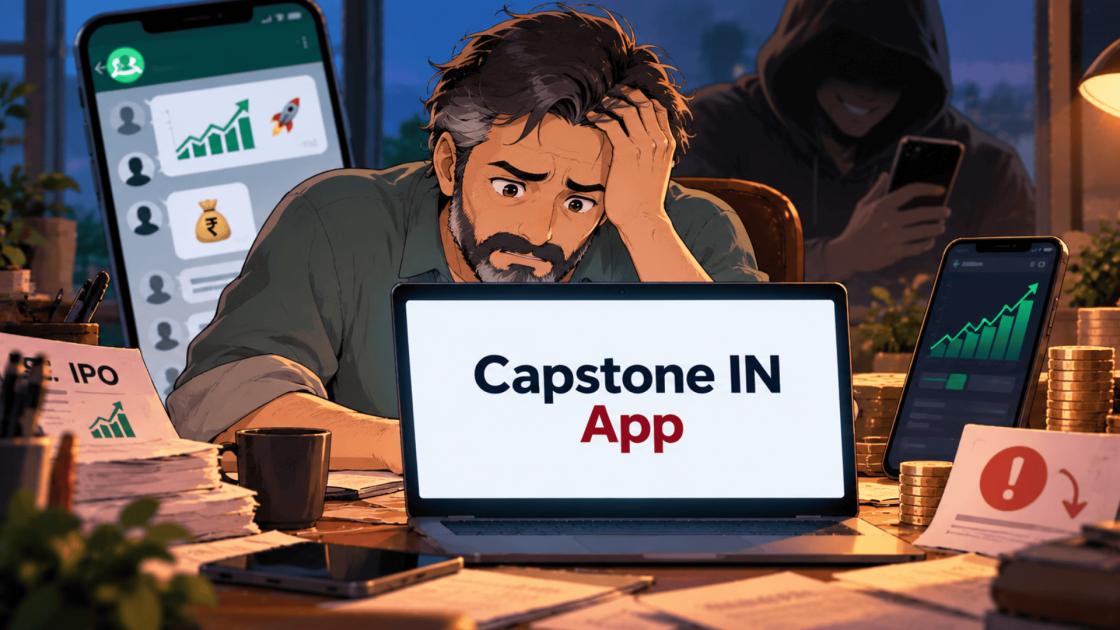
The Capstone IN app reached investors through WhatsApp stock and IPO groups run by a man calling himself a US based stockbroker. Two Hyderabad men filed complaints in January 2026 after losing a combined ₹1.64 crore. One saw ₹1.47 crore in “assets” on the app but couldn’t withdraw, and was asked for ₹33.65 lakh as “pending IPO balance.” The other was asked for ₹49.39 lakh for “over allotment.” The complainants found the app had no valid registration.
It usually starts with something that feels like a lucky break.
You’re added to a WhatsApp group full of people discussing IPOs, an “expert” shares wins every day, and soon someone offers you an account that can get you IPO shares nobody else can.
For two investors in Hyderabad, that account was on the Capstone IN app, and the shares it showed them looked worth crores.
We went through the police complaint details reported in the news and checked the app’s IPO claims against public exchange data.
If you’ve been dealing with the same group and want to report financial fraud in India, the steps at the end will help you act in the right order.
What Is the Capstone IN App?
Before getting into how people lost money, it helps to see what the app claimed to be.
The pitch was simple and very attractive for anyone following the IPO boom.
Victims were told Capstone IN was a legitimate stock trading app with IPO access.
One of them was asked to open a “QIB trading account,” a term borrowed from Qualified Institutional Buyers, the large institutions that get a separate quota in real IPOs.
Registration, deposits, and every next step happened through WhatsApp, with a helper presenting herself as the platform’s customer service manager.
She also shared the bank accounts where the money had to go.

When the complainants checked, they found the app was forged, with no valid registration, and one of them stated it was not a SEBI-registered entity.
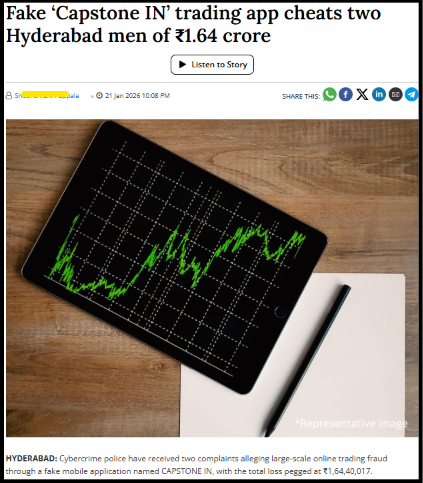
Is Capstone IN App Real or Fake?
A real broker in India is a SEBI-registered stock broker, and you can look up its name and registration number on SEBI’s website before sending a rupee.
The money you deposit goes to the broker’s own client bank account, never to a list of unrelated accounts shared on WhatsApp.
Retail investors also can’t buy into the QIB quota.
QIBs are mutual funds, banks, insurers and similar institutions, so a “QIB account” offered to an individual through a chat group isn’t something any real platform can sell.
On every one of these points, the Capstone IN app as described in the complaints doesn’t match how a registered trading platform works.
How the Capstone IN WhatsApp Group Worked
Both complaints describe the same playbook, just with slightly different hooks.
Here’s how it moved from a friendly chat to crores on a screen.
The “US Stockbroker” in the Group
In November 2025, a 52-year-old private company employee from Kondapur got a WhatsApp message from a man calling himself Prem Prakash Verma, who said he was a stockbroker based in the US.
He was then added to WhatsApp groups that discussed stock trading and IPOs.
The second complainant, a 41-year-old software employee from Gajularamaram, was added that same month to a group called “V10 New Book Discussion Group,” where the same name appeared with impressive academic and professional credentials.
Weekly Returns of 20% to 30%
The software employee was promised weekly returns of 20% to 30%.
That works out to more than doubling your money every month, a return no genuine market investment can promise, let alone deliver week after week.
A Small Withdrawal First
Both men were allowed to withdraw a little early on.
The first got back ₹1,01,000, and the second ₹2,083.
Those small payouts mattered. Once money comes back once, it feels safe to send much more, and that’s exactly what happened next.
Capstone IN IPO Allotments and Profits on the Dashboard
This is the stage where the numbers on the app grew far bigger than the money going in.
It’s also where the claims can be checked against public data.
The Kondapur investor was shown IPO profits from Modern Diagnostics and Gabion Technologies India Limited.
He was then “allotted” large quantities of Gabion shares and asked to pay for the extra shares as “over allotment.”
Believing the profits were real, he sold his ESOP shares and took a loan from a friend.
In all, he transferred ₹1,04,06,100.
The software employee invested ₹61,37,000 across several transfers.
His app showed virtual assets of more than ₹1.47 crore, but every withdrawal attempt failed.
What the Real IPOs Looked Like
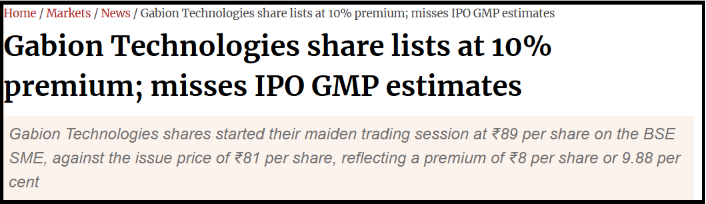
Both IPOs named on the app were real SME issues listed on BSE in January 2026.
Here’s what public data shows about them, which tells you how unlikely a big allotment was.
| Detail | Modern Diagnostic & Research Centre | Gabion Technologies India |
| Exchange | BSE SME | BSE SME |
| Price band | ₹85 to ₹90 | ₹76 to ₹81 |
| Lot size | 1,600 shares | 1,600 shares |
| Issue dates | 31 Dec 2025 to 2 Jan 2026 | 6 to 8 Jan 2026 |
| Listing | 7 Jan 2026 | 13 Jan 2026, at ₹89 |
| Demand | Subscribed 768 times overall |
When an issue is subscribed 768 times, most applicants get nothing at all, and the lucky ones usually get a single lot.
Allotment is decided by the registrar and the exchange, and it’s credited only to a real demat account.
A large Gabion allotment that came with a bill for “over allotment” doesn’t fit how this IPO was actually allotted.
No genuine allotment ever asks you to pay extra afterwards.
Also Read: Upstox IPO Scam, where a lookalike website allotted a real SME IPO at a fake price and showed ₹7.91 lakh as unpaid.
Capstone IN Withdrawal and the Extra Payment Demands
Once the balance looked big enough, the platform changed direction. Instead of paying out, it started asking for more.
The software employee was told he had to pay ₹33,65,226 as “pending IPO balance” before his funds could be released.
The Kondapur investor was asked for ₹49,39,866, and that’s when he stopped and realised something was wrong.
Their combined loss came to ₹1,64,40,017.
Both filed complaints with the Hyderabad Cybercrime police on 20 January 2026, asking for action against the app operators, the WhatsApp users and the holders of the bank accounts that received the money.
Is the Capstone IN app asking you for a “pending IPO balance” before it lets you withdraw?
Don’t pay it. Tell us what you’ve sent so far and where it went, and we’ll help you file a complaint that gives the money trail the best chance of being frozen. Register with us for a free consultation.
Warning Signs of a Capstone IN Style IPO Group
The app name changes often, but the script rarely does.
If what you’re seeing matches even two of these, step back before sending anything more.
- A WhatsApp contact claiming to be a foreign stockbroker who adds you to IPO “study” groups.
- A “QIB” or institutional account offered to you as an individual.
- Weekly returns of 20% or more, or profits that never seem to dip.
- Deposits to different bank accounts shared by a “customer service manager” in chat.
- IPO allotments far bigger than anyone in the market got, followed by a payment demand.
- Release fees such as “pending IPO balance,” “over allotment,” or tax before withdrawal.
A quick check that never fails: log in to your own broker’s app or your NSDL or CDSL statement.
If the shares aren’t there, they aren’t yours.
What to Do If You Invested Through the Capstone IN App?
If you’ve already transferred money, speed matters more than anything else.
These steps are in the order that gives you the best chance of stopping funds before they move on.
Report It on the CyberCrime Portal the Same Day
Call the cyber fraud helpline and then file a written complaint on cybercrime portal, listing every transfer with its UTR number.
Our step-by-step walkthrough on how to file a cyber crime complaint shows which details police need so the receiving accounts can be traced quickly.
Stop Every Further Payment
No “pending IPO balance,” tax, or unlocking fee will release your money. Each payment only leads to the next demand.
Write to Your Bank
Send your bank a written fraud report with every UTR and ask it to raise a dispute with the receiving banks. Keep a copy of what you send.
Save Your Evidence
Apps like this can vanish overnight, so capture everything while you still can.
- Screenshots of the app, including the dashboard, IPO allotments, and withdrawal screens.
- Exported WhatsApp chats with the group, the “stockbroker” and the customer service contact.
- Bank statements and UTR numbers for every transfer.
- The app’s download link or the APK file you installed.
If friends or family lent you money for this, the pressure can feel enormous.
The checklist on what to do if online fraud happens breaks the follow-up into small, clear steps so nothing gets missed after the first complaint.
Also Read: IndusInd Securities DMA Account, where a WhatsApp offer led to ten deposits and a ₹4 lakh IPO bill.
Disclaimer: This article is based on a Hyderabad Mail news report of complaints filed with the Hyderabad Cybercrime police and on public IPO data. It describes the complainants’ accounts and does not accuse any listed company, bank account holder, or named individual of wrongdoing.
Conclusion
The Capstone IN app followed a pattern that’s now common across India.
A friendly expert in a WhatsApp group, a special institutional account, a small early withdrawal, and then IPO allotments on a screen that no real issue could have produced.
The money went to bank accounts shared in chat, and when the investors tried to take their profits out, the app asked for lakhs more.
If you’re in a group like this, stop paying, save your chats, and report on cybercrime portal today.
And check every IPO allotment in your own demat account, not inside an app someone sent you.
Report. Recover. Stay Fraud Free.
Frequently Asked Questions
The complainants in the Hyderabad case found the Capstone IN app was forged, with no valid registration, and not a SEBI registered entity. It showed IPO profits that could not be withdrawn.
A man calling himself a US based stockbroker added investors to WhatsApp IPO groups, got them to register on the app, and allowed a small withdrawal. The app then showed large IPO allotments and demanded more money.
It was the account one victim was asked to open. Real QIB quotas are only for institutions like mutual funds and banks, so retail investors cannot get them through a WhatsApp group.
One victim was asked to pay ₹33.65 lakh as "pending IPO balance" before release of funds. Genuine IPOs never ask for extra payment after allotment, so this is a demand for fresh money.
File a complaint on cybercrime portal with your UTR numbers, app screenshots and WhatsApp chats. Report every transfer to your bank in writing as well.


 Add us as a preferred source on Google »